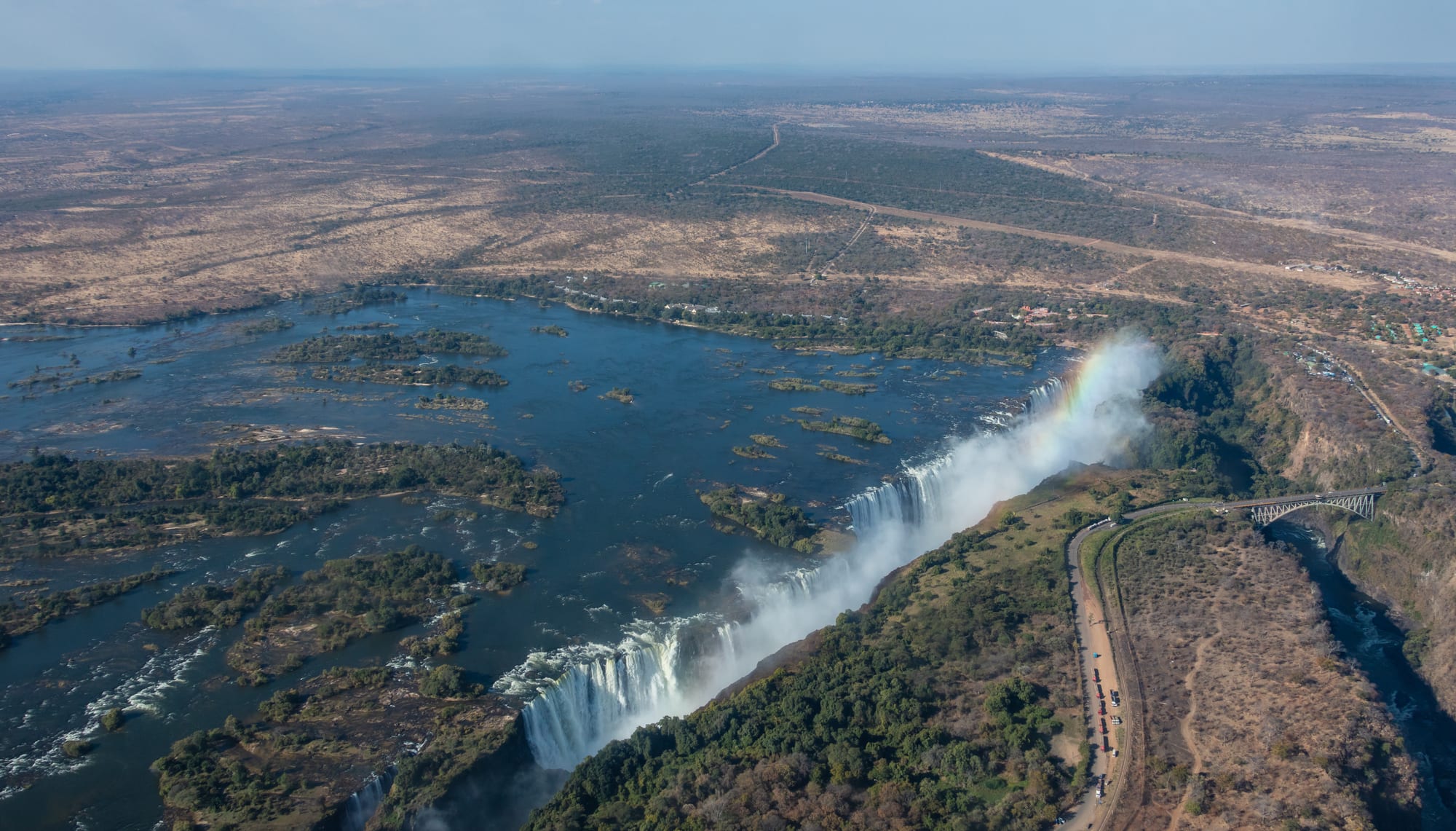
A wide curtain of waterfall pouring into a narrow gorge, throwing up a tall column of spray against green cliffs

Zambia

Victoria Falls — Mosi-oa-Tunya, "the smoke that thunders" — on the Zambezi at the Zambia–Zimbabwe border, a UNESCO World Heritage Site. (Diego Delso / Wikimedia Commons · CC BY-SA 4.0)

A landlocked, copper-rich country on the high plateau of south-central Africa — one of the continent's more stable democracies, shaped by the mining economy and the Zambezi River, and the place where the walking safari was invented.

Explore Zambia

History

Bantu-speaking farmers settled the plateau over the first millennium AD, and by the eighteenth and nineteenth centuries a number of kingdoms and chieftaincies — the Lozi of the Zambezi floodplain, the Bemba of the northeast, the Chewa, Tonga, Ngoni, and others — held the region. The explorer David Livingstone reached the Zambezi in the 1850s and named the falls for Queen Victoria; the town of Livingstone still bears his name.

Cecil Rhodes's British South Africa Company took control in the 1890s, and the territory became the British protectorate of Northern Rhodesia. The discovery of vast copper deposits in the 1920s and 1930s created the Copperbelt, drew migrant labour, and tied the economy to a single metal. Between 1953 and 1963 Northern Rhodesia was yoked, against African opposition, into a federation with Southern Rhodesia (now Zimbabwe) and Nyasaland (now Malawi).

Zambia became independent in 1964 under Kenneth Kaunda, whose philosophy of "Zambian Humanism" and one-party rule from 1972 combined a welfare push with economic decline as copper prices fell. Zambia paid a heavy price for hosting the liberation movements of Rhodesia, South Africa, Namibia, and Angola. Multiparty politics returned in 1991, and power has since changed hands peacefully several times — a regional rarity. In 2020 Zambia became the first African country to default on its debt during the pandemic; Hakainde Hichilema, elected in 2021, has pursued restructuring and reform while copper prices and recurring drought keep the economy volatile.

  • Zambia: The Copper Country A landlocked plateau in south-central Africa built around one of the world's great copper belts — a company territory, then a British protectorate, independent since 1964, and a country whose fortunes still rise and fall with the price of a single metal

Culture & Customs

Zambia has more than seventy ethnic groups, and a strong tradition of coexistence — partly a legacy of Kaunda's "One Zambia, One Nation" motto — means ethnic politics is muted by regional standards. The country is constitutionally a "Christian nation", overwhelmingly so in practice, with churches central to community life, alongside enduring traditional beliefs and healers.

Traditional ceremonies are the great cultural events: the Lozi Kuomboka, in which the king (the Litunga) is paddled in a great black-and-white barge from his flooded dry-season palace to higher ground; the Ngoni N'cwala first-fruits festival with its warrior dancing; and dozens of others across the country, many revived and well attended.

Extended family and clan obligations, respect for elders and chiefs (who retain authority over customary land), and a relaxed, courteous sociability are widely noted. Football is the mass sport, and Zambian music — from kalindula to contemporary gospel and hip-hop — is popular across the region.

Daily Life

About 20 million people live in Zambia, a young and fast-growing population, concentrated along the "line of rail" from Livingstone through Lusaka to the Copperbelt cities of Kitwe and Ndola; large areas of the country are sparsely settled bush and farmland.

The economy still rises and falls with the copper price: mining dominates exports and government revenue, alongside subsistence and commercial farming (maize, tobacco, sugar), and a growing tourism sector around Victoria Falls and the parks. Recent years have brought debt distress, a weak kwacha, and — because the country depends on the Kariba dam for most of its electricity — severe, prolonged power cuts during drought.

For most Zambians daily life is rural or peri-urban, organised around the maize field, the market, the church, and the extended family, with the cities offering trade, mining, and public-sector work.

Food

The staple, eaten at almost every meal, is nshima — a stiff porridge of white maize meal, taken by hand and dipped into ndiwo or relish. The relish might be beans, groundnut-thickened greens (pumpkin leaves, rape, chibwabwa), okra, kapenta (small dried lake fish), dried kapenta, or, when affordable, chicken or beef.

"Village chicken" (free-range and prized over broilers), grilled or stewed beef, fresh bream and Nile perch from the lakes and rivers, and inswa (fried flying termites, a seasonal delicacy) fill out the diet. Cassava replaces maize as the staple in parts of the north and northwest.

Chibuku, a thick, mildly alcoholic sorghum or maize beer sold in cartons, and munkoyo, a lightly fermented root drink, are the traditional drinks, alongside Mosi and Castle lagers and strong sweet tea.

Attractions & Natural Wonders

Victoria Falls, shared with Zimbabwe, is the headline: the Zambian side, at Livingstone, offers close-up walks along the gorge edge, the Knife-Edge Bridge into the spray, and — when the river is low — the swim to the very lip at Devil's Pool, plus rafting, bungee jumping, and microlight flights over Mosi-oa-Tunya National Park.

South Luangwa, in the east, is one of Africa's great wildlife parks and the birthplace of the walking safari: superb leopard sightings, large herds along the Luangwa River, and camps that specialise in tracking game on foot. The Lower Zambezi National Park, opposite Zimbabwe's Mana Pools, is known for canoe safaris past elephants and hippos, and the vast Kafue National Park in the west has the Busanga floodplain and far fewer visitors.

Elsewhere, Lake Tanganyika reaches into Zambia's far north near the Kalambo Falls; Lake Bangweulu's swamps hold the shoebill and the endemic black lechwe; and Kasanka National Park stages, each November and December, the arrival of some ten million straw-coloured fruit bats — one of the largest mammal gatherings on Earth.

  • Zambia: Seven Attractions and Natural Wonders Known as "The Smoke that Thunders" — one of the largest waterfalls on earth, a natural infinity pool perched right on its lip, and a national park regarded as the birthplace of the walking safari

Planning basics

Budget

Independent travel in Zambia is inexpensive, but the wildlife — the point of most trips — is not: park fees, a vehicle and guide, and the safari lodges of South Luangwa and the Lower Zambezi add up quickly, and many are remote fly-in camps. Livingstone, for Victoria Falls, has budget backpackers alongside luxury hotels.

Daily Budget Safari
USD 300–700+ per day for a guided South Luangwa or Lower Zambezi safari, all in
Daily Budget Shoestring
USD 40–70 off-safari (guesthouses, nshima and relish, buses and shared taxis)

Base in Livingstone for a low-cost Victoria Falls trip; book safari camps as packages, and consider the green season (Nov–Mar) for lower rates.

Visa Requirements

Zambia has waived tourist visas for citizens of many countries, including the UK, US, most of the EU, Canada, and Australia, who now enter visa-free for short stays; others use the e-visa or visa on arrival. The KAZA UniVisa, covering Zambia and Zimbabwe and day trips to Botswana, suits a Victoria Falls trip that crosses the border.

Typical Stay
Visa-free for many Western passports for up to 90 days; KAZA UniVisa for cross-border Falls trips

Check whether your nationality is on the visa-waiver list; if not, use the e-visa and consider the KAZA UniVisa for Zimbabwe-side visits.

Safety

Zambia is one of the safer countries in the region, politically stable and generally calm for visitors. Petty theft in Lusaka and around bus stations, road accidents on long intercity drives, and the usual hazards of wildlife areas and the Zambezi are the main risks. Prolonged drought has caused severe electricity load-shedding, so power cuts are common.

Health
Malaria is a year-round risk countrywide — take prophylaxis; bilharzia is present in lakes and slow rivers; tap water is best avoided in favour of bottled or filtered

Take malaria precautions everywhere, don't swim in still fresh water except at managed sites, carry a torch and power bank for load-shedding, and follow your guide on foot in the parks.

Climate

Subtropical, moderated by altitude. There are three seasons: cool and dry (May–August), hot and dry (September–October), and warm and wet (November–April), when afternoon storms green the bush. The Zambezi and Victoria Falls are at their fullest around March–May and at their lowest, clearest, and most swimmable around September–December.

Dry Season
May–October (cool then hot)
Wet Season
November–April

Transportation

Kenneth Kaunda International Airport in Lusaka is the main gateway, with Livingstone and the Copperbelt also served, and light aircraft flying into the safari areas. Intercity buses link the main towns on a limited paved network; distances are long and roads to the parks are rough. Self-driving is possible for the confident, but most visitors fly or transfer with a lodge.

Fly into the remote parks rather than enduring long drives on poor roads; use a lodge transfer or a reputable operator for South Luangwa and the Lower Zambezi.

Best Time to Visit

June to October is prime safari time — thin bush, animals concentrated at water, and the best walking conditions — with September and October hot and excellent for game but uncomfortable by day. Victoria Falls thunders after the rains (March–May) and allows swimming at Devil's Pool when the river is low (roughly August–January).

Events
Independence Day (24 October); the Kuomboka ceremony of the Lozi people (moving the king's barge as the floods rise, usually March–April); N'cwala harvest festival of the Ngoni (February)

Currency

The currency is the Zambian kwacha. US dollars are used for park fees, lodges, and Victoria Falls activities; ATMs are reliable in Lusaka, Livingstone, and the Copperbelt towns. Carry kwacha cash for markets, fuel, and rural areas.

Symbol
K
Currency Code
ZMW — Zambian kwacha

Language

English is the official language, used in government, business, and schooling. Seven Zambian languages have regional official status — Bemba, Nyanja, Tonga, Lozi, Lunda, Luvale, and Kaonde — and Nyanja is the common language of Lusaka while Bemba dominates the Copperbelt and north.

Widely Spoken
Bemba, Nyanja, Tonga, Lozi and others
Official Language
English