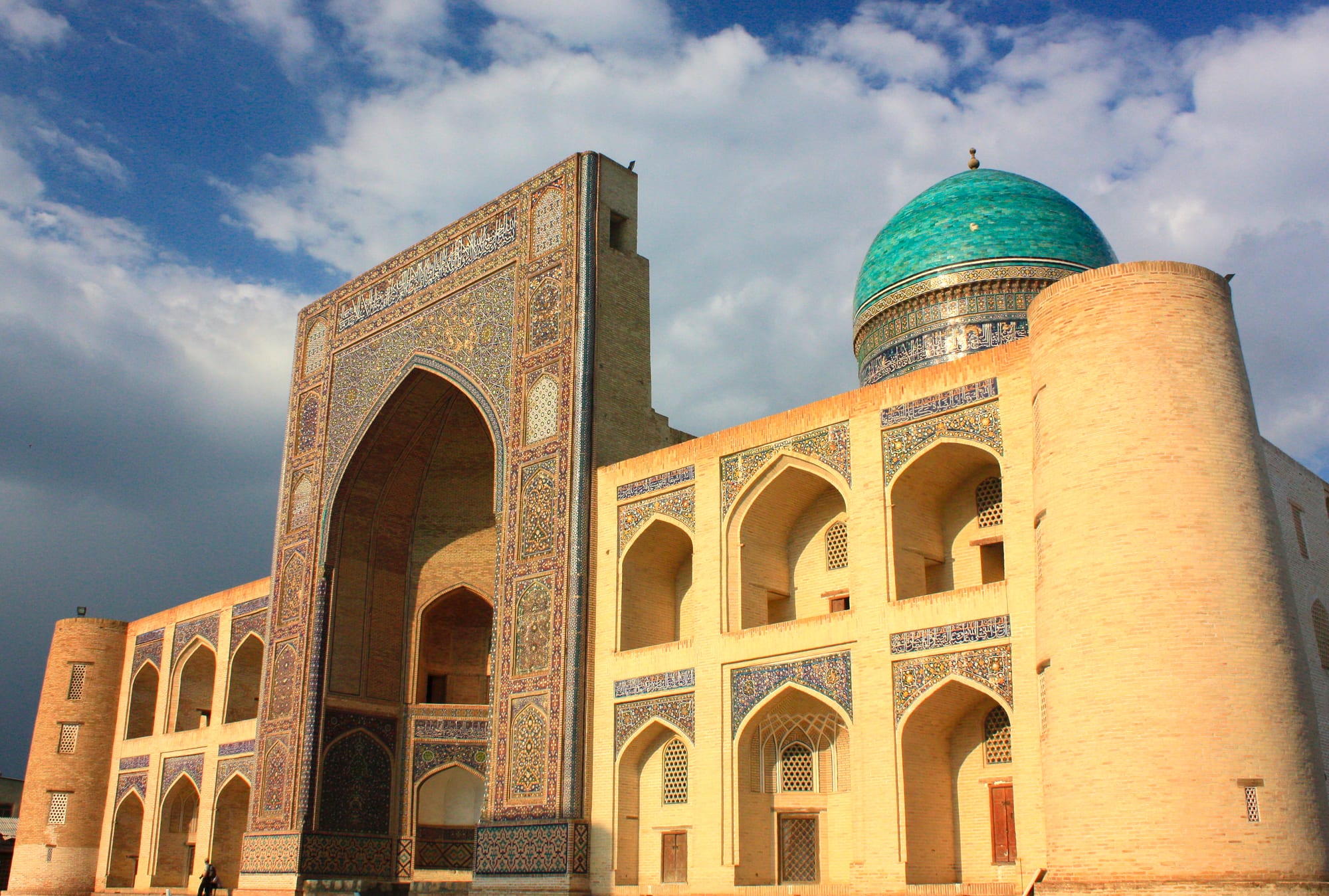
A two-storey madrasa of golden brick with a towering tiled entrance portal, arched galleries, a round corner tower and a turquoise dome, lit by low warm sun against dark storm clouds

Uzbekistan

The Mir-i-Arab Madrasa in Bukhara in warm evening light, its tiled portal and turquoise dome set against a stormy sky. (RK / Wikimedia Commons · CC BY-SA 4.0)

A doubly landlocked country at the heart of Central Asia and of the Silk Road — home to Samarkand, Bukhara, and Khiva — ruled for 27 years by one strongman, and since 2016 slowly opening up under his successor.

Explore Uzbekistan

History

The region between the Amu Darya and Syr Darya rivers — ancient Transoxiana — was the land of the Sogdians, Silk Road merchants whose oasis cities grew rich on the caravan trade between China, Persia, India, and the Mediterranean. Alexander the Great passed through; the Arab conquest of the eighth century brought Islam; and under the Persian Samanid dynasty, Bukhara became a centre of learning.

The defining figure is Timur (Tamerlane), who from the 1370s built a vast, brutal empire from his capital at Samarkand and adorned it with monumental architecture. His grandson Ulugh Beg was an astronomer of the first rank. This "Timurid Renaissance" left the tiled madrasas, mosques, and mausolea that still dominate the cities. Later the region fragmented into the Uzbek khanates of Bukhara, Khiva, and Kokand, which the Russian Empire conquered in the 1860s and 1870s.

The Soviet Union created the Uzbek Soviet Socialist Republic and turned it into a cotton monoculture, diverting the rivers that fed the Aral Sea for irrigation and causing one of the worst environmental disasters of the century as the sea shrank to a fraction of its size. Uzbekistan became independent in 1991 under Islam Karimov, the former Communist Party boss, who ruled repressively for 27 years — the 2005 Andijan killings were a low point — until his death in 2016. His successor, Shavkat Mirziyoyev, has liberalised the currency, eased travel, largely ended the forced-labour cotton harvest, and courted tourism and investment, while keeping firm political control.

  • Uzbekistan: The Heart of the Silk Road The land of Samarkand and Bukhara — Timur's imperial capital and a cradle of Islamic science, conquered by Russia, made a Soviet cotton republic that helped drain the Aral Sea, and independent since 1991 under two long-serving presidents

Culture & Customs

Uzbek society is Sunni Muslim but, after decades of Soviet secularism and continuing state management of religion, generally moderate in public practice. Identity is layered — national, regional (the Fergana Valley, Khorezm, the Tashkent orbit), and, in Samarkand and Bukhara, Tajik-speaking — and clan and locality networks matter.

Hospitality is elaborate and central: guests are seated at the place of honour around a low table (dastarkhan) piled with bread, fruit, nuts, and sweets, and tea is poured with a ritual of pouring back into the pot three times. Bread (non), baked in a tandoor and often stamped with a decorative chekich, is treated as sacred and never placed upside down or thrown away.

Craft traditions are strong — suzani embroidery, ikat silk, Rishton and Gijduvan ceramics, miniature painting, woodcarving — and the mahalla, the neighbourhood community with its committee and mosque, organises much of social life, from weddings to disputes.

Daily Life

About 35 million people live in Uzbekistan, the most populous country in Central Asia and a young one. Tashkent, rebuilt after a 1966 earthquake, is a green, low-rise Soviet-planned capital of wide boulevards; the Fergana Valley in the east is densely farmed and populated; and much of the west is desert and steppe.

The economy still leans on cotton, gold (Uzbekistan is a major producer), natural gas, and increasingly on textiles, cars, and remittances from the roughly two million Uzbeks working in Russia and Kazakhstan. Reforms since 2017 have opened markets and eased some restrictions, but state enterprises, corruption, and a weak private sector remain drags, and water shortages linked to the shrunken Aral basin are a chronic threat to farming.

Daily life runs on the mahalla, the bazaar, the extended family, and the tea-house (choyxona), with weddings — large, expensive, and frequent — the great social events.

Food

The national dish is plov (osh or palov): rice slow-cooked with mutton, carrots, onion, cumin, and sometimes chickpeas, quince, or barberries in a heavy kazan, with recipes varying by city. It is eaten for celebrations, for guests, and, in some places, for Thursday lunch, and the craft of making it is on UNESCO's heritage list.

Around it are shashlik (skewered grilled meat), manti (large steamed dumplings), lagman (hand-pulled noodles in a spiced meat-and-vegetable sauce/soup), samsa (flaky meat pastries baked in a tandoor), and shurpa (mutton soup). Round tandoor bread accompanies everything.

Green tea is the constant drink, black tea more in the north; fresh and dried fruit — melons, apricots, grapes, pomegranates — and nuts are exceptional and central to hospitality. Halva, navat (rock sugar), and parvarda are the sweets.

Attractions & Natural Wonders

Samarkand is the showpiece: the Registan's three madrasas, the ribbed dome of the Gur-e-Amir (Timur's mausoleum), the huge Bibi-Khanym Mosque, the blue-tiled necropolis of Shah-i-Zinda, and the ruins of Ulugh Beg's observatory. Bukhara, smaller and more atmospheric, has an entire living old city on the UNESCO list — the Poi Kalyan minaret and mosque, the Ark fortress, dozens of madrasas, and the Lyab-i Hauz pool ringed by mulberry trees.

Khiva, out toward Turkmenistan, is a walled desert town — the Itchan Kala — of minarets, madrasas, and mud-brick lanes that can feel like a film set. Tashkent offers a contrast: Soviet planning, a chandeliered metro, the Chorsu bazaar under its blue dome, and the Khast Imam complex with one of the world's oldest Qur'ans.

Beyond the cities, the Fergana Valley is the country's craft heartland (silk in Margilan, ceramics in Rishton), the Nuratau mountains offer village homestays and yurt camps at Lake Aydarkul, the Chimgan mountains near Tashkent have hiking and skiing, and at Moynaq, ships sit rusting on the sand where the Aral Sea used to be.

  • Uzbekistan: Six Attractions and Natural Wonders Three colossal turquoise-tiled madrasas facing each other across a single square, a leaning minaret that has stood for eight centuries, and a metro system decorated like an underground palace

Planning basics

Budget

Uzbekistan is inexpensive. Family-run guesthouses and small hotels in the old towns of Samarkand, Bukhara, and Khiva are good value; food and the high-speed train cost little. The main splurges are a private driver between cities and desert yurt camps.

Daily Budget Midrange
USD 60–130 (boutique guesthouse, restaurants, high-speed trains, a car and driver for day trips)
Daily Budget Shoestring
USD 25–45 (guesthouse, bazaar and canteen food, shared taxis and trains)

Book the Afrosiyob high-speed train between Tashkent, Samarkand, and Bukhara a few days ahead, and stay in the atmospheric old-town guesthouses.

Visa Requirements

Uzbekistan has opened up considerably: citizens of the EU, UK, and many other countries enter visa-free for 30 days, and most other nationalities, including US and Canadian citizens, can use a straightforward e-visa. The old requirement to keep hotel registration slips has been relaxed but it is still wise to keep them.

Typical Stay
30 days visa-free for many; e-visa for others

Keep your hotel registration receipts as a precaution, and carry a passport valid for at least three months beyond your stay.

Safety

Uzbekistan is a safe country for travellers, with low crime and a heavy but generally unobtrusive police presence. Petty scams and overcharging in tourist bazaars are the main nuisances. The border regions of the Fergana Valley near Kyrgyzstan and Tajikistan can occasionally see tension, and the far west near Afghanistan and Turkmenistan is sensitive.

Health
Tap water is best avoided in favour of bottled; stomach upsets are common; summer heat is severe; medical care is basic outside Tashkent

Drink bottled water, pace sightseeing around the midday heat in summer, and carry small change for entry fees and toilets.

Climate

Continental and dry. Summers (June–August) are very hot, regularly 38–42°C in the lowland cities; winters (December–February) are cold, with frost and occasional snow. Spring and autumn are mild and the best times to travel. Rain is scarce and mostly falls in winter and spring.

Summer
Very hot, often 40°C+
Winter
Cold, sometimes below freezing

Transportation

Tashkent has the main international airport, with Samarkand and Bukhara also served. The Afrosiyob high-speed train links Tashkent, Samarkand, Bukhara, and (more slowly) Khiva; it is comfortable, cheap, and the best way to move between the Silk Road cities. Shared taxis fill the gaps, and Tashkent has a handsome Soviet-era metro.

Base your trip on the high-speed train between the three great cities, and hire a car with driver for the long, dull stretch out to Khiva or the desert.

Best Time to Visit

April to early June and September to October are ideal — warm days, cool nights, and the bazaars full of fruit. Midsummer is punishing for sightseeing among stone and tile; winter is cold but very quiet, with the monuments almost to yourself.

Events
Navruz (spring equinox, the main holiday); the Silk and Spices Festival in Bukhara (spring); Independence Day (1 September); Sharq Taronalari music festival in Samarkand (odd years)

Currency

The currency is the som. After a 2017 liberalisation the black market largely disappeared, and ATMs (dispensing som and sometimes US dollars) are now common in cities. It is still a cash-heavy economy; carry som for bazaars and small towns, and some US dollars as backup.

Symbol
so'm
Currency Code
UZS — som

Language

Uzbek, a Turkic language written in a Latin-based alphabet (though Cyrillic is still widely seen), is the state language. Russian remains a major second language, especially in Tashkent and in business. Tajik (Persian) is the everyday language of much of Samarkand and Bukhara.

Also Spoken
Russian; Tajik in Samarkand and Bukhara
State Language
Uzbek