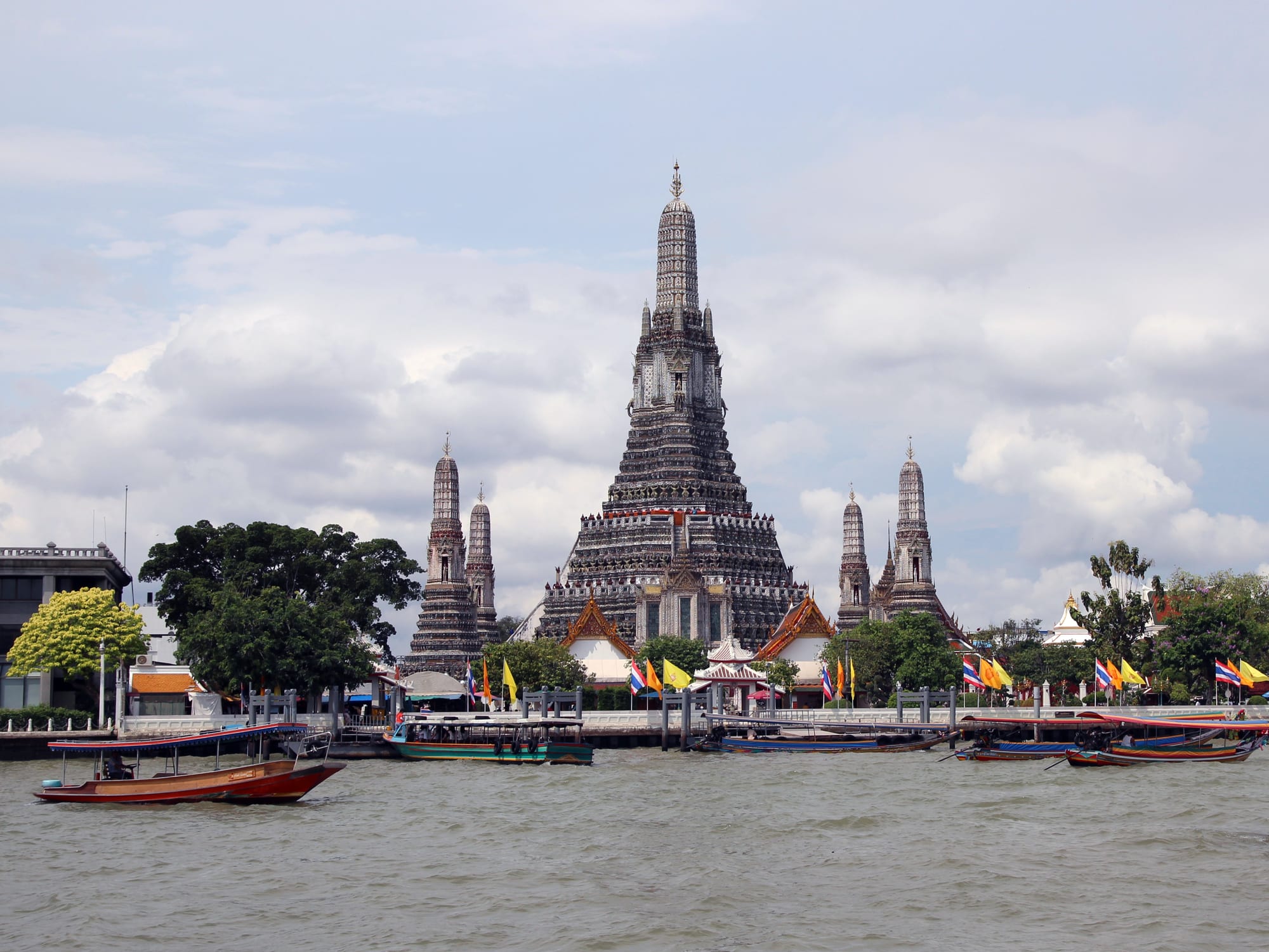
A tall, steeply tiered temple spire encrusted with coloured porcelain, rising beside a wide river under a bright sky

Thailand

Wat Arun, the Temple of Dawn, on the Chao Phraya River in Bangkok, its central prang decorated with broken Chinese porcelain. (Rolf Heinrich, Köln / Wikimedia Commons · CC BY 3.0)

A Southeast Asian kingdom of some 70 million people — the only country in the region never colonised by a European power — with a revered monarchy, a politically active military, a devout Buddhist majority, and one of the world's largest tourism industries.

Explore Thailand

History

Tai-speaking peoples moved south into the region over centuries, and the kingdoms of Sukhothai (13th–14th century) and then Ayutthaya (1351–1767) built the Siamese state, drawing on Khmer, Mon, and Indian models and adopting Theravada Buddhism. Ayutthaya was a wealthy, cosmopolitan trading capital until a Burmese army sacked it in 1767. The general who reunified the country founded a new capital, and in 1782 the Chakri dynasty, still on the throne, established Bangkok.

Siam was the one Southeast Asian state to keep its independence through the colonial era, playing Britain and France against each other, ceding territory at the edges, and modernising the administration under kings Mongkut (Rama IV) and Chulalongkorn (Rama V). A bloodless revolution in 1932 ended absolute monarchy and installed a constitutional system — but real power has swung between elected governments and the military ever since, with around a dozen successful coups, the most recent in 2014.

The country was renamed Thailand in 1939. The long reign of King Bhumibol Adulyadej (Rama IX, 1946–2016) coincided with rapid development and became a pillar of national identity; his son Vajiralongkorn (Rama X) succeeded him. Politics in the 2000s and 2010s was dominated by conflict between supporters and opponents of the populist Shinawatra family, and recent elections have seen a reformist party win the most votes only to be blocked from power. Criticism of the monarchy is constrained by a strict lèse-majesté law.

  • Thailand: The Land That Was Never Colonised The one Southeast Asian country that kept its independence through the age of empire — a Buddhist kingdom that traded territory for survival, replaced its absolute monarchy with a fragile constitution in 1932, and has cycled through a dozen coups since

Culture & Customs

Three institutions — monarchy, Buddhism, and the military — anchor Thai public life, and images of the king are displayed with reverence. About 90 per cent of Thais are Theravada Buddhist; most young men still ordain as monks for a period, temples (wat) are community centres, and spirit houses stand outside homes and businesses.

Social manners emphasise composure and the avoidance of open conflict or "loss of face"; the wai, a bow with palms pressed together, is the greeting, and its height signals respect. The head is regarded as sacred and the feet as low and unclean, so one does not touch people's heads or point feet at people or Buddha images. Sanuk, the idea that activities should be enjoyable, and a generally easy-going approach are widely noted.

Modest dress is expected at temples (covered shoulders and knees, shoes removed), and the monarchy and religion should not be treated lightly. Regional cultures — Isan in the northeast, Lanna in the north, the Malay-Muslim south — have their own languages, music, and food.

Daily Life

About 70 million people live in Thailand. Greater Bangkok, with roughly 10 million or more, dominates the economy and government; the northeast (Isan) is the most populous and poorest region and sends migrant workers to the capital and abroad. The population is ageing quickly and the birth rate is low.

The economy is diverse by regional standards — car and electronics manufacturing, agriculture (Thailand is a top exporter of rice, rubber, and seafood), and tourism, which in normal years is among the largest in the world and a major employer. Cannabis was decriminalised in 2022, prompting a boom in shops that the government has since moved to re-regulate.

Everyday life mixes the modern and the devout: office towers and malls, street-food stalls on every corner, morning alms for monks, motorbikes threading traffic, and weekends at the temple, the market, or the beach.

Food

Thai food balances sweet, sour, salty, spicy, and sometimes bitter, and it is intensely regional. Central Thai cooking gives the dishes best known abroad — tom yum and tom kha soups, green and red curries, pad thai, and pad kaphrao (stir-fried holy basil with a fried egg). Northeastern (Isan) food is fierce and herbal: som tam (green papaya salad), larb (minced-meat salad), grilled chicken, and sticky rice eaten by hand.

The north (Lanna) has milder, earthier dishes like khao soi (curry noodle soup) and sai ua sausage; the south is the spiciest, with turmeric-yellow curries, gaeng tai pla, and fresh seafood. Street stalls and markets are where much of the country eats, at all hours.

Rice or noodles anchor every meal, fish sauce and chilli are on every table, and fruit — mango, durian, mangosteen, rambutan — is abundant. Iced coffee and tea (often sweet and orange), fresh coconut water, and Singha or Chang beer are the usual drinks.

Attractions & Natural Wonders

Bangkok holds the Grand Palace and Wat Phra Kaew with the Emerald Buddha, the reclining Buddha of Wat Pho, Wat Arun across the river, the canals of Thonburi, the Chatuchak weekend market, and a serious food and nightlife scene. The ruins of Ayutthaya and, further north, Sukhothai — both UNESCO sites — are day trips into the Siamese past.

The north centres on Chiang Mai, a moated old city of temples ringed by mountains, with hill-tribe villages, elephant sanctuaries, cookery schools, and the temple of Doi Suthep above town; Chiang Rai and the former opium country of the Golden Triangle lie beyond, and Pai is a mountain backpacker hub.

The south is beaches and islands: Phuket and Phang Nga Bay with its limestone towers on the Andaman side; Krabi, Railay, and the Phi Phi and Similan islands for climbing and diving; and Koh Samui, Koh Phangan, and Koh Tao in the Gulf. In between are national parks such as Khao Yai and Khao Sok, with rainforest, waterfalls, and karst lakes.

  • Thailand: Ten Attractions and Natural Wonders A temple encrusted with shattered porcelain along the Chao Phraya River, limestone cliffs rising sheer from turquoise water, and the ruins of a capital once among the largest and wealthiest cities on earth

Planning basics

Budget

Thailand is one of the best-value destinations in the world. Street food, guesthouses, domestic flights, and local transport are cheap; the costs climb only with beach resorts, islands in high season, and Bangkok's upscale hotels and nightlife. It suits everyone from backpackers to luxury travellers.

Daily Budget Midrange
USD 70–150 (comfortable hotel, restaurants, domestic flights, tours and islands)
Daily Budget Shoestring
USD 25–45 (guesthouse or hostel, street food, buses and trains)

Eat where the locals eat, use the trains and public buses in Bangkok, and book island transfers and high-season resorts ahead.

Visa Requirements

Citizens of many countries, including the UK, EU, US, Canada, and Australia, enter visa-free for 60 days (extendable by 30 days at an immigration office). Others use the e-visa or visa on arrival. A digital arrival card (TDAC) is now required, completed online before entry.

Typical Stay
60 days visa-free for many Western passports, extendable

Complete the online Thailand Digital Arrival Card before you land, and carry proof of onward travel.

Safety

Thailand is generally safe for visitors, with the main problems being scams (gem shops, rigged tuk-tuk tours, jet-ski damage claims), motorbike accidents — a leading cause of tourist deaths — drink spiking in nightlife areas, and drownings in rip currents. Political demonstrations in Bangkok can turn tense. Avoid the far-southern provinces of Pattani, Yala, and Narathiwat, where a separatist insurgency continues.

Health
Dengue is common; rabies is present; tap water is not for drinking; road safety is poor

Only ride a motorbike with a licence, a helmet, and experience; check the surf and flags before swimming; watch drinks in bars; and steer clear of protests and the deep south.

Climate

Tropical, with three seasons over most of the country: cool and dry (November–February), hot (March–May), and the southwest-monsoon rainy season (roughly June–October). The Andaman coast and the Gulf coast have offset rainy seasons, so one side is usually drier than the other.

Rainy
June–October (mainland and Andaman); the Gulf islands are wettest Oct–Dec
Dry And Cool
November–February (best overall)

Transportation

Bangkok's two airports (Suvarnabhumi and Don Mueang) are major hubs, and domestic flights are cheap and frequent. Bangkok has the BTS Skytrain, MRT metro, and river boats; overnight trains and long-distance buses connect the regions; and songthaews, tuk-tuks, and ride-hailing apps (Grab, Bolt) handle the last mile. Ferries and speedboats serve the islands.

Use the Skytrain and river boats in Bangkok to beat the traffic, take a sleeper train to Chiang Mai, and use apps rather than negotiating tuk-tuk fares.

Best Time to Visit

November to February is the prime season nationwide — dry, cooler, and peak for the islands and the north. March to May is very hot; the rains bring lush landscapes, lower prices, and afternoon downpours rather than all-day rain. Choose the coast that is in its dry season.

Events
Songkran (Thai new year water festival, mid-April); Loy Krathong and Yi Peng lantern festival (November); Vegetarian Festival in Phuket (Sept/Oct); the King's birthday and other royal days

Currency

The currency is the Thai baht. Cash is used for street food, markets, and small shops; cards work in malls, hotels, and chain stores. ATMs are everywhere but charge a fixed foreign-card fee per withdrawal, so take out larger amounts.

Symbol
฿
Currency Code
THB — Thai baht

Language

Thai is the official language, written in its own script and tonal. English is widely used in tourism, hotels, and international business in Bangkok and the resort areas, but far less so in rural areas and among older people. Regional dialects and languages (Isan, Northern Thai, Malay in the south) are widely spoken.

English
Common in tourism and Bangkok; limited elsewhere
Official Language
Thai