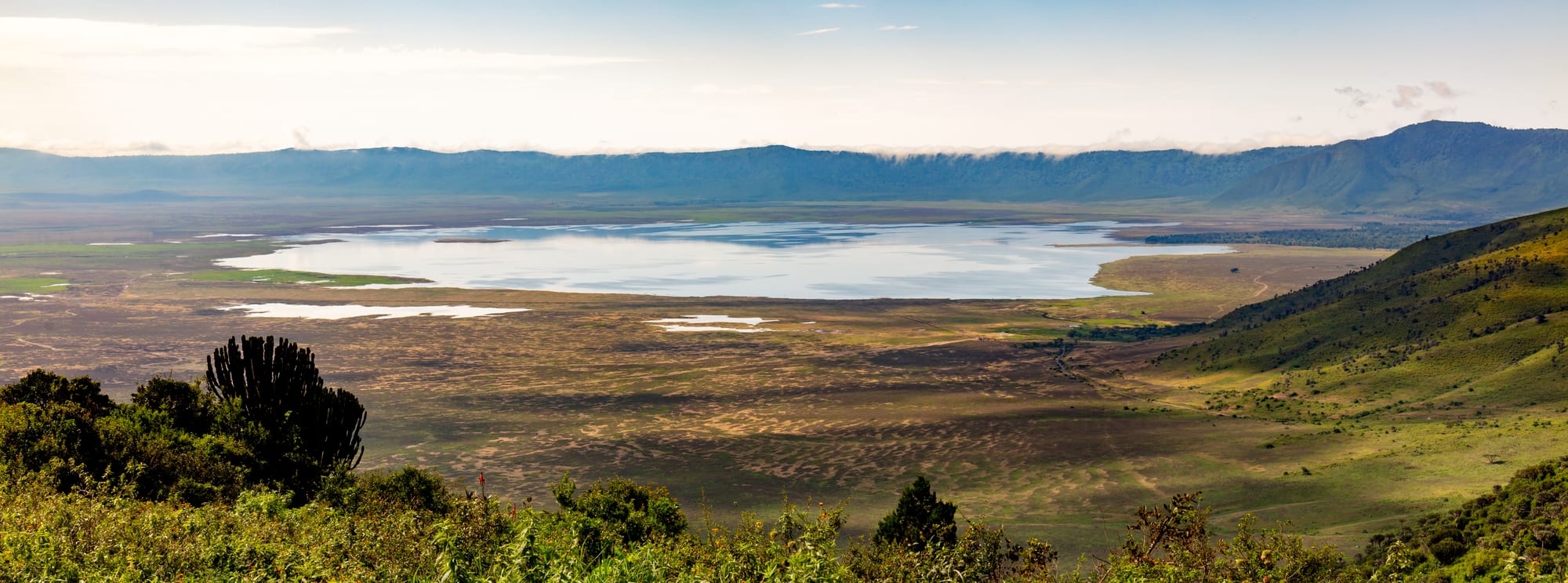
A vast grassy crater floor with a soda lake and scattered trees, ringed by a high forested rim under a wide sky

Tanzania

The Ngorongoro Crater, a collapsed volcanic caldera about 20 km across whose floor holds dense concentrations of wildlife. (Diego Delso / Wikimedia Commons · CC BY-SA 4.0)

A large East African country formed by the union of mainland Tanganyika and the islands of Zanzibar — one of the continent's most stable and peaceful states, holding Kilimanjaro, the Serengeti, and Ngorongoro, and bound together by the Swahili language.

Explore Tanzania

History

The East African coast has been part of the Indian Ocean trading world for nearly two thousand years, and from around the eighth century Arab and Persian contact with Bantu-speaking communities produced Swahili civilisation — the city-states of Kilwa, Zanzibar, and others, Muslim, mercantile, and stone-built. Zanzibar became the seat of the Sultanate of Oman in the nineteenth century and the hub of a vast trade in enslaved people and ivory reaching deep into the interior.

Germany colonised the mainland as German East Africa from the 1880s, crushing the Maji Maji rebellion of 1905–07 with a scorched-earth campaign and famine that killed vast numbers. After the First World War, Britain took over the mainland (as Tanganyika) under a League of Nations mandate, while Zanzibar remained a British protectorate under its sultan.

Tanganyika became independent in 1961 under Julius Nyerere, and Zanzibar in 1963; a 1964 revolution overthrew Zanzibar's sultan, and that year the two united as Tanzania. Nyerere pursued Ujamaa, a policy of African socialism and village collectivisation that fostered national unity and literacy but left the economy weak. One-party rule lasted until multiparty elections resumed in 1995, with the ruling CCM winning every one since. President John Magufuli died in office in 2021 and was succeeded by Samia Suluhu Hassan, the country's first woman president. Zanzibar retains its own president and parliament and a semi-autonomous status that remains politically sensitive.

  • Tanzania: The Union of the Mainland and the Isles A country made in 1964 by joining mainland Tanganyika to the spice islands of Zanzibar — the site of humanity's oldest footprints, a German then British colony, and the home of an African socialism that kept the peace but not the prosperity

Culture & Customs

Tanzania's success in holding together a very diverse population — more than 120 ethnic groups, plus large Christian and Muslim communities roughly balanced on the mainland and an overwhelmingly Muslim Zanzibar — is often credited to Nyerere's promotion of Swahili and a deliberate national, rather than tribal, identity.

Coastal and island culture is Swahili and Islamic, with its own architecture, dress (the kanga and kanzu), taarab music, and Ramadan rhythms. Inland, communities such as the Maasai and Hadza retain distinct pastoral and hunter-gatherer ways of life, and Maasai imagery has become closely tied to the tourist industry.

Respect for elders, modest dress (particularly in Zanzibar and Muslim areas), greetings before business, and a relaxed sense of time (pole pole, "slowly slowly") are widely noted. Football and, increasingly, Bongo Flava music are national common ground.

Daily Life

About 65 million people live in Tanzania, a young and fast-growing population, still largely rural and dependent on farming — maize, cassava, bananas, coffee, cashews, and cotton — and livestock. Dar es Salaam is the commercial capital and one of Africa's fastest-growing cities; Dodoma, in the centre, is the official capital and seat of parliament.

The economy has grown steadily on agriculture, mining (gold, and newly significant natural gas offshore), and tourism, though poverty remains widespread and infrastructure patchy outside the main corridors. Chinese investment is prominent, including in the standard-gauge railway and the port.

On Zanzibar, the economy runs on cloves and spices, seaweed farming, fishing, and a large tourism sector, with a persistent undercurrent of political tension over the union with the mainland.

Food

Everyday Tanzanian food centres on ugali, a stiff maize porridge eaten with the hands and dipped into stews of beans, greens (sukuma wiki or mchicha), fish, or meat. Rice, plantains (ndizi), and chapati are also staples, and nyama choma — grilled meat, usually goat or beef — is the sociable meal, often with a tomato-and-onion relish (kachumbari).

The coast and Zanzibar have a richer, spiced cuisine reflecting Indian, Arab, and Portuguese influence: pilau and biryani, fish and octopus in coconut curry (mchuzi wa pweza), urojo (Zanzibar mix soup), samosas, and mandazi fried dough. The Zanzibar night market at Forodhani is a well-known food scene.

Chai with spices and plenty of sugar is the standard drink, along with fresh tropical juices and sugarcane juice. Zanzibar's spice farms grow the cloves, nutmeg, cinnamon, and cardamom that flavour the food, and Tanzanian coffee, grown around Kilimanjaro and Mbeya, is exported worldwide.

Attractions & Natural Wonders

The northern safari circuit is among the finest in the world: the Serengeti, with the year-round wildebeest migration and its dramatic Mara and Grumeti river crossings; the Ngorongoro Crater, a natural amphitheatre packed with game including black rhino; and Tarangire, known for elephants and baobabs. Lake Manyara adds tree-climbing lions and flamingos.

Mount Kilimanjaro, at 5,895 metres the highest point in Africa and the tallest free-standing mountain on Earth, is climbed over five to nine days on several routes without technical equipment. Mount Meru near Arusha is a serious climb in its own right.

The south and west hold huge, wild, and little-visited parks — Nyerere (formerly the Selous), Ruaha, Katavi — and Gombe and Mahale on Lake Tanganyika, where chimpanzees can be tracked. Off the coast, Zanzibar's Stone Town is a UNESCO World Heritage Site of coral-stone palaces, mosques, and the former slave market, fringed by white-sand beaches, and the quieter islands of Pemba and Mafia offer diving and marine parks.

  • Tanzania: Ten Attractions and Natural Wonders Africa's tallest freestanding mountain, the largest unbroken volcanic caldera on earth acting as a natural wildlife enclosure, and a migration of over a million animals moving in an endless annual circuit

Planning basics

Budget

Tanzania spans a wide range. Independent travel on the mainland and in Zanzibar can be inexpensive, but the northern safari circuit is costly — park fees alone run to tens of dollars a day, plus a vehicle, guide, and lodging — and climbing Kilimanjaro is a four-figure undertaking because guides, porters, and permits are mandatory.

Daily Budget Safari
USD 250–700+ per day for a guided northern-circuit safari, all in
Daily Budget Shoestring
USD 40–80 off-safari (guesthouses, local food, buses, Zanzibar dalla-dallas)

Book safaris and Kilimanjaro climbs through licensed operators; save money by combining a short safari with independent time in Zanzibar or the southern parks.

Visa Requirements

Most visitors need a visa. An e-visa is available online in advance, and visa on arrival is offered at the main airports and land borders for many nationalities. US citizens are typically issued a multiple-entry visa. Zanzibar requires proof of travel insurance on arrival.

Typical Validity
90 days, single or multiple entry

Get the e-visa in advance to avoid airport queues, and arrange the mandatory Zanzibar travel insurance before flying there.

Safety

Tanzania is generally safe and politically stable. The main risks are opportunistic crime — bag-snatching and muggings in parts of Dar es Salaam and Stone Town, and on some beaches after dark — road accidents on intercity routes, and the ordinary hazards of wildlife areas and high altitude. Terrorism risk is higher near the Mozambique border in the far south.

Health
Malaria is present nationwide including Zanzibar — take prophylaxis; yellow-fever vaccination is required if arriving from an endemic country; altitude sickness on Kilimanjaro

Take malaria precautions everywhere, don't walk on beaches or in cities after dark, follow your guide's instructions on safari, and acclimatise properly on Kilimanjaro.

Climate

Tropical, moderated by altitude. The coast and Zanzibar are hot and humid; the northern highlands and safari areas are cooler. There are "long rains" from roughly March to May and "short rains" in November and December, with dry seasons in between; the far south and west have a single long wet season.

Long Rains
March–May
Short Rains
November–December

Transportation

Julius Nyerere International Airport in Dar es Salaam and Kilimanjaro International Airport are the main gateways, with Zanzibar also served internationally. Domestic flights link the safari hubs and islands. The new standard-gauge railway connects Dar es Salaam to Dodoma and beyond; buses cover the country cheaply; and ferries run Dar–Zanzibar. Safari travel is by 4x4 with a driver-guide.

Fly between distant points to save long bus days, take the fast ferry or a short flight to Zanzibar, and use a reputable operator's vehicle for the parks.

Best Time to Visit

June to October is the dry-season peak for wildlife across the northern parks and for climbing Kilimanjaro, and coincides with the Serengeti river crossings around July–September. January to February is a good warm, drier window and the calving season on the southern Serengeti plains. Avoid the long rains for safari.

Events
Sauti za Busara music festival, Zanzibar (February); Zanzibar International Film Festival (mid-year); Nane Nane farmers' day (8 August); Eid al-Fitr and Eid al-Adha, especially on the coast

Currency

The currency is the Tanzanian shilling. US dollars are widely accepted for park fees, tours, and hotels (notes must be recent and undamaged). ATMs are common in cities and tourist towns; carry cash for rural areas and markets.

Symbol
TSh
Currency Code
TZS — Tanzanian shilling

Language

Swahili (Kiswahili) is the national language and the medium of primary education and daily life, and it is the great unifier across more than 120 ethnic groups. English is the language of higher education, courts, and much business, and is widely used in tourism.

Other
English (education, business, tourism); many local languages
National Language
Swahili