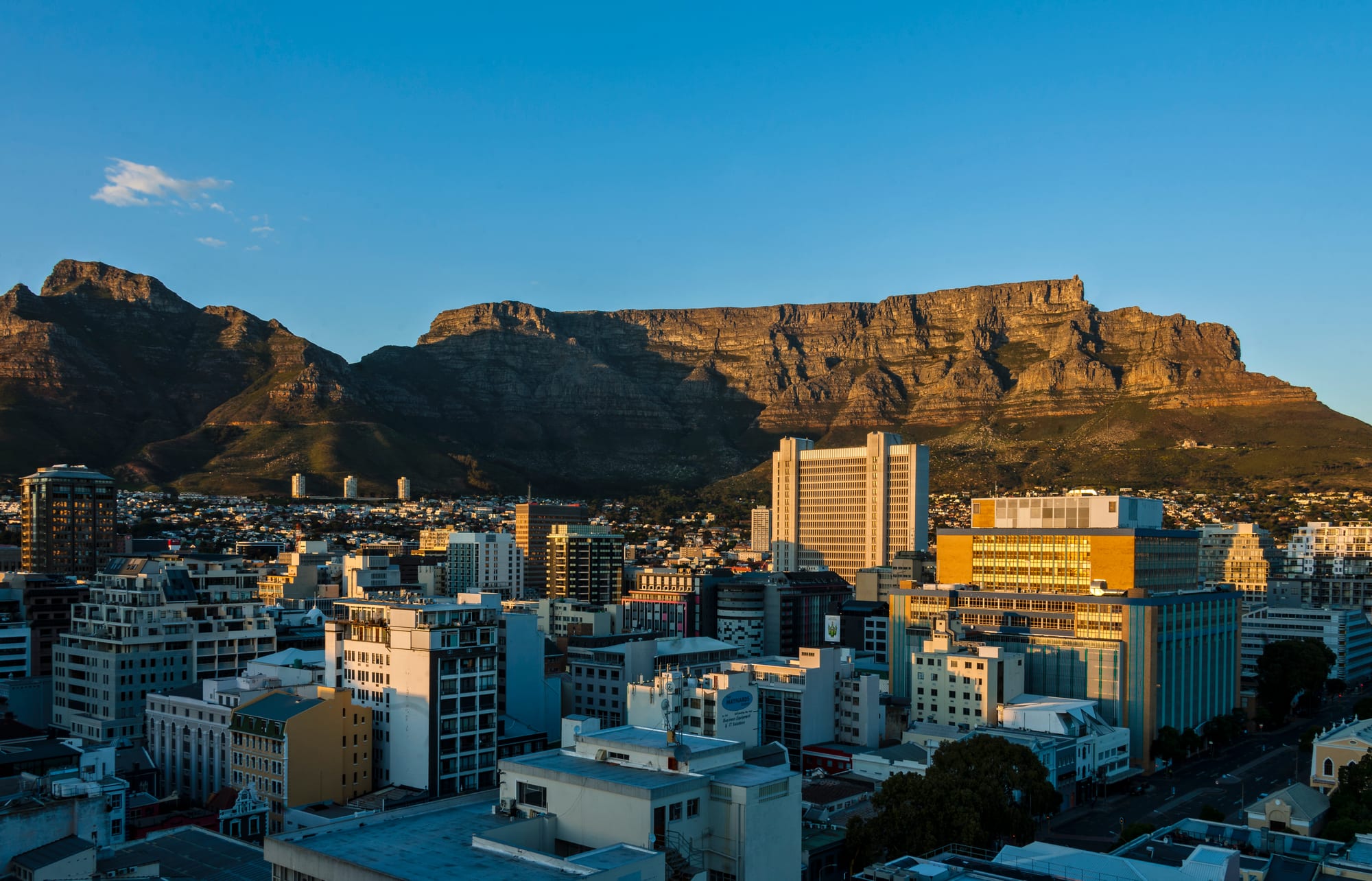
A flat-topped mountain catching first light above a city spread across a bowl of land between peaks and the sea

South Africa

Table Mountain above the Cape Town City Bowl at dawn, with Devil's Peak and Lion's Head framing the centre. (Daniel Case / Wikimedia Commons · CC BY-SA 3.0)

The most industrialised economy at Africa's southern tip, and a land of exceptional landscapes and wildlife — ruled by a white-minority apartheid regime until 1994, when Nelson Mandela's election opened a constitutional democracy still shadowed by deep inequality.

Explore South Africa

History

The oldest inhabitants were San hunter-gatherers and Khoekhoe herders; Bantu-speaking farmers had settled the eastern half by around 300 AD. The Dutch East India Company founded a supply station at the Cape in 1652, which grew into a slave-holding colony that expanded east into a century of frontier wars with the Xhosa. Britain took the Cape permanently in 1806. In the 1810s–20s the Zulu kingdom rose under Shaka, and from the 1830s Boer settlers trekked inland to found republics beyond British control.

The discovery of diamonds at Kimberley in 1867 and gold on the Witwatersrand in 1886 transformed everything, drawing capital and labour and sharpening conflict. After the Anglo-Zulu War of 1879 and the South African (Boer) War of 1899–1902, the British colonies and defeated Boer republics were joined in the Union of South Africa in 1910 — a self-governing state that excluded the Black majority from power. The African National Congress was founded in 1912 in response.

The National Party won the whites-only election of 1948 and built apartheid into a comprehensive legal system of racial classification, segregation, and forced removal. Resistance met with the Sharpeville massacre in 1960, the jailing of Nelson Mandela and others in 1964, the Soweto uprising of 1976, and repeated states of emergency in the 1980s under international sanctions. President F. W. de Klerk unbanned the ANC and freed Mandela in 1990; the first non-racial election in April 1994 made Mandela president, and a Truth and Reconciliation Commission followed. Since then the ANC has governed nationally — through the Mbeki years and their AIDS-policy failures, the corruption-riddled "state capture" of the Zuma era, and Cyril Ramaphosa's presidency from 2018 — until the party lost its majority in 2024 and formed a coalition Government of National Unity.

  • South Africa: The Long Road From Apartheid A land of deep human history and deeper division — Dutch and British settlement, the mineral revolution, a war between white powers, half a century of legislated white supremacy, and a negotiated revolution that produced one of the world's most admired constitutions

Culture & Customs

South Africa calls itself the "rainbow nation", and its diversity is structural: twelve official languages, and communities including Zulu, Xhosa, Sotho, Tswana, Venda, Afrikaner, English-speaking whites, "coloured" (mixed-heritage) people, and South Africans of Indian and other descent. The Nguni concept of ubuntu — a person is a person through other people — is often invoked as a shared value.

The braai, a barbecue that is as much a social ritual as a meal, cuts across every group. Music runs deep: gospel and choral traditions, jazz, kwaito, and now amapiano, which has spread worldwide from Gauteng's townships. Sport is a unifier and a flashpoint — the Springboks have won the Rugby World Cup four times, and cricket and football have huge followings.

The country has produced outsized literature and art (Nadine Gordimer and J. M. Coetzee both won the Nobel), a robust free press, and an active civil society. Most South Africans are Christian, often blending church with traditional ancestral practice; there are also significant Hindu, Muslim, and Jewish communities.

Daily Life

About 63 million people live in South Africa, in one of the world's most unequal societies. Gated suburbs with private security sit near townships and informal settlements that still lack full services, a direct inheritance of apartheid spatial planning. Unemployment runs around a third of the workforce, and higher among the young.

For years "load-shedding" — rotating blackouts caused by the failing power stations of the state utility Eskom — structured daily and business life; outages eased markedly in 2024–25 but the risk has not gone. Water security is also fragile, as Cape Town's near-miss "Day Zero" in 2018 showed.

Alongside the hardship is a large, cosmopolitan middle class, world-class universities and hospitals in the private sector, a lively arts and restaurant scene in the cities, and strong constitutional courts and media that regularly check those in power.

Food

The braai anchors the food culture — grilled boerewors sausage, lamb chops, sosaties (kebabs), and pap (maize porridge) with tomato-and-onion chakalaka. Cape Malay cooking, developed by enslaved and free people of Southeast Asian descent, brings gently spiced dishes such as bobotie (curried mince with an egg topping), bredie stews, koeksisters, and malva pudding.

Regional specialities include Durban's Indian-South African curries and the bunny chow — curry served in a hollowed loaf — and Cape Town's gatsby, a loaded submarine sandwich. Biltong and droëwors (air-dried, spiced meat) are the national snack, and potjiekos is a slow stew cooked outdoors in a three-legged pot.

South Africa is a serious wine country, centred on Stellenbosch and Franschhoek, known for Chenin Blanc and the local red grape Pinotage. Rooibos, a caffeine-free bush tea, is grown only in the Western Cape, and the cream liqueur Amarula is made from marula fruit.

Attractions & Natural Wonders

Kruger National Park, roughly the size of Wales, is the classic Big Five safari, ranging from budget-friendly rest camps to the exclusive private reserves of the Sabi Sand on its western edge. Other reserves — Addo (elephants), Hluhluwe–iMfolozi (rhino), Kgalagadi, and Pilanesberg — spread the wildlife across the country.

Cape Town packs Table Mountain, Cape Point, the penguins at Boulders Beach, the V&A Waterfront, and the ferry to Robben Island into one setting, with the Cape Winelands and their Cape Dutch estates just inland. The Garden Route runs east along the coast through Knysna and the forests and gorges of Tsitsikamma.

Inland, the Drakensberg escarpment (the uKhahlamba–Drakensberg Park, a UNESCO site with ancient San rock art) offers the country's best mountain hiking, and the Panorama Route above it takes in the Blyde River Canyon and God's Window. The Cradle of Humankind near Johannesburg holds hominin fossil sites; Namaqualand erupts in wildflowers each spring; and the whales gather off Hermanus from mid-year.

  • South Africa: Ten Attractions and Natural Wonders A flat-topped mountain rising straight from a coastal city, one of Africa's greatest wildlife reserves, and the prison island where a future president spent 18 years before leading his country to democracy

Planning basics

Budget

South Africa offers strong value to visitors spending hard currency: restaurant meals, wine, fuel, and domestic flights are inexpensive by Western standards. Safari is the big-ticket item, ranging from self-catering rest camps in the national parks to private reserves costing several hundred dollars a night. Self-driving keeps costs low.

Daily Budget Midrange
USD 130–300 (boutique guesthouse, restaurants, car hire, some guided activities)
Daily Budget Shoestring
USD 45–80 (hostel or guesthouse, self-catering, self-drive, national-park camps)

Self-drive and stay in SANParks rest camps for affordable wildlife; save the private lodges for a few nights if the budget allows.

Visa Requirements

Citizens of the UK, EU, US, Canada, Australia, and many other countries enter visa-free for up to 90 days; some nationalities get 30. An e-visa scheme is being expanded to more countries. Strict documentation rules apply to travel with children under 18.

Typical Stay
Up to 90 days visa-free for most Western passports

If travelling with a minor, check the current birth-certificate and consent-letter requirements well ahead.

Safety

Violent crime rates are high, but most of it is concentrated in areas visitors do not go; the main tourist routes — Cape Town centre, the Winelands, the Garden Route, Kruger and the private reserves — are heavily travelled and generally fine with sensible precautions. Risks include mugging, smash-and-grab at traffic lights, ATM fraud, and carjacking in certain areas. Do not walk at night, avoid townships without a guide, and stay alert at petrol stops and quiet viewpoints.

Health
Malaria in the far northeast (Kruger lowveld, northern KwaZulu-Natal) — take prophylaxis; the sun is strong; tap water is safe in cities

Don't display phones or jewellery, keep the car locked in traffic, use Uber or Bolt after dark, take malaria precautions for the lowveld, and drive with headlights on and caution for animals and pedestrians.

Climate

Mostly temperate, with regional contrasts. Most of the country has summer rain (roughly October–March), hot in the interior and the lowveld; winter (June–August) is dry, sunny, and cool, with frost on the highveld and snow on the Drakensberg. The Western Cape is the reverse — dry summers and wet, cool winters.

Western Cape
Winter rain May–Aug; dry, warm summers
Interior And North
Summer rain Oct–Mar; dry winters Jun–Aug

Transportation

OR Tambo in Johannesburg is the regional air hub, with Cape Town and Durban also well served and cheap domestic flights between them. Self-driving on a good road network (on the left) is the normal way to tour, with intercity coaches (Intercape) as a backup. In cities, Uber and Bolt are the safe way to get around; scheduled passenger rail is limited outside luxury services and the Gautrain in Gauteng.

Hire a car for touring, use Uber or Bolt within cities rather than walking at night or using minibus taxis, and keep doors locked and windows up in traffic.

Best Time to Visit

May to September is prime time for wildlife — the bush is thin and dry and animals gather at water — and for the Winelands and Cape Town outside the wettest weeks. November to March suits the Cape beaches, the Garden Route, and the Drakensberg. Whale-watching off the Western Cape runs June to November.

Events
Cape Town Cycle Tour (March); the jacarandas of Pretoria (Oct/Nov); whale season (Jun–Nov); Comrades Marathon (June); wine-harvest festivals

Currency

The currency is the South African rand, which is widely traded and can be volatile. Cards are accepted almost everywhere, including in national parks; carry some cash for tips, markets, and rural areas.

Symbol
R
Currency Code
ZAR — South African rand

Language

South Africa has twelve official languages, including South African Sign Language. English is the common language of business, government, and signage although only about one in ten speak it at home. isiZulu and isiXhosa are the largest first languages, and Afrikaans is widely spoken in the west and the Cape.

Common Language
English
Largest First Languages
isiZulu, isiXhosa, Afrikaans