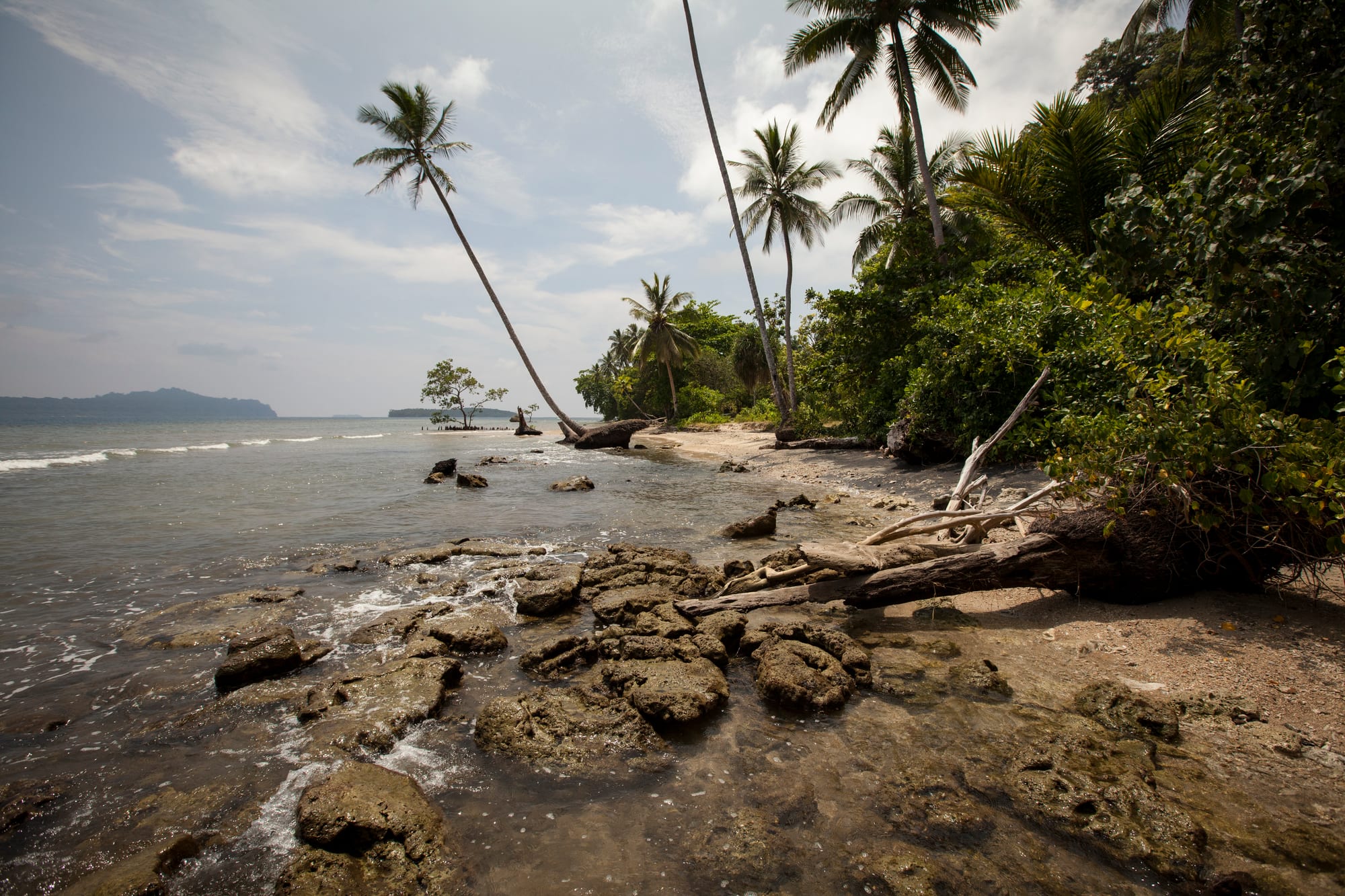
A calm turquoise lagoon fringed by dense jungle and coconut palms, with a low forested island offshore under a bright sky

Solomon Islands

A jungle-backed lagoon shoreline in the Solomon Islands, where most land is held by clans and most people live by the sea. (Alex DeCiccio / Wikimedia Commons · CC BY-SA 4.0)

A Melanesian archipelago of some 900 islands east of Papua New Guinea — the setting of the Second World War's Guadalcanal campaign, independent from Britain since 1978, and one of the Pacific's poorest and least-visited nations.

Explore Solomon Islands

History

People reached the Solomons at least three thousand years ago, part of the Lapita expansion into the western Pacific, and developed the seafaring, gardening, and clan-based societies that persist today. A Spanish expedition under Álvaro de Mendaña sighted the islands in 1568 and named them for the biblical King Solomon, imagining gold that was not there. In the nineteenth century "blackbirding" ships took thousands of islanders, often by force or deceit, to work plantations in Queensland and Fiji.

Britain declared a protectorate over the southern islands in 1893. During the Second World War the archipelago became a crucial theatre: the Guadalcanal campaign of 1942–43, fought on land, at sea, and in the air, was the first major Allied offensive against Japan and a turning point in the Pacific, at a heavy cost in lives and ships. The waters off Honiara are still called Iron Bottom Sound for the wreckage that lies there.

Independence came in 1978. From 1998 to 2003 the country was torn by "the Tensions", a conflict between militias from Guadalcanal and Malaita rooted in land and migration grievances, which paralysed the state until the Australian-led Regional Assistance Mission (RAMSI) restored order and stayed until 2017. Riots hit Honiara in 2006 and again in 2021, and in 2019 the government switched diplomatic recognition from Taiwan to Beijing, followed in 2022 by a security agreement with China that drew concern across the region.

  • Solomon Islands: The Scene of the Battle A double chain of Melanesian islands with more than 70 languages — a labour reservoir for Queensland's cane fields, a British protectorate, the turning-point battleground of the Pacific War at Guadalcanal, and an independent state strained by ethnic conflict

Culture & Customs

Society is organised around the wantok system — literally "one talk", the network of language, clan, and kin that carries strong mutual obligations of support and hospitality. Most land is held communally under customary tenure, not by the state, and permission from the owning clan is needed to use a beach, reef, or forest.

Christianity is near-universal and church life is central, but it coexists with kastom, the body of ancestral custom, ritual, and law. Regional cultures are distinct: Malaita is known for its shell money, still used in bride-price and compensation; the Western Province for fine canoe carving and the nguzunguzu figurehead; and many islands for panpipe ensembles and dance. Betel nut chewing is widespread.

Respect for elders and chiefs, restraint in public behaviour, and modest dress away from resorts are expected, and the pace of village life is slow and communal.

Daily Life

Around 750,000 people live in the Solomons, and roughly three-quarters of them in villages, growing taro, yam, sweet potato, and cassava, fishing the reefs, and selling copra, cocoa, or garden produce. Honiara, on Guadalcanal, is the only real town and draws a steady drift of young people looking for work and schooling.

The cash economy depends on logging — much of it foreign-run and widely seen as unsustainable — along with fisheries, palm oil, and a nascent gold mine. Government services are thin, electricity and roads are limited, and the population is very young and growing fast.

The islands are highly exposed to natural hazards: cyclones, earthquakes, and tsunamis strike regularly, and rising seas have already forced some communities on low-lying reef islands to move to higher ground.

Food

The everyday diet is built on root crops — taro, yam, sweet potato (kumara), and cassava — with reef fish, shellfish, and coconut in many forms. Food is often cooked in a motu, an earth oven of hot stones, and coconut cream (miti) dresses fish and greens. Slippery cabbage (a local hibiscus spinach) and ferns are common vegetables.

Imported white rice and tinned fish or corned beef have become staples, especially in Honiara, alongside instant noodles and bread. Markets sell tropical fruit — pawpaw, pineapple, banana, and cut-nut and ngali nut in season.

Betel nut, chewed with lime and leaf, is the near-universal stimulant rather than alcohol or kava, though beer is sold in town. Fresh coconut and locally grown cocoa and coffee are the notable drinks.

Attractions & Natural Wonders

The Western Province is the scenic heart: Marovo Lagoon, one of the world's largest saltwater lagoons, enclosed by a double barrier reef, with carving villages and eco-lodges, plus world-class diving and surfing around Gizo and the New Georgia group. Wreck and reef diving is the main draw nationally, above all in Iron Bottom Sound off Honiara, where warships and aircraft lie within reach.

Guadalcanal holds the Second World War sites — Bloody Ridge, the Vilu open-air war museum, and coastal relics — as well as waterfalls and rainforest behind the capital. Rennell Island in the far south has East Rennell, a UNESCO World Heritage Site: the largest raised coral atoll in the world, with the brackish Lake Tegano at its centre.

Tetepare, the largest uninhabited island in the South Pacific, is run as a community conservation area with nesting turtles and dugongs, and Malaita's lagoons hold hand-built artificial islands and the shell-money workshops of Langa Langa. Almost everything requires a boat, a guide, and time.

  • Solomon Islands: Five Attractions and Natural Wonders One of the largest lagoons on earth ringed by hundreds of islands, WWII wrecks still resting where they sank during one of the Pacific War's most decisive campaigns, and villages that welcome visitors with ceremony rooted in centuries of tradition

Planning basics

Budget

Travel here is more expensive than the modest facilities suggest. Flights are limited and dear, Honiara's hotels are priced for officials and aid workers, and the dive and eco-lodges in the Western Province are a significant outlay. Village guesthouses and homestays are basic and cheap but hard to book ahead.

Daily Budget Midrange
USD 180–380 (Honiara hotel or island lodge, some domestic flights, guided dives)
Daily Budget Shoestring
USD 60–110 (village guesthouse, local markets, shared boats)

Carry enough cash for the whole trip once you leave Honiara, and budget for domestic flights or long boat transfers between island groups.

Visa Requirements

Many nationalities, including the UK, EU, US, Canada, Australia, and New Zealand, are granted a visitor permit on arrival, usually for up to three months. A passport valid for six months, an onward ticket, and proof of funds are expected.

Typical Stay
Up to 3 months on a visitor permit on arrival for most Western passports

Confirm the current arrival-permit list with an embassy before travel, as rules change; carry an onward ticket.

Safety

Most of the country is peaceful, but Honiara has seen serious unrest, including riots in 2006 and 2021 that targeted the Chinatown and business districts. Petty theft and occasional break-ins occur in the capital. Land and reef access is controlled by clans, and disputes can flare, so a local contact or guide matters. Malaria is widespread and medical care is very limited.

Health
Malaria year-round — take prophylaxis; dengue occurs; hospitals are basic, so evacuation insurance is essential

Avoid demonstrations and the Honiara Chinatown area during any political tension, always ask permission before entering land or reefs, and take strict malaria precautions.

Climate

Tropical, hot, and humid year-round, with temperatures around 28–31°C. The wetter northwest-monsoon season runs November to April and includes the cyclone risk; May to October is drier and a little cooler, with steadier trade winds.

Dry Season
May–October
Wet Season
November–April (cyclone risk)

Transportation

Honiara's Henderson airport has flights from Brisbane, Nadi, and Port Moresby. Solomon Airlines flies small aircraft to provincial airstrips, often on limited schedules; otherwise travel is by inter-island ferry, copra boat, or open "banana boat" with an outboard. Guadalcanal has a partly paved coastal road; most islands have almost none.

Build slack into your plans — domestic flights and boats are frequently delayed or cancelled by weather and logistics.

Best Time to Visit

June to September, in the drier season, offers the best diving visibility, calmer seas for boat transfers, and lower cyclone risk. Avoid the January–March peak of the rains. Sea conditions dictate travel between islands more than anything else.

Events
Independence Day (7 July); provincial second-appointed-day holidays; church and custom festivals; the Western Province war-canoe events

Currency

The currency is the Solomon Islands dollar. It is a cash economy outside Honiara, where a few hotels and shops take cards. ATMs exist in Honiara and a handful of provincial centres only.

Symbol
SI$
Currency Code
SBD — Solomon Islands dollar

Language

English is the official language, used in government and education. Solomon Islands Pijin is the everyday lingua franca that links the islands. Around seventy indigenous languages are spoken, more than in almost any country of its size.

Lingua Franca
Solomon Islands Pijin
Official Language
English