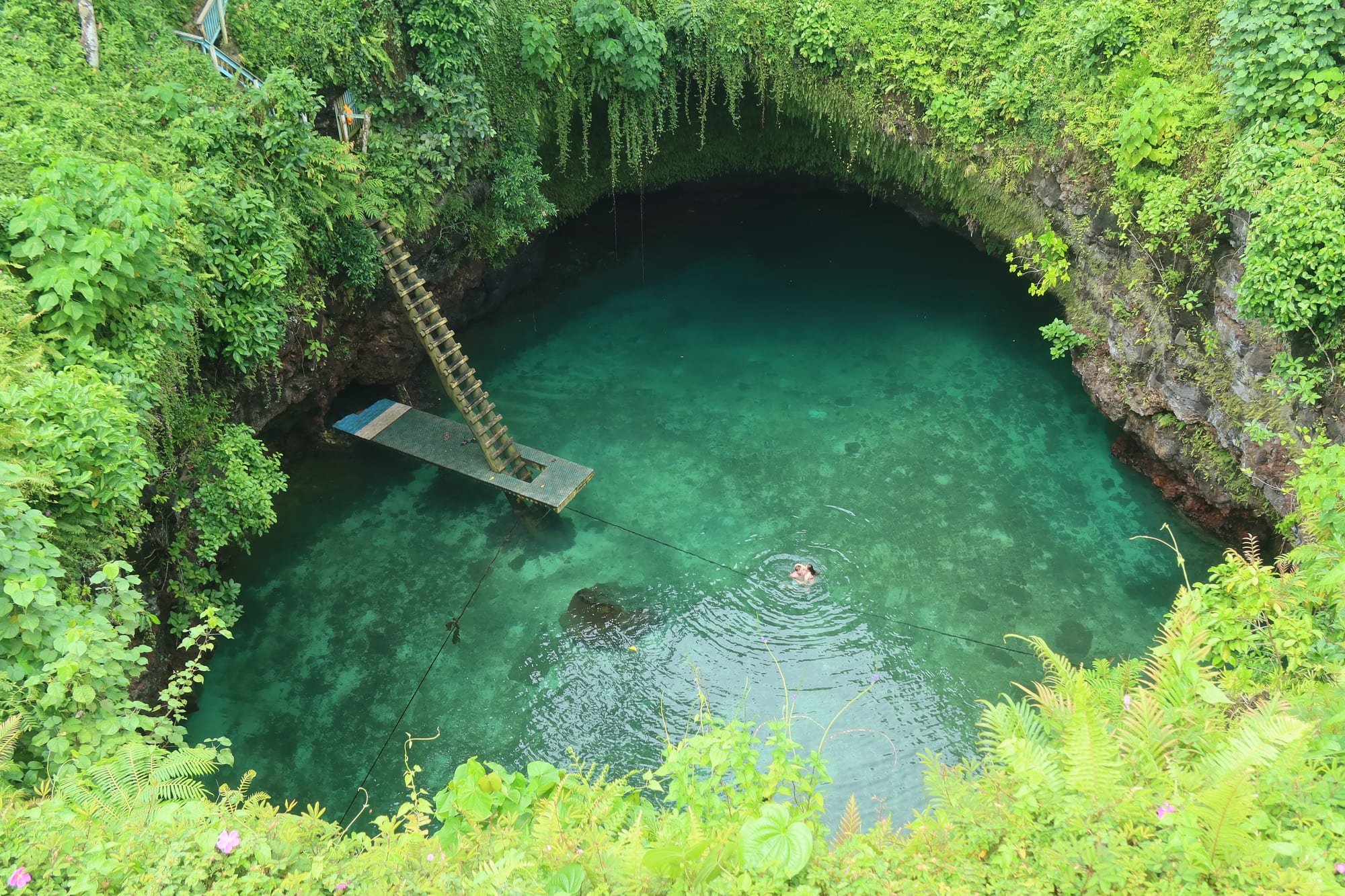
A deep circular swimming hole of clear turquoise water in a lush garden, ringed by rock and greenery, with a long wooden ladder descending into it

Samoa

The To Sua ocean trench on Upolu, a lava-collapse swimming hole linked to the sea, reached by a long ladder. (Gelu Purcelu / Wikimedia Commons · CC BY-SA 4.0)

Two main islands and a scatter of islets in the central South Pacific — a cradle of Polynesian settlement, deeply Christian and organised around the chiefly fa'a Samoa system, and the first Pacific island nation to gain independence.

Explore Samoa

History

Samoa was settled more than three thousand years ago and, with Tonga, is often called a cradle of Polynesia, from where the wider Pacific triangle was later peopled. A powerful chiefly society developed, and missionaries who arrived from 1830 converted the islands rapidly.

In the late nineteenth century, Germany, Britain, and the United States contended for Samoa, with civil wars and a famous 1889 naval standoff in Apia harbour ended by a cyclone. An 1899 agreement partitioned the islands: Germany took the west, the United States the east (today's American Samoa), and Britain withdrew. New Zealand seized German Samoa in the First World War and administered it under a League mandate and then a UN trusteeship — a period marked by the 1918 influenza epidemic, which killed around a fifth of the population, and the non-violent Mau independence movement, whose peaceful march was fired on by police in 1929.

Western Samoa became independent on 1 January 1962, the first Pacific island nation to do so, and dropped "Western" from its name in 1997. The Human Rights Protection Party governed almost continuously from 1982, until a knife-edge 2021 election and a constitutional standoff brought the FAST party to power and made Fiamē Naomi Mata'afa the country's first woman prime minister.

  • Samoa: The Heart of Polynesia One of Polynesia's oldest societies and a cradle of its culture — carved up by Germany, Britain and the United States, ruled harshly from New Zealand, and the first Pacific island nation to win back its independence

Culture & Customs

Life is organised around fa'a Samoa, "the Samoan way": the aiga (extended family), the matai (titled chiefs) who hold family land and represent the family in the village fono council, and the web of reciprocal obligations — fa'alavelave — by which families contribute to weddings, funerals, church, and title bestowals. Around four-fifths of the land is customary and cannot be sold.

Christianity is central and visible: a large church in every village, White Sunday for children in October, and a constitutional declaration in 2017 that Samoa is a Christian state. Sunday and the evening prayer curfew are observed strictly.

Traditional arts remain strong — the siva dance, the fiafia feast and performance, fine mat weaving ('ie tōga), siapo bark cloth, and the pe'a, the hand-tapped male tattoo from waist to knee that is a mark of commitment to Samoan custom.

Daily Life

Most Samoans live on Upolu, in and around Apia and in coastal villages, with the larger island of Savai'i quieter and less developed. The economy is small and heavily supported by aid and, above all, by remittances from a Samoan diaspora in New Zealand, Australia, and the United States that is larger than the population at home.

Agriculture — taro, coconut, cocoa, bananas, nonu juice — and fishing are the main livelihoods, with a modest tourism sector and a light-manufacturing base that has shrunk. The country is acutely exposed to disaster: catastrophic cyclones in 1990–91, the 2009 tsunami, and a 2019 measles epidemic that killed 83 people, mostly infants, in a country with then-low vaccination rates.

Village life runs on the church calendar, communal work, and the authority of the matai and the fono.

Food

Samoan food is based on root crops, coconut, and the sea. Taro, breadfruit, and green bananas are the staples, cooked with fish, chicken, or pork, and palusami — young taro leaves baked in coconut cream, wrapped in banana leaf — is the signature dish. The umu, an above-ground earth oven of hot stones, cooks the Sunday to'ona'i feast.

Oka, raw fish marinated in coconut cream, lime, and chilli, is eaten fresh, and the market in Apia sells everything from octopus to fa'ausi coconut-caramel squares. Koko Samoa, a thick local cocoa drink, and green coconut water are the everyday refreshments, and 'ava (kava) is drunk in ceremony.

  • Samoa: Food and the National Dish A whole feast cooked underground in heated stones, built around coconut-wrapped taro leaves and shared across an entire village

Attractions & Natural Wonders

Upolu, the main island, has the To Sua ocean trench near Lotofaga, the waterfalls of Papapapaitai and Togitogiga, the Piula cave pool, and the palm-backed south- coast beaches of Lalomanu and around Aleipata, many lined with beach fales. Apia has the Robert Louis Stevenson museum at Vailima, where the writer spent his last years and is buried on Mount Vaea, along with the fish market and the Immaculate Conception cathedral.

Savai'i, the larger and wilder island, has the Alofaaga blowholes, the Saleaula lava fields from a 1905–11 eruption that buried villages and a church, the Falealupo rainforest canopy walkway, and the giant Pulemelei stone mound, the largest ancient structure in Polynesia. Between them, the ferry crossing and the reef- protected lagoons are attractions in their own right.

  • Samoa: Five Attractions and Natural Wonders A swimming hole sunk into a collapsed lava tube, traditional open-sided beach huts sleeping right on the sand, and the Pacific hideaway where a Scottish novelist chose to spend his final years

Planning basics

Budget

Samoa is one of the more affordable Pacific destinations. Beach fales (open-sided huts, usually with breakfast and dinner included), the colourful local buses, and market food keep costs low; Apia hotels and a few resorts cost more.

Daily Budget Midrange
WST 300–650 / USD 110–235 (mid-range hotel or resort, restaurants, a hire car, tours)
Daily Budget Shoestring
WST 100–180 / USD 36–65 (beach fale or guesthouse, market and local food, buses)

A beach fale on Upolu's south coast or on Savai'i, with meals included, is the classic budget-to-mid stay.

Visa Requirements

Most nationalities receive a free 60-day entry permit on arrival with a passport valid for six months and proof of onward travel and accommodation.

Typical Stay
60-day visitor permit on arrival, extendable

Safety

Samoa is a very safe country for visitors, with low crime and strong village-level social control. Petty theft from fales, rooms, and cars is the main issue. The real risks are natural: cyclones and flooding from November to April, tsunami (a 2009 wave killed about 150 on Upolu's south coast — a felt earthquake means move to high ground at once), and strong currents, sharp reef, and dangerous surf on parts of the coast.

Customs
Sunday is strictly for church and rest; an evening prayer curfew (sa) is signalled by a bell — stop and wait; dress modestly in villages and always in church, and ask before entering a village or swimming at its beach

Swim only in protected lagoons and heed local advice, don't swim alone, and carry insurance with medical evacuation cover.

Climate

Tropical, hot and humid year-round. A wetter season from November to April brings heavy rain and the cyclone risk, and a drier, slightly cooler trade-wind season from May to October is the best time to travel. Savai'i and the highlands are wetter.

Wet Season
November–April, cyclone risk December–March
Temperature
24–31°C year-round

Transportation

Faleolo International Airport on Upolu, west of Apia, has flights from Auckland, Sydney, Brisbane, Fiji, and American Samoa. A frequent car ferry links Upolu and Savai'i. On the islands there are cheap, unscheduled local buses, fixed-fare taxis, and hire cars — driving is on the left, on quiet sealed roads.

Local buses stop when you wave and follow no timetable; hire a car for flexibility, and carry small notes for site custom fees.

Best Time to Visit

May to October is drier, less humid, and outside the cyclone season. Humpback whales pass from about July to October. The Teuila Festival in early September is the main cultural event.

Events
Independence Day (1 June); Teuila Festival (early September); White Sunday, a children's church day (October)

Currency

The currency is the Samoan tālā (WST). Cards are accepted at Apia hotels and larger businesses; carry cash for fales, buses, markets, and the custom fees charged at many natural sites. ATMs are in Apia and Salelologa on Savai'i.

Symbol
$ / WS$
Currency Code
WST — tālā

Language

Samoan and English are both official. Samoan, a Polynesian language, is spoken by virtually the entire population and is central to identity and the chiefly system. English is taught in schools and widely understood in Apia, tourism, and government, so visitors manage well.

Official Languages
Samoan, English