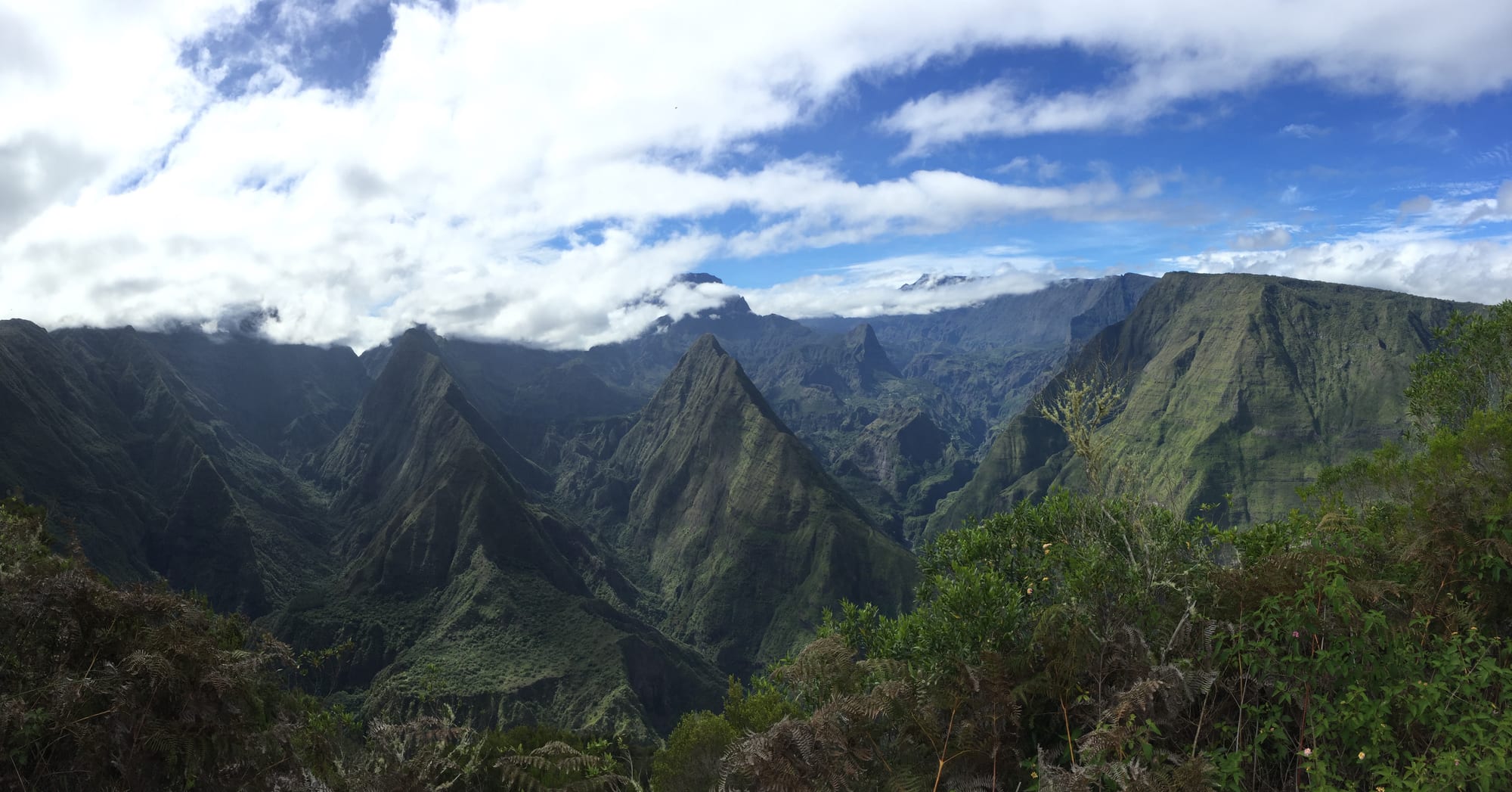
A vast eroded mountain amphitheatre of sharp green ridges and pinnacles falling to a deep valley, cloud drifting through

Réunion

The Cirque de Mafate, a collapsed volcanic caldera on Réunion reachable only on foot or by helicopter, and still home to a few hundred people. (Air miasma / Wikimedia Commons · CC BY-SA 4.0)

A volcanic island in the Indian Ocean east of Madagascar that is an overseas region of France and part of the European Union — dramatically mountainous, with an active volcano and three vast eroded cirques, and a deeply mixed Creole society built entirely by settlement and indenture.

Explore Réunion

History

Réunion had no indigenous population. Arab and European sailors knew the uninhabited island, and France took possession in the 1640s, naming it Île Bourbon. Settlers established coffee and later sugar plantations worked by enslaved people brought from Madagascar, East Africa, and India. Renamed Réunion during the Revolution, it was briefly held by Britain in the Napoleonic Wars.

Slavery was abolished in 1848 — commemorated on 20 December as "Fèt Kaf" — and the plantations then recruited indentured labourers, overwhelmingly Tamil-speaking Hindus from South India (the Malbars), along with Muslims from Gujarat (the Zarabes) and Chinese traders, adding the strands that make up Réunion's population today.

In 1946 Réunion became an overseas department of France, later part of the European Union, with French law, the euro, and social benefits. State transfers and EU funds transformed infrastructure and living standards, but structural unemployment — especially among the young — remains very high, and the cost of living and inequality have driven periodic protest, including major road blockades in 2018–19.

  • Réunion: The Island France Built From Scratch An uninhabited volcanic island in the Indian Ocean, settled by France in the 17th century — a slave-and-sugar colony that became, in 1946, a full department of the French Republic, 9,000 kilometres from Paris

Culture & Customs

Réunion is a genuinely creolised society, often held up as a model of vivre ensemble: within a single extended family there may be Catholic, Hindu, Muslim, and Chinese-temple traditions, and the calendar accommodates all of them, from the Tamil fire-walking ceremonies and Dipavali to Guan Di celebrations, Eid, and the Catholic saints' days.

The music is maloya — the drum-and-chant music created by enslaved workers, long suppressed, now a proud symbol and a UNESCO-listed heritage — alongside the lighter séga. Creole is spoken everywhere informally, French in official life, and there is ongoing debate about the language's place in schools and public life.

Hiking is close to a national pastime, with a dense network of trails and mountain gîtes, and the island's calendar peaks with the Grand Raid, a brutal ultramarathon across the cirques. Family, the Sunday pique-nique under the varangue or by the lagoon, and the kabar (a maloya gathering) organise social life.

Daily Life

About 870,000 people live in Réunion, the most populous French overseas territory, concentrated on the coastal plain around Saint-Denis in the north and Saint-Pierre in the south; the interior cirques hold only small, dispersed populations. The population is young and still growing, unlike the Antilles.

The economy rests on the public sector, tourism, EU and state transfers, and agriculture — sugar cane and rum, along with the island's prized geranium and vetiver essential oils, vanilla, and lentils from Cilaos. Unemployment is around a fifth of the workforce and much higher among the young, and many Réunionnais move to mainland France for work and study.

Daily life is French in framework and Creole in texture, lived between the busy, hot coast and the cool, green mountains behind it, and shaped by the cyclone season and the shark ban on the sea.

Food

Réunionnais cooking is Creole with African, Indian, Chinese, and French threads. The everyday meal is a cari (curry) — chicken, pork, fish, or octopus (cari zourite) — served with rice, grains (lentils or beans), rougail (a fresh or cooked tomato-and-chilli relish), and a fiery chilli paste (piment). Rougail saucisses (smoked sausages in tomato) and cari poulet are the classics.

Achards (pickled vegetables), samoussas and bonbons piment (chilli fritters) as snacks, gratin de chouchou (chayote), and civet de cerf (venison stew) show the range, and bouchons (steamed pork dumplings) and fried noodles reflect the Chinese heritage. Cilaos lentils and the local palmiste heart of palm are speciality ingredients.

Rum is the island spirit, drunk as a rhum arrangé — infused for months with fruit, spices, or vanilla. Dodo, the local lager, sirop de fraise, and strong coffee (Bourbon pointu, a rare varietal, has been revived) are the other drinks.

Attractions & Natural Wonders

The Piton de la Fournaise, one of the world's most active volcanoes, sits inside a huge caldera reached across the Plaine des Sables, a red, lunar expanse; when it is quiet the crater can be hiked, and when it erupts — effusively and often without danger to visitors — the lava flows are watched from viewpoints.

The three cirques are the island's other great landscape, all part of the "Pitons, cirques and remparts" UNESCO World Heritage Site. Cilaos, reached by a famously twisting mountain road, has thermal baths, lentils, wine, and hiking to the Piton des Neiges, the highest point in the Indian Ocean at 3,071 metres. Salazie is greener and wetter, with waterfalls including the Voile de la Mariée and the pretty village of Hell-Bourg. Mafate has no road at all — its scattered hamlets are supplied by helicopter and reached only on foot, making it a bucket-list multi-day trek.

Elsewhere, the Trou de Fer is a rainforest canyon of stacked waterfalls best seen by helicopter; the west coast has the calm, reef-protected lagoon beaches of L'Hermitage, Saint-Gilles, and Saint-Leu (the only safe swimming on the island) plus surf breaks and the Kélonia turtle centre; and the Maïdo viewpoint looks straight down into Mafate at dawn.

  • Réunion: Six Attractions and Natural Wonders One of the most active volcanoes on earth, three vast eroded amphitheatres ringed by sheer cliffs, and a waterfall plunging hundreds of metres into a gorge reachable only by helicopter or serious multi-day trek

Planning basics

Budget

Réunion has French prices in the Indian Ocean, with much imported. There are gîtes de montagne and family-run guesthouses (chambres d'hôtes) that keep hiking trips affordable, alongside hotels on the west coast. A hire car is close to essential outside the coastal towns.

Daily Budget Midrange
EUR 130–260 (hotel or good guesthouse, restaurants, car hire, a helicopter flight or canyoning trip)
Daily Budget Shoestring
EUR 55–90 (gîte or chambre d'hôtes with half board, picnic lunches, shared or economy car)

Book mountain gîtes in Mafate and on the Piton des Neiges trail weeks ahead, take half board where offered, and hire a car for everything outside the west-coast strip.

Visa Requirements

Réunion is part of France but not part of the Schengen Area, so a Schengen visa is not automatically valid. Citizens of the EU, UK, US, Canada, Australia, and many others enter visa-free with a passport; those who need a visa require a French visa endorsed for the overseas departments.

Typical Stay
90 days visa-free for most Western passports; separate from Schengen

If you need a French visa, ensure it is valid for the overseas departments; EU citizens can also use a national ID card.

Safety

Réunion is generally safe, with petty theft, vehicle break-ins, and some social unrest (as in the 2018–19 "yellow vest" blockades) the main issues. The serious hazards are natural: cyclones, flash floods and landslides on mountain roads, and — crucially — shark attacks, which led to a ban on swimming and surfing outside the west-coast lagoon and supervised areas along much of the coast.

Health
Dengue and chikungunya circulate, with significant outbreaks in recent years — use repellent; tap water is drinkable in most towns; the volcano and mountain trails have real exposure and rockfall risk

Only swim and surf inside the lagoon or in supervised, netted areas because of the shark risk, check weather and trail conditions before hikes, use insect repellent, and follow volcano-access rules during eruptions.

Climate

Tropical, strongly shaped by altitude and aspect. The coast is warm to hot year-round; the mountains are cool, and the Piton des Neiges summit can get frost. A hot, wet, cyclone-prone season runs November to April; May to October is drier, cooler, and the main hiking season. The east (windward) side is far wetter than the west.

Dry Season
May–October (best for hiking)
Wet Season
November–April (cyclone risk)

Transportation

Roland Garros Airport near Saint-Denis has flights from Paris, Mauritius, Madagascar, and elsewhere in the region. A coastal ring road and a new offshore highway link the main towns; a hire car is the standard way around. Buses (Car Jaune) circle the island slowly, and the cirques are reached by mountain roads to Cilaos and Salazie or on foot to Mafate.

Hire a car for the coast and the roads into Cilaos and Salazie; for Mafate, plan a multi-day walk with gîte bookings, or take a scenic helicopter flight.

Best Time to Visit

May to November, the cooler dry season, is best for hiking the cirques and the volcano and for the west-coast beaches, with September–October ideal. Humpback whales pass the coast between about June and September. Avoid the January–March cyclone peak.

Events
The Grand Raid (Diagonale des Fous) ultra-trail across the island (October); the Fête du Vacoa and Cilaos lentil festival; Dipavali (Diwali) in Saint-André; the December abolition commemoration (20 December, 'Fèt Kaf')

Currency

The currency is the euro. Cards are widely accepted, including in mountain guesthouses; carry some cash for markets, small shops, and picnic-stop snacks.

Symbol
Currency Code
EUR — euro

Language

French is the official language, used in administration, schooling, and media. Réunion Creole, a French-based creole, is the everyday language of most islanders. English is limited outside tourism.

Everyday Language
Réunion Creole
Official Language
French