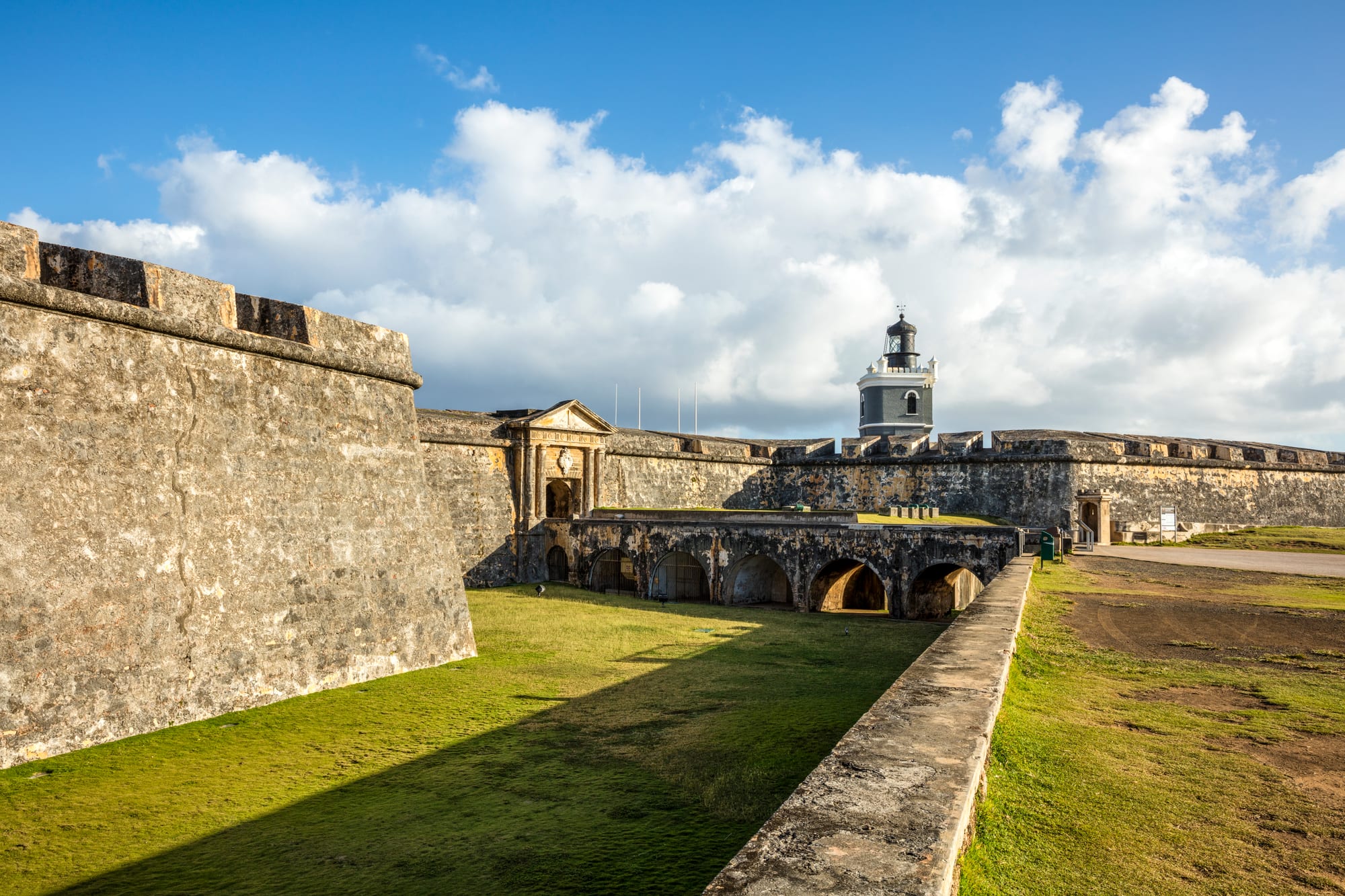
A low, thick-walled stone fortress with a lighthouse on a green headland, waves breaking on the rocks below

Puerto Rico

Castillo San Felipe del Morro guarding the entrance to San Juan Bay — part of the Spanish colonial fortifications of Old San Juan, a UNESCO World Heritage Site. (Godot13 / Wikimedia Commons · CC BY-SA 4.0)

A Caribbean island that is an unincorporated territory of the United States — a "Commonwealth" whose 3.2 million people are US citizens but cannot vote for president, shaped by four centuries of Spain and more than a century of America, and still recovering from Hurricane Maria and a long debt crisis.

Explore Puerto Rico

History

The island the Taíno called Borikén — the source of "Boricua", still used with pride — was colonised by Spain after Ponce de León's settlement in 1508. San Juan became one of Spain's most heavily fortified strongholds, its walls and the castles of El Morro and San Cristóbal built to hold the gateway to the Caribbean against the English, Dutch, and French; the historic core is now a UNESCO World Heritage Site. Sugar, coffee, and tobacco estates were worked by enslaved Africans until abolition in 1873, and Spain granted the island a brief autonomy in 1897.

In 1898 the United States took Puerto Rico from Spain in the Spanish-American War. Congress made Puerto Ricans US citizens in 1917, and in 1952 the island adopted its current status as a "Commonwealth" (Estado Libre Asociado), with its own constitution and elected governor but ultimate authority resting with Washington. Residents of the island vote in party primaries but not in the presidential election, and send only a non-voting delegate to Congress. Mid-century industrialisation under "Operation Bootstrap" pulled people from farms to factories and, in huge numbers, to the US mainland.

Since 2006 the economy has been in a long slump. A debt crisis of more than seventy billion dollars led Congress in 2016 to impose a federal oversight board and a restructuring process under the PROMESA law, deeply resented locally. In September 2017 Hurricane Maria devastated the island, causing an estimated several thousand excess deaths and destroying the electricity grid, with some areas left without power for months. Mass protests in 2019 ("el Verano del 19") forced out the governor over a leaked chat, and the grid — now run by a privatised operator — continues to fail, with island-wide blackouts as recently as 2024 and 2025. The status question — statehood, independence, or the current arrangement — remains unresolved despite repeated nonbinding plebiscites.

  • Puerto Rico: The Unincorporated Island A Spanish stronghold for four centuries and a US possession since 1898 — a Caribbean society whose people are American citizens but cannot vote for president, and who have never settled the question of what their island should be

Culture & Customs

Puerto Rican culture is a blend of Taíno, Spanish, and African roots, and it is carried above all through music. Salsa was codified by Puerto Rican and Nuyorican musicians; bomba and plena are the older Afro-Puerto Rican drum-and-song forms; and reggaeton was born on the island and has, through artists from Daddy Yankee to Bad Bunny, become one of the world's dominant pop genres, with Bad Bunny also a prominent advocate for the island.

Family is central, and the extended clan gathers for Sunday meals, fiestas patronales (each town's patron-saint festival), and the long Christmas season of parrandas — surprise musical house visits — that runs well past New Year. Catholicism remains the largest faith, with fast-growing Evangelical churches and enduring Afro-Caribbean spiritual practice.

Islanders move fluidly between Puerto Rico and mainland communities in Florida, New York, and elsewhere — more people of Puerto Rican origin now live on the mainland than on the island — and questions of identity, status, language, and the diaspora are constant themes in politics and the arts.

Daily Life

About 3.2 million people live in Puerto Rico, a number that has fallen sharply since 2006 through emigration accelerated by the recession and Maria. The San Juan metropolitan area holds roughly a third of the population; Ponce, Mayagüez, and Caguas are the other main cities, and the central mountains are rural and thinly populated.

The economy runs on pharmaceuticals and medical-device manufacturing (helped by past tax incentives), tourism, services, agriculture (coffee, plantains, dairy), and federal transfers. Puerto Ricans pay federal payroll taxes but generally not federal income tax on island income. Unemployment and poverty rates are well above any US state, the grid is unreliable, and the recovery from Maria and the debt crisis has been slow and contested.

Daily life is bilingual in signage but Spanish in substance, car-dependent outside San Juan, and shaped by the heat, the beach, the family, and the ever-present possibility of a blackout or a storm.

Food

Puerto Rican cooking — cocina criolla — starts with sofrito, a purée of peppers, onion, garlic, culantro, and ají dulce, and adobo seasoning. Mofongo — fried green plantain mashed with garlic and pork crackling, often mounded around shrimp or stewed meat — is the dish most associated with the island. Arroz con gandules (rice with pigeon peas) served with pernil (slow -roast pork shoulder) is the classic holiday plate.

Lechón asado, a whole pig roasted on a spit, is the speciality of the mountain road at Guavate (the "Ruta del Lechón"), and the beach kioskos of Luquillo and Piñones sell alcapurrias, bacalaítos, and pastelillos — a run of fritters — alongside cold medalla beer. Tostones and sweet amarillos (fried plantain), sancocho stew, and, at Christmas, pasteles wrapped in banana leaf round out the table.

Puerto Rico grows fine highland coffee, especially around Yauco. The piña colada is claimed to have been invented in San Juan; pitorro (home-distilled rum) appears at Christmas; and the island is the home of Bacardí, whose enormous distillery across the bay from Old San Juan runs public tours.

Attractions & Natural Wonders

Old San Juan is the centrepiece: the two great Spanish forts, El Morro and San Cristóbal, the city walls and the San Juan Gate, the blue cobblestones and pastel houses, La Fortaleza (the governor's residence), and the cathedral where Ponce de León is entombed. Beyond the walls, the Santurce and Río Piedras districts have the art and food scenes, and Condado and Isla Verde the beach hotels.

El Yunque National Forest, in the northeast mountains, is the only tropical rainforest in the US National Forest System, with waterfalls, pools, and lookout towers on well-made trails. The island's three bioluminescent bays — Mosquito Bay on Vieques, reckoned the brightest in the world, plus Laguna Grande at Fajardo and La Parguera in the southwest — glow blue when the water is disturbed on a dark night.

The offshore islands of Vieques and Culebra have the finest beaches, including Culebra's Flamenco Beach; the west coast around Rincón is surf-and-sunset country with winter humpback whales; and the south has the historic city of Ponce, the Camuy river caves, the salt flats and pink-tinged beach of Cabo Rojo, and the Arecibo site where the great radio telescope stood until its collapse in 2020.

  • Puerto Rico: Ten Attractions and Natural Wonders A 16th-century fortress guarding a colourful colonial old town, a bay that glows electric blue when disturbed at night, and rainforest cool enough to escape the tropical heat within the US National Forest system

Planning basics

Budget

Puerto Rico is priced like the mainland US, with sales tax added at the register and tipping of around 18–20 per cent expected in restaurants. San Juan hotels and the resorts are the big costs; guesthouses, the roadside kioskos and lechoneras, and public beaches keep a trip affordable. A rental car is close to essential outside San Juan.

Daily Budget Midrange
USD 180–380 (hotel, restaurants with tax and tips, rental car and fuel, tours and bio-bay trips)
Daily Budget Shoestring
USD 70–120 (guesthouse or hostel, kiosko and food-truck meals, rental car shared)

Eat at the kioskos of Luquillo and Piñones and the lechoneras of Guavate, and rent a car to reach the rainforest, the west coast, and the bio bays.

Visa Requirements

Puerto Rico is US territory, so US entry rules apply. Travellers arriving from abroad need the same authorisation as for the mainland US — ESTA under the Visa Waiver Program for eligible nationalities, or a US visa otherwise. There are no immigration formalities on flights from the US mainland.

Typical Stay
As for the US: 90 days on ESTA (Visa Waiver Program), or a US visa

Apply for ESTA (or a US visa) before travelling from abroad; flights from the mainland are treated as domestic.

Safety

Puerto Rico has a higher violent-crime rate than most US states, but it is concentrated in specific areas and largely tied to the drug trade; tourists are rarely the target. Everyday risks are petty theft and car break-ins, rip currents and rough surf on north- and west-coast beaches, and the island's fragile power grid, which suffers frequent outages and occasional island-wide blackouts.

Health
Tap water is generally safe in cities; dengue occurs; strong currents on many beaches; bring a torch and be ready for power cuts

Avoid unfamiliar urban areas at night, don't leave valuables in cars, check beach conditions and swim near lifeguards, and keep a charged power bank for outages.

Climate

Tropical, warm and humid year-round, around 28–31°C on the coast and cooler in the central mountains. The drier season runs roughly December to April; the wetter months are May to November, overlapping the Atlantic hurricane season. El Yunque, the rainforest, is wet all year.

Dry Season
December–April
Wet Season
May–November (hurricane season)

Transportation

Luis Muñoz Marín International Airport in San Juan is the main gateway, with Aguadilla and Ponce also served, and small planes and ferries to Vieques and Culebra. There is no useful passenger rail beyond San Juan's short Tren Urbano; a rental car is the standard way to get around, with taxis, públicos (shared vans), and ride-hailing in the metro area.

Rent a car for anything beyond San Juan; book the Vieques and Culebra ferry or flights ahead, especially on weekends.

Best Time to Visit

December to April has the best weather and is the peak season, busiest and priciest around the winter holidays and the mid-January Fiestas de la Calle San Sebastián. May and November are quieter. Hurricane risk peaks August to October, and the bioluminescent bays glow brightest around the new moon.

Events
Fiestas de la Calle San Sebastián, Old San Juan (mid-January); Carnaval de Ponce (Feb/Mar); Noche de San Juan (23 June, beach bonfires and backward dips in the sea); the island's fiestas patronales town by town; Christmas parrandas running into January

Currency

The currency is the US dollar. Cards and mobile payment are accepted almost everywhere; carry small bills for kioskos, piraguas (shaved-ice carts), and tips.

Symbol
$
Currency Code
USD — United States dollar

Language

Spanish and English are both official, but Spanish is overwhelmingly the language of daily life, government, and schooling, spoken in a distinctive Puerto Rican variety. English is taught throughout school and widely understood in San Juan and tourist areas, less so in the interior and among older people.

Also Official
English (widely understood in tourism)
Everyday Language
Spanish