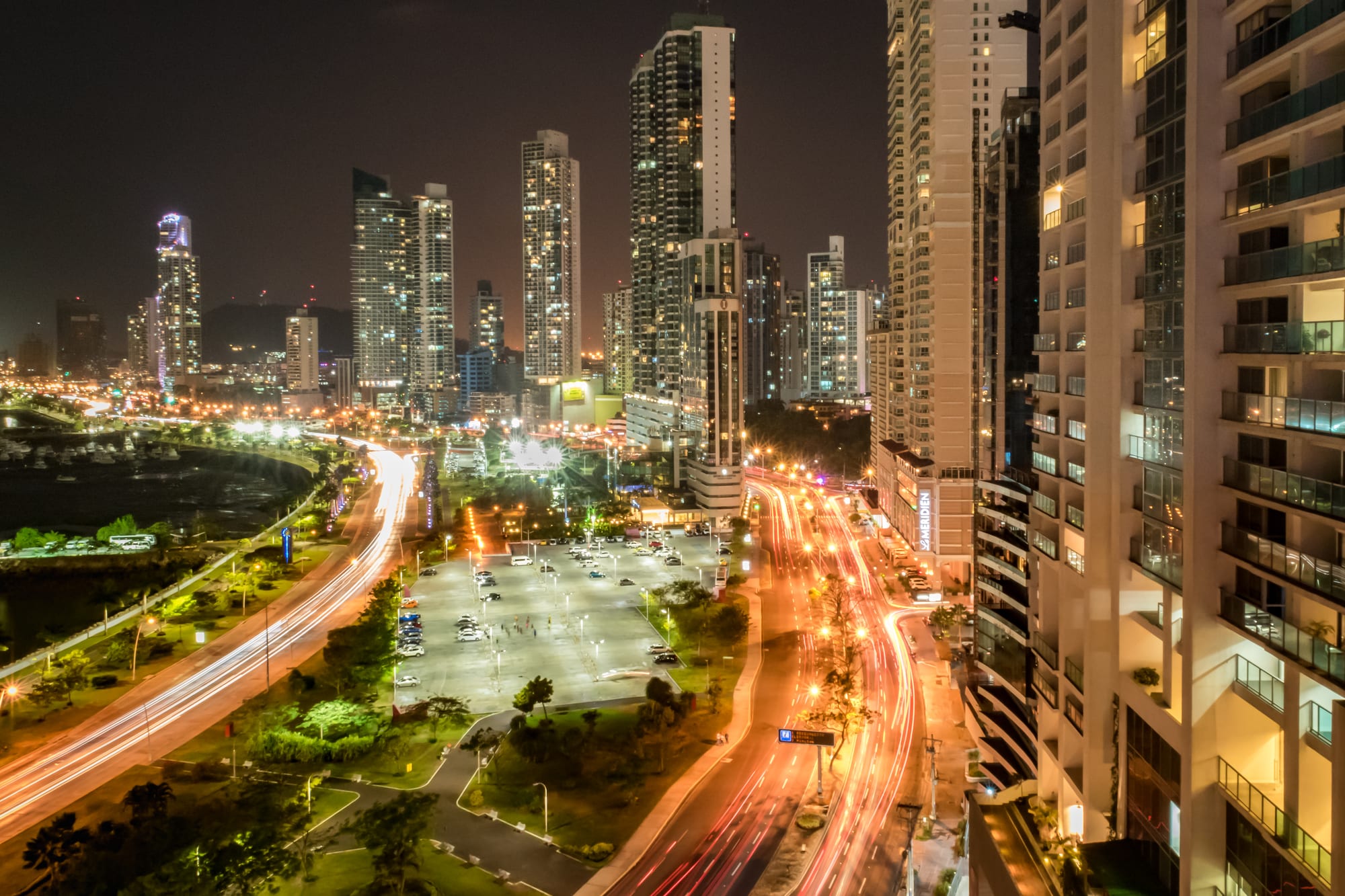
A dense cluster of glass high-rise towers on a curving tropical coastline, green hills and open Pacific water beyond

Panama

The skyline of Panama City on the Pacific coast, the financial and services hub of a fast-growing, dollarised economy. (dronepicr / Wikimedia Commons · CC BY 3.0)

The narrow isthmus joining Central and South America, cut through by the canal that links the Atlantic and Pacific — a US-backed breakaway from Colombia in 1903, now a fast-growing, dollarised services economy with a Miami-like capital skyline.

Explore Panama

History

The isthmus was a crossing point long before the canal. Balboa reached the Pacific across it in 1513, and Panama City, founded in 1519, became the funnel through which Peruvian silver flowed to Spain, drawing pirate raids and Henry Morgan's 1671 sacking of the city. Panama won independence from Spain in 1821 as part of Gran Colombia, then remained a province of Colombia. Its transit value only grew — a US-built railway for the 1849 Gold Rush, then a French attempt at a canal in the 1880s that collapsed into bankruptcy, scandal, and the deaths of some 22,000 workers from disease.

In 1903, backed by US warships, Panama seceded from Colombia, and a treaty handed the United States a perpetual Canal Zone. The Americans built the canal between 1904 and 1914, a feat of engineering and of mosquito control, and the Zone spent the next decades as a US enclave splitting the country — a running nationalist grievance that turned deadly in the 1964 Flag Riots.

Military rule came in 1968, first under the populist Omar Torrijos, who negotiated the 1977 treaties to return the canal, then under the dictator Manuel Noriega, a former CIA asset turned drug-trafficking pariah, removed by a US invasion in December 1989 that killed hundreds and burned a Panama City neighbourhood. Democracy has held since 1990; the canal was handed to Panama on the last day of 1999 and has been run efficiently and profitably ever since, with a major expansion opening in 2016. Recent strains include the 2016 Panama Papers scandal, 2023 protests that forced a giant copper mine to close, a drought-hit canal, a migration surge through the Darién Gap, and public pressure from a US president demanding the canal back.

  • Panama: The Isthmus and the Canal A narrow neck of land between two oceans — a Spanish crossing point for Peruvian silver, a province of Colombia, a country created in 1903 so the United States could build a canal, and a nation that spent a century getting the canal back

Culture & Customs

Panama's culture blends Spanish-colonial, Afro-Caribbean, Afro-colonial, Indigenous, and North American strands. The Afro-colonial Congo tradition of the Caribbean coast — drumming, dance, and devil masks re-enacting resistance to slavery — is on UNESCO's heritage list, as is the pollera, the elaborate embroidered national dress worn at Carnival and the festival of Las Tablas.

Music runs from accordion-driven típico folk to the brass of Carnival and, in the cities, reggaeton and Spanish-language reggae, which Panama helped invent. Baseball is the traditional national sport, with many major-league players, though football has gained ground since the team's first World Cup in 2018. The Guna of Guna Yala are known for their mola appliqué textiles and for running one of the most autonomous Indigenous territories in the Americas.

Family, Catholicism with a growing evangelical minority, and a relaxed, Caribbean-tinged pace shape daily life, alongside the outsized influence of the canal and a century of US presence.

Daily Life

Panama City, a fast-grown skyline of glass towers on the Pacific bay, holds close to half the country's people and most of its money — banking, the canal, the Colón Free Zone across the isthmus, logistics, and a construction boom served by a modern metro. The interior — the cattle country of the Azuero peninsula, the coffee highlands of Chiriquí, the Caribbean coast — is far poorer and more traditional, and the Indigenous comarcas poorer still.

The economy has been among Latin America's fastest-growing for two decades on the strength of the canal, finance, trade, and, until 2023, copper, but inequality is high and many workers are informal. The country runs on the US dollar and uses North American brands and habits heavily.

Two pressures now define the national conversation: a canal short of the freshwater it needs after recent droughts, and the roadless Darién jungle that has become a migration corridor toward the United States.

Food

Panamanian home cooking is simple and starchy, built on rice, beans, plantain, and maize. Sancocho, a chicken, yam, and culantro soup, is the comfort dish; arroz con pollo and stewed beans are everyday staples; and fried things abound — hojaldras at breakfast, carimañolas stuffed with meat, empanadas, and twice-fried patacones.

The Caribbean coast adds coconut, in coconut rice and the seafood stew rondón, while ceviche of corvina is a Pacific favourite, sold by the cup at the Panama City fish market. Street and festival food includes raspao shaved ice and the sweet corn drink chicheme.

Panama also grows some of the world's most prized coffee — the Geisha variety from Boquete sets auction records — and the local beers are Balboa, Atlas, and Panamá.

  • Panama: Food and the National Dish A hearty chicken and root vegetable soup from a country whose canal-side geography brings Caribbean and Pacific cooking to the same table

Attractions & Natural Wonders

The canal is the headline: ships can be watched rising and falling at the Miraflores and Agua Clara visitor centres, or you can transit part of it on a tour boat. Panama City pairs the restored colonial quarter of Casco Viejo — plazas, churches, rooftop bars, and the ruins of the older Panamá Viejo across the bay — with a Miami-like financial district and the Amador Causeway, built from canal spoil.

Inland, the Chiriquí highlands around Boquete offer coffee farms, cloud-forest birding, hot springs, whitewater, and the pre-dawn climb of Volcán Barú, the country's highest point, from which both oceans can be seen on a clear day.

The Caribbean side has the laid-back Bocas del Toro archipelago of over-water cabins and reefs, and the Spanish silver-era forts of Portobelo and San Lorenzo. Guna Yala (San Blas) is a string of hundreds of tiny palm islands run by the Guna, and Coiba, a former prison island turned national park, protects some of the richest marine life in the eastern Pacific.

  • Panama: Ten Attractions and Natural Wonders A canal that reshaped global trade, a Caribbean archipelago of hundreds of islands governed by its own Indigenous nation, and a colonial old town wedged between a modern skyline and the sea

Planning basics

Budget

Panama is mid-priced for Latin America and dollarised, so nothing feels cheap by regional standards. Panama City has hostels and boutique hotels; Bocas del Toro and Boquete run from backpacker to upmarket. San Blas island stays and canal tours are the notable added costs.

Daily Budget Midrange
USD 90–200 (mid-range hotel, restaurants, domestic flights or a hire car, tours)
Daily Budget Shoestring
USD 40–70 (hostel, local fondas, buses and the metro)

Eat the set-lunch menú del día at local fondas, use the metro and Uber in the capital, and book San Blas trips through a reputable operator.

Visa Requirements

Citizens of the EU, the UK, the US, Canada, Australia, New Zealand, and many other countries can enter visa-free for 90 to 180 days. Proof of onward travel and of sufficient funds may be requested. A yellow-fever certificate is needed if arriving from an endemic country and is recommended for the Darién.

Typical Stay
90–180 days visa-free for most Western passports

Safety

Panama is one of the safer countries in Central America, and the main tourist areas are generally fine with normal precautions. But armed robbery, muggings, and "express kidnapping" occur in parts of Panama City, and Colón city has a poor reputation. The Darién Gap and the Colombia border region are dangerous — drug trafficking, armed groups, and the migrant route — and independent travel there is strongly advised against.

Health
Dengue is widespread; malaria and yellow fever are risks in the Darién and along the Caribbean coast

Avoid walking in unfamiliar city neighbourhoods after dark, don't flash valuables, heed beach rip-current flags, and do not attempt the Darién Gap overland.

Climate

Tropical, with a dry season roughly from mid-December to April — sunny, breezy, and the peak travel time — and a wet season the rest of the year, with heavy afternoon rain. The lowlands are hot and humid all year; the Caribbean side is wetter than the Pacific; and the Chiriquí highlands around Boquete are cool and spring-like. Panama lies outside the hurricane belt.

Lowlands
26–32°C year-round, humid
Highlands
Boquete and Cerro Punta, cool and misty, 10–24°C

Transportation

Tocumen International in Panama City is a major regional hub. Domestic flights serve David, Bocas del Toro, and the islands. The Pan-American Highway runs the length of the country and then stops at the roadless Darién Gap. Buses from Panama City's Albrook terminal are cheap and frequent, and the capital has a modern metro and the scenic Panama Canal Railway to Colón.

Use Uber or registered taxis in Panama City, treat Colón as a place to pass through, and reach San Blas by a 4x4-and-boat transfer or a light plane.

Best Time to Visit

Mid-December to April, the dry season, is best for beaches, hiking, and the islands. Humpback whales pass the Pacific coast from July to October, and Carnival, in the four days before Ash Wednesday, is a major event, especially in Las Tablas on the Azuero peninsula.

Events
Carnival (Feb–March); Independence celebrations across November; the Corpus Christi devil dances in Villa de Los Santos

Currency

Panama uses the US dollar as paper currency; its own coins, called balboas, are the same size and value as US coins. Cards are widely accepted in the cities and tourist areas; carry cash for buses, fondas, and the islands.

Symbol
$ / B/.
Currency Code
USD (local coins called the balboa)

Language

Spanish is the official language and the mother tongue of the great majority. English is widely spoken in Panama City business and tourism and along parts of the Caribbean coast, where an English-based Creole is spoken by the Afro-Antillean community descended from West Indian canal workers. Indigenous languages including Ngäbere and Guna are spoken in the comarcas.

Also Spoken
English and Caribbean Creole on the coast; Ngäbere, Guna and other Indigenous languages
Official Language
Spanish