A sheer grey rock peak shaped like a sail rising above green slopes and boulders, with blue fjords on either side and sunlit clouds overhead

Norway

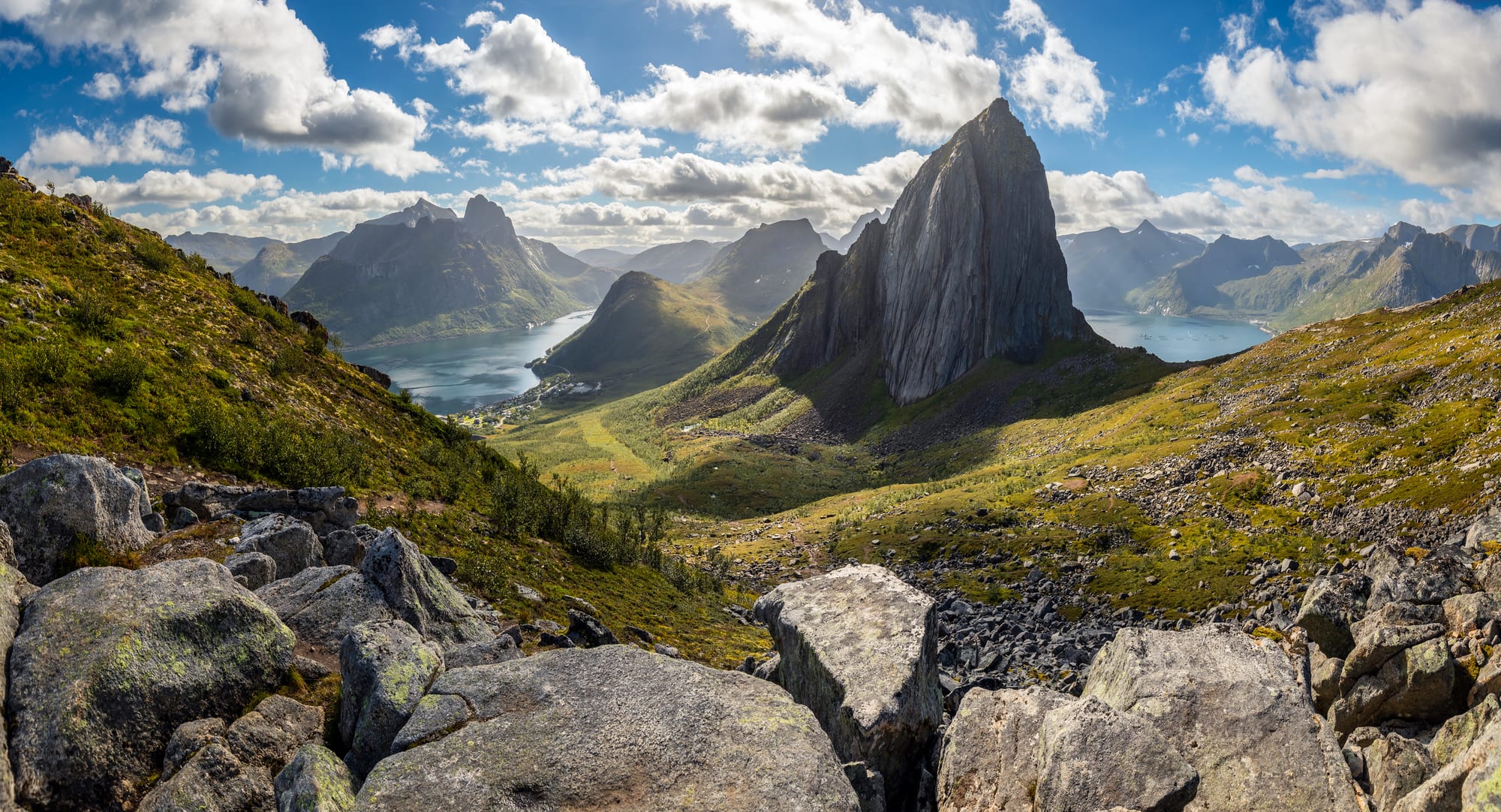
The peak of Segla seen from the ridge at Hesten on Senja, with Ørnfjorden on the left and Mefjorden on the right. (Ximonic (Simo Räsänen) / Wikimedia Commons · CC BY-SA 4.0)

A long, mountainous country down the Atlantic edge of Scandinavia, cut by fjords and reaching far into the Arctic — a former junior partner of Denmark and Sweden that struck oil in 1969 and turned the wealth into the world's largest sovereign fund.

Explore Norway

History

Norway was a heartland of the Viking Age, its seafarers raiding, trading, and settling across the North Atlantic from Ireland to Newfoundland between the eighth and eleventh centuries. Harald Fairhair is traditionally credited with unifying the kingdom around 872, and Christianity took hold under Olaf II, killed at Stiklestad in 1030 and made the country's patron saint. The Black Death of 1349 gutted the medieval kingdom, and from 1397 Norway became the junior partner in a union dominated first by Denmark for some four centuries.

At the end of the Napoleonic Wars in 1814, Denmark ceded Norway to Sweden. Norwegians seized the moment to write a liberal constitution at Eidsvoll on 17 May — still the national day — but were forced into a looser union with Sweden that lasted until it was peacefully dissolved in 1905, when Norway chose a Danish prince as King Haakon VII.

Germany invaded neutral Norway in April 1940; the king and government led resistance from exile in London while the collaborator Vidkun Quisling ran a puppet regime and the retreating Germans burned the far north. After the war Norway helped found NATO and built a Nordic welfare state. The 1969 discovery of North Sea oil transformed it: the state took the bulk of the revenue and channelled the surplus into what is now the world's largest sovereign wealth fund, making Norway one of the richest and most equal countries. In 2011 a far-right terrorist killed 77 people, most of them teenagers at a Labour Party youth camp, in the country's worst peacetime atrocity.

  • Norway: The Long Country A coastline of fjords that launched the Viking age — four centuries under Denmark, a union with Sweden, independence in 1905, wartime occupation, and an oil fund that made a small nation one of the world's richest

Culture & Customs

At the centre of Norwegian life is friluftsliv, "open-air life" — an almost moral value placed on hiking, skiing, foraging, and cabin weekends, underpinned by the legal right to roam and camp on uncultivated land. Cross-country skiing is close to national identity, and Norway wins Winter Olympic medals out of all proportion to its size.

Social norms lean egalitarian and understated. The "Law of Jante" frowns on thinking yourself better than others; hierarchies are flat, first names are universal, social trust is very high, and reserve thaws slowly. Dugnad, communal volunteer work, keeps sports clubs and housing blocks running, and 17 May is a day of children's parades, marching bands, and national costume, with no military display.

Culturally Norway punches hard: Ibsen and modern drama, the novelists Hamsun and Undset and today's Scandi-noir, Munch and "The Scream", Grieg's music, and the "Slow TV" experiments that broadcast a train journey or a coastal voyage in real time. The country still commercially hunts minke whales, an international controversy that stirs little debate at home.

Daily Life

Most Norwegians live along the coast and in the milder southeast, with about a quarter in the Oslo region and the rest in Bergen, Trondheim, Stavanger, Tromsø, and the towns. Wages and prices are both high; alcohol is sold through a state monopoly and taxed heavily, as are cars and sugar.

Public services are generous — long shared parental leave, subsidised childcare, five weeks' holiday, strong unions — and the hytte, the holiday cabin, is a national institution, with weekends and holidays given over to "going to the cabin". Electricity is almost entirely hydropower, and Norway now leads the world in electric cars, which make up the large majority of new sales.

The country's contradictions are live political issues: Western Europe's biggest oil and gas supplier trying to hold a climate-leader image, a debate over opening the Arctic seabed to mining, and rows over electricity prices and the cables that link cheap Norwegian power to a more expensive European market. In the north, the Indigenous Sámi have their own parliament and a recent official reckoning with a long assimilation policy.

Food

Norwegian food is the food of the sea. Salmon — Norway is by far the world's largest producer — cod fresh in winter or dried as stockfish in a trade older than the nation, herring, trout, king crab, and shrimp are the foundation, in dishes from creamy Bergen fish soup to simple boiled cod. Lamb and mutton give the official national dish, fårikål (mutton and cabbage), and the salt-cured, steamed lamb ribs of a west-coast Christmas.

Brown cheese — a sweet, caramel-coloured whey cheese sliced thin with a cheese slicer — goes on bread and on heart-shaped waffles served with jam and sour cream. Lefse flatbread, sour-cream porridge, and, in the north, cloudberries with cream are traditional treats.

Aquavit, a caraway spirit aged in oak, is the classic partner to heavy festive food, and Oslo has become an unlikely fine-dining capital, home to the three-Michelin-star Maaemo and a wider New Nordic movement built on foraging and fermentation. Coffee is drunk in enormous quantities.

  • Norway: Food and the National Dish Mutton and cabbage simmered together in one pot, in a country whose long coastline supplies some of the world's most exported salmon

Attractions & Natural Wonders

The western fjords are the signature. Geirangerfjord and Nærøyfjord are on the World Heritage list; the Sognefjord is the longest and deepest, reached by the spectacular Flåm Railway; and the Hardangerfjord, blossoming in spring, lies near the cliff-edge hikes of Trolltunga and Preikestolen. Bergen, the "gateway to the fjords", has the Hanseatic wharf of Bryggen, a fish market, and a funicular up its rainy hills.

Oslo has the Munch Museum, the new National Museum with "The Scream", the Vigeland sculpture park, an opera house you can walk over, and the polar-exploration museums on the Bygdøy peninsula. Trondheim is built around the medieval Nidaros Cathedral, and Stavanger is the base for the Lysefjord hikes and the country's oil museum.

Far to the north, the Lofoten and Vesterålen islands throw jagged peaks straight out of the sea above red fishing cabins and white beaches; Tromsø is a lively Arctic city and a base for whale-watching and the Northern Lights, best seen from September to March. The midnight sun shines north of the Arctic Circle from late May to late July, and the coastal ferry from Bergen to Kirkenes, calling at 34 ports, is billed as the world's most beautiful voyage. Svalbard, at nearly 78°N, offers glaciers, polar bears, and the Global Seed Vault.

  • Norway: Nine Attractions and Natural Wonders Fjords cut a thousand feet deep by ice, a rock ledge hanging over open air, a medieval wharf of leaning timber warehouses, and a sky that turns green and violet through the long Arctic winter

Planning basics

Budget

Norway is one of the most expensive countries in the world. Alcohol, restaurant meals, and transport are the big hits. Self-catering, supermarket food, hostels and campsites, the right-to-roam for wild camping, and rail passes keep costs down; fjord cruises and famous hikes are where money goes.

Daily Budget Midrange
NOK 2,200–4,500 / USD 200–420 (mid-range hotel, restaurants, scenic trains and fjord boats, a hire car)
Daily Budget Shoestring
NOK 800–1,300 / USD 75–120 (hostel or campsite, supermarket food, some trains and buses)

Buy food in supermarkets (Kiwi, Rema 1000), carry a refillable bottle — tap water is excellent — and book scenic trains and the coastal ferry well ahead.

Visa Requirements

Norway is in the Schengen Area (though not the EU). Citizens of the EU/EEA, the UK, the US, Canada, Australia, New Zealand, and many others need no visa for stays of up to 90 days in any 180-day period. Svalbard is visa-free for everyone under treaty, but you transit mainland Norway to reach it.

Typical Stay
90 days in any 180-day period, visa-free, for most Western passports

Safety

Norway has among the lowest crime rates in the world. Pickpocketing in central Oslo and Bergen in summer is the main urban risk. The real hazards are outdoors: fast-changing mountain weather, avalanches, cold-water drowning, and hikers underestimating long, exposed routes such as Trolltunga and Besseggen, where rescue call-outs are frequent. Winter driving, roaming moose and reindeer, and polar bears on Svalbard are the other concerns.

Check the weather and the avalanche forecast (varsom.no) before any mountain trip, respect cold-water and current warnings, carry insurance for costly rescue and treatment, and never leave Svalbard's settlements without a guide and rifle.

Climate

Moderated by the sea and sharply varied. The coast, kept mild for its latitude by the Gulf Stream, is wet and windy — Bergen is among Europe's rainiest cities. The interior and the east are drier, cold in winter and warm in summer. North of the Arctic Circle the sun stays down for weeks around midwinter (the polar night) and up around the clock near midsummer (the midnight sun).

Coast
Mild and wet; Bergen has around 230 rainy days a year
Interior North
Cold winters (−20 to −40°C inland); polar night and midnight sun in the far north

Transportation

Oslo's Gardermoen is the hub, with a dense domestic network — essential given the distances — including tiny Widerøe planes serving the coast and the north. The scenic railways are attractions in themselves: the Bergen Railway, the steep Flåm branch, and the Nordland Railway across the Arctic Circle to Bodø, where the rail network ends. Car ferries are part of the road system in fjord country.

Driving
Good roads with many long tunnels, automatic tolls billed to the plate, strict speed enforcement, and winter tyres required in the mountains from November to April

For the fjords and the National Scenic Routes, a hire car gives the most freedom; otherwise combine trains, buses, and express boats, or take the Hurtigruten coastal ferry.

Best Time to Visit

June to August for the fjords, hiking, the midnight sun, and the coastal voyage, though the west-coast weather is changeable and the famous sites get crowded. May and September are quieter, with blossom in Hardanger or autumn colour on the peaks. Late September to late March is Northern Lights season in the north; February to April is for skiing.

Events
Constitution Day (17 May), with children's parades and national dress; Sankthans midsummer bonfires (23 June); the Sámi Easter festivals in Kautokeino and Karasjok

Currency

The currency is the Norwegian krone (NOK). Norway is close to fully cashless: cards and the Vipps app are used for everything, many places refuse cash, and ATMs are disappearing. A contactless Visa or Mastercard works everywhere.

Symbol
kr
Currency Code
NOK — Norwegian krone

Language

Norwegian is the official language, in two written standards — Bokmål (the majority) and Nynorsk — both official and both taught; people speak their local dialect everywhere. Sámi languages are official in parts of the north, and Kven is a recognised minority language. Almost everyone speaks excellent English, so visitors have no language barrier.

Also Official
Sámi languages in parts of the north
Official Language
Norwegian (Bokmål and Nynorsk)