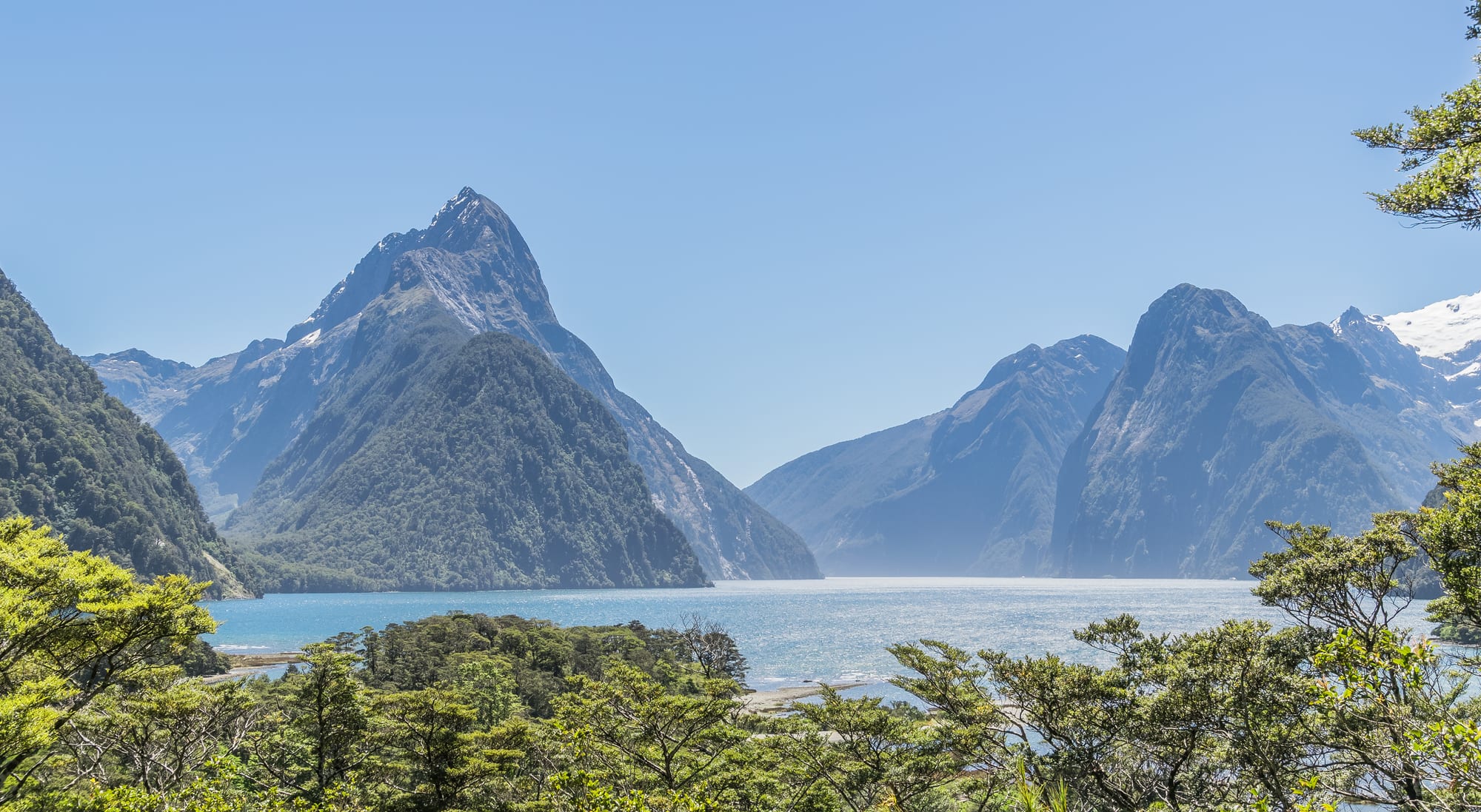
A dark forested fiord walled by sheer mountains, with a pointed peak rising straight from calm water and cloud drifting across the ridges

New Zealand

Milford Sound / Piopiotahi in Fiordland, a glacier-carved inlet on the South Island's remote southwest coast. (Krzysztof Golik / Wikimedia Commons · CC BY-SA 4.0)

A pair of large islands in the southwest Pacific, 2,000 kilometres from any neighbour — one of the last places on Earth settled by humans, a bicultural Māori and European society, and a country of mountains, fiords, volcanoes, and coast out of all proportion to its five million people.

Explore New Zealand

History

New Zealand was among the last large landmasses humans reached. Polynesian navigators, the ancestors of Māori, arrived from East Polynesia around 1250–1300, the final leg of the great Pacific migration, and developed a distinct culture of iwi (tribes) across both islands. The Dutch navigator Abel Tasman sighted the coast in 1642, and James Cook charted it in 1769–70; sealers, whalers, traders, and missionaries followed, bringing muskets and disease.

In 1840 the British Crown and around 540 Māori chiefs signed the Treaty of Waitangi, the country's founding document — but the Māori and English texts differ on the crucial point of whether Māori ceded sovereignty or only a right to govern, a disagreement that remains central to New Zealand politics. Land confiscations and the New Zealand Wars of the 1860s and 70s followed, and from 1975 the Waitangi Tribunal has investigated Crown breaches, driving decades of Treaty settlements.

New Zealand became self-governing from 1856 and effectively independent through the twentieth century. It was the first self-governing country to give women the vote, in 1893, and an early welfare state. Its soldiers fought at Gallipoli in 1915, an event at the core of national memory. Sweeping free-market reforms in the 1980s reshaped the economy, and a 1984 anti-nuclear policy — banning nuclear-armed and nuclear-powered ships — caused a lasting rift with the United States. Recent years have brought the Christchurch earthquakes, the 2019 mosque attacks and swift gun reform, a strict pandemic response, and, since 2023, a centre-right government whose attempt to redefine the Treaty principles drew one of the largest protests in the country's history before being voted down.

  • New Zealand: Two Peoples, One Treaty The last large landmass humans settled — a Māori world of a few centuries, a British colony founded on a contested 1840 treaty, land wars and confiscation, a pioneering welfare democracy, and a long reckoning with what the treaty meant

Culture & Customs

New Zealand's foundation is bicultural — Māori and Pākehā (New Zealanders of European descent) — and increasingly multicultural, with Auckland the largest Polynesian city in the world and fast-growing Asian communities. Māori culture is woven through public life: the haka performed by the All Blacks, the pōwhiri welcome onto a marae, the hongi pressing of noses, carving and weaving, and a language revival that has restored place names and put te reo back into schools and signs.

The Pākehā "Kiwi" identity prizes egalitarianism and a suspicion of anyone who gets above themselves, "number 8 wire" improvisation, understatement, and dry humour. It is bound up with the outdoors: tramping, the beach, the family bach (holiday cottage), and, above all, rugby union, which is close to a national religion. For its size the country produces an outsized crop of writers, musicians, and filmmakers, and it takes its coffee — and its claim to the flat white — seriously.

Dress is casual, first names are the rule, shoes come off indoors, and going barefoot in public is unremarkable. The "OE", a working stint overseas, is a rite of passage, and the steady drift of young New Zealanders to higher wages in Australia is a running national worry.

Daily Life

Despite the wilderness image, New Zealand is highly urban: most people live in Auckland, Wellington, Christchurch, Hamilton, and Tauranga, and the South Island holds only a quarter of the population. Life is car-dependent outside the two biggest cities, suburban house-and-garden living is the norm, and nature is close — most people are within an hour of a beach or a bush walk.

The dominant domestic issue is housing: prices among the least affordable in the developed world have put ownership out of reach for many under-forty New Zealanders. Alongside it sit regional inequality, child poverty, an infrastructure backlog, and a persistent socio-economic gap between Māori and Pasifika New Zealanders and the rest.

The economy is small, open, and still built on the land — dairy (the country is the world's largest dairy exporter), sheep and beef, wine, kiwifruit, and forestry — together with tourism, a substantial film industry, and services. Weather is a constant topic, and so is the tension between the "clean, green" brand and the river pollution that intensive dairying has caused.

Food

New Zealand food has British roots — roasts, fish and chips, the mince pie, the pavlova (disputed with Australia), the lamington — transformed by Pacific and Asian influences and by excellent produce. Lamb and beef, green-lipped mussels, seasonal Bluff oysters and whitebait, crayfish, and farmed salmon are the pick of it, and the Māori hāngī steams meat and vegetables in an earth oven over hot stones.

Kūmara (sweet potato), manuka honey, hokey-pokey ice cream, and the soft drink L&P are national staples, and the café brunch — eggs, sourdough, flat whites — is a weekend institution. Feijoas are the beloved backyard fruit of autumn.

The wines put the country on the world map: Marlborough sauvignon blanc above all, plus Central Otago and Martinborough pinot noir and Hawke's Bay reds and chardonnay. Craft beer has boomed, and farmers' markets are found in most towns.

Attractions & Natural Wonders

The North Island runs from Auckland's harbour and volcanic cones and the sailing grounds of the Bay of Islands — where the Waitangi Treaty Grounds sit — down through the geothermal country of Rotorua, with its geysers, mud pools, and Māori cultural performances, to the volcanoes of Tongariro National Park and the Tongariro Alpine Crossing, one of the world's great day hikes. Wellington, the compact capital, has the Te Papa national museum, a cable car, and the Weta film-effects workshop.

The South Island holds the headline scenery. Milford Sound and Doubtful Sound in Fiordland are glacier-carved inlets walled by waterfalls; Aoraki/Mount Cook National Park has the country's highest peak, the turquoise of Lake Pukaki, and the dark skies of the Mackenzie reserve; and the West Coast pairs the Franz Josef and Fox glaciers with rainforest and the Pancake Rocks at Punakaiki. Queenstown is the adventure capital — bungy jumping was commercialised here — with Wanaka a quieter lakeside alternative and Central Otago's vineyards and rail-trail cycleway nearby.

Abel Tasman National Park has a golden-sand coast track, Kaikōura offers whales and seals on a dramatic shore, and the Otago Peninsula near Dunedin has an albatross colony, penguins, and sea lions. Ten "Great Walks" and film locations from Middle-earth are scattered the length of both islands.

Planning basics

Budget

New Zealand is expensive, and the way most people travel it — a hire car or campervan over long distances — is the main cost, along with adventure activities and the Great Walk huts. Holiday parks, hostels, and self-catering keep accommodation down; eating out adds up quickly.

Daily Budget Midrange
NZD 250–500 / USD 150–300 (motel or B&B, restaurants, a hire car, one or two paid activities)
Daily Budget Shoestring
NZD 90–150 / USD 55–90 (hostel or campground, supermarket food and the odd pie, a share of a car and fuel)

A campervan splits accommodation and transport into one cost; book Great Walk huts and popular activities the day bookings open, months ahead.

Visa Requirements

Citizens of around 60 visa-waiver countries can visit for up to three months (the UK, six) without a visa, but must obtain an NZeTA online before travelling and pay the International Visitor Conservation and Tourism Levy (NZD 100 from October 2024). Australian citizens need neither. Others need a visitor visa in advance.

Typical Stay
3 months (UK: 6 months) visa-free with an NZeTA

Apply for the NZeTA well before you fly — it is not issued at the airport — and keep proof of onward travel and funds.

Safety

New Zealand is one of the safest and least corrupt countries in the world, with low violent crime. The common tourist crime is theft from parked cars at trailheads and scenic stops. The real dangers are environmental: a high rate of visitor drownings and tramping accidents, road crashes, sudden alpine weather, earthquakes and, on the coast, tsunami, and a few active volcanoes. The sun is fierce enough to burn in under 20 minutes.

Check the forecast and sign the intentions book before any hike, respect rip-current and river warnings, carry a locator beacon in the backcountry, and never leave valuables visible in a car.

Climate

Temperate and maritime, and famously changeable — "four seasons in one day" is a real saying. The far north is subtropical and the deep south is cool. Westerly winds soak the western ranges — Fiordland and the West Coast are among the wettest places on Earth — while the eastern regions (Canterbury, Marlborough, Central Otago) are drier and hotter in summer.

Summer
December–February, 20–30°C in most places, variable and windy
Winter
June–August, mild in the north; cold with mountain snow in the south (ski season)

Transportation

Auckland, Christchurch, Wellington, and Queenstown have the main airports, and domestic flights are common given the distances and Cook Strait. The Interislander and Bluebridge ferries link the two main islands (Wellington–Picton), and three scenic trains — the TranzAlpine, Coastal Pacific, and Northern Explorer — are journeys in their own right. Most visitors self-drive.

Driving
On the left, on narrow winding roads with one-lane bridges and few motorways — allow far more time than the distance suggests

Overseas drivers cause a disproportionate share of fatal crashes; don't drive the day you land, take regular breaks, and pull over to let traffic pass.

Best Time to Visit

December to April for beaches, tramping, and the Great Walks, with February to April often the most settled. June to September is the ski season in Queenstown, Wanaka, and on Mount Ruapehu, and Central Otago is crisp and clear. Ex-tropical cyclones can strike the north in summer and autumn.

Events
Waitangi Day (6 February); Anzac Day (25 April); Matariki, the Māori new year (June–July); the World of WearableArt (Wellington, spring)

Currency

The currency is the New Zealand dollar (NZD). Card and contactless payment are near-universal, the local EFTPOS debit network is everywhere, and some businesses are cashless. Tipping is not expected. ATMs are common in towns but sparse in rural areas.

Symbol
$
Currency Code
NZD — New Zealand dollar

Language

English is the everyday language and one of three official languages. Te reo Māori, official since 1987, is in strong revival — bilingual signs and place names, Māori-medium schooling, and everyday words such as kia ora and whānau — and the country is increasingly called Aotearoa New Zealand. New Zealand Sign Language is the third official language; Samoan is the most spoken after English and Māori.

Everyday Language
English
Official Languages
English, te reo Māori, New Zealand Sign Language