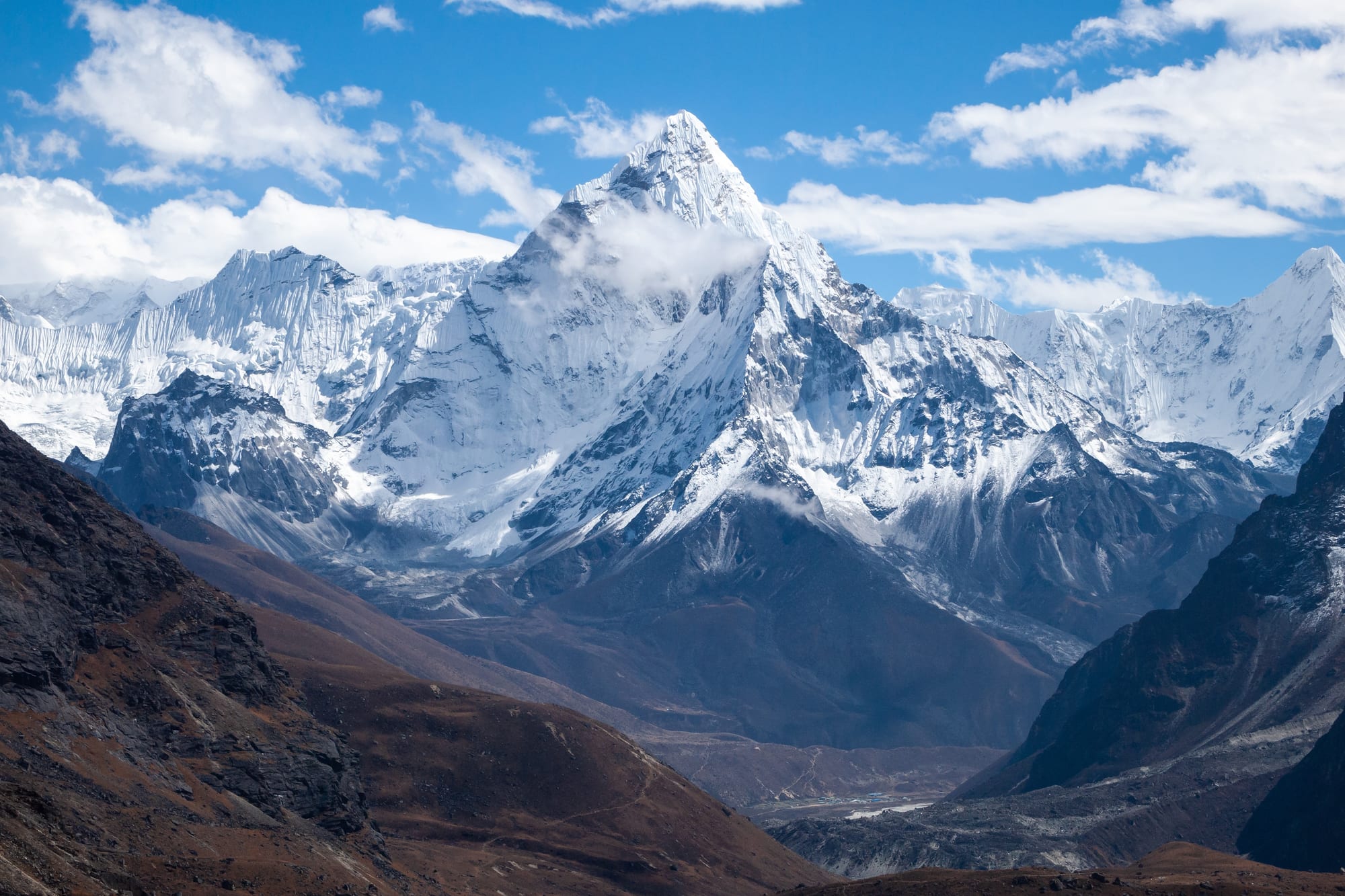
The sharp snow-and-rock summit of Ama Dablam rising above brown ridges and thin cloud under a clear blue sky

Nepal

Ama Dablam (6,812 m) in the Khumbu, on the trekking route to Everest Base Camp — one of the most admired peaks in the Himalaya. (Vyacheslav Argenberg / Wikimedia Commons · CC BY 4.0)

A landlocked country wedged between India and China that holds eight of the world's fourteen highest mountains, including Everest — a Hindu-and-Buddhist society of great ethnic variety that abolished its monarchy in 2008 after a decade of civil war.

Explore Nepal

History

The Kathmandu Valley was the cradle of Nepali civilisation: the early historic Licchavi period, then the medieval Malla kingdoms, whose three rival city-states — Kathmandu, Patan, and Bhaktapur — produced a golden age of Newar art and the pagoda-temple architecture on their Durbar Squares. In 1768–69 Prithvi Narayan Shah of the hill principality of Gorkha conquered the valley and unified Nepal under the Shah dynasty.

Expansion was checked by war with British India in 1814–16, which fixed the borders and began the tradition of Gurkha recruitment into foreign armies. From 1846 the Rana family ruled as hereditary prime ministers, keeping the Shah kings as figureheads and the country isolated for a century, until a 1951 revolt restored the monarchy. A brief democratic opening was ended by a royal coup in 1960 and a party-less system that lasted until the People's Movement of 1990 forced multiparty rule.

A Maoist insurgency from 1996 to 2006 killed some 17,000 people. In 2001 the crown prince shot dead most of the royal family and himself. King Gyanendra's seizure of absolute power in 2005 triggered a second mass uprising, and in 2008 Nepal abolished the monarchy and became a federal secular republic. A new constitution followed in 2015, promulgated weeks after an earthquake that killed around 9,000 people; politics since has been a churn of unstable coalitions led by the same few figures.

Culture & Customs

Hinduism and Buddhism are so intertwined in Nepal that the same shrine, festival, or deity is often shared, and Kathmandu even worships a living goddess, the Kumari, a young Newar girl. The festival calendar is dense: Dashain, the fifteen-day celebration of the goddess Durga and of family; Tihar, the festival of lights, with days honouring crows, dogs, and cows; Holi; Indra Jatra; and the Tibetan new year, Losar, in the mountains.

The Kathmandu Valley's Newars built a distinct urban civilisation of brick and carved wood — tiered pagoda temples, latticed windows, sunken stone water spouts, and courtyard bahal — and keep their own language, cuisine, and craft guilds. Beyond the valley, dozens of hill and mountain peoples — Gurung, Magar, Tamang, Rai, Limbu, Sherpa, Thakali — and the Madhesi and Tharu of the Terai each have their own languages and customs.

The Gurkha soldier and his curved khukuri knife, the Sherpa high-altitude guide, and the plate of daal bhaat are all part of how Nepal sees itself. Greetings are made with palms together and a namaste, shoes come off at temples and homes, and the cow is sacred and protected.

Daily Life

The Kathmandu Valley is the crowded, dust-hazed, fast-growing core of the country, with its traffic, its earthquake rebuilding, and a young urban scene. The middle hills are terraced farming country, hard and subsistence-based, steadily losing people as men leave for work abroad and families follow to the towns or down to the Terai. The Terai plains, with their open border and close cultural ties to India, are now the demographic and economic centre.

Nepal is one of Asia's poorest countries, and remittances — sent home by millions working in the Gulf, Malaysia, South Korea, and India — make up around a quarter of the economy. The village shop built on Gulf wages, and the family split across continents, are the defining social facts, along with the human cost of that migration.

Agriculture still occupies most of the workforce; tourism and mountaineering, hydropower now being developed for export to India, tea, carpets, and garments fill out the rest. Religion runs through the daily routine, from the morning puja to the festival that closes the shops.

Food

The everyday meal, eaten twice a day by most Nepalis, is daal bhaat: steamed rice, lentil soup, a vegetable curry, pickle, and often greens, curd, or a little meat, with unlimited refills. Momos, steamed or fried dumplings served with a tomato-and-sesame relish, are the national snack.

Newari cuisine is a rich tradition of its own — chatamari rice-flour pancakes, bara lentil patties, spiced grilled choila, the ceremonial samay baji platter, and sweet yomari dumplings, washed down with the local spirit aila. Thakali food from the Annapurna region is a refined version of the daal bhaat set. In the mountains the cooking turns Tibetan: thukpa noodle soup, tsampa, dried meat, and butter tea.

Ring-shaped sel roti appears at festivals, fermented greens (gundruk) and dried meat (sukuti) preserve the harvest, and spiced milk tea (chiya) is constant. Everest and Gorkha beers, distilled raksi, and millet tongba sipped hot through a straw are the drinks.

Attractions & Natural Wonders

The Kathmandu Valley alone holds seven UNESCO monument zones: the Durbar Squares of Kathmandu, Patan, and Bhaktapur, largely rebuilt since 2015; the great Buddhist stupas of Boudhanath and hilltop Swayambhunath; and the Hindu temple and cremation ghats of Pashupatinath on the Bagmati. Thamel is the trekking and traveller hub.

Trekking is the main draw. The Everest Base Camp route climbs through the Khumbu past Namche Bazaar and Tengboche monastery under Ama Dablam; the Annapurna region offers the Circuit, the Base Camp sanctuary trek, and the Poon Hill sunrise; and more remote routes lead into Langtang, around Manaslu, and up to the walled Tibetan-Buddhist kingdom of Upper Mustang. Pokhara, on a lake below the Annapurnas and the Fishtail peak, is the relaxed base for much of this, and a paragliding centre.

In the Terai, Chitwan National Park offers rhino, tiger, and gharial on jeep and canoe safaris, and Lumbini, the birthplace of the Buddha, has the Maya Devi Temple and a monastic park of temples built by Buddhist nations from around the world. Scenic mountain flights from Kathmandu run the length of the Himalaya, and the rivers off the hills — the Trishuli, Sun Koshi, and Karnali — are classic whitewater.

Planning basics

Budget

Nepal is inexpensive. Guesthouses, local eateries (bhojanalaya), and buses cost very little; trekking adds up through permits, a guide and porter, and teahouse food that gets pricier the higher you go. Domestic flights to the mountains and organised safaris are the other big costs.

Daily Budget Midrange
NPR 6,000–14,000 / USD 45–110 (comfortable hotel, restaurants, a guided trek or a Chitwan safari, some flights)
Daily Budget Shoestring
NPR 2,000–3,500 / USD 15–28 (guesthouse, daal bhaat, local buses)

On a trek, budget for tea, charging, hot showers, and bottled or treated water separately — they add up over two weeks.

Visa Requirements

Most nationalities get a tourist visa on arrival at Kathmandu airport and the main land borders, for 15, 30, or 90 days, paid in cash US dollars or by card. A few nationalities must arrange it in advance. Indian citizens need no visa. Trekking areas require separate permits, and restricted regions such as Upper Mustang and Manaslu need a licensed agency and a minimum group.

Typical Validity
15/30/90 days on arrival, extendable up to 150 days per year

Bring a passport photo and US dollars for the visa fee, and arrange trekking permits (national park entry and the TIMS card) in Kathmandu or Pokhara.

Safety

Nepal is generally safe, with little violent crime against visitors. The serious dangers are altitude sickness — which kills trekkers every year who climb too fast — sudden mountain weather and avalanches, dangerous domestic flights and mountain airstrips, monsoon landslides, and crashes on cliff-edge roads. Kathmandu has a major earthquake risk.

Trekking Rule
Since 2023, foreign trekkers in the national parks generally must hire a licensed guide

Ascend slowly and know the signs of altitude sickness, use reputable trekking agencies, carry travel insurance that covers helicopter rescue, and build buffer days around Lukla flights.

Climate

Nepal runs from the subtropical Terai lowlands through the temperate middle hills to the arctic high mountains, so altitude matters more than season. The summer monsoon (June–September) brings heavy rain, leeches, cloud-hidden peaks, and landslides. The clear, stable post-monsoon months and the warmer, hazier spring are the trekking seasons.

Terai
Hot and humid; over 40°C before the monsoon
Kathmandu
Mild; roughly 2–20°C in winter, 20–30°C before the monsoon

Transportation

Kathmandu's Tribhuvan airport is the main gateway. Domestic flights reach Lukla, Pokhara, Jomsom, and other mountain strips and are often the only way into remote areas, but Nepal's domestic aviation has a poor safety record. Tourist buses run Kathmandu–Pokhara–Chitwan–Lumbini; local buses and jeeps serve the hills on slow, winding roads. There is no useful railway.

Road accidents on mountain highways are a leading cause of tourist deaths — choose tourist coaches over local buses, and avoid night travel.

Best Time to Visit

October and November — clear skies, stable weather, and the big festivals of Dashain and Tihar — are the prime season. March and April bring blooming rhododendrons and the Everest climbing season but hazier air. Winter is cold in the hills but fine in the Terai; the monsoon suits only the rain-shadow areas of Mustang and Dolpo.

Events
Dashain (Sept–Oct); Tihar/Deepawali (Oct–Nov); Indra Jatra in Kathmandu; Holi; Buddha Jayanti

Currency

The Nepalese rupee (NPR) is pegged to the Indian rupee. It is a cash economy; ATMs are common in cities and trekking gateways but have low withdrawal limits and fees, and the trails are cash-only. Carry small notes.

Symbol
रु / Rs
Currency Code
NPR — Nepalese rupee

Language

Nepali (Khas Nepali), written in Devanagari, is the official language and the common tongue, the first language of about 45 per cent of people and understood by most. More than 120 other languages are spoken — Maithili, Bhojpuri, Tharu, Tamang, Nepal Bhasa (Newari), Magar, and many more. English is widely used in tourism and education.

Also Spoken
Maithili, Bhojpuri, Tharu, Tamang, Nepal Bhasa and 120+ others
Official Language
Nepali