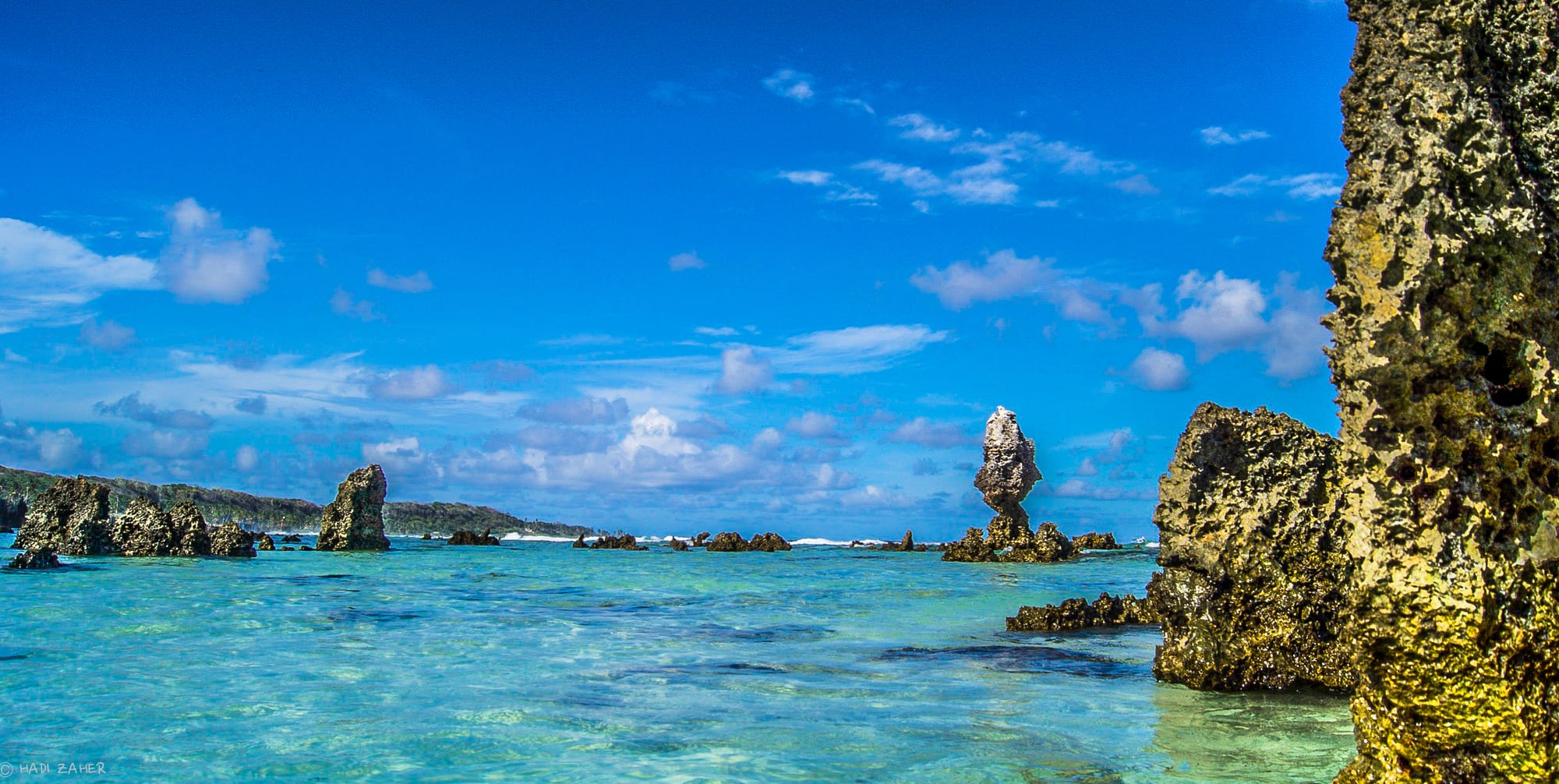
Weathered coral rock formations rising from a shallow turquoise sea along a reef coast, open ocean beyond

Nauru

The reef and coral pinnacles at Anibare Bay on Nauru's east coast, the island's main stretch of beach. (Hadi Zaher / Wikimedia Commons · CC BY 2.0)

A single raised-coral island of 21 square kilometres in the central Pacific — the world's smallest republic, its interior hollowed out by a century of phosphate mining, now living on Australian aid and an offshore detention centre.

Explore Nauru

History

Nauru was settled about three thousand years ago by people of Micronesian and Polynesian descent, organised into twelve matrilineal clans — the twelve points of the star on the flag. A British whaler named it "Pleasant Island" in 1798. In the 1870s a decade of clan warfare, worsened by imported guns and alcohol, killed around a third of the population and ended only when Germany annexed the island in 1888.

Phosphate rock — the product of millennia of seabird droppings over coral — was identified in 1900, and mining began at once, with most of the profit going to the companies and the countries that ran the island: Germany, then Australia, New Zealand, and Britain under a League of Nations mandate. The Japanese occupation of 1942–45 was brutal: over a thousand Nauruans were deported to Chuuk as forced labour, and hundreds died there or of starvation at home.

Nauru became independent in 1968 and soon bought out the foreign phosphate operation. Through the 1970s and 80s the royalties gave it one of the highest incomes per head in the world, but the money was lost to bad investments, mismanagement, and extravagance, and by 2000 the phosphate was nearly exhausted and the country bankrupt. Since then Nauru has relied on a tax-haven phase, the sale of diplomatic recognition, and, above all, hosting Australia's offshore asylum-processing centre, opened in 2001 and reopened in 2012.

  • Nauru: The Island That Was Sold The world's smallest republic — a single phosphate rock strip-mined for a century, briefly among the richest countries on Earth, then bankrupt, and now living on payments to hold other countries' asylum seekers

Culture & Customs

Nauruan society is built on the twelve clans, traced through the mother's line. Christianity — Congregational and Catholic — is the dominant faith, and church and extended family are the centre of social life on an island where everyone knows everyone.

Many older traditions were lost during the phosphate decades, but some are remembered: the catching and taming of frigatebirds, kept as pets and fishing aids; navigation and fishing by the stars; and the raising of milkfish in brackish ponds. Angam Day marks the two occasions — after the 1920 influenza and after the Second World War — when the population recovered to 1,500, the number once thought necessary for the community to survive.

The national sport is weightlifting, Nauru's main source of Commonwealth Games medals; one champion lifter, Marcus Stephen, went on to become president. Australian Rules football is widely played and followed.

Daily Life

Everyone lives on the narrow coastal strip, because the interior — "Topside", about four-fifths of the island — is a wasteland of jagged limestone pinnacles left by mining. A single ring road circles the island in about twenty minutes by car, and Nauruans drive it constantly despite the short distances, one factor in a health crisis: Nauru has among the world's highest rates of obesity and type 2 diabetes, driven by the loss of the traditional diet and of land to grow food on.

The government and the detention centre are the main employers. Almost all food and fuel is imported by ship — the island has no natural harbour, though a new port opened in 2021 — and electricity comes mostly from diesel generators. An undersea internet cable finally reached the island in 2023.

The latest resource gamble is deep-sea mining: Nauru has pushed hard for international rules that would let a Nauru-sponsored company harvest metal-rich nodules from the Pacific floor, a plan environmental groups strongly oppose.

Food

Traditional Nauruan food was limited by the size of the island: coconut, pandanus, reef and ocean fish, and milkfish raised in ponds. Today the diet is overwhelmingly imported — white rice, tinned corned beef and fish, instant noodles, fried chicken, and sugary drinks — and that shift is the direct cause of the country's diabetes epidemic.

Fresh fish and coconut are still eaten, and families cook for church events and celebrations, but there is little in the way of a restaurant scene beyond the hotels and a few takeaways. Almost everything on a shop shelf has come a long way by sea.

Attractions & Natural Wonders

Nauru is not set up for tourism, and the interest in visiting is partly the curiosity of reaching the least-visited country on Earth. Anibare Bay, on the east coast, is the one real beach, with turquoise water and coral pinnacles offshore, though swimming is limited by the reef.

Command Ridge, the island's highest point at about 65 metres, has rusting Japanese anti-aircraft guns, bunkers, and a lookout with a view across the whole island and the pinnacle fields. Buada Lagoon, a palm-ringed brackish lake in an inland hollow, is one of the few green places left.

The mined-out Topside itself is the island's strangest sight — a moonscape of coral spires where the phosphate was cut away — alongside scattered wartime relics and the frigatebirds that still wheel along the coast.

  • Nauru: Five Attractions and Natural Wonders The world's smallest island nation — a coral atoll mined almost hollow for phosphate, a single lagoon left untouched at its centre, and rusting relics of a brutal Pacific war

Planning basics

Budget

Nauru is expensive relative to what is on offer: a couple of basic hotels, imported food, and little to do. There is no tourist infrastructure and few visitors other than officials, contractors, and people connected to the detention centre.

Daily Budget Midrange
AUD 250–400 (better room, restaurant meals, a hired car, a boat trip)
Daily Budget Shoestring
AUD 150–220 (the cheaper hotel, store and takeaway food, a shared vehicle)

Bring Australian dollars in cash; card acceptance is minimal and ATMs are unreliable.

Visa Requirements

Every visitor needs a visa arranged in advance directly with Nauru's immigration office; there is no visa on arrival for tourists. Applications require a sponsor or confirmed accommodation and can be slow, and the regime is restrictive — media and researcher visas are costly and often refused.

Typical Validity
30 days, single entry, granted at the government's discretion

Start the visa process weeks ahead and have hotel bookings and a return ticket ready.

Safety

Crime is low in such a small, close-knit society, with occasional alcohol-related trouble. The practical concerns are very limited medical care — serious cases are evacuated to Australia — fierce equatorial sun, scarce fresh water, and fast driving on the ring road. Swimming is hazardous off most of the coast because of the reef and currents.

Swim only where locals do, at Anibare, carry water and sun protection, and be aware that anything serious means a flight out for treatment.

Climate

Tropical, hot, and humid all year on the equator, typically 25–35°C. The trade-wind months from about April to October are a little more bearable; a wetter season runs from November to February, but rainfall is erratic and multi-year droughts occur, a serious problem for an island that depends on rain catchment and a desalination plant.

Hazards
Drought and freshwater shortage; coastal erosion and sea-level rise
Temperature
25–35°C year-round

Transportation

Nauru International Airport is served only by the government-owned Nauru Airlines, which flies to Brisbane and a handful of Pacific hubs including Nadi, Tarawa, and Majuro. The island road crosses the runway and closes for landings. On the ground there is a single 19-kilometre sealed ring road, no public transport, and only informal taxis; hotels arrange vehicles.

Book Nauru Airlines flights early and keep plans flexible — the schedule is thin and disruptions ripple across the region.

Best Time to Visit

There is no tourist season. The drier, breezier months from April to October are marginally more comfortable. Angam Day on 26 October and Independence Day on 31 January are the main national occasions.

Events
Independence Day (31 January); Angam Day (26 October); Constitution Day (17 May)

Currency

Nauru uses the Australian dollar. It is a cash economy; there is one bank branch, card acceptance is very limited, and ATMs cannot be relied on. Bring enough cash for the whole stay.

Symbol
$
Currency Code
AUD — Australian dollar

Language

Nauruan, a distinct Micronesian language not closely related to its neighbours, is the national language. English is the language of government, business, and law and is widely spoken, so visitors have no language barrier.

Also Official
English (used in government and widely spoken)
National Language
Nauruan