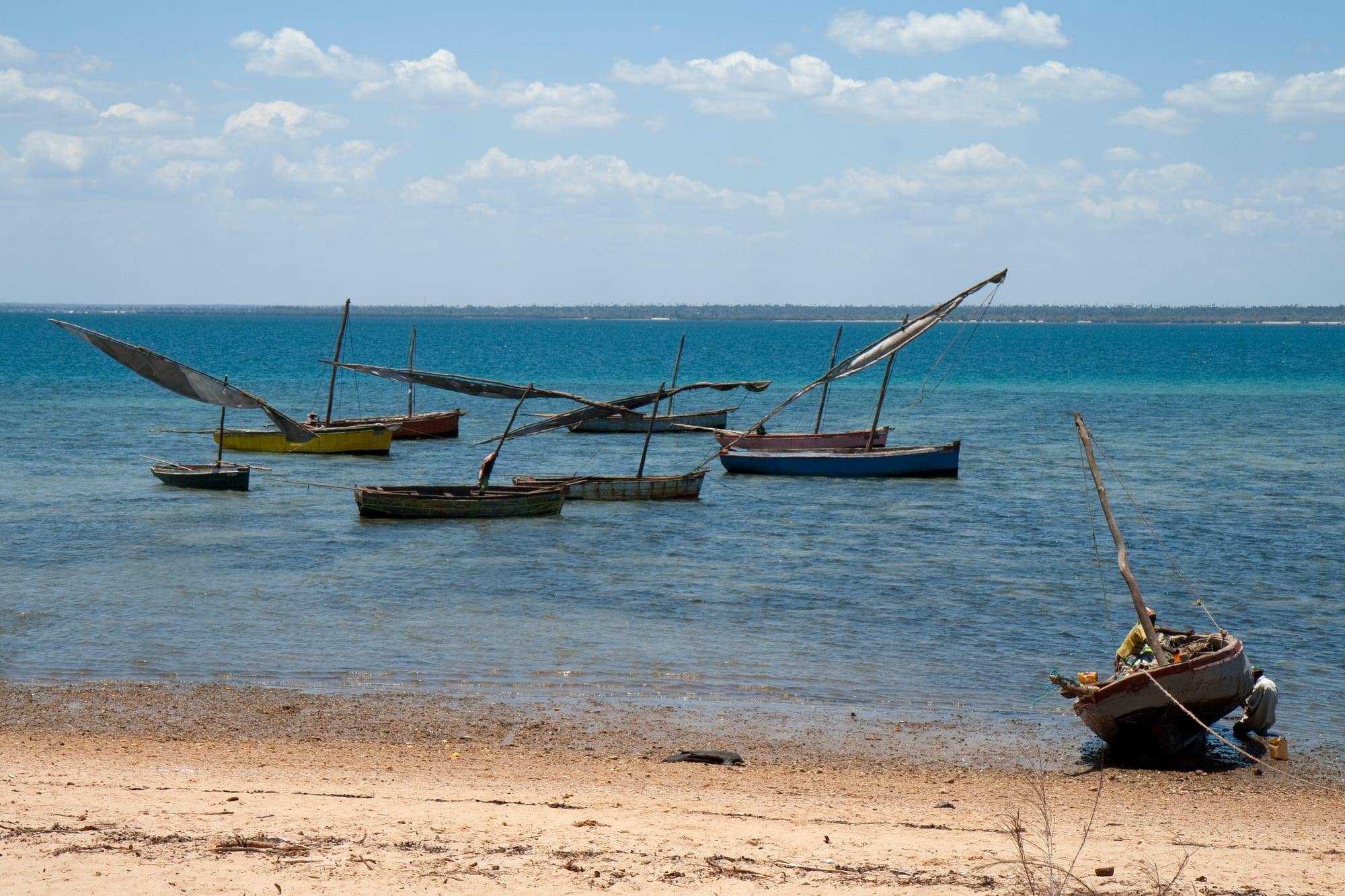
Wooden dhows and small boats resting on shallow water beside the low stone town of the Island of Mozambique under a bright sky

Mozambique

Dhows off the Island of Mozambique, a UNESCO-listed stone town that was the capital of Portuguese East Africa for centuries. (Stig Nygaard / Wikimedia Commons · CC BY 2.0)

A long Indian Ocean country in southeast Africa — a former Portuguese colony that won independence in 1975, endured a 15-year civil war, and now faces an Islamist insurgency in its gas-rich far north alongside recurring cyclones and deep poverty.

Explore Mozambique

History

Long before the Portuguese, the Mozambican coast was studded with Swahili trading towns — the Island of Mozambique, Sofala, and others — shipping gold and ivory from the interior into an Indian Ocean network. Vasco da Gama called in 1498, and Portugal seized the coast, making the Island of Mozambique the capital of Portuguese East Africa for centuries. Colonial rule meant deep involvement in the slave trade, forced labour, forced cotton growing, and the export of migrant miners to South Africa.

The liberation movement FRELIMO launched an armed struggle in 1964 and, after Portugal's 1974 revolution, took power at independence in 1975. Most Portuguese settlers left almost at once, taking skills and capital with them. FRELIMO set up a one-party Marxist state, and almost immediately faced the RENAMO insurgency, armed first by white-ruled Rhodesia and then by apartheid South Africa. The civil war that followed, from 1977 to 1992, killed around a million people, displaced millions more, and left the country mined and wrecked.

A 1992 peace accord brought multiparty politics, though FRELIMO has won every election since. The 2010s were shadowed by a "hidden debts" scandal of secret state-guaranteed loans that triggered a financial crisis. Since 2017 an Islamist insurgency has raged in the northern gas province of Cabo Delgado, and the disputed October 2024 election set off months of protest and a deadly crackdown before Daniel Chapo was inaugurated in early 2025.

  • Mozambique: The Long Coast A Swahili gold coast and a thin Portuguese colony for four centuries — a liberation war, a Marxist state, a proxy civil war that killed a million people, and a fragile recovery now shadowed by gas and jihad

Culture & Customs

Mozambique is really several cultural worlds. The north is coastal and Swahili- influenced, with a large Muslim population and Makonde communities famed for blackwood sculpture and masked mapiko dances. The Zambezi valley in the centre has its own peoples and history, and the south, around Maputo, is Tsonga in culture and closely tied to South Africa by a century of labour migration.

Music binds them: marrabenta, the guitar-driven popular sound of Maputo; the timbila xylophone orchestras of the Chopi in Inhambane, recognised by UNESCO; and modern pandza and South African house. The printed capulana cloth, worn, gifted, and used to carry babies and messages, is a common thread nationwide.

Christianity, both Catholic and a fast-growing Pentecostalism, is the majority faith, with Islam strong in the north. Extended-family obligation, community labour, and rotating savings clubs (xitique) are part of how people get by, and Portuguese colonial architecture — Art Deco Maputo, the iron house, the old railway station — is a distinctive backdrop in the cities.

Daily Life

Most Mozambicans live rurally and farm — cassava, maize, coconut, and cashew, of which the country was once the world's top exporter. Urban growth is concentrated in Maputo and its twin city Matola, and in Nampula, Beira, and Nacala. Poverty is widespread, power and water supply are unreliable outside the main cities, and the long, thin country's north has always been far from the government in the far south.

The formal economy runs on an aluminium smelter near Maputo, coal from Tete, the transport corridors and ports that serve landlocked neighbours, prawns, and, increasingly, offshore natural gas — the Rovuma Basin holds some of the largest finds anywhere, though the biggest onshore project stalled after a 2021 insurgent attack and is only now restarting.

Cyclones are a recurring catastrophe: Idai flattened much of Beira in 2019, and Kenneth and Freddy followed. Between the storms, the war's legacy, the debt crisis, and the northern conflict, the gas wealth has yet to reach most people's daily lives.

Food

The staple is xima, a stiff maize porridge, eaten with a sauce or relish. The signature dish is matapa — cassava leaves stewed with ground peanuts and coconut milk, often with prawns or crab. Coconut runs through coastal cooking, in curries and rice, and the north adds Indian-influenced chamuças (samosas), curries, and flatbreads.

Portugal's legacy is everywhere: crusty bread rolls, prego and bifana meat sandwiches, custard tarts, and above all frango à piri-piri, chicken grilled with a fierce chilli-and-garlic sauce that is Mozambique's best-known contribution to world menus. Prawns from Maputo Bay, crab, grilled line fish, and lobster are the coastal treats.

To drink there are 2M and Laurentina beers, Tipo Tinto rum mixed with raspberry soda (the "R&R"), cashew feni, and strong coffee. Roasted, salted cashews are sold everywhere.

Attractions & Natural Wonders

The Island of Mozambique, reached by a three-kilometre single-lane bridge, is a World Heritage Site: a lime-washed stone town, the huge sixteenth-century Fortress of São Sebastião, and a small chapel often called the oldest European building in the southern hemisphere, alongside a densely packed reed-house quarter.

The Bazaruto Archipelago, off Vilanculos, is the country's premier beach and diving destination — sand islands with towering dunes, coral reefs, and one of the last populations of dugong, all within a national park. Further south, Tofo and Barra near Inhambane are a diving hub known for manta rays and whale sharks, and the southern coast has a string of resorts — Vilanculos, Xai-Xai, Bilene — popular with South Africans driving up from the border.

Inland, Gorongosa National Park in the centre is a celebrated restoration project, its lions, elephants, and antelope rebuilt from near-nothing after the war. Maputo itself rewards a wander for its faded modernist architecture, its craft markets, and its seafood. The Quirimbas Archipelago in the north, with the crumbling Swahili-Portuguese town of Ibo, is a remarkable place that the insurgency has put out of reach.

  • Mozambique: Seven Attractions and Natural Wonders A Swahili-Portuguese trading island layered with five centuries of history, dune-backed archipelagos in the Indian Ocean, and a wildlife park rebuilt almost from nothing after decades of civil war

Planning basics

Budget

Mozambique is not the cheap destination its economy might suggest: imported goods, poor roads, and fly-in beach lodges push costs up. Backpacker hostels and pensões exist in the towns and along the southern coast; mid-range means beach resorts aimed at South African visitors.

Daily Budget Midrange
USD 100–260 (beach lodge or mid-range hotel, restaurants, domestic flights, diving)
Daily Budget Shoestring
USD 35–65 (hostel or pensão, local food and markets, chapa minibuses)

Distances are huge and roads slow; budget for domestic flights between Maputo, the southern beaches, and the north.

Visa Requirements

Most nationalities need a visa. A visa on arrival is available to tourists from many countries — including the US, the UK, the EU, and Australia — at the main airports and land borders, sometimes requiring an e-visa pre-approval. Rules change often, so confirm before travel. Many SADC nationals enter visa-free.

Typical Validity
30 days, single entry, extendable in-country

Check the current visa-on-arrival and e-visa position with a Mozambican mission shortly before travel; requirements have shifted several times.

Safety

The overriding issue is Cabo Delgado province in the far north, where an Islamist insurgency linked to Islamic State has killed thousands and displaced around a million people since 2017; most governments advise against all travel there, and the Quirimbas Islands and Pemba are effectively closed to tourism. Elsewhere, muggings and carjackings occur in Maputo, Beira, and Nampula, and post-election unrest since late 2024 has brought protests and roadblocks.

Health
Malaria is a high risk countrywide — take prophylaxis and precautions

Avoid Cabo Delgado and adjacent districts entirely, don't walk in cities after dark or display valuables, and check the current situation before travelling to the centre and north.

Climate

Tropical. The hot, wet season runs from November to April and carries a serious cyclone risk, especially on the central coast around Beira. The dry season, May to October, is cooler and the best time to travel. The far south around Maputo is subtropical and a little drier; the centre and north are wetter.

Dry Season
May–October, warm days, cooler nights, low rain
Wet Season
November–April, hot and humid, cyclones

Transportation

Maputo has the main international airport, with regional airports along the coast. Because the country is so long and roads are slow, most visitors fly between Maputo, the southern beaches, and the north on LAM or regional carriers. Long-distance "chapa" minibuses and a few coaches serve the EN1 highway; rail is mostly for freight. A 4x4 helps for the beach tracks.

Expect police roadblocks and requests for 'fines'; carry your documents, stay calm, and ask for an official receipt.

Best Time to Visit

May to November, the dry season, is best for beaches, diving, and wildlife — Gorongosa's animals concentrate as the land dries from August to October, and humpback whales pass the coast from July to October. Avoid the January–March cyclone peak on the central coast.

Events
Independence Day (25 June); Marrabenta Festival, Maputo (February); Timbila festivals in Inhambane province

Currency

The currency is the metical (MZN). It is largely a cash economy; US dollars and South African rand are useful in the south and at tourist lodges. ATMs are in the cities and accept Visa more reliably than Mastercard; upmarket hotels and restaurants take cards.

Symbol
MT
Currency Code
MZN — metical

Language

Portuguese is the sole official language and the language of government, schooling, and the cities, spoken — often as a second language — by around half the population. Most people's mother tongue is a Bantu language: Makhuwa in the north, Changana around Maputo, Sena and Ndau in the centre, among many others. English is used in tourism and near South Africa.

Official Language
Portuguese
Main Local Languages
Makhuwa, Changana, Sena, Ndau and others