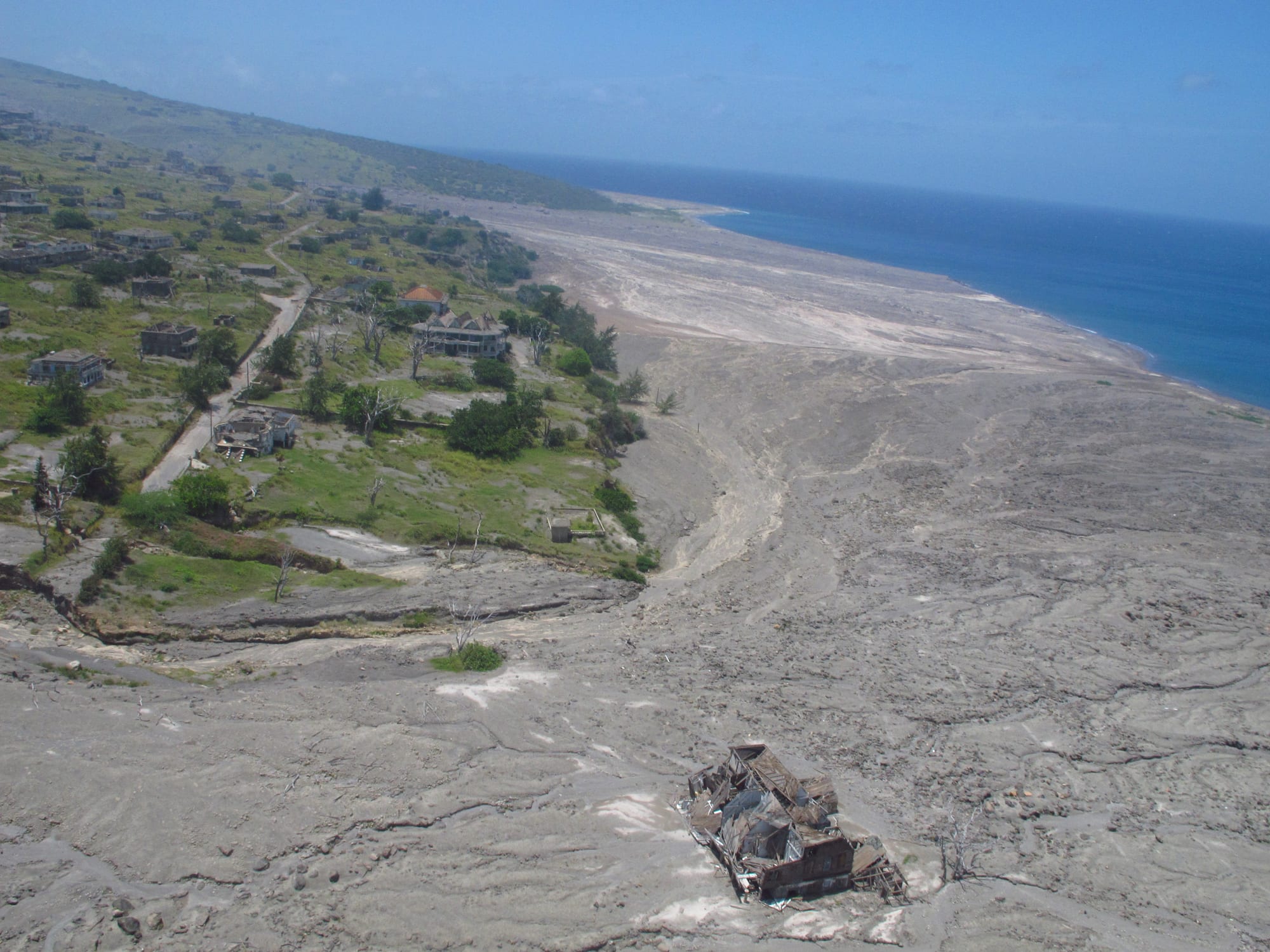
A grey, ash-choked landscape of half-buried buildings and dried mudflows below a steaming, cloud-wrapped volcanic dome

Montserrat

The Soufrière Hills volcano above the ruins of Plymouth, the former capital, buried by pyroclastic flows and mudflows and abandoned since the late 1990s. (Patrick Hawks / Wikimedia Commons · CC BY 3.0)

A small, mountainous British Overseas Territory in the Leeward Islands — the "Emerald Isle" of the Caribbean for its Irish heritage — with its southern two-thirds, including the former capital of Plymouth, buried and abandoned since the Soufrière Hills volcano came back to life in 1995.

Explore Montserrat

History

Columbus named the island in 1493 for a monastery near Barcelona. From 1632 it was settled by English and Irish Catholics — some indentured, some transported from Ireland under Cromwell, others fleeing anti-Catholic Nevis — which made Montserrat unusually Irish, a fact still marked by the shamrock on its flag and passport stamp. Sugar and lime plantations were worked by enslaved Africans; a revolt planned for St Patrick's Day in 1768 was betrayed and crushed, and is now commemorated alongside the Irish heritage.

After emancipation in 1834 the island grew limes — the origin of the "Montserrat lime" — and stayed a quiet colony. In the 1970s and 80s George Martin's AIR Studios made it a rock-recording destination: Dire Straits' Brothers in Arms, along with albums by Elton John, the Police, and Paul McCartney, were made here. Hurricane Hugo flattened the island in 1989.

Then, in July 1995, the long-dormant Soufrière Hills volcano began to erupt. Pyroclastic flows destroyed the capital, Plymouth, and the airport; nineteen people were killed in 1997; and the southern two-thirds of the island became an Exclusion Zone. The population fell from around 11,000 to about 4,000 as most residents emigrated, many to the United Kingdom. A new capital is being built at Little Bay in the north, with a new airport and port, and the volcano's activity has declined since about 2010, though it is monitored around the clock.

  • Montserrat: The Island With a Buried Capital The "Emerald Isle" of the Caribbean, settled by Irish Catholics and enslaved Africans — a quiet British colony until a volcano woke in 1995, buried its capital, and emptied two-thirds of the island

Culture & Customs

Montserratian culture is English-speaking and Christian, with a proud and much-marketed Irish thread. St Patrick's Day has grown into a ten-day festival that both celebrates the Irish ancestry and remembers the 1768 revolt, and Irish surnames and place names are common. String-band music, masquerade with its "jumbie" dance, and the goat-water stew are older island traditions.

The community is tiny — around 4,400 people — resilient, and closely bound to a diaspora many times its size. The volcano runs through the island's sense of itself: the loss of Plymouth and the villages, the long resettlement in the north, and a dark, matter-of-fact humour about living beside it.

Daily Life

Everyone now lives in the safe northern third of the island; Brades and the rising town at Little Bay serve as the de facto capital. The economy leans heavily on United Kingdom budgetary aid, along with construction, a little tourism — volcano tours, diving, birdwatching — and the mining of the volcanic sand deposits.

Power and water supply are a continuing challenge, and geothermal energy from the volcano is being developed to help. Daily life is rural and car-dependent, crime is almost unknown, and the rhythm is set by the ferry and flight schedule to Antigua and by the Observatory's reports.

Food

"Goat water", a thin goat stew with breadfruit and dumplings, is the national dish, traditionally eaten at celebrations. Saltfish with breadfruit, fresh fish, pumpkin soup, and ducana (a sweet-potato and coconut dumpling) are everyday fare, with johnnycakes alongside. The "mountain chicken", a large native frog once a delicacy, is now protected after disease and the eruptions cut its numbers. Local rum and Sunday soup round out a small, homey food scene.

  • Montserrat: Food and the National Dish A spiced goat stew from a small Caribbean island whose food culture, like nearly everything else here, was reshaped by a volcano that buried its own capital

Attractions & Natural Wonders

The volcano and its aftermath are the reason most visitors come. The Montserrat Volcano Observatory has a public viewing deck and exhibits, and guided viewpoints at Jack Boy Hill and Garibaldi Hill look out over the grey, ash-buried ruins of Plymouth — a "modern Pompeii" that can be approached only with a guide and permit when conditions allow.

Away from the volcano, the reefs off the northwest coast — around Woodlands and Rendezvous Bay, the island's one white-sand beach, reached by trail or boat — offer healthy diving and snorkelling; the other beaches are black volcanic sand. The Centre Hills rainforest holds the endemic Montserrat oriole, the national bird, and the Runaway Ghaut spring, which legend says will bring you back to the island if you drink from it. The exterior of the abandoned AIR Studios can be seen on the way, and the St Patrick's Festival in March is the best time to experience the island's culture in full.

Planning basics

Budget

Montserrat is not a luxury island. Accommodation is a handful of small hotels, guesthouses, and villas, mostly mid-range, and eating is local and inexpensive. Costs come mainly from getting there — the short flight or ferry from Antigua — and from hiring a car.

Daily Budget Midrange
USD 180–350 (small hotel or villa, restaurant meals, a guided volcano tour, car hire)
Daily Budget Shoestring
USD 90–150 (guesthouse, local eateries, shared car)

Fly the 20-minute hop from Antigua or take the ferry, hire a car for the northern zone, and eat where the locals do.

Visa Requirements

Citizens of the UK, EU, US, Canada, and many other countries enter visa-free, with the permitted stay depending on nationality (up to six months for some). A passport valid for the stay, an onward or return ticket, and proof of funds and accommodation are expected. Access is normally via Antigua.

Typical Stay
Visa-free for most Western passports; permitted period varies by nationality

Book the Antigua–Montserrat flight or ferry as part of your itinerary; there are no direct long-haul services.

Safety

Crime is very low. The defining hazard is the volcano: the southern Exclusion Zone is off-limits or entry-by-permit-only, the alert level can change, and ashfall and, more rarely, pyroclastic activity remain possible. Follow the Montserrat Volcano Observatory's guidance and never enter a restricted area without an authorised guide. Otherwise the usual apply — sun, sea currents, and hurricanes.

Health
Medical care is basic; serious cases are flown to Antigua or Guadeloupe; the beaches are mostly black volcanic sand with some surf

Check the Observatory's alert level before and during your visit, respect all Exclusion Zone boundaries, and only visit Plymouth's edge with a licensed guide when access is open.

Climate

Tropical and warm at around 26–31°C, with a drier season from December to April and a wetter one from July to November that coincides with the hurricane season; the mountains catch more rain. When the volcano is active and the wind is wrong, ashfall can briefly affect air quality.

Dry Season
December–April
Wet Season
July–November (hurricane season)

Transportation

John A. Osborne Airport in the north takes short flights from Antigua (about 20 minutes, on small aircraft), and a passenger ferry runs from Antigua on scheduled days. On the island, hire a car — a local permit is issued on arrival — or use taxis; driving is on the left, and the road network exists only in the safe northern zone.

Reserve the small plane or the ferry well ahead, as capacity is very limited, and rent a car once on the island.

Best Time to Visit

December to April for the driest weather. The St Patrick's Festival in mid-March is the big event of the year. Whatever the season, check the volcano's current alert level, published by the Montserrat Volcano Observatory, before you travel.

Events
St Patrick's Festival (ten days around 17 March), commemorating both the Irish heritage and the 1768 enslaved people's revolt; the Calabash Festival (July); the Alliouagana Festival of the Word (November)

Currency

The East Caribbean dollar is the official currency, pegged to the US dollar at 2.70. US dollars are accepted. Cards work at hotels and the bank; carry cash elsewhere, as ATMs are few.

Symbol
EC$
Currency Code
XCD — East Caribbean dollar (US dollars accepted)

Language

English is the official and everyday language, spoken in a local creole-influenced form.

Official Language
English