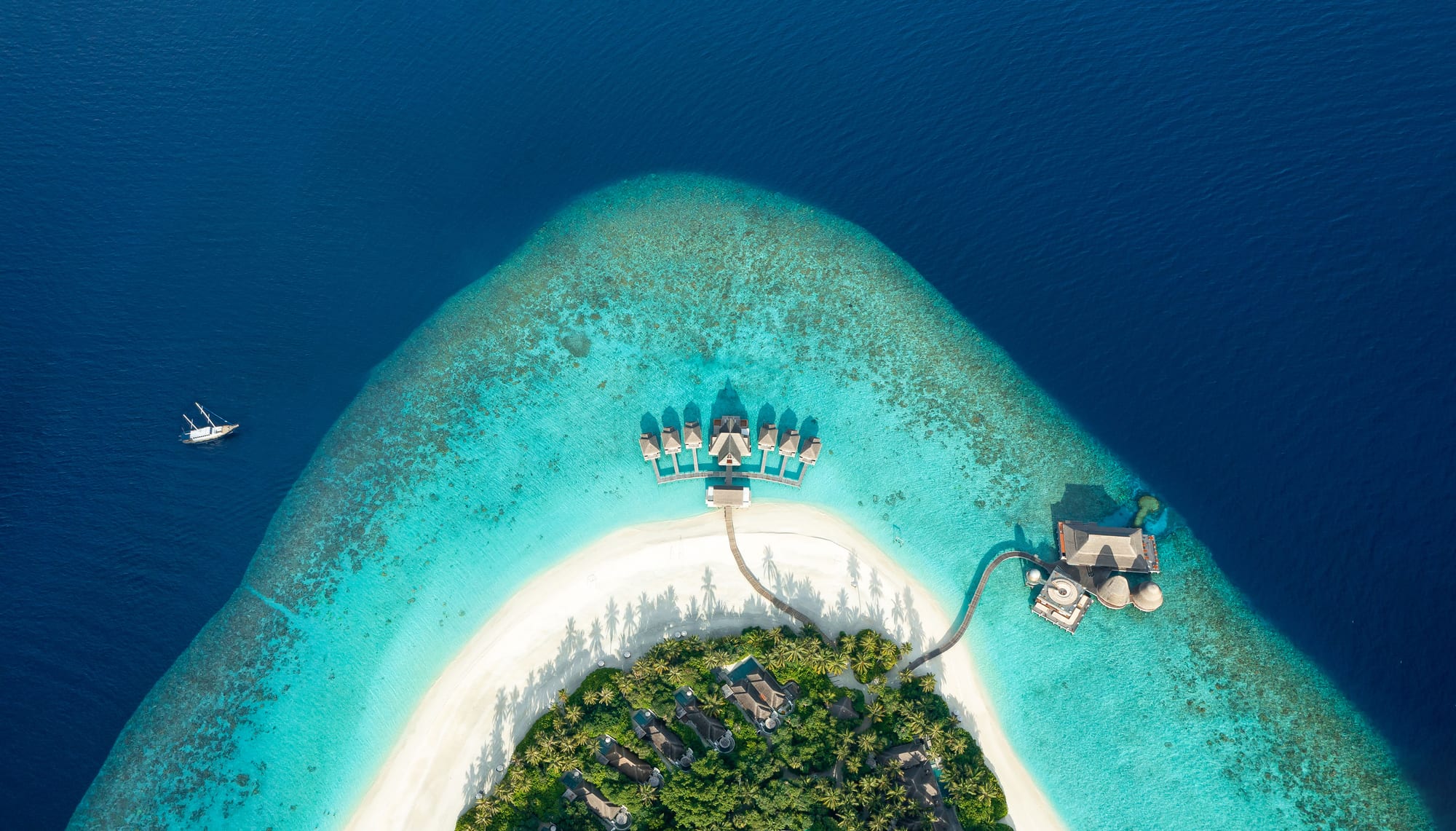
An aerial view of a small ring-shaped coral island with white beaches, a row of overwater villas, and deep-blue and turquoise water

Maldives

A Maldivian atoll island from the air — a strip of coral, a reef, and the graded blues of the lagoon and open ocean. (Matheenfaiz / Wikimedia Commons · CC BY-SA 4.0)

A nation of nearly 1,200 low coral islands strung across the Indian Ocean southwest of Sri Lanka — the flattest and lowest-lying country on Earth, a Muslim republic, and a byword for turquoise-water resort holidays.

Explore Maldives

History

Settled from southern India and Sri Lanka, with later Arab, African, and Southeast Asian influence from the Indian Ocean trade, the Maldives was Buddhist for more than a thousand years before converting to Islam in 1153 — an event still commemorated as a national holiday. The islands were then a sultanate, briefly and brutally occupied by the Portuguese in the sixteenth century (their expulsion is the other founding holiday), and loosely overseen by the Dutch and then the British, becoming a British protectorate from 1887 until independence in 1965.

The sultanate was abolished in 1968 and replaced by a republic. Maumoon Abdul Gayoom ruled as president for thirty years, launching luxury tourism but also surviving coup attempts and ruling autocratically. The 2004 Indian Ocean tsunami washed over almost the entire country, causing huge damage. A democratic opening in 2008 brought the activist Mohamed Nasheed to office — famous for holding an underwater cabinet meeting to dramatise sea-level rise — before he was forced out in 2012 and later jailed.

Politics since has swung between camps more aligned with India and with China, with heavy Chinese infrastructure lending, and, since Mohamed Muizzu's 2023 election on an "India Out" platform, a cooler relationship with New Delhi. The economy is overwhelmingly tourism, with pole-and-line tuna fishing the traditional second pillar, and the country is rich by regional standards but exposed to tourism shocks, import dependence, external debt, and, above all, the rising ocean.

  • Maldives: The Low Country A thousand coral islands on the Indian Ocean trade routes — Buddhist for a millennium, Muslim since 1153, a British protectorate, a tourism economy, and the flattest nation on Earth facing a rising sea

Culture & Customs

The Maldives is officially entirely Sunni Muslim — Islam is a requirement of citizenship, the open practice of other religions is not permitted, and importing alcohol, pork, and non-Islamic religious items is banned. This produces the country's dual character: on the resort islands, alcohol, swimwear, spa treatments, and pork are all available in a sealed bubble; on inhabited islands, visitors dress modestly, alcohol is unavailable, and the rhythm of prayer and Ramadan shapes the day.

Traditional Maldivian culture is that of a seafaring, fishing people: the dhoni, a curved wooden boat, is a national symbol; bodu beru, big-drum music and dance of African-influenced rhythm, is performed at celebrations; and lacquer work, coir rope, and reed mats are the old crafts. Extended-family and island-community ties are strong.

The overwhelming concentration of the population on tiny Malé, one of the most densely populated cities on Earth, sits alongside a scatter of small island communities where a few hundred people live around a mosque, a school, a harbour, and a football pitch.

Daily Life

Around a third of Maldivians live on Malé and the linked reclaimed island of Hulhumalé, in a packed high-rise capital where housing, congestion, and the cost of imported everything are the daily grind. The rest live on inhabited islands across the 26 atolls, and a large migrant workforce, mostly Bangladeshi, staffs construction and the resorts.

The economy is tourism, directly and indirectly, plus fishing and a little agriculture. Almost all food and fuel is shipped in, external debt is high, and the government has been building the raised artificial island of Hulhumalé — and floating out proposals for a floating city — as insurance against the sea.

Daily life on the local islands moves with the tides, the fishing boats, the five prayers, and the ferry timetable; on Malé it is more urban, wage-based, and crowded.

Food

Maldivian cooking is built on tuna, coconut, and rice, with plenty of chilli. The staple sauce is garudhiya, a clear tuna broth served over rice with lime, chilli, and onion. Mas huni — shredded smoked tuna with grated coconut, onion, and chilli, eaten with the flatbread roshi — is the classic breakfast.

Rihaakuru, a thick brown tuna paste, flavours many dishes; "short eats" (hedhika) — fried fish rolls (bajiya), gulha dumplings, and masroshi — fill the tea houses; and bambukeyluboakibaa, a breadfruit-and-coconut cake, is a traditional sweet.

On resort islands you eat international buffet and à la carte food, often excellent, with imported everything and full bars. On local islands, the tea house (sai hotaa) and a few simple cafés serve Maldivian and South Asian food, sweet milk tea, and fresh juices — no alcohol.

Attractions & Natural Wonders

The draw is the sea. The Maldives has some of the best reef snorkelling and diving in the world — soft corals, reef sharks, turtles, and huge aggregations of manta rays and whale sharks, with Hanifaru Bay in the UNESCO-listed Baa Atoll and the South Ari Atoll protected area the famous feeding sites — plus channel and pinnacle dives and a scatter of reef surf breaks.

Accommodation itself is the experience: overwater villas, castaway-beach seclusion, and picnic trips to bare sandbanks that appear and vanish with the tide, at every price point from mid-range guesthouse to the world's most expensive hotels. Since local-island tourism opened up, independent travellers base themselves in villages like Maafushi, Dhigurah, and Thulusdhoo and take day trips by shared boat.

Malé itself is worth a few hours: the coral-stone Old Friday Mosque with its intricate lacquer and carving, the fish market, the tsunami monument, and the sheer spectacle of a whole capital on one small island. The one slow-moving but genuine threat behind it all is the rising sea, around which the entire country is now organised.

  • Maldives: Seven Attractions and Natural Wonders The flattest country on earth — overwater villas on private reef islands, whale sharks and manta rays offshore, sandbanks that appear and vanish with the tide, and a crowded capital unlike any resort brochure

Planning basics

Budget

The Maldives spans extremes. Resort islands run from mid-range to among the most expensive hotels in the world, with seaplane or speedboat transfers adding hundreds of dollars. Since a 2009 rule change, guesthouses on inhabited "local" islands offer a far cheaper way in, using public ferries and shared speedboats. Resorts bill in US dollars.

Daily Budget Midrange
USD 250–600+ per day at a resort, transfers and full board included
Daily Budget Shoestring
USD 70–140 on a local island (guesthouse, local cafés, ferries, a day trip)

Stay on a local island (Maafushi, Dhigurah, Ukulhas, Thulusdhoo) for a fraction of the resort price; add a resort night or two if you want the overwater experience.

Visa Requirements

A free 30-day visa on arrival is granted to all nationalities, with an onward ticket and proof of a booking or funds. A departure "green tax" and airport fee apply and are usually built into the trip cost.

Typical Stay
30 days, free visa on arrival for all

Fill in the online arrival form (Traveller Declaration) shortly before flying.

Safety

The resort islands are extremely safe, with sunburn, reef cuts, the odd stingray, and strong channel currents the main hazards — dive and snorkel with guides and heed briefings. Malé has petty theft and, at times, gang violence and a drug problem in its back streets, rarely affecting visitors, and there have been isolated extremist incidents. Political demonstrations in Malé can be tense.

Source
US Department of State and UK FCDO travel advisories — check for the latest wording.

On local islands, respect the dress code (cover shoulders and knees off the designated 'bikini beaches'), and note that alcohol, pork, and non-Islamic religious items are banned outside the resorts.

Source: US Department of State and UK FCDO travel advisories — check for the latest wording.

Climate

Hot and humid tropical year-round, around the high 20s to low 30s Celsius, with two monsoon-driven seasons: a drier, sunnier northeast-monsoon "high season" from about December to April (calm seas, best visibility, peak prices), and a wetter southwest-monsoon "green season" from May to November (more rain and wind, lower prices, plankton blooms that bring whale sharks and manta rays).

High Season
December–April, drier, calmer, clearest water
Green Season
May–November, wetter and windier; better for manta and whale-shark feeding

Transportation

Velana International Airport, on an island beside the capital Malé, is the hub. Resorts are reached by speedboat (near atolls), domestic flight plus speedboat, or seaplane (day-flights only). Local islands are reached by cheap public ferries or faster shared speedboats. There is no other internal transport to speak of.

Confirm your transfer type and cost when booking a resort; a seaplane transfer can add several hundred dollars per person.

Best Time to Visit

December to April for the most reliable sun and diving visibility, at the highest prices and with Christmas and New Year at a premium. May, June, and November are good-value shoulders with generally fine conditions. Surf is best around March to October.

Currency

The currency is the Maldivian rufiyaa (MVR), but resorts and most tourism businesses price and bill in US dollars, and cards are used for almost everything at that level. You only need rufiyaa or small dollar bills for local-island cafés, shops, and ferries.

Symbol
Rf / $
Currency Code
MVR — Maldivian rufiyaa; US dollars in wide use

Language

Dhivehi, an Indo-Aryan language related to Sinhala and written in the right-to-left Thaana script, is the official language. English is very widely spoken in Malé, in government, and universally in the resorts and guesthouses.

English
Very widely spoken in tourism and Malé
Official Language
Dhivehi