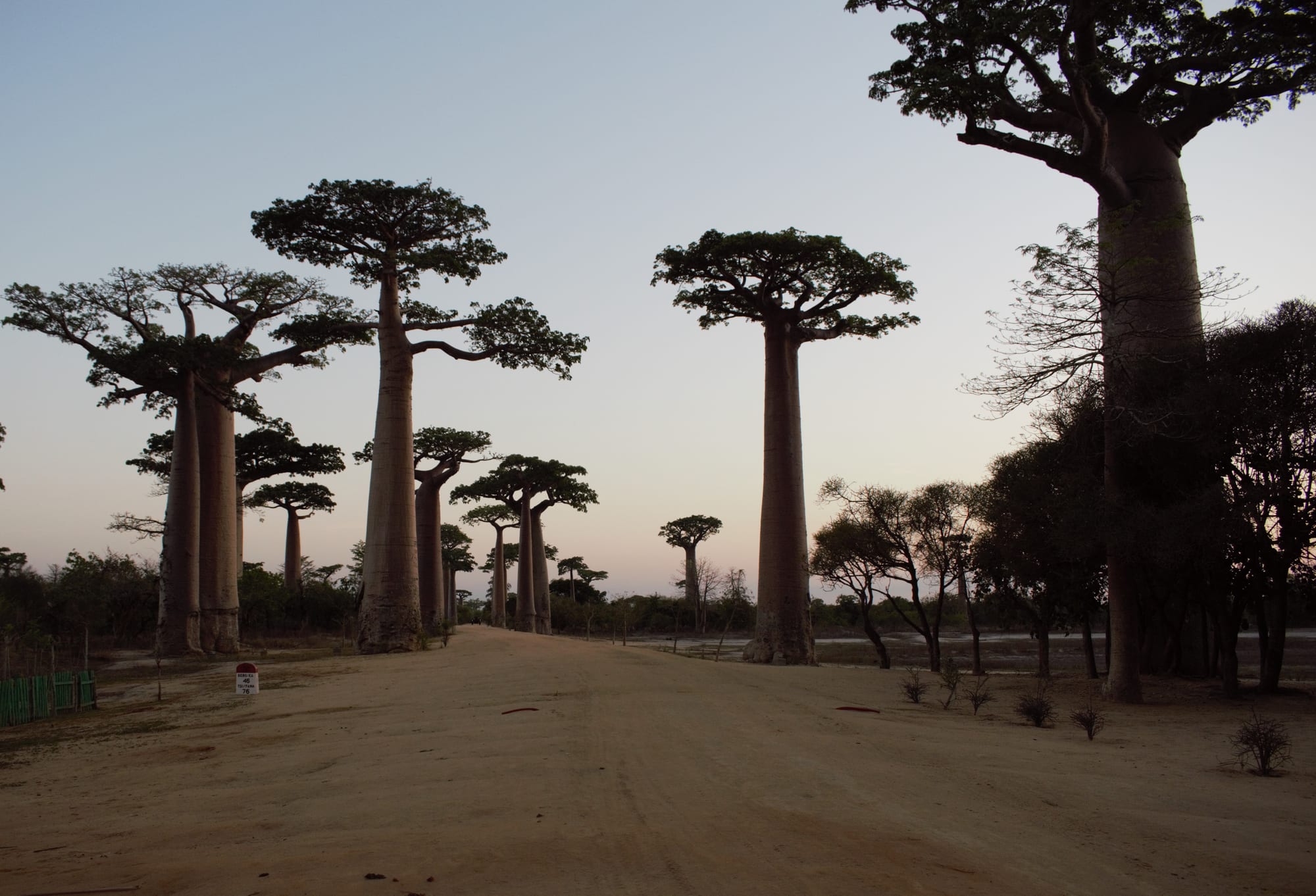
A row of enormous, smooth-trunked baobab trees lining a red dirt road, silhouetted against a warm evening sky

Madagascar

The Avenue of the Baobabs near Morondava, a dirt road lined with towering Grandidier's baobabs. (Cactus0625 / Wikimedia Commons · CC BY-SA 4.0)

The world's fourth-largest island, adrift off East Africa for 88 million years — long enough that most of its wildlife lives nowhere else — with a people of Southeast Asian and African origin and a culture built on reverence for ancestors.

Explore Madagascar

History

Madagascar was one of the last large landmasses on Earth to be settled by people. The first arrivals, around 1,500 to 2,000 years ago, came by sea and were primarily of Austronesian (Southeast Asian) origin — the Malagasy language is closely related to a language of Borneo — later joined and mixed with East African, Arab, and other Indian Ocean peoples. Rice farming and outrigger canoes came with them.

The island was divided among highland and coastal kingdoms until, in the early nineteenth century, the Merina Kingdom based in Antananarivo unified most of it, adopted Christianity and a written script, and modernised. France invaded in 1895–96, abolished the monarchy, and ruled Madagascar as a colony; a 1947 anti-colonial uprising was crushed with tens of thousands of deaths.

Independence came in 1960. The decades since have brought a Soviet-aligned socialist period under Didier Ratsiraka, repeated political crises and disputed transfers of power — including a 2009 coup that led the former DJ and mayor Andry Rajoelina to power and got the country cut off from aid — and, through it all, a slow decline: Madagascar is one of the poorest countries in the world, with income per head lower than at independence.

  • Madagascar: The Eighth Continent A vast Indian Ocean island settled from Borneo, unified by the Merina kings, conquered by France after a bloody war, and marked by the 1947 uprising and decades of decline since

Culture & Customs

Malagasy culture is unusually unified across a large island — one language, one broad worldview — and centred on the ancestors (razana). The clearest expression is the famadihana, the "turning of the bones," a highland ceremony in which families exhume ancestors every several years, rewrap them in fresh silk shrouds, dance with them, and rebury them; tombs are often grander and more carefully built than houses.

A pervasive system of fady — taboos that vary by place, clan, and family — governs behaviour: which days one may work, which foods to avoid, whether to point at a tomb. These are taken seriously and visitors are expected to respect local guidance. Other traditions include the hira gasy day-long highland performances, the valiha bamboo zither, zebu cattle as wealth and sacrifice, and a slow, proverb-rich style of conversation summed up as mora mora — take it easy.

Most Malagasy are Christian, often blended with ancestral belief, with a Muslim minority on the coasts. The eighteen recognised ethnic groups — highland Merina and Betsileo, cattle-herding Bara and Antandroy of the south, coastal Vezo, Sakalava, and others — differ in dialect, custom, and livelihood.

Daily Life

About a tenth of the roughly 30 million people live in Antananarivo, a hilly highland capital of stairways, rice paddies in the low ground, and crumbling French-colonial and Merina architecture. The rest are overwhelmingly rural, farming rice terraces, growing vanilla and cloves in the northeast, herding zebu in the south, and fishing the coasts.

The economy rests on subsistence rice, on vanilla — Madagascar produces most of the world's natural supply, a boom-and-bust crop plagued by price swings and theft — on cloves, cocoa, coffee, lychees, nickel, and a slowly growing tourism sector. Deforestation from slash-and-burn farming, charcoal, and illegal rosewood logging has stripped most of the original forest, and the far south suffers recurrent drought and hunger.

Daily life follows the farming and rains, the market, the church and the ancestral tomb, and the long, slow journey by bush taxi between towns.

Food

Malagasy cooking is built on rice — vary — eaten at every meal, often three times a day, with a side (laoka) of meat, fish, beans, or greens in a light broth. Romazava, a beef-and-leafy-greens stew flavoured with the peppery herb anamalao, is the national dish, and ravitoto (pounded cassava leaves cooked with pork) is close behind.

Zebu meat, grilled or stewed, chicken, freshwater and sea fish, and koba (a rice-flour, peanut, and banana log steamed in leaves) are common, with sakay, a fiery chilli condiment, on the side. The coasts add coconut-based curries and excellent seafood.

Ranovola or ranon'apango, "burnt-rice water" made by boiling water in the pot after the rice, is the everyday drink; toaka gasy (home-distilled rum) and THB (Three Horses Beer) are the alcoholic staples, and Madagascar grows its own coffee and vanilla-scented everything.

Attractions & Natural Wonders

The Avenue of the Baobabs near Morondava — a red dirt road lined with towering Grandidier's baobabs, best at sunrise or sunset — is the island's signature image. For wildlife, Andasibe-Mantadia in the eastern rainforest is the easiest place to see and hear the indri, the largest living lemur, with its siren-like call; Ranomafana and Masoala add more rainforest species.

Isalo National Park in the south is a sandstone massif of canyons, natural pools, and palm-filled oases; the Tsingy de Bemaraha in the west is a UNESCO site of razor-sharp limestone pinnacle "forests" and gorges, reached by rough track and river. The classic overland route is the Route Nationale 7 from Antananarivo to Toliara, taking in highland craft towns, Antsirabe's rickshaws, the Anja reserve's ring-tailed lemurs, wine country, and Isalo.

The coasts and islands are the beach draw: Nosy Be and its satellites off the northwest for diving and lemur-spotting, and Île Sainte-Marie off the east coast, a former pirate haven with whale-watching from July to September. The Amber Mountain and the eroded Red Tsingy near Diego Suarez in the far north round out a country where the getting-there is always part of the trip.

Planning basics

Budget

Madagascar is inexpensive on the ground — guesthouses, local "hotely" eateries, and taxi-brousse bush taxis cost little — but the poor roads and huge distances mean most visitors spend heavily on a hired 4x4 with driver or on internal flights. Park fees and mandatory guides add up. Cash is essential outside Antananarivo.

Daily Budget Midrange
USD 70–160 (hotel, hired car with driver, park fees and guides, some flights)
Daily Budget Shoestring
USD 25–45 (guesthouse, hotely food, taxi-brousse)

A 4x4 and driver for the classic Route Nationale 7 trip is the biggest single cost; split it between travellers.

Visa Requirements

Tourists of most nationalities get a visa on arrival at the main airports, or an e-visa in advance, in 30, 60, or 90-day versions. A yellow fever certificate is required if arriving from a risk country.

Typical Validity
30 to 90 days, e-visa or visa on arrival

Have US dollars or euros in cash for the on-arrival fee; the queue can be slow.

Safety

Petty theft and pickpocketing are common in Antananarivo, and there has been a rise in armed robbery, home invasion, and highway banditry ("dahalo" gangs) on some rural routes and in the deep south and southwest. Add cyclones and flooding, intense malaria on the coasts, and rough roads and overloaded bush taxis with a poor accident record.

Source
US Department of State and UK FCDO travel advisories — check for the latest wording.

Avoid walking in Antananarivo after dark and around the Analakely market, don't drive rural roads at night, take rigorous malaria precautions, and check regional advice for the south before travelling there.

Source: US Department of State and UK FCDO travel advisories — check for the latest wording.

Climate

Tropical but hugely varied. The east coast is hot and wet with rainforest and a cyclone season (December–March); the central highlands are temperate and can be genuinely cold at night in winter (June–August); the west is hot and dry; and the south is near-desert. The dry season, roughly April/May to October/November, is the main travel window.

Highlands
cool; Antananarivo 10–25°C, chilly winter nights
East Coast
hot, humid, wet; cyclones December–March
West And South
hot and dry

Transportation

Antananarivo's Ivato airport is the gateway, and internal flights (Madagascar Airlines / Tsaradia) link the regions, though schedules change often. Roads are poor and distances vast, so overland travel is measured in days; most visitors hire a 4x4 with driver. Shared taxi-brousse bush taxis are the cheap, slow, crowded alternative.

Do not underestimate travel times — the map lies. Night driving between towns is strongly discouraged.

Best Time to Visit

April/May to October/November, the dry season, for road access and hiking, with the cooler months good for the highlands. Humpback whales pass Île Sainte-Marie from July to September. Avoid the cyclone season, when the east coast roads can be cut for weeks.

Currency

The currency is the Malagasy ariary (MGA). It is one of only two currencies in the world not based on tens — five iraimbilanja to the ariary — and prices are sometimes still quoted in the old franc. It cannot be obtained abroad; change money on arrival.

Symbol
Ar
Cash To Bring
US dollars or euros to change
Currency Code
MGA — Malagasy ariary

Language

Malagasy — an Austronesian language, closely related to a language of Borneo — and French are the official languages. Malagasy is spoken by everyone, in regional dialects; French is used in government, business, and secondary education. English is limited to the tourism trade.

English
Limited; found mainly in tourism
Official Languages
Malagasy, French