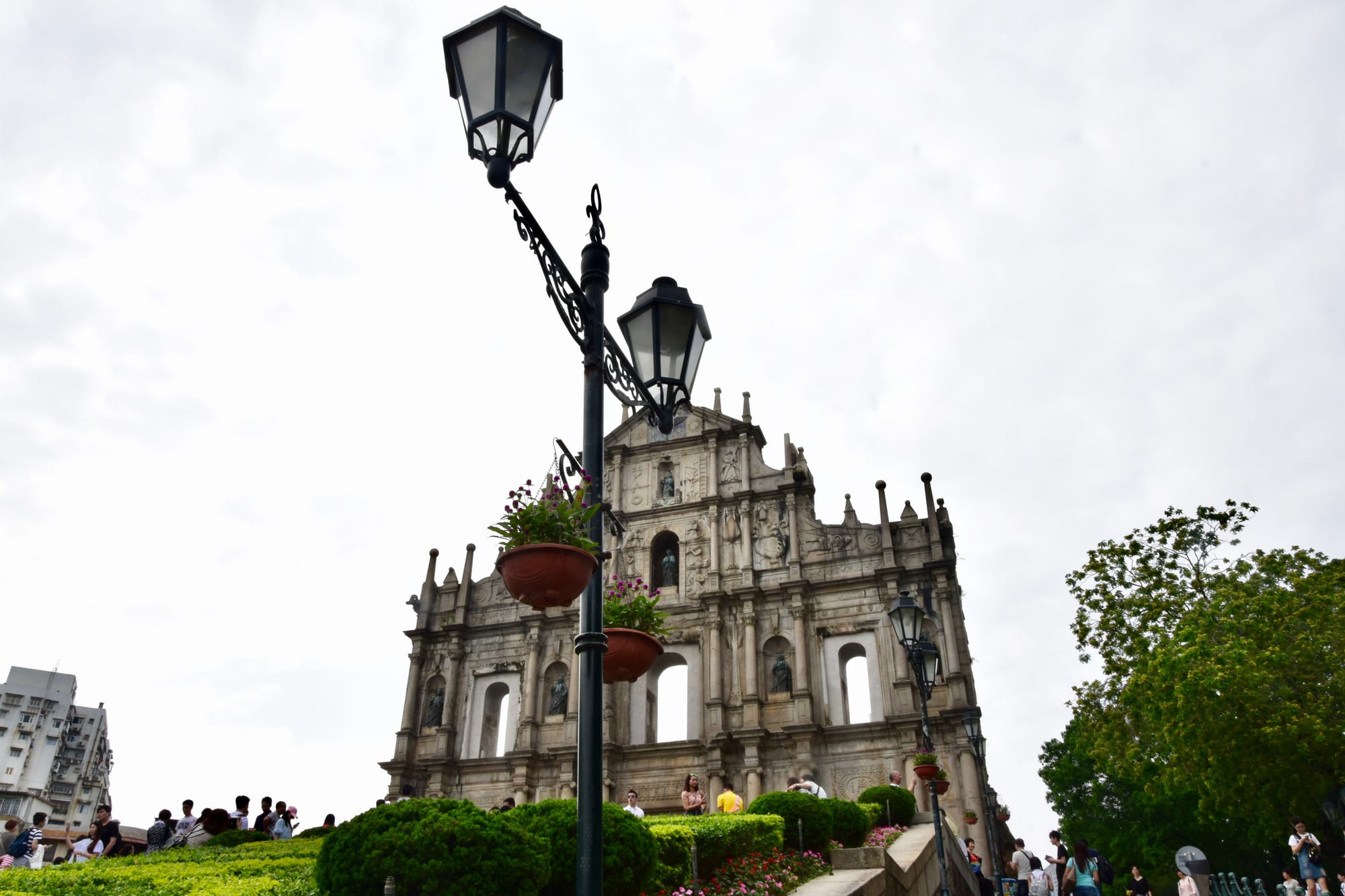
An ornate carved stone church facade standing alone at the top of a wide staircase against a blue sky, the rest of the building gone

Macau

The Ruins of St Paul's, the surviving front wall of a 17th-century Jesuit church, the symbol of Macau and part of its UNESCO-listed historic centre. (Ank Kumar / Wikimedia Commons · CC BY-SA 4.0)

A tiny, ultra-dense peninsula and pair of islands on China's south coast — the oldest European settlement in East Asia, Portuguese from the 1550s until 1999, and now a Chinese Special Administrative Region that has become the largest gambling centre in the world.

Explore Macau

History

Portuguese traders settled the peninsula around 1557 with the tolerance of Ming officials, paying an annual ground rent, and Macau became the hub of Portugal's trade with China and Japan and a base for the Jesuit mission to East Asia — the Church of St Paul and its college were built in this period. As Guangzhou opened and Hong Kong and the treaty ports rose in the nineteenth century, Macau's commercial importance faded, and it leaned on gambling, licensed from 1847.

Portugal declared full sovereignty in 1887. After Portugal's 1974 revolution it offered to return the territory; China preferred to wait, and Macau was redefined as "Chinese territory under Portuguese administration". The 1987 Sino-Portuguese Joint Declaration set the terms, and Macau was handed over on 20 December 1999 as a Special Administrative Region with its own Basic Law and a 50-year guarantee of its system, on the "one country, two systems" model.

In 2002 the government ended the decades-old gaming monopoly and licensed new operators, including American casino companies. Gaming revenue overtook the Las Vegas Strip by 2006 and grew to several times its size, funding an annual cash handout to residents and a vast building boom on reclaimed land between Taipa and Coloane, the Cotai Strip. The pandemic shut the border and collapsed tourism in 2020–22; visitors have since returned, and Beijing is pressing Macau to diversify away from its near-total dependence on gambling.

  • Macau: The First and Last Colony The oldest European settlement in East Asia — a Portuguese trading post from 1557, a decaying backwater in Hong Kong's shadow, the last colonial territory returned to China, and now the largest gambling centre on Earth

Culture & Customs

Macau is overwhelmingly Cantonese-speaking and Han Chinese, but four and a half centuries of Portuguese presence left a distinctive layer: pastel colonial buildings and baroque churches, calçada wave-pattern paving, Portuguese street names, and the Macanese — a small Eurasian community of mixed Portuguese and Asian descent with their own near-extinct creole, Patuá, and their own cuisine.

Catholic and Chinese religious life run in parallel, sometimes on the same street: the A-Ma Temple to the sea goddess who may have given Macau its name, and the churches of the historic centre, a UNESCO World Heritage Site. Festivals follow both calendars — the Feast of the Drunken Dragon and A-Ma alongside the Procession of the Passion — and the Macau Grand Prix, run since 1954 through the streets of the peninsula, is the city's great secular event.

Daily Life

About 685,000 people live on roughly 33 square kilometres, making Macau one of the most densely populated places on Earth. Gaming and the tourism around it account for the bulk of the economy and, directly or indirectly, most jobs; residents receive an annual share of the gaming windfall in cash.

The territory is knitted ever more tightly to the neighbouring mainland city of Zhuhai and to the wider Greater Bay Area, with huge daily cross-border flows of workers and visitors and the long bridge to Hong Kong. Property is expensive, imported labour fills many service jobs, the population is ageing, and crime is low. Everyday life is compact and walkable in the old core, and shaped by the rhythms of the casinos and the tourist week.

Food

Macanese cuisine is often called the world's first fusion food, blending Portuguese techniques with ingredients and spices gathered along Portugal's trade routes through Africa, India, and Southeast Asia. Signature dishes include minchi (minced beef or pork with diced potato, soy, and a fried egg), African chicken (grilled in a coconut-and-chilli sauce), Portuguese chicken, tacho (a winter hotpot), and serradura "sawdust pudding".

Alongside it, Macau has excellent Cantonese cooking, and its snacks are famous: the Macau-style Portuguese egg tart with a scorched top, the crisp pork-chop bun, and the almond cookies and slabs of bak kwa jerky sold along the Rua do Cunha in Taipa Village. Portuguese wines, vinho verde, and port are widely available, a legacy of the colonial connection.

  • Macau: Food and the National Dish A misleadingly named chicken dish that traces its spice through four continents, from a territory often credited with the world's first fusion cuisine

Attractions & Natural Wonders

The historic centre threads from the Ruins of St Paul's and the Monte Fort above it, past the Macau Museum, down to Senado Square with its rippling paving and pastel façades, and on to A-Ma Temple by the inner harbour. Other stops include St Joseph's and St Lawrence's churches, the Mandarin's House, the Moorish Barracks, and the Guia Fortress with its lighthouse and chapel, the oldest on the China coast.

Taipa Village keeps a strip of Macanese houses, now a museum, and green Coloane has the black sand of Hac Sa beach and a quiet colonial-era church. The Cotai Strip is the other Macau entirely: casino-resorts built as themed cities — a canal-and-gondola Venice, an Eiffel Tower, a mock London — with arena shows, shopping malls, and the "House of Dance" spectacular.

Macau Tower offers a glass floor and one of the world's highest commercial bungee jumps, and the streets of the peninsula host the Grand Prix each November, when Formula 3 cars and motorcycles race past the same baroque churches.

  • Macau: Seven Attractions and Natural Wonders A Portuguese-Chinese old town that survived 450 years of colonial history, the highest bungee platform on earth, casino resorts bigger than the Las Vegas Strip, and a fishing village where it all began

Planning basics

Budget

Room rates swing hard: cheap midweek, expensive at weekends when mainland visitors pour in. The casinos subsidise the local economy — free shuttle buses, cheap buffets — which visitors can use. Day-trippers from Hong Kong keep costs down; staying over is where the expense is.

Daily Budget Midrange
MOP 1,200–3,000 / USD 150–370 (hotel, restaurant meals, a show, taxis)
Daily Budget Shoestring
MOP 500–850 / USD 60–105 (guesthouse, food courts and bakeries, buses, or a day trip from Hong Kong)

Visit midweek or as a day trip from Hong Kong, and use the free casino shuttle buses to get around.

Visa Requirements

Macau runs its own immigration, separate from mainland China and from Hong Kong. Citizens of the EU, UK, US, Canada, and Australia enter visa-free for 30 to 90 days depending on nationality; many others get 30 days. Entering from or to the mainland or Hong Kong is a separate border crossing each time.

Typical Stay
30–90 days visa-free for most Western passports

A Macau entry does not cover mainland China or Hong Kong — each is a separate crossing with its own rules.

Safety

Macau is very safe for visitors, with low violent crime; the pawnshop and loan-shark fringe around the casinos and occasional organised-crime disputes do not affect tourists. Pickpocketing occurs in crowds. The real local harm is problem gambling and the debt that follows it. Typhoons are the main natural hazard, and the old town can flood in a big storm.

Health
Tap water is safe but most drink bottled; summer heat and humidity are severe

Set a firm limit before entering a casino, watch your belongings in crowds, and check typhoon signals in summer.

Climate

Humid subtropical, the same pattern as Hong Kong: hot, sticky summers (May–September) with a typhoon risk that can flood the low-lying old town, a warm and dry autumn (October–December) that is the best season, and a cool, sometimes damp winter.

Autumn
Warm, dry, clear (October–December)
Summer
Hot, humid, typhoon-prone (May–September)

Transportation

Macau International Airport is on Taipa. Most visitors instead arrive by ferry from Hong Kong (about an hour) or overland from Zhuhai and across the Hong Kong–Zhuhai–Macao Bridge. On the ground, the free casino shuttle buses are the great transport hack, backed by cheap public buses, a short Light Rapid Transit line on Taipa, and taxis. The historic centre is walkable.

Ride the free casino shuttles between the ferry terminals, the border, and the main sights; the old town is best on foot.

Best Time to Visit

October to December for dry, comfortable weather. The Macau Grand Prix takes over the city streets in mid-November. Avoid the humid, storm-prone summer, and expect crowds and higher prices around Chinese New Year and mainland holiday weeks.

Events
Macau Grand Prix (November); the A-Ma Festival and the Feast of the Drunken Dragon (spring); the Procession of the Passion of Our Lord (Lent); the International Fireworks Contest (September)

Currency

The currency is the Macanese pataca, pegged to the Hong Kong dollar at about 1.03. Hong Kong dollars are accepted everywhere at par in practice, though change is given in patacas. Cards and mobile wallets are standard in hotels and casinos.

Symbol
MOP$
Currency Code
MOP — Macanese pataca (Hong Kong dollars accepted at par)

Language

Chinese (Cantonese) and Portuguese are both official. Cantonese is the everyday language; Portuguese survives mainly in signage, the courts, and a small community, and is spoken by a minority. English is widely understood in hotels, casinos, and tourism, and Mandarin is increasingly common.

Also Used
English in tourism; Mandarin increasingly
Official Languages
Chinese (Cantonese) and Portuguese