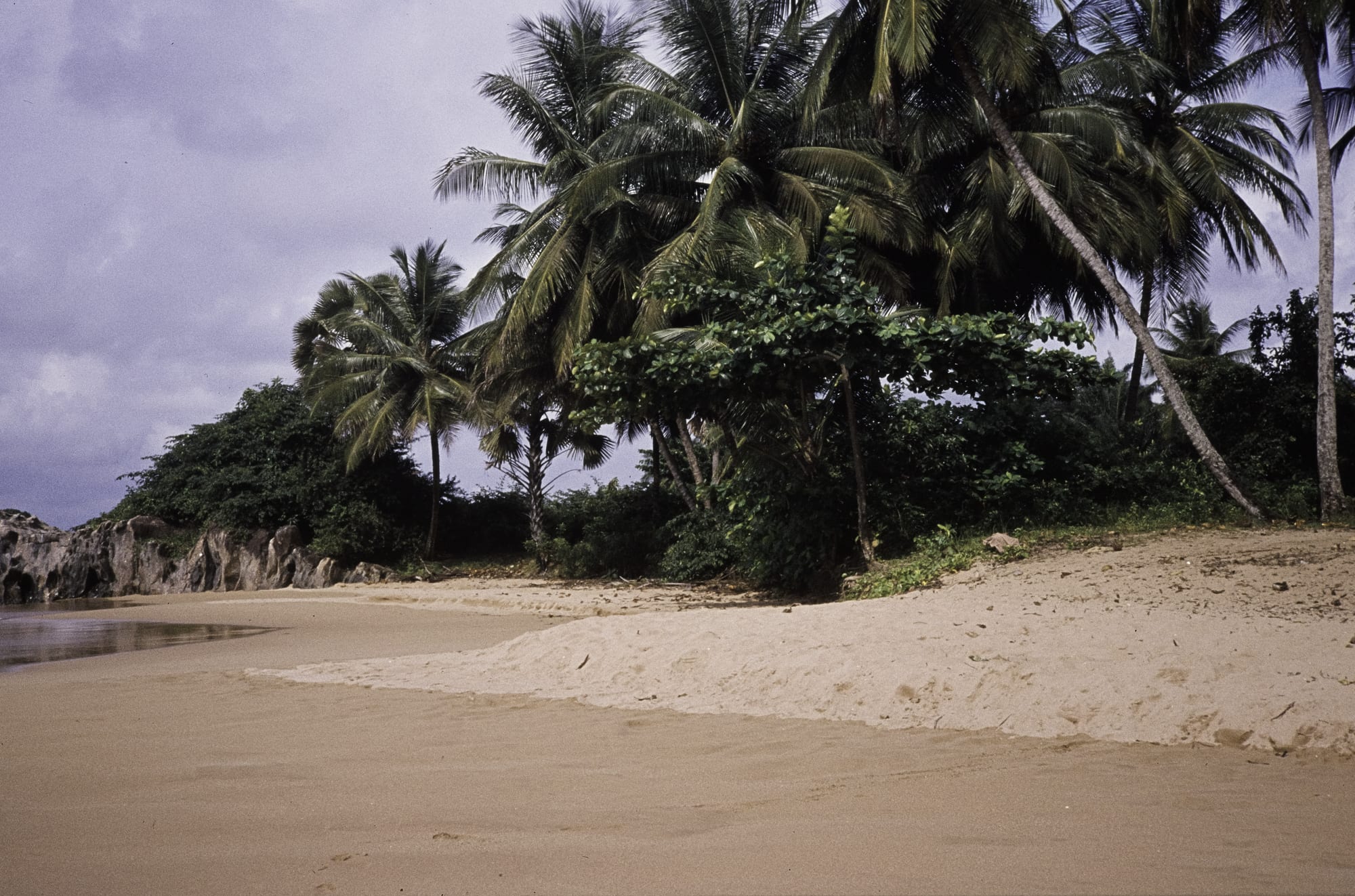
Coconut palms leaning over a wide, empty sandy beach with scattered dark rocks and Atlantic surf breaking beyond

Liberia

The Atlantic coast near Fishtown in southeastern Liberia — long, lightly developed beaches back much of the country's shore. (Fred van der Kraaij / Wikimedia Commons · CC BY-SA 4.0)

Africa's oldest republic — founded in 1822 as a settlement for freed African-Americans — with an Atlantic coast of surf beaches and rainforest, still rebuilding from two brutal civil wars and the Ebola epidemic.

Explore Liberia

History

Liberia was founded in 1822 by the American Colonization Society as a settlement for freed and freeborn African-Americans, and declared independence in 1847 — the oldest republic in Africa. The settlers, known as Americo-Liberians, built a state with a flag, constitution, and politics modelled on the United States, and ruled the Indigenous majority — around 95 percent of the population — as a disenfranchised underclass through a single party for more than a century. Firestone established the world's largest rubber plantation here in 1926.

In 1980 a coup led by Master Sergeant Samuel Doe, from an Indigenous group, ended Americo-Liberian dominance and began a slide into disaster. Two civil wars, from 1989 to 1997 and 1999 to 2003 — Charles Taylor's insurgency, the use of child soldiers, mass atrocities, and spillover into Sierra Leone — killed around a quarter of a million people and destroyed the economy and infrastructure.

Peace came in 2003 with a regional and then a UN peacekeeping force. Ellen Johnson Sirleaf, elected in 2005, became Africa's first elected woman head of state and a Nobel Peace laureate. The footballer George Weah was president from 2018 to 2023, when Joseph Boakai won. Liberia was also the hardest-hit of the three countries in the 2014–16 West African Ebola epidemic, which killed almost 5,000 people here.

  • Liberia: The Settler Republic Africa's oldest republic, founded in 1822 by freed African Americans who ruled the Indigenous majority for 133 years — a rubber economy, a 1980 coup, 14 years of civil war, and a hard recovery

Culture & Customs

Liberia is culturally distinctive in West Africa for its American inheritance — the language, the place names, Baptist and other American church traditions, and the "Congo" elite's Antebellum-style architecture in Monrovia — layered over Indigenous cultures. About sixteen Indigenous ethnic groups, in three broad language families, retain strong traditions, including the Poro and Sande secret societies that run initiation and much of village governance.

Most Liberians are Christian, with a Muslim minority among the Mandingo and Vai, and syncretic practice widespread. The Vai are notable for having invented their own syllabic script in the nineteenth century, one of the few Indigenous writing systems developed in Africa.

Football is a national passion — George Weah's rise to the world's best player and then the presidency is a point of enormous pride — and music, storytelling, and mask traditions are strong. Hospitality is warm, and Liberians are generally quick to welcome the rare foreign visitor.

Daily Life

Around a quarter of the population lives in Greater Monrovia, a sprawling, low-lying coastal city of markets, half-finished concrete, and the ruined Ducor Hotel on its hill. The rest of the country is farming villages and small towns, many cut off by bad roads in the rains, and the mining and plantation enclaves.

Liberia is one of the poorest countries in the world, still recovering from war and Ebola, with the economy resting on iron ore, rubber, gold, timber, and palm oil, on remittances, and — a quirk — on the world's second-largest ship registry, which flies the Liberian flag of convenience. Unemployment and under-employment are very high, and electricity and clean water remain scarce.

Daily life runs on the shared taxi, the market, the church, and the extended family, with the single long rainy season shaping the farming and travelling year.

Food

Liberian cooking is West African, built on rice — eaten at nearly every meal — with a rich, often fiery soup or stew poured over it. Cassava leaf (pounded and simmered with palm oil, meat or fish, and seasoning), potato greens, and palm-butter soup are the classics, along with jollof rice, "dry rice" with gravy, and "check rice" with greens.

"Dumboy" and "fufu" (pounded cassava) are eaten with pepper soup; "torborgee" is a pungent fermented-bean stew; and grilled fish and chicken with pepper sauce are the street staples. The American influence shows in cornbread, biscuits, and doughnuts.

Palm wine and cane juice (a raw sugarcane spirit) are the traditional drinks, along with ginger beer, and Club Beer is the local lager. Kola nuts are exchanged as a gesture of welcome and respect.

  • Liberia: Food and the National Dish A rich palm-nut soup ladled over rice, in a West African nation whose food carries a distinctive layer of history unlike any of its neighbours'

Attractions & Natural Wonders

Liberia's tourism is minimal, and its appeal is coast and forest rather than built sights. Monrovia has Providence Island, where the first settlers landed, a small national museum, the bustling Waterside market, and the view from the skeletal Ducor Hotel, plus city beaches that are best appreciated from a distance because of pollution and currents.

Robertsport, on Lake Piso in the northwest, is the country's most relaxed spot — a small town with long empty beaches and some of the best-known surf breaks in West Africa, plus fishing pirogues and a scattering of simple lodges. Marshall, south of Monrovia, has river islands and mangroves.

Sapo National Park, in the southeast, protects the largest area of primary rainforest in the country, part of the Upper Guinean forest belt, with forest elephants, pygmy hippos, and chimpanzees. It is hard to reach and lightly developed, visited only by determined travellers with an organised expedition. Kpatawee Falls in Bong County and the Firestone plantation are other occasional stops.

  • Liberia: Eight Attractions and Natural Wonders Africa's oldest republic, founded by freed African-Americans — a surf coast still finding its tourists, a rainforest holding pygmy hippos, and a war-scarred hotel with the best view in the capital

Planning basics

Budget

Liberia is expensive relative to what is on offer, with Monrovia hotel and restaurant prices inflated by the aid and NGO economy and by heavy reliance on imports and generators. Local guesthouses and "cook shops" are cheap. Cash — Liberian and US dollars — is essential.

Source
Limited recent traveller data — verify against a current source.
Daily Budget Midrange
USD 100–200 (Monrovia hotel, hired car with driver, a trip to Robertsport)
Daily Budget Shoestring
USD 40–70 (basic guesthouse, local food, shared taxis)

Carry US dollars for larger payments and Liberian dollars for small ones; ATMs are limited to Monrovia and unreliable.

Source: Limited recent traveller data — verify against a current source.

Visa Requirements

A visa is required for most nationalities and must generally be arranged in advance at a Liberian embassy; a visa on arrival is possible with prior approval. A yellow fever vaccination certificate is mandatory for entry.

Typical Validity
30 to 90 days, single or multiple entry

Apply well ahead through an embassy, and carry your yellow fever card with your passport.

Safety

Liberia is calm at the national level but the state is weak, and rates of armed robbery, burglary, and rape are high, with Monrovia requiring the most caution. Mob justice, poor roads, and disease (malaria is intense, and Ebola is a recent memory) are the other realities.

Source
US Department of State and UK FCDO travel advisories — check for the latest wording.

Do not walk after dark, avoid isolated beaches, use arranged transport, keep a low profile with valuables, and take rigorous malaria precautions. Most governments urge a high degree of caution.

Source: US Department of State and UK FCDO travel advisories — check for the latest wording.

Climate

Tropical and among the wettest in West Africa. The long rainy season runs from about May to October — Monrovia is one of the rainiest capitals in the world — with a shorter dry season (November–April) that includes the dusty Harmattan haze early on.

Dry Season
November–April, hot and humid; hazy during the Harmattan
Rainy Season
May–October, very heavy rain, roads deteriorate badly

Transportation

Roberts International Airport, southeast of Monrovia, is the gateway, with a long road into the city. There is no passenger rail (the lines serve the mines). Roads outside Monrovia range from paved to impassable in the rains; shared taxis and minibuses cover the main routes, and a hired 4x4 with driver is needed for the interior.

Reaching Sapo National Park or the southeast is a serious overland undertaking best arranged with a local operator.

Best Time to Visit

November to April, the dry season, for passable roads, better surf conditions at Robertsport in the earlier months, and easier travel to Sapo and the interior. The rains make much of the country hard to move around.

Currency

Liberia uses the Liberian dollar (LRD), but the US dollar circulates alongside it and is used for hotels, larger purchases, and much of the formal economy. Prices are often quoted in US dollars.

Symbol
$ (L$ / US$)
Cash To Bring
US dollars, in cash
Currency Code
LRD — Liberian dollar; US dollars in wide use

Language

English is the official language, spoken in a distinctive Liberian form, with "Kolokwa" (Liberian Kreyol) as a widely used vernacular. Around twenty Indigenous languages are spoken — Kpelle, Bassa, Grebo, Kru, Vai (which has its own Indigenous script) — often as first languages.

Vernacular
Kolokwa (Liberian Kreyol)
Official Language
English