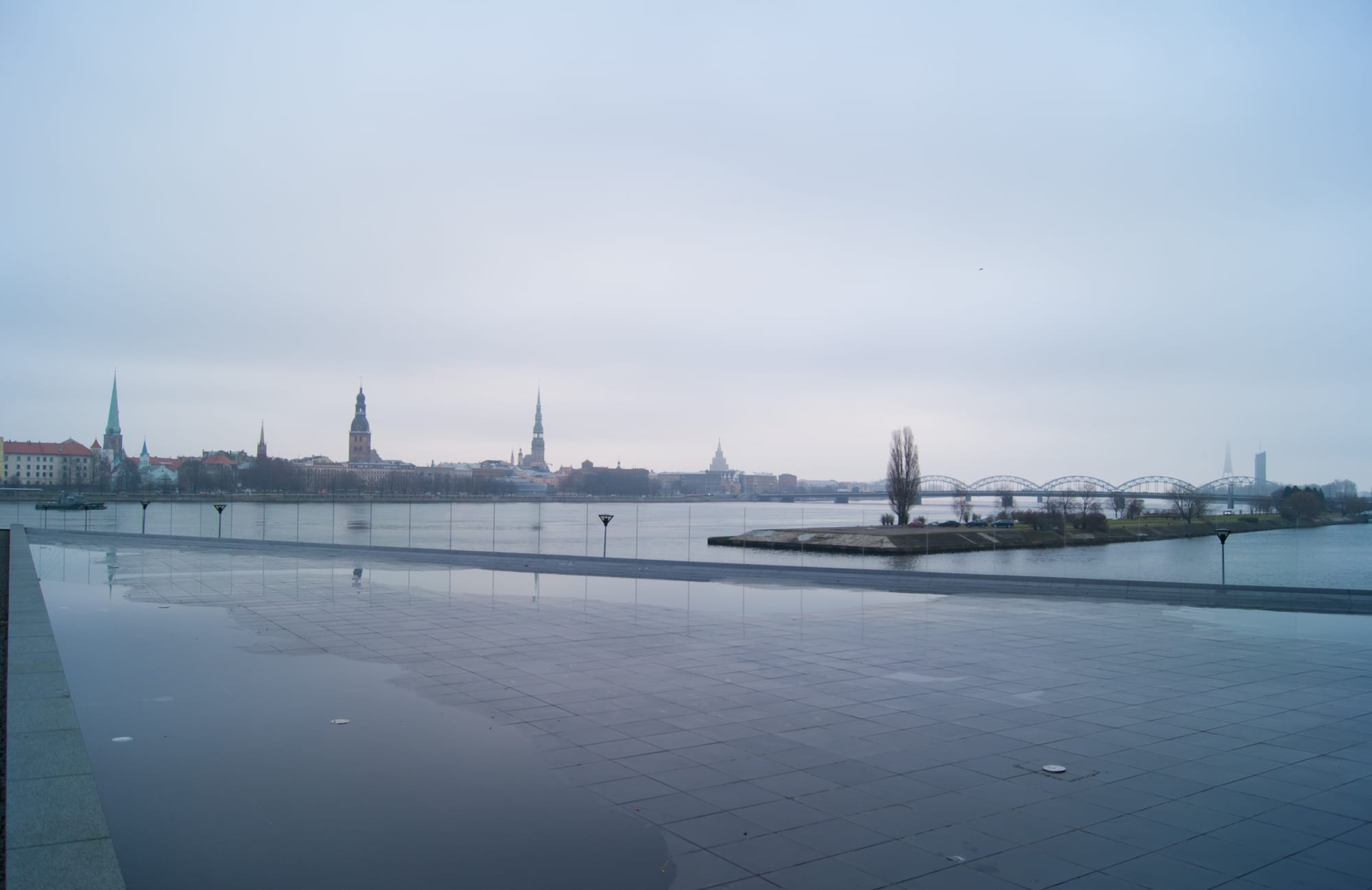
A skyline of church spires and red-tiled roofs rising above a river, seen from across the water under a pale sky

Latvia

The spires of Riga's Old Town — St Peter's, the Dome, and St James's — above the Daugava River. (Guillaume Speurt / Wikimedia Commons · CC BY-SA 2.0)

The middle Baltic state — flat, forested, and bog-strewn, on the Baltic Sea — with a Hanseatic capital famous for its Art Nouveau, a language spoken almost nowhere else, and a large Russian-speaking minority.

Explore Latvia

History

Latvians and the related Livonians were among the last pagan peoples in Europe until German crusaders — the Livonian Order — conquered the region in the thirteenth century. For the next 700 years Latvia was ruled by others: the Order, Poland-Lithuania, Sweden, and, from the eighteenth century, the Russian Empire, while a German-speaking nobility owned the land and Riga grew as a major Hanseatic and then imperial port.

A national awakening in the nineteenth century produced a Latvian-language press, literature, and choirs. Latvia declared independence in 1918 and secured it in a war against both German and Soviet forces, enjoying two decades as first a democracy and then an authoritarian state before the 1939 Molotov–Ribbentrop Pact assigned it to the Soviet sphere.

Soviet occupation in 1940, Nazi occupation from 1941 — when the Holocaust destroyed Latvia's Jewish community — and Soviet re-occupation in 1944 followed, with mass deportations to Siberia and an armed "Forest Brothers" resistance. Soviet-era industrialisation brought a huge influx of Russian-speakers, and by 1989 Latvians were barely a majority. Non-violent mass protest — the "Singing Revolution" and the 1989 Baltic Way — helped restore independence in 1991, and Latvia joined NATO and the EU in 2004.

  • Latvia: Riga and the Baltic Crossroads A Baltic people conquered by German crusaders and ruled for seven centuries by Swedes, Poles and Russians — two decades of independence between the wars, a Soviet half-century, and a return to Europe

Culture & Customs

Latvian identity is bound up with the land, the forest, and folk song. The dainas, a vast corpus of short, unrhymed four-line verses, carry pre-Christian myth and everyday wisdom, and the Song and Dance Festival — held every five years, with tens of thousands of choral singers before an audience in the six figures — is on UNESCO's list and is tied to the independence story.

Jāņi, the midsummer festival, is the emotional heart of the year: bonfires, oak and flower wreaths, caraway cheese and beer, and staying up until the sun rises. Amber, "Baltic gold" washed up on the shore, is worked into jewellery and sold everywhere.

Latvians have a reputation, which they accept, for reserve and understatement. Sauna culture, forest walks, mushroom and berry picking, and a strong following for ice hockey and, historically, basketball round out daily life. Religion — Lutheran in the west and centre, Catholic in Latgale, Orthodox among Russians — is present but observance is low.

Daily Life

About a third of Latvia's 1.9 million people live in Greater Riga, the largest city in the Baltic states. Daugavpils in the southeast is largely Russian-speaking; Liepāja and Ventspils are Baltic ports; and much of the country is farmland, forest, and small towns, with a low and ageing population.

The economy is open and services-heavy — transit and logistics, timber and wood products, IT, and finance — closely tied to the EU and the Nordic countries. Emigration of young people since EU accession, and one of the world's lowest birth rates, have shrunk the population, and security anxiety about Russia, on whose border Latvia sits, runs through public life.

Daily life is quiet and outdoors-friendly: the commute, the market, the sauna, the summer at a country house or on the coast, and long light evenings in June set against dark, indoor winters.

Food

Latvian cooking is northern and seasonal, built on rye bread, potatoes, dairy, pork, fish, and forest foods. Dark sourdough rye is eaten at every meal; sklandrausis, a sweet carrot-and-potato tart, is a Kurzeme speciality; and grey peas with speck (pelēkie zirņi ar speķi) is close to a national dish.

Cold beet soup (aukstā zupa), a shocking-pink summer soup of kefir and beetroot; smoked and pickled Baltic fish and sprats on rye; cottage cheese (biezpiens) in many forms; and rupjmaizes kārtojums, a dessert of rye breadcrumbs, cream, and cranberry, are all traditional.

Kvass, a fermented rye-bread drink, is popular in summer; Rīgas Melnais balzams (Riga Black Balsam), a dark, bitter herbal liqueur, is the national spirit; and craft beer and cider have grown fast.

Attractions & Natural Wonders

Riga is the centrepiece. The medieval Old Town — the reconstructed House of the Blackheads, the Three Brothers, St Peter's and the Dome, the Town Hall Square, and the winding lanes — is a UNESCO World Heritage Site, and the "quiet centre" just outside the walls has one of the finest concentrations of Art Nouveau architecture in the world, especially along Alberta and Elizabetes streets. The Central Market fills old Zeppelin hangars, and the Ethnographic Open-Air Museum on the city's edge gathers farmsteads from across the country.

Jūrmala, a short train ride west, is a strung-out seaside resort of wooden villas and a pine-backed white-sand beach. East of Riga, the Gauja National Park around Sigulda and Cēsis has castles — the red-brick tower of Turaida, medieval Cēsis — a river valley, caves, and a Soviet-built bobsleigh track you can ride.

Rundāle Palace, a Baroque country residence by the architect of the Winter Palace, is the "Latvian Versailles." The Kurzeme coast offers Cape Kolka, where two seas meet, and Liepāja's abandoned Tsarist and Soviet naval base at Karosta. In the east, Latgale is "the land of blue lakes," with the Aglona basilica, a major Catholic pilgrimage site, and Daugavpils, birthplace of the painter Mark Rothko, who has a museum in the town's old fortress.

  • Latvia: Eight Attractions and Natural Wonders The largest collection of Art Nouveau architecture in the world, a river valley of sandstone cliffs and castles, a beach resort that entertained the Soviet elite, and a bog you cross on a raised walkway

Planning basics

Budget

Latvia is mid-range for the EU — cheaper than the Nordic countries across the sea, a little pricier than it was before the euro. Riga's Old Town is the most expensive spot; the regions, markets, and self-catering keep costs down. Card and phone payment is near-universal.

Daily Budget Midrange
EUR 100–180 (mid-range hotel, restaurants, a rental car, day trips)
Daily Budget Shoestring
EUR 45–75 (hostel or guesthouse, market and café food, buses)

Visa Requirements

Latvia is in the EU, the Schengen Area, and the eurozone. Citizens of the EU, the UK, the US, Canada, Australia, and many other countries need no visa for stays of up to 90 days in any 180-day period.

Typical Stay
90 days in any 180-day period, visa-free, for most Western passports

Safety

Latvia is a safe country with low levels of violent crime. Petty theft and overpriced or scam bars aimed at stag groups occur in Riga's Old Town, and winter driving and thin ice are the seasonal hazards.

Watch belongings in the Old Town nightlife area, agree bar prices, and use winter tyres in the cold season.

Climate

Cool temperate, moderated by the Baltic. Summers are short, mild, and bright, with long June days; winters are long, cold, and often snowy, with the sea sometimes freezing near the coast. Spring and autumn are brief and changeable, and the country is over half forest.

Summer
June–August, generally 17–23°C, near-midnight light in June
Winter
December–February, around -3 to -8°C, snow cover, short days

Transportation

Riga Airport is the main gateway, with ferries to Stockholm. Intercity buses are the backbone of domestic travel, frequent and cheap; trains serve Sigulda, Jūrmala, and other lines. A rental car suits Kurzeme and Latgale. Riga has trams, trolleybuses, and buses.

Jūrmala and Sigulda are quick, easy train trips from Riga; a car helps for the Cape Kolka coast and the eastern lakes.

Best Time to Visit

May to September for mild weather, the beaches and forests at their best, and the light nights of June, when Jāņi (midsummer, 23–24 June) is the biggest holiday. Winter offers a snowy Old Town, Christmas markets, and quiet, at the cost of cold and dark.

Currency

Latvia uses the euro, adopted in 2014. Cards and contactless work everywhere, and some places no longer take cash.

Symbol
Currency Code
EUR — euro

Language

Latvian, a Baltic language related only to Lithuanian, is the official language. Russian is the first language of about a quarter of the population, concentrated in Riga, the eastern region of Latgale, and some industrial towns; citizenship and language politics remain sensitive. English is widely spoken by younger people.

English
Common among younger people and in tourism
Russian
Spoken by a large minority
Official Language
Latvian