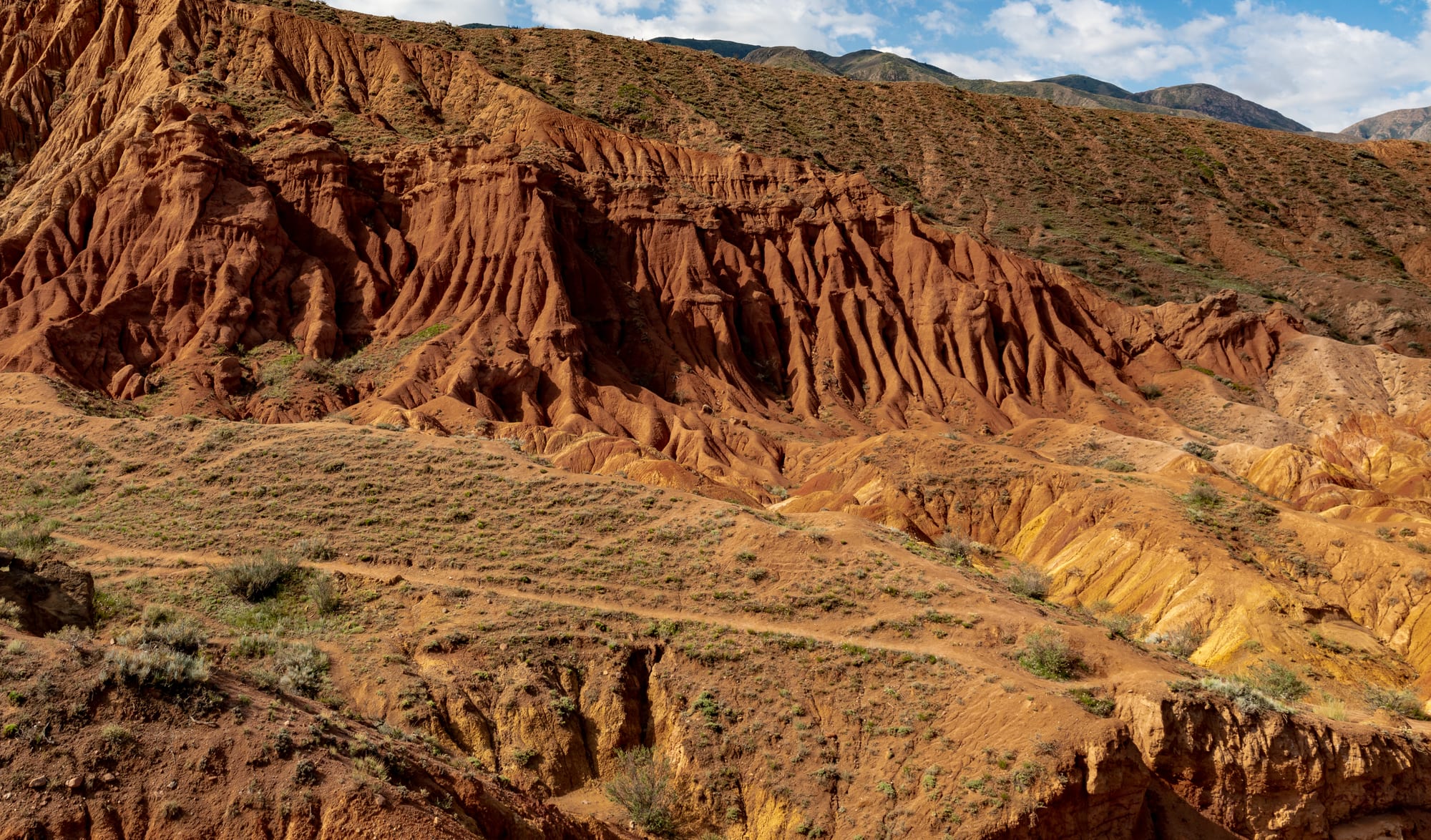
Ridges and gullies of eroded red and ochre rock rising in jagged fins above a dry valley, with dark mountains beyond

Kyrgyzstan

The eroded red sandstone of Skazka ("Fairy Tale") Canyon on the south shore of Lake Issyk-Kul. (Ninara / Wikimedia Commons · CC BY 2.0)

A small, almost entirely mountainous country in the Tian Shan of Central Asia — with a living nomadic culture of yurts, horses, and high summer pastures, and the most open borders and turbulent politics in the region.

Explore Kyrgyzstan

History

The Kyrgyz are a Turkic people with roots on the Yenisei River in Siberia, who migrated to the Tian Shan over centuries and lived as nomadic herders in a society of clans and tribes, without a centralised state. The Silk Road crossed the region, leaving caravanserais such as Tash Rabat and the trading history of Osh.

The Russian Empire annexed the area in the second half of the nineteenth century. A 1916 revolt against conscription was crushed, and tens of thousands of Kyrgyz died or fled to China in the "Urkun." Soviet rule drew the modern borders — cutting awkwardly across the Fergana Valley — collectivised the herds, and settled the nomads, while also building schools, roads, and industry.

Independence came in 1991. Kyrgyzstan has since been the most politically volatile of the Central Asian states, with three uprisings that ousted presidents — the 2005 "Tulip Revolution," a 2010 revolt followed by deadly Kyrgyz–Uzbek violence in Osh, and unrest in 2020 that brought Sadyr Japarov to power. Border clashes with Tajikistan in 2021 and 2022 killed dozens. The economy leans on gold mining, remittances from labour migrants in Russia, re-export trade, and, increasingly, tourism.

  • Kyrgyzstan: The Mountain Republic A nomad people of the Tian Shan with an epic half a million lines long — Russian conquest and the 1916 exodus, a Soviet republic, and three revolutions since independence

Culture & Customs

Kyrgyz culture is rooted in the nomadic life, and much of it is still practised: the yurt (its wooden crown, the tündük, is on the national flag), the seasonal move to the high jailoo pastures, herding on horseback, and hunting with golden eagles. Fermented mare's milk (kymyz), the kalpak felt hat, and felt carpets (shyrdak, ala-kiyiz) are everyday markers of identity.

The oral tradition is central. The Manas epic, one of the longest in the world, is chanted from memory by trained manaschy and is recognised by UNESCO, along with the felt-making and the ak-kalpak craft. Horse games — the wild goat-carcass contest kok-boru, long-distance racing, and games of skill and courtship on horseback — are performed at festivals, and Kyrgyzstan hosts the World Nomad Games.

Islam, adopted late and lightly, coexists with strong pre-Islamic and Tengrist elements; shrines, sacred trees and springs, and ancestor respect are widespread. Hospitality to travellers is a genuine obligation, and community-based tourism has turned that tradition into a network of homestays.

Daily Life

Bishkek, a leafy, low-rise Soviet-planned city beneath the Ala-Too range, holds a large share of the country's people and most of its formal jobs; Osh, in the south, is older, hotter, more Central Asian, and closer to Uzbekistan. The rest of the population lives in valley towns and mountain villages, herding, farming irrigated plots, and mining.

The economy is one of the poorest in the region. The Kumtor gold mine, nationalised from a Canadian company in 2021, is a major earner, but the single biggest source of income is money sent home by hundreds of thousands of Kyrgyz working in Russia. Winters bring power shortages, and the herding economy is exposed to hard seasons.

Daily life follows the marshrutka, the bazaar, and, in the countryside, the livestock calendar and the summer move to the pastures, where whole families live in yurts from June to September.

Food

Kyrgyz cooking is meat-and-dough food built for cold and altitude. Beshbarmak — "five fingers" — is boiled mutton or horse over wide flat noodles, eaten by hand at any celebration, with the broth drunk after. Kuurdak (fried meat and offal) and chuchuk (horsemeat sausage) belong to the same tradition.

The wider Central Asian repertoire is everywhere: plov (rice pilaf), manty (steamed dumplings), laghman (hand-pulled noodles in a spiced sauce or soup), samsa from the tandoor, and ashlan-fu, a cold Dungan noodle dish that is an Karakol speciality. Bread (nan) is baked in a clay oven and treated with respect.

Kymyz, fermented mare's milk, is the drink of summer on the pastures; maksym and jarma, fermented grain drinks, are sold on the street; and tea, poured from a height into bowls, is offered to every guest.

Attractions & Natural Wonders

Song-Köl is the classic Kyrgyz experience: a broad, cold lake at 3,000 metres, ringed in summer by herders' yurt camps, with horses grazing to the shore, huge skies, and dark nights. It is reached by rough road or on a multi-day horse or trekking route over the passes.

Lake Issyk-Kul, the second-largest alpine lake in the world, fills a basin in the north-east, with resort towns on the north shore and, on the south, the "Fairytale" (Skazka) canyon of eroded red rock, the "Seven Bulls" cliffs at Jeti-Ögüz, and hot springs. Karakol at its eastern end is the base for Tian Shan trekking — the turquoise Ala-Kul lake, the Karakol and Altyn Arashan valleys — and for skiing.

Elsewhere: Ala-Archa National Park's glacier and gorge walks a short drive from Bishkek; Tash Rabat, a stone caravanserai near the Torugart pass into China; the sacred Sulaiman-Too mountain rising out of Osh, a UNESCO site, with the country's biggest bazaar below; the Burana Tower, a Karakhanid minaret near Tokmok surrounded by carved stone figures; and Arslanbob, said to be the world's largest natural walnut forest.

Planning basics

Budget

Kyrgyzstan is inexpensive. Homestays, yurt camps, shared taxis (marshrutka), and hearty canteen meals cost little, and the community-based tourism networks make independent travel cheap and easy. Cash is essential outside Bishkek and Osh; ATMs are in the main towns.

Yurt Stay
Roughly USD 20–35 per person including meals at a Song-Köl or Tian Shan camp
Daily Budget Midrange
USD 55–110 (guesthouse or hotel, a hired driver or horse trek, restaurants)
Daily Budget Shoestring
USD 25–45 (homestay or yurt stay, local food, shared transport)

Visa Requirements

Kyrgyzstan is the most open of the Central Asian states: citizens of the EU, the UK, the US, Canada, Australia, and around 60 other countries enter visa-free for up to 60 days.

Typical Stay
60 days visa-free for most Western passports

Register with the authorities only if staying beyond 60 days; short visits need nothing.

Safety

Kyrgyzstan is generally safe and welcoming, with petty theft and occasional bribe-seeking police in Bishkek the main issues. The Fergana Valley border areas with Uzbekistan and Tajikistan, and the Tajik border itself, are sensitive — there have been deadly clashes with Tajikistan — and political protests in Bishkek can be large.

Source
US Department of State and UK FCDO travel advisories — check for the latest wording.

Stay clear of the exact border zones in the Fergana Valley and along the Tajik frontier, avoid demonstrations, and take mountain weather, altitude, and river crossings seriously.

Source: US Department of State and UK FCDO travel advisories — check for the latest wording.

Climate

Continental and shaped by altitude. Winters are cold and snowy; summers are warm in the valleys and cool in the mountains. The high pastures (jailoo) and the passes are only open and comfortable from roughly June to September; Lake Issyk-Kul, large and deep, moderates its own shore and never freezes.

Mountains
cool summers; heavy snow and closed passes in winter
Valleys Summer
warm, 25–32°C

Transportation

Bishkek's Manas Airport and Osh's airport are the gateways, linked by cheap domestic flights across the mountains. Shared marshrutka minibuses and taxis cover the roads; a hired car with driver is the practical way to reach Song-Köl, Tash Rabat, and the trailheads. Community-based tourism offices arrange horses, guides, and homestays.

The road to Song-Köl and some other tracks are rough and 4x4-only; hiring a driver is standard.

Best Time to Visit

Late June to early September for trekking, horse trips, the yurt camps at Song-Köl, and the mountain lakes, when the passes are clear and the pastures green. Issyk-Kul's shore is a July–August beach season. Winter is for skiing at Karakol and, for a few, ski touring.

Events
The World Nomad Games and regional horse-game festivals fall in summer and early autumn

Currency

The currency is the Kyrgyzstani som (KGS). It cannot be obtained abroad; change money in Bishkek or Osh on arrival. Carry small notes for marshrutkas and markets.

Symbol
с
Currency Code
KGS — Kyrgyzstani som

Language

Kyrgyz, a Turkic language, is the state language. Russian has official status and remains widely used in Bishkek, in government, and in business. English is spoken by younger people in the capital and in the tourism trade, less so elsewhere; some Russian is very useful.

English
Limited outside Bishkek and tourism
State Language
Kyrgyz (Turkic)
Official Language
Russian, widely used