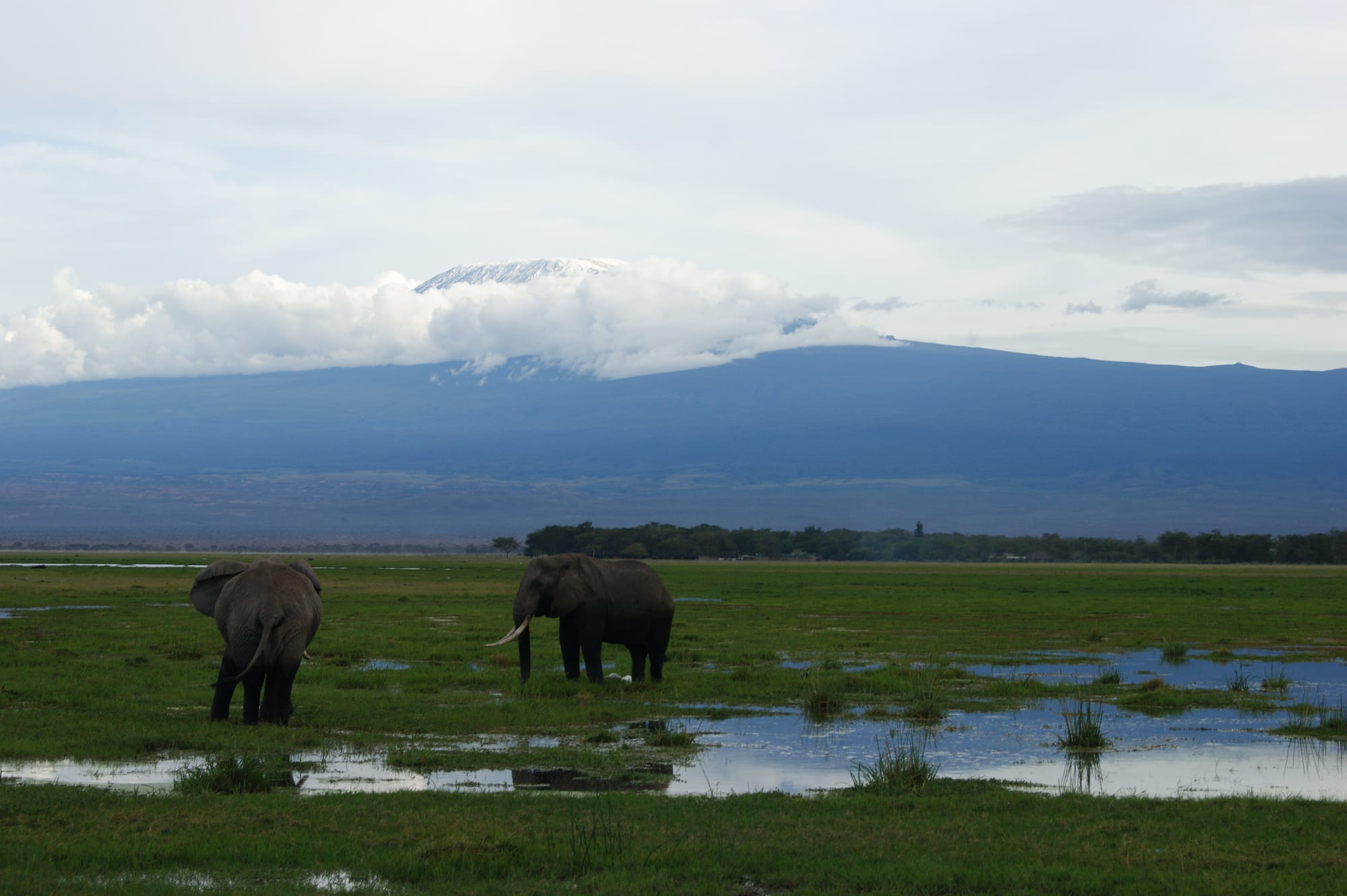
A herd of elephants crossing golden grassland with the snow-capped bulk of Kilimanjaro rising behind them

Kenya

Elephants in Amboseli National Park, with Mount Kilimanjaro — just across the border in Tanzania — behind. (Lafleursauvage / Wikimedia Commons · CC BY-SA 4.0)

East Africa's economic hub and its classic safari country — a land spanning the Indian Ocean coast, the Great Rift Valley, snow on the equator at Mount Kenya, and the plains of the Maasai Mara.

Explore Kenya

History

The Kenyan coast was part of the Swahili world for over a thousand years — a string of Muslim city-states such as Lamu, Malindi, and Mombasa trading with Arabia, Persia, and India, and later contested by the Portuguese and the sultans of Oman. The interior was home to Bantu-speaking farmers, Nilotic pastoralists like the Maasai, and Cushitic peoples in the north, and to some of the oldest known human fossils, unearthed around Lake Turkana.

Britain declared the East Africa Protectorate in 1895 and, in 1920, the colony of Kenya, encouraging white settlers onto the fertile "White Highlands" and pushing Africans, especially the Kikuyu, off their land. The Mau Mau rebellion of the 1950s, centred on Kikuyu grievances over land and rights, was suppressed with mass detention, villagisation, and brutal violence, but it helped force the pace toward independence, which came in 1963 under Jomo Kenyatta.

Kenyatta and his successor Daniel arap Moi ran a one-party state for decades. Multiparty politics returned in 1991, but elections have often been fought and disputed along ethnic lines; the 2007–08 vote triggered violence that killed more than 1,000 people. Since then Kenya has become East Africa's business and technology hub, with Nairobi a regional headquarters city, even as debt, corruption, and inequality drive periodic mass protest, notably the youth-led demonstrations of 2024.

  • Kenya: Highlands, Coast, and Rift A Swahili trading coast and a fertile highland taken for white settlement — the Mau Mau rebellion, independence under Kenyatta, decades of one-party rule, and East Africa's commercial hub

Culture & Customs

Kenya has more than 40 ethnic groups — the Kikuyu, Luhya, Luo, Kalenjin, Kamba, and Maasai among the largest — each with its own language and traditions, overlaid by a shared Swahili coastal culture and by Christianity, which most Kenyans practise, alongside a Muslim minority strong on the coast and in the northeast.

Community self-help, captured in the word Harambee ("let us pull together"), is a national ethos and a fixture of fundraising for schools, clinics, and funerals. The Maasai and Samburu, with their red shúkà cloth, beadwork, and cattle-centred life, are the most internationally recognised, though they are a small minority. Kenya's global fame in distance running rests largely on the Kalenjin of the Rift Valley, home of a remarkable line of Olympic and marathon champions.

Nairobi has a lively music, fashion, and arts scene, and the matatu — the loud, customised minibus — is a culture in itself. Respect for elders, extended-family obligation, and, on the coast, the rhythms of Islam and the Swahili calendar shape daily life.

Daily Life

Nairobi, founded as a railway depot and now a metropolis of five million, is the political and commercial centre, a city of glass towers, sprawling estates, the Kibera informal settlement, and a national park on its doorstep. Mombasa is the main port and coastal hub; Kisumu sits on Lake Victoria; and much of the country is farming country — tea and coffee in the highlands, maize and livestock elsewhere — with the arid north thinly peopled by pastoralists.

The economy is the largest in East Africa, led by services, agriculture (Kenya is a leading exporter of tea and cut flowers), tourism, and a technology sector built on the success of M-Pesa mobile money. Growth has been steady, but high living costs, youth unemployment, and public debt are the pressing issues, and drought in the north has repeatedly brought hunger.

Daily life runs on the matatu, the duka corner shop, church or mosque, and, for many, a shamba (small farm) tended alongside a town job. Football and athletics dominate the sporting conversation.

Food

Kenyan cooking centres on ugali, a stiff maize porridge, eaten with sukuma wiki (braised collard greens), beans, or a stew of beef, goat, or chicken. Nyama choma — roasted meat, usually goat, shared straight off the grill with kachumbari salad — is the social meal, ordered by the kilo at butcheries and bars.

Other staples include githeri (maize and beans), mukimo (mashed greens, potato, and maize), pilau and biryani rice on the coast, mandazi fried dough, and chapati. Coastal Swahili cooking is richer and spiced with coconut — fish and prawns in coconut curry, biryani, and mahamri with mbaazi (pigeon peas) for breakfast.

Chai, strong tea boiled with milk and sugar, is the national drink; fresh juices and maziwa mala (fermented milk) are common; and Tusker lager is the ubiquitous beer.

  • Kenya: Food and the National Dish A firm maize dough eaten by hand with greens and stew, and a grilled-meat social tradition that has become as central to Kenyan life as the staple itself

Attractions & Natural Wonders

The Maasai Mara, in the southwest, is Kenya's flagship reserve — big cats, elephants, and, from about July to October, the wildebeest migration crossing the Mara River from the Serengeti. Amboseli, on the Tanzanian border, is famous for its elephant herds framed against Kilimanjaro; Tsavo East and West are vast and red-dusted; and Lake Nakuru and Lake Bogoria draw flamingos and hold rhino.

Mount Kenya, the second-highest peak in Africa, has trekking routes to its glaciers and its own national park; the Aberdares and Laikipia add highland forest and community conservancies. Nairobi National Park, with lions and rhino against the city skyline, and the nearby elephant orphanage and giraffe centre make an easy first day.

The coast is the other Kenya: Diani and the south-coast beaches, the marine parks of Watamu and Malindi, and, further north, the car-free Swahili old town of Lamu, a UNESCO World Heritage Site of coral-stone houses, dhows, and donkeys. Hell's Gate, walkable and cyclable among the cliffs, and the Rift Valley lakes round out the classic circuit.

  • Kenya: Ten Attractions and Natural Wonders The plains of the Maasai Mara at the height of the migration, elephants against Kilimanjaro, flamingo-pink Rift Valley lakes, a snow-capped equatorial peak, and a Swahili stone town on the Indian Ocean

Planning basics

Budget

Kenya spans budgets. Independent travel using matatus, local guesthouses, and "chapo" cafés is cheap, but national-park fees and organised safaris — especially in the Maasai Mara — are expensive, with premium conservancies costing hundreds of dollars a day. Card and, above all, mobile-money (M-Pesa) payment is everywhere.

Park Fees
Maasai Mara and the big parks charge USD 70–200 per person per day
Daily Budget Midrange
USD 120–250, plus USD 150–500+ per day on safari depending on the park and lodge
Daily Budget Shoestring
USD 40–70 (guesthouse, local food, matatus) — safari extra

Visa Requirements

Almost all visitors need an Electronic Travel Authorisation (eTA), applied for online before travel; the old visa-on-arrival and e-visa systems were replaced by it. A yellow fever certificate is required if arriving from a risk country.

Typical Validity
90 days on the eTA, applied for online in advance

Apply for the eTA at least a few days ahead through the official portal.

Safety

Kenya requires real care. Nairobi and Mombasa have significant street crime — mugging, bag-snatching, carjacking, and burglary — and there is a terrorism threat from the Somalia-based al-Shabaab, with past attacks in Nairobi and near the coast and northeast. Safari areas and the main tourist sites are heavily secured and generally trouble-free with an operator.

Source
US Department of State and UK FCDO travel advisories — check for the latest wording.

Avoid the northeastern counties and the immediate Somali border, take care in Nairobi's central and eastern districts and after dark, use hotel or app-based transport, and take malaria precautions outside the highlands.

Source: US Department of State and UK FCDO travel advisories — check for the latest wording.

Climate

Governed by altitude and by two rainy seasons rather than by temperature. Nairobi and the highlands are temperate; the coast is hot and humid; the north is arid. The "long rains" fall roughly March to May and the "short rains" October to December, with dry, cooler weather between.

Coast
hot and humid, 26–33°C
Highlands
Nairobi around 10–26°C, cool nights
Dry Seasons
January–February and June–September — the best for safari

Transportation

Nairobi's Jomo Kenyatta airport is the regional hub, with Mombasa and several bush airstrips also served. The modern Standard Gauge Railway links Nairobi and Mombasa. Long-distance coaches and shared matatu minibuses cover the roads; safaris are done by 4x4 with a driver-guide, and light aircraft link the parks.

For the Mara, most visitors fly in from Nairobi's Wilson Airport rather than face the long, rough road.

Best Time to Visit

June to October for the dry season and the best wildlife viewing, with the wildebeest crossing the Mara River in the Maasai Mara from roughly July to October. January and February are also dry and good. The long rains (March–May) are green, quiet, and cheaper but can make some tracks difficult.

Currency

The currency is the Kenyan shilling (KES). Mobile money (M-Pesa), pioneered in Kenya, is used for almost everything locally; visitors mostly use cash and cards, with ATMs widespread in towns.

Cards
Accepted in hotels, lodges, and city restaurants; carry cash for markets and matatus
Symbol
KSh
Currency Code
KES — Kenyan shilling

Language

Swahili (Kiswahili) and English are both official. Swahili is the national lingua franca; English is used in government, business, and higher education and is widely spoken in cities and tourism. Over 40 other languages are spoken by their communities, and "Sheng," a Swahili-English slang, is the language of young Nairobi.

English
Widely spoken in cities and the tourism industry
Official Languages
Swahili, English