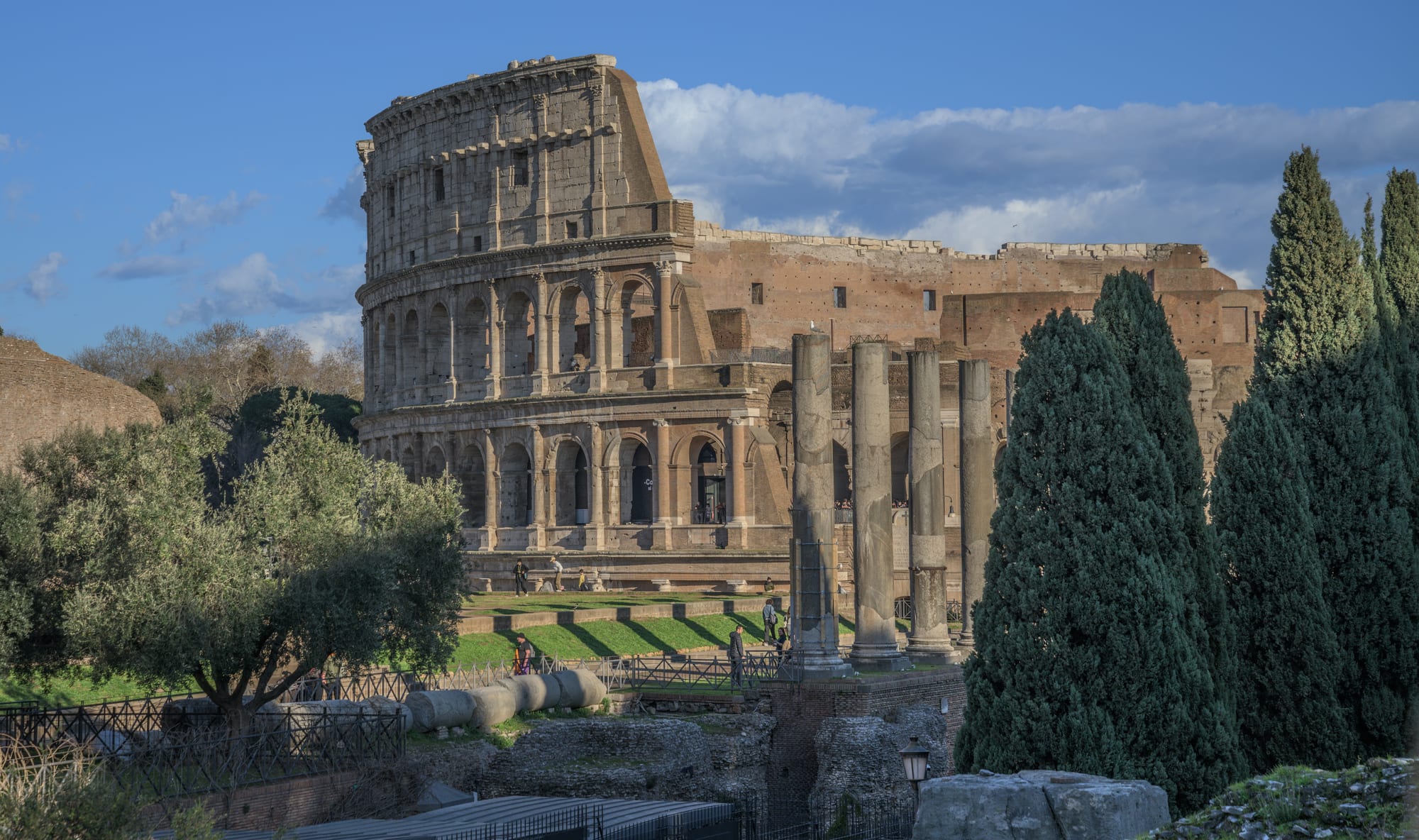
The great oval stone amphitheatre of the Colosseum, its tiered arches partly ruined, with the Roman Forum beside it

Italy

The Colosseum in Rome, completed around 80 AD and the largest amphitheatre ever built. (Wilfredor / Wikimedia Commons · CC0 (public domain dedication))

A Mediterranean peninsula and islands that were the heart of the Roman Empire and the cradle of the Renaissance — unified only in the 1860s, and still a country of fiercely distinct regions, cuisines, and dialects.

Explore Italy

History

Rome, founded by tradition in 753 BC, grew from a city-state into a republic and then an empire that ruled the Mediterranean world for centuries, leaving Latin, Roman law, engineering, and — after Constantine — Christianity as its enduring legacy. When the Western Empire fell in 476, the peninsula fragmented, and for more than 1,300 years "Italy" was a patchwork of city-states, kingdoms, papal lands, and foreign-ruled provinces.

That division bred fierce local identities and, in the Middle Ages and Renaissance, an extraordinary concentration of art, banking, and learning in Florence, Venice, Rome, Milan, and Naples — Dante, Giotto, Brunelleschi, Leonardo, Michelangelo, Galileo, Machiavelli. Unification, the Risorgimento, was completed only between 1861 and 1870, under the House of Savoy, with Rome as capital.

Liberal Italy gave way to Mussolini's Fascist dictatorship from 1922 — the first of its kind — an alliance with Nazi Germany, defeat and occupation in the Second World War, and a resistance movement. Since a 1946 referendum, Italy has been a republic and a founding member of the European Community and NATO. The post-war "economic miracle" turned a poor, emigrant country into a G7 power, though the gap between the industrial North and the poorer South, organised crime, chronic political instability, high debt, and a very low birth rate remain defining problems. Giorgia Meloni became prime minister in 2022.

  • Italy: Rome, the City-States, and the Nation The peninsula that built the Roman Empire and, a thousand years later, the Renaissance — then spent centuries divided under foreign rule before unifying in 1861, only to fall to Fascism and rebuild as a republic

Culture & Customs

Italy holds an outsized share of the world's cultural heritage — more UNESCO World Heritage Sites than any other country — and the arts are woven into everyday life: opera was born here, cinema has a long and influential history, and Milan is a world capital of fashion and design. Regional pride (campanilismo, loyalty to one's own bell tower) is strong; a Sicilian, a Venetian, a Neapolitan, and a Milanese will describe distinct histories, foods, and temperaments.

Family is central, meals are unhurried and taken at set times, and the passeggiata — the evening stroll through the piazza — is a daily ritual. Coffee has strict unwritten rules (no cappuccino after mid-morning; espresso standing at the bar), and the calendar still turns on Catholic feast days and patron saints even as regular church attendance has fallen.

Football (Serie A, four World Cups), the Giro d'Italia, and a deep attachment to one's home town and its cuisine are shared threads across an otherwise varied country.

Daily Life

Italy's roughly 59 million people are spread across no single dominant city: Rome is the largest and the capital, followed by Milan (the business and fashion hub), Naples, Turin, and a string of mid-sized cities, with the Po Valley in the north the industrial heartland. The population is ageing and slowly shrinking, and many inland and southern towns are losing people.

The economy is built on high-value manufacturing — machinery, cars, luxury goods, food and wine — much of it from small and mid-sized family firms, alongside tourism and agriculture. Youth unemployment, especially in the South, and the emigration of graduates are persistent concerns, as is a large public debt.

Daily life tends toward a long lunch break (shorter in the big northern cities), a late dinner, shops that may still close in the afternoon in smaller towns, and a noticeable national slowdown around Ferragosto in mid-August, when much of the country heads to the coast or the mountains.

Food

Italian cooking is the world's most widely exported cuisine, and it is intensely regional — there is no single "Italian food." The north favours butter, rice (risotto), polenta, and filled pastas; the centre and Tuscany, grilled meats, beans, and simple sauces; Rome, its offal and cacio e pepe, carbonara, and amatriciana; the south, olive oil, tomatoes, and dried pasta; and Naples, pizza in its original form.

Cured meats and cheeses (Parmigiano Reggiano, mozzarella di bufala, prosciutto di Parma), seafood on the coasts, and gelato and espresso everywhere round out the picture. A meal is a sequence — antipasto, primo, secondo with contorno, dessert, coffee — though a plate of pasta and a glass of wine is a perfectly respectable lunch.

Wine is made in every region, from Chianti and Barolo to Prosecco, Amarone, and the whites of the south and the islands, and each area has its own aperitivo, amaro, or grappa.

  • Italy: Food and the National Dish A simple round of dough, tomato and cheese invented in Naples in the 19th century, at the head of a country where regional identity matters more than any single dish

Attractions & Natural Wonders

Rome layers ancient, papal, and modern city: the Colosseum and Roman Forum, the Pantheon, the Trevi Fountain and Spanish Steps, and — enclosed within it — Vatican City, with St Peter's Basilica and the Sistine Chapel. Florence and Tuscany bring the Renaissance in concentration: the Duomo, the Uffizi, Michelangelo's David, and the hill towns of Siena, San Gimignano, and the Val d'Orcia amid the Chianti vineyards.

Venice and its lagoon — St Mark's, the Grand Canal, the islands of Murano and Burano — are unlike anywhere else, though crowded and fragile. Milan pairs its Gothic Duomo and Leonardo's Last Supper with the fashion district and easy access to Lakes Como, Garda, and Maggiore. Naples, raucous and full of art, is the base for Pompeii and Herculaneum, Vesuvius, and the Amalfi Coast and Capri.

Sicily offers Greek temples at Agrigento, the Baroque towns of the southeast, Mount Etna, and Palermo's markets and mosaics; Sardinia has some of the Mediterranean's best beaches; the five cliff-clinging villages of the Cinque Terre line the Ligurian coast; the Dolomites in the north are a hiking and skiing wonderland; and Matera's ancient cave dwellings, the "Sassi," are a UNESCO World Heritage Site.

Planning basics

Budget

Italy spans a wide range. Rome, Venice, Florence, the Amalfi Coast, and the alpine ski resorts are expensive; much of the south, the countryside, and the "menu del giorno" lunch remain good value. Card payment is now accepted almost everywhere; carry some cash for small bars, markets, and rural spots.

Daily Budget Midrange
EUR 140–280 (mid-range hotel, restaurants, museums, some fast-train travel)
Daily Budget Shoestring
EUR 60–110 (hostel or agriturismo, market and pizza-by-the-slice food, trains)

A standing espresso at the bar costs a fraction of a seated one; and lunch menus are far cheaper than dinner.

Visa Requirements

Italy is in the EU and the Schengen Area. Citizens of the EU, the UK, the US, Canada, Australia, and many other countries need no visa for stays of up to 90 days in any 180-day period. The EU's ETIAS pre-travel authorisation for visa-exempt visitors is being introduced.

Typical Stay
90 days in any 180-day period, visa-free, for most Western passports

Safety

Italy is generally safe, with low levels of violent crime against visitors. The persistent problem is pickpocketing and bag-snatching in the big tourist cities — Rome (around Termini and the metro), Florence, Milan, Naples, and Venice — along with taxi overcharging, ticket and "gladiator photo" scams, and distraction teams on public transport.

Keep bags zipped and in front of you on the metro and buses and at monuments, use official white taxis or apps, and be wary of anyone pressing a "free" bracelet or rose into your hand.

Climate

Mediterranean on the coasts and in the south — hot dry summers, mild winters — and continental in the Po Valley of the north, with foggy cold winters and humid hot summers. The Alps and the Apennines are cooler, with a long alpine ski season.

Summer
hot, 28–35°C, hotter and more humid inland; heat waves increasingly common
Winter
mild in the south, cold and grey in the north; snow in the mountains

Transportation

High-speed trains (Trenitalia's Frecce and the private Italo) link the big cities in a few hours; regional trains and buses reach smaller places. A car is useful for Tuscany, the south, and the mountains but a liability in historic city centres, where camera-enforced "ZTL" restricted zones fine unauthorised drivers.

Book fast trains ahead for the best fares; validate paper regional tickets before boarding to avoid a fine.

Best Time to Visit

April to June and September to October for warm, pleasant weather and lighter crowds than the July–August peak, when the cities are hot and much of Italy itself is on holiday (many businesses close in mid-August). December to March is the alpine ski season; spring and autumn suit the art cities and the wine harvest.

Currency

Italy uses the euro, adopted in 1999 as a founding member. Cards work widely; keep a little cash for small purchases, and note that many cities levy a per-night tourist tax collected at your accommodation.

Symbol
Currency Code
EUR — euro

Language

Italian, based on the Tuscan of Dante, is the official language, with strong regional dialects and recognised minority languages (German in South Tyrol, French in the Aosta Valley, Sardinian, and others). English is spoken in tourist areas and by younger people, less so among older Italians and in the countryside; a few Italian courtesies go a long way.

English
Common in tourist areas; patchier elsewhere
Official Language
Italian