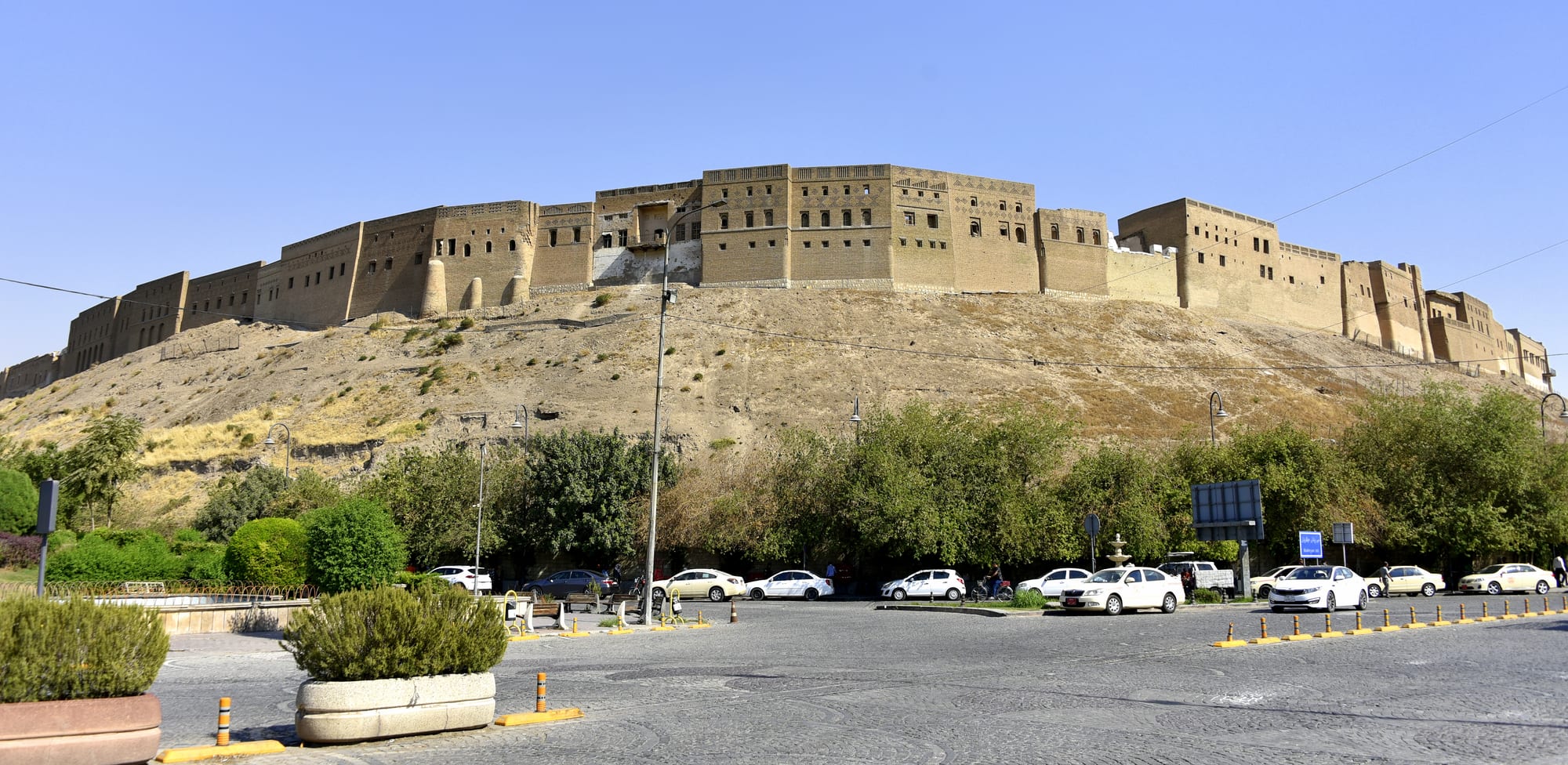
A circular walled mound rising above a modern city, its edge lined with the tall facades of old brick houses

Iraq

The Citadel of Erbil in Iraqi Kurdistan, a tell claimed as one of the longest continuously inhabited places on Earth — a UNESCO World Heritage Site. (Osama Shukir Muhammed Amin / Wikimedia Commons · CC BY-SA 4.0)

Ancient Mesopotamia, the "land between the rivers" where cities and writing began — later the heart of the Abbasid Caliphate — and, after decades of war and sanctions, a fragile country whose autonomous Kurdish north is far more open to visitors than its south.

Explore Iraq

History

Southern Iraq is where urban civilisation began. The Sumerians built the first cities — Uruk, Ur, Eridu — and invented writing, the wheel, and monumental architecture; the Akkadians, Babylonians (Hammurabi's law code, Nebuchadnezzar's walls), and Assyrians (Nineveh, Nimrud) followed. It was here, by tradition, that the Garden of Eden and the Tower of Babel were placed.

After Alexander and the Persians, the region became, from 762, the centre of the Abbasid Caliphate: Baghdad grew into the largest city in the world and a hub of science, medicine, translation, and poetry until the Mongols sacked it in 1258. Four centuries of Ottoman rule followed.

Modern Iraq was assembled by Britain after the First World War from three Ottoman provinces, with a Hashemite king. The monarchy fell in 1958; a series of coups brought the Ba'ath Party and, from 1979, Saddam Hussein — the Iran–Iraq War, the gassing of Kurds at Halabja, the 1990 invasion of Kuwait and the 1991 Gulf War, and a decade of sanctions. The 2003 US-led invasion toppled Saddam and was followed by occupation, insurgency, and a Sunni–Shia civil war. ISIS seized a third of the country in 2014 and was defeated by 2017, leaving Mosul in ruins. Since then Iraq has had a fragile, corruption-plagued stability, with powerful Iran-aligned militias and periodic mass protests.

  • Iraq: The Land Between the Rivers Mesopotamia gave the world its first cities and its first writing — later the seat of the Abbasid caliphate, a kingdom stitched together by Britain, Saddam Hussein's dictatorship, and two decades of war since 2003

Culture & Customs

Iraq is majority Shia Muslim, with a large Sunni minority (both Arab and Kurdish) and historic communities of Christians (Chaldean, Assyrian, Syriac), Yazidis, and Sabian-Mandaeans, several of them badly reduced by recent violence. Najaf and Karbala are among the holiest cities of Shia Islam, and the Arba'een pilgrimage to Karbala draws some of the largest crowds on Earth.

Hospitality is a deep obligation — a visitor will be pressed to eat, drink tea, and stay — and the coffee house, backgammon, and poetry evenings are social staples. The maqam, a classical Iraqi vocal tradition, is on UNESCO's list, and the culture of the southern marshes, where Marsh Arabs live in vaulted reed houses and herd water buffalo, is a distinctive survival, partly restored after Saddam drained the wetlands.

Kurdish culture in the north has its own language, dress, music, and the spring festival of Newroz, marked with mountain bonfires. Decades of war have also shaped a culture of endurance, dark humour, and strong extended-family and tribal ties.

Daily Life

Around a fifth of Iraq's roughly 44 million people live in Greater Baghdad, a sprawling city of concrete blast walls, checkpoints, markets, and river-front cafés slowly reopening. Basra in the oil-rich south, Mosul in the north, and the Kurdish cities of Erbil and Sulaymaniyah are the other main centres. The population is young and heavily urban.

Iraq holds some of the world's largest oil reserves, and oil provides almost all government revenue, but the wealth has been hollowed out by war, corruption, and a bloated state payroll; electricity is rationed even in summer, public services are weak, and youth unemployment is high — the trigger for the 2019 protest movement. Water shortages, as upstream dams and climate change shrink the Tigris and Euphrates, are an growing crisis.

Daily life runs on the extended family, the mosque or church, the market, and — for many — a government or militia-linked job, against a background of checkpoints and the ever-present memory of the past two decades.

Food

Iraqi cooking blends Mesopotamian, Persian, Turkish, and Levantine traditions. The national dish is masgouf — river carp butterflied, seasoned, and grilled upright beside an open fire, then finished over the coals — eaten by the Tigris in Baghdad. Kubba (bulgur or rice shells stuffed with spiced meat), dolma (stuffed vegetables and vine leaves), tashreeb (bread soaked in broth), and biryani are staples.

Iraq was historically the world's leading date producer, and dates appear everywhere — eaten fresh or dried, pressed into syrup (dibis), and served with geymar clotted cream at breakfast. Amba, a tangy pickled-mango sauce, is a national condiment, splashed on sandwiches and grills.

Tea, strong and sweet in small glasses (istikan), is constant, along with cardamom coffee. Alcohol is legal but its sale has become more restricted; arak, the aniseed spirit, is the traditional drink where it is served.

  • Iraq: Food and the National Dish A whole carp split and grilled over an open fire on the banks of the Tigris, in the land where some of the world's oldest written recipes were recorded

Attractions & Natural Wonders

The Kurdistan Region is where most independent travel happens. Erbil's Citadel — an inhabited tell rising above the modern city, claimed as one of the oldest continuously occupied sites in the world — anchors a walkable old centre with a covered bazaar. Beyond it lie the Rawanduz gorge and Bekhal falls, the mountain resort of Amedi on its plateau, the Yazidi holy valley of Lalish, and Sulaymaniyah with its excellent museum and the former secret-police prison, Amna Suraka, now a memorial.

Federal Iraq holds the great ancient sites, visited on tours and increasingly by independent travellers: the reconstructed walls and Ishtar Gate remains of Babylon near Hillah; the towering ziggurat of Ur near Nasiriyah; the spiral Malwiya minaret at Samarra; and the Assyrian remains around Mosul, damaged by ISIS and being restored. The southern Marshes, explored by boat from Chibayish, are a UNESCO-listed landscape of reed islands and buffalo herders.

Baghdad itself, for the confident traveller, offers Mutanabbi Street and its Friday book market, the rebuilt National Museum with its Mesopotamian treasures, the shrine of Kadhimiya, and the riverside. Najaf and Karbala, with the vast gold- domed shrines of Imam Ali and Imam Hussein, can often be visited respectfully outside the peak pilgrimage periods.

  • Iraq: Ten Attractions and Natural Wonders The land between the rivers where cities and writing began — a spiral minaret, the ruins of Babylon and Ur, the marshes of the Ma'dan, and the golden shrines of Najaf and Karbala

Planning basics

Budget

Iraq is moderately priced. The Kurdistan Region has a reasonable range of hotels; federal Iraq has fewer options aimed at visitors and prices can be high in Baghdad. A car with a driver, often arranged through a local contact or agency, is the usual way to get around, and it is the main cost. Cash is essential.

Source
Traveller reports, 2023–2024 — verify against current advice, which changes quickly.
Daily Budget Midrange
USD 120–250 (better hotel, private car and driver, guide)
Daily Budget Shoestring
USD 45–80 (simple hotel, local restaurants, shared taxis) — mainly feasible in Kurdistan

Foreign cards rarely work; bring US dollars in cash and change some into dinars for daily spending.

Source: Traveller reports, 2023–2024 — verify against current advice, which changes quickly.

Visa Requirements

Federal Iraq now issues a visa on arrival at Baghdad, Basra, and Najaf airports to citizens of many countries, typically for 30 days. The Kurdistan Region issues its own separate visa on arrival (often 30 days) at Erbil and Sulaymaniyah — this does not by itself allow travel into federal Iraq, and vice versa.

Typical Validity
30 days; the federal and Kurdistan visas are administered separately

Decide in advance whether you are visiting the Kurdistan Region, federal Iraq, or both, and check the current rules for each.

Safety

This is the decisive planning fact for Iraq. The Kurdistan Region (Erbil, Sulaymaniyah, Duhok) is relatively safe and receives a growing number of independent travellers. Federal Iraq — Baghdad, the south, and the shrine cities — has improved and is visited on tours and, increasingly, independently, but risks remain: militia activity, kidnapping risk in places, unexploded ordnance, occasional rocket fire tied to regional tensions, and areas near Syria and around Mosul and Anbar with residual ISIS activity. Most Western governments still advise against all or all-but-essential travel to much of federal Iraq.

Source
US Department of State, UK FCDO, and other advisories — check for the latest wording.

Worldlore covers Iraq so it can be understood. Anyone travelling should follow their government's current advisory, use a local operator for federal Iraq, keep away from border regions and demonstrations, and never stray off cleared ground near former front lines.

Source: US Department of State, UK FCDO, and other advisories — check for the latest wording.

Climate

Hot desert over most of the country. Summers are extreme — Baghdad and Basra regularly reach 45–50°C from June to September — while winters are mild in the south and cold, with snow, in the Kurdish mountains. Spring brings dust storms; the north sees genuine rain and greenery in winter and spring.

Lowlands
brutally hot summers, mild winters, little rain
Kurdish Mountains
cold snowy winters, warm summers, a real spring

Transportation

Baghdad, Basra, Najaf, Erbil, and Sulaymaniyah have airports, and internal flights link them. Overland travel is by car — usually a hired car with driver — on roads with frequent security checkpoints; a passenger railway between Baghdad and Basra runs but is slow. Moving between the Kurdistan Region and federal Iraq means passing an internal border with its own checks.

Arrange drivers and any permits through a trusted local operator; independent long-distance driving is not advisable in the south.

Best Time to Visit

October to April, avoiding the worst summer heat. March and April bring wildflowers and green hills to Kurdistan; the marshes in the south are best in spring and autumn. The Shia commemorations of Ashura and Arba'een fill Najaf and Karbala with millions of pilgrims.

Currency

The currency is the Iraqi dinar (IQD). US dollars are widely used for larger transactions and hotels; dinars are for everyday spending. Prices run into large numbers. Foreign bank cards mostly do not work.

Symbol
ع.د
Cash To Bring
US dollars, in cash
Currency Code
IQD — Iraqi dinar

Language

Arabic and Kurdish are both official at the national level. Iraqi Arabic is the main language of the centre and south; Kurdish (mostly the Sorani dialect) dominates the Kurdistan Region. Turkmen, Syriac, and other languages are spoken by minorities. English is understood by some in Erbil and among younger and educated people, less so elsewhere.

English
Limited; more common in Erbil and the tourism trade
Official Languages
Arabic, Kurdish