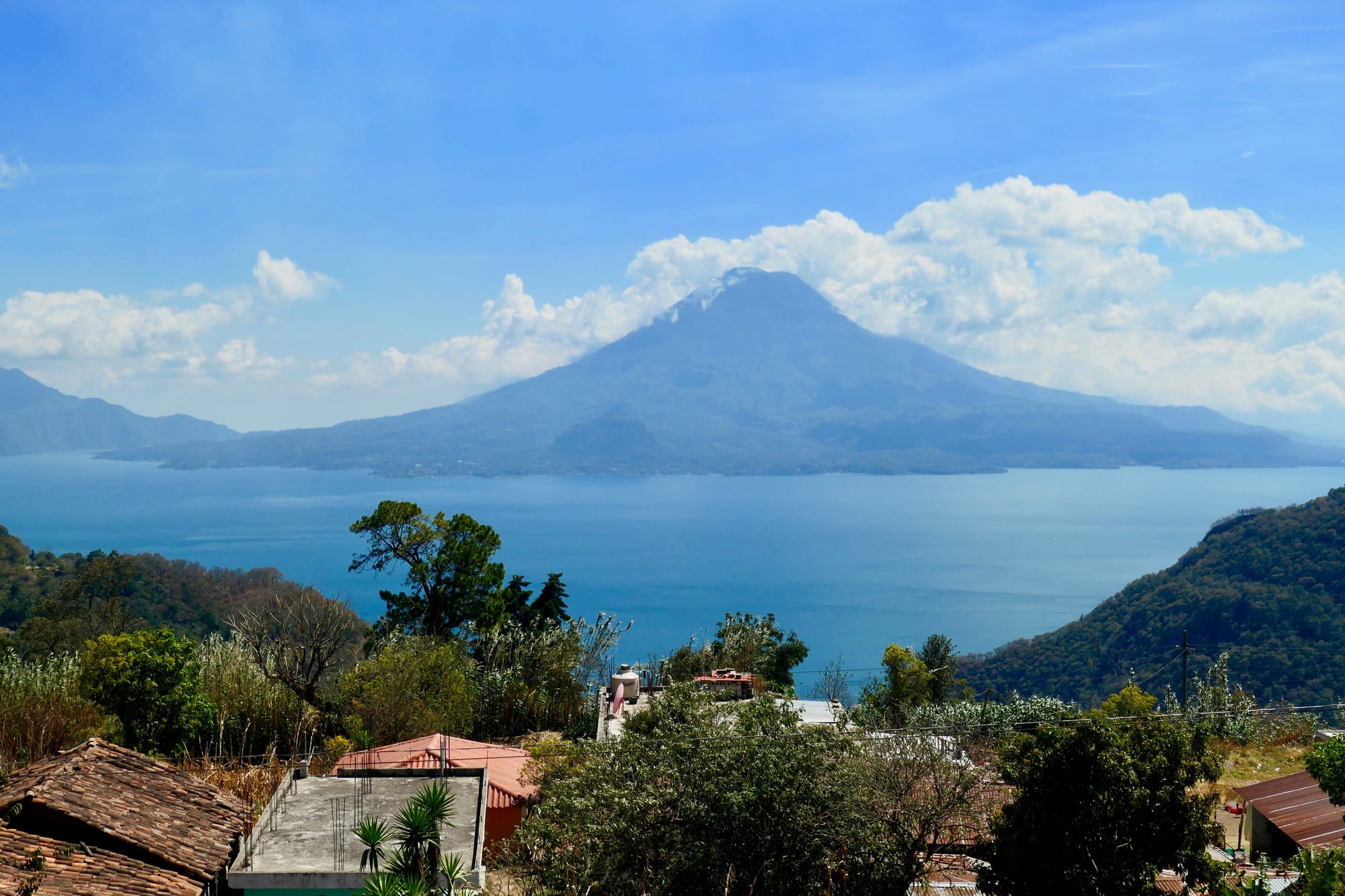
A deep blue lake ringed by steep green shores with three symmetrical volcanoes rising along the far side

Guatemala

Lake Atitlán, a caldera lake in the western highlands ringed by volcanoes and Maya villages. (Bruno Rijsman / Wikimedia Commons · CC BY-SA 2.0)

The most populous country in Central America and the heartland of the living Maya world — a volcanic highland landscape of colonial towns, lake villages, and jungle temples, shadowed by a long civil war.

Explore Guatemala

History

The Maya built one of the ancient world's great civilisations across what is now Guatemala, southern Mexico, Belize, and Honduras — cities such as Tikal and El Mirador with stepped pyramids, hieroglyphic writing, astronomy, and long-count calendars — before a widespread collapse of the lowland centres around the ninth century. Highland Maya kingdoms, chiefly the K'iche', remained powerful when the Spanish arrived.

Pedro de Alvarado conquered the highlands in the 1520s. Colonial Guatemala was governed from Antigua until earthquakes destroyed it in 1773 and the capital moved to present-day Guatemala City. Independence from Spain came in 1821, followed by a brief Central American federation and then a separate republic dominated by coffee, land concentrated among a small elite, and a series of strongmen.

In 1954 a CIA-backed coup overthrew the elected government of Jacobo Árbenz after it began land reform affecting the United Fruit Company. The instability that followed became a 36-year civil war (1960–1996) between the military and leftist guerrillas. It killed or disappeared around 200,000 people, most of them Indigenous Maya civilians, and a UN-backed commission found the army had committed acts of genocide. Peace accords were signed in 1996. Since then Guatemala has struggled with poverty, organised crime, corruption, and large-scale migration to the United States.

  • Guatemala: The Maya Heartland The core of the ancient Maya world — Spanish conquest, a coffee economy built on seized land and forced labour, a CIA coup in 1954, and a 36-year war that the UN called genocide

Culture & Customs

Guatemala has the largest Indigenous population, as a share, of any country in Central America — roughly two-fifths identify as Maya — and highland life is strongly Maya in language, dress, and belief. Women's huipil blouses and corte skirts vary by town, encoding local identity, and Maya spirituality, often blended with Catholicism, shapes ceremonies, the 260-day ritual calendar, and figures such as Maximón, a folk saint honoured with cigars and liquor.

The other Guatemala is Ladino — mestizo and Spanish-speaking — dominant in Guatemala City, the eastern lowlands, and among the elite. On the Caribbean coast, Livingston is a Garífuna town with its own Afro-Indigenous language and music.

Religion is mostly Catholic, with a large and growing evangelical Protestant minority. Antigua's Holy Week is famous for its processions over "carpets" (alfombras) of dyed sawdust and flowers, and the giant kites flown over highland cemeteries on the Day of the Dead are a unique tradition.

Daily Life

Around a fifth of Guatemalans live in Greater Guatemala City, a sprawling, traffic-choked capital of gated zones and informal settlements. Most of the population, though, is rural — highland Maya farming maize and beans on steep plots, and Ladino communities in the coffee, sugar, and cattle lowlands.

The economy runs on remittances from Guatemalans in the United States (the single largest source of foreign exchange), agriculture (coffee, sugar, bananas, cardamom — Guatemala is the world's top exporter), textiles, and tourism. Poverty and chronic child malnutrition are among the worst in the hemisphere, and inequality is stark.

Daily life follows the market day, the comedor set lunch, the church or the Maya ceremony, and the long, crowded bus ride between highland towns. Emigration north, and the money and the family separations it brings, is a constant presence.

Food

Guatemalan food is built on the Maya trinity of maize, beans, and squash, with Spanish and, in the east, Caribbean layers. Hand-patted tortillas accompany almost every meal, alongside black beans (whole or fried), fresh cheese, and cream. Tamales — steamed in banana or maxan leaves, some savoury, some sweet — are the weekend and holiday food.

The three classic "recados" (sauced stews) are pepián (a toasted seed-and-chilli stew, often chicken), jocón (green, with tomatillo and cilantro), and kak'ik, a fiery turkey soup from Cobán. Chiles rellenos, hilachas (shredded beef in tomato sauce), and grilled meats round out the menu.

Street food means tostadas, chuchitos (small tamales), garnachas, and elotes locos, and highland markets sell atol, a warm maize drink, and pan dulce. Guatemalan coffee, grown in Antigua, Huehuetenango, and Cobán, is among the world's finest, though the best is exported.

  • Guatemala: Food and the National Dish A rich stew thickened with roasted seeds and chillies, corn treated as something closer to sacred than staple, and a Maya food tradition still very much alive

Attractions & Natural Wonders

Antigua, ringed by three volcanoes, is the classic base — a UNESCO World Heritage Site of cobbled streets, ruined baroque churches, courtyard hotels, Spanish schools, and Semana Santa pageantry. From here, an overnight trek up Acatenango to watch neighbouring Volcán de Fuego erupt through the night has become a rite of passage, and the easier Pacaya offers a shorter lava-field walk.

Lake Atitlán, a blue caldera lake beneath three volcanoes, is ringed by Maya villages, each with its own character — Panajachel the hub, San Marcos the wellness retreat, Santiago Atitlán the most traditional — linked by small boats. Chichichastenango's twice-weekly market is the largest in the highlands.

In the north, Tikal rises out of the Petén jungle, its temple-pyramids breaking the canopy above howler monkeys and toucans; the remote El Mirador, with the largest known Maya pyramid by volume, is a multi-day jungle trek. Other draws include the turquoise limestone pools of Semuc Champey near Lanquín, the colonial highland city of Quetzaltenango (Xela), the Río Dulce gorge and the Garífuna town of Livingston on the Caribbean, and the black-sand Pacific beaches with their turtle-nesting sites.

Planning basics

Budget

Guatemala is inexpensive. Comedor meals, "chicken buses," and simple guesthouses cost very little; Antigua's boutique hotels, private shuttles, Spanish schools, and volcano tours are the main add-ons. Cash is essential outside Antigua and Guatemala City; ATMs are common in towns.

Acatenango Hike
An overnight guided trek to watch Volcán de Fuego erupt runs roughly USD 40–100
Daily Budget Midrange
USD 60–120 (hotel, shuttles, restaurants, guided tours)
Daily Budget Shoestring
USD 25–45 (guesthouse, comedor food, chicken buses)

Visa Requirements

Citizens of the EU, the UK, the US, Canada, Australia, and most of Latin America enter visa-free for up to 90 days. Guatemala is part of the "CA-4" agreement with El Salvador, Honduras, and Nicaragua, so the 90 days are shared across all four countries.

Typical Stay
90 days across the CA-4 region, visa-free, for most Western passports

To reset the clock you must usually leave the CA-4 region, not just cross into a neighbour.

Safety

Guatemala has significant crime, including gang activity and armed robbery, concentrated in parts of Guatemala City and on some highways and rural routes. The main tourist circuit — Antigua, Lake Atitlán, Tikal — is far calmer and well travelled, but bag-snatching, express robbery, and scams occur, and volcano hikes and some trails have seen armed hold-ups.

Source
US Department of State and UK FCDO travel advisories — check for the latest wording.

Use tourist shuttles rather than chicken buses where possible, avoid Guatemala City's Zonas 1, 3, and 18 and travel after dark, hike volcanoes only with reputable guided groups, and keep valuables out of sight.

Source: US Department of State and UK FCDO travel advisories — check for the latest wording.

Climate

Governed by altitude. The highlands (Guatemala City, Antigua, Lake Atitlán, Quetzaltenango) are spring-like year-round — warm days, cool nights. The Pacific and Caribbean lowlands and the Petén jungle are hot and humid. The dry season runs November to April; the wet season, May to October, brings afternoon rain.

Highlands
18–26°C by day, chilly nights
Lowlands And Peten
hot and humid, 28–35°C

Transportation

Guatemala City's airport is the main gateway; a smaller airport at Flores serves Tikal. Retired US school buses ("chicken buses") cover the country cheaply and colourfully but with a poor safety record; tourist shuttle vans link the main destinations more safely; a rental car works for the highlands.

Most travellers use shuttle vans between Antigua, Lake Atitlán, Lanquín, and Flores rather than public buses.

Best Time to Visit

November to April for the driest weather and clear volcano views, with the Semana Santa (Holy Week) processions in Antigua a major draw around March or April. The wet season is green and quieter, with rain usually confined to the afternoon.

Events
Semana Santa in Antigua (March/April); Día de los Muertos giant kites at Sumpango and Santiago Sacatepéquez (1 November)

Currency

The currency is the Guatemalan quetzal (GTQ), named for the national bird. It is fairly stable. US dollars are accepted at some hotels and tour operators but the quetzal is used for everyday transactions.

Cards
Accepted in Antigua and the cities; cash needed elsewhere
Symbol
Q
Currency Code
GTQ — Guatemalan quetzal

Language

Spanish is the official language and the lingua franca. Guatemala also recognises 24 other languages: 22 Maya languages (K'iche', Q'eqchi', Kaqchikel, and Mam are the largest), plus Xinka and Garífuna. Many highland and Petén Maya speak their own language first, and some rural women speak little Spanish. English is limited to tourism.

English
Common in Antigua and tourist hubs; limited elsewhere
Official Language
Spanish
Indigenous Languages
22 Maya languages, plus Xinka and Garífuna