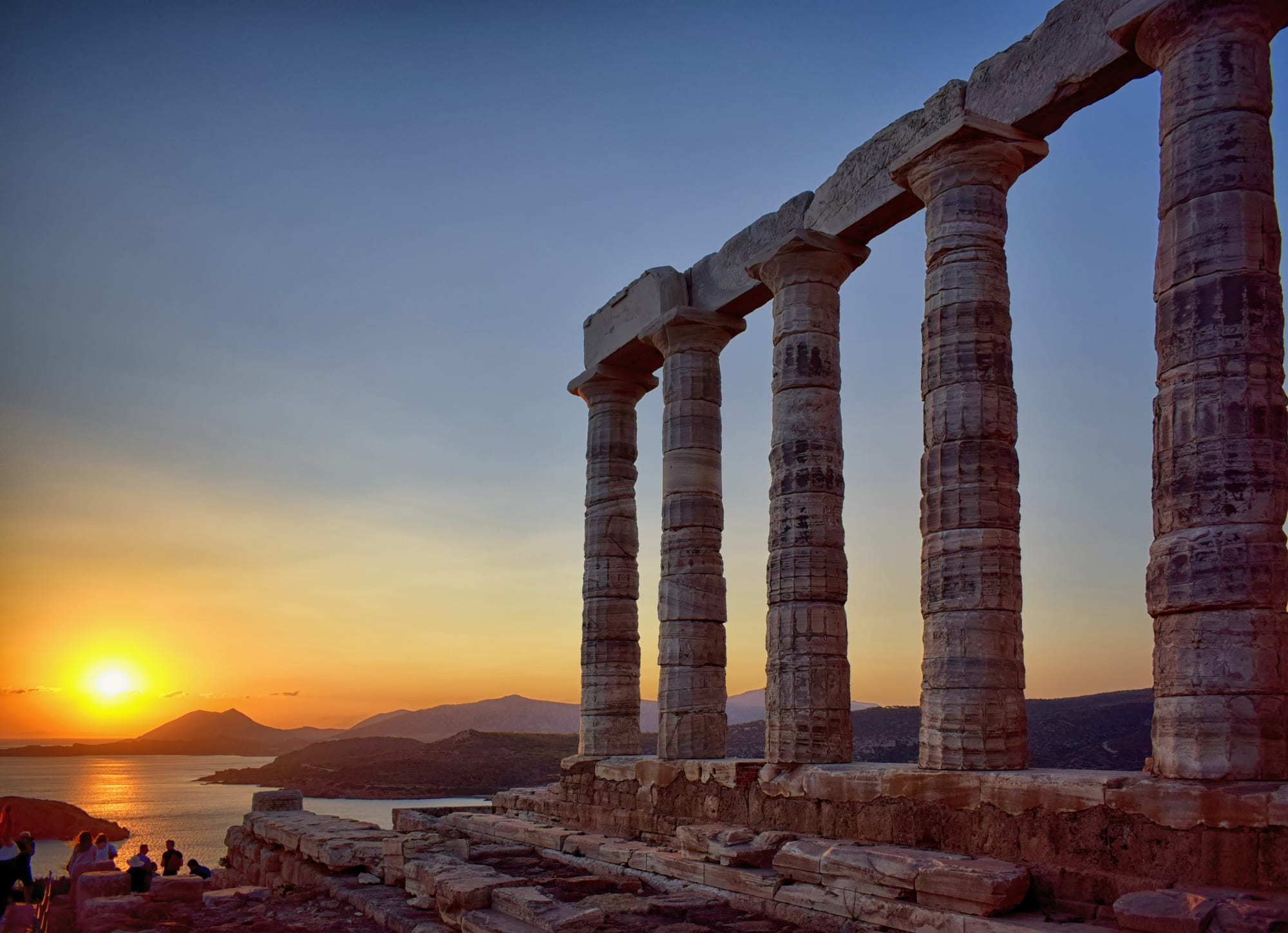
A row of weathered marble temple columns glowing in warm light as an orange sun sets over the sea and hazy blue headlands, with a few small figures watching from the rocks below

Greece

The columns of the Temple of Poseidon at Cape Sounion at sunset, looking out over the sea. (Petroskaz / Wikimedia Commons · CC BY-SA 4.0)

The southern tip of the Balkans and thousands of islands across the Aegean and Ionian seas — the birthplace of Western democracy, philosophy, and theatre, and one of the Mediterranean's great summer destinations.

Explore Greece

History

Greece was the setting for the first flourishing of Western civilisation: the Minoan and Mycenaean Bronze Age palaces, then, after a dark age, the city-states (poleis) of the Archaic and Classical periods. Fifth-century-BC Athens produced democracy, drama, history-writing, and philosophy from Socrates to Aristotle, while Sparta, Thebes, and others contended for dominance. Alexander of Macedon then carried Greek culture across the Near East.

Rome absorbed Greece in the second century BC but was in turn Hellenised, and the eastern Roman — Byzantine — Empire, Greek-speaking and Orthodox Christian, ruled from Constantinople for a thousand years until 1453. Nearly four centuries of Ottoman rule followed.

The Greek War of Independence began in 1821 and won a small kingdom, which expanded over the next century to roughly its present borders. The twentieth century brought a disastrous war with Turkey and a population exchange in 1922–23, occupation and famine in the Second World War, a bitter civil war (1946–49), and a military junta (1967–74). Greece joined the European Community in 1981 and the euro in 2001; a severe debt crisis from 2010 brought years of bailouts and harsh austerity before the economy recovered.

  • Greece: The Long Inheritance Minoan palaces, the city-states and their golden age, Alexander's empire, a thousand years of Byzantium, four centuries under the Ottomans, and a modern nation rebuilt on the memory of all of it

Culture & Customs

Greek identity rests on the Greek language and the Greek Orthodox Church, whose calendar of saints' days, name-days (often celebrated more than birthdays), and above all Easter — with midnight services, candles, and roast lamb — structures the year. Family ties are strong, and hospitality (filoxenia, "love of the stranger") is a point of pride.

Daily life keeps a Mediterranean rhythm: a late, long lunch, an afternoon lull, and social life outdoors in the evening over coffee — the slow frappé or freddo — and meze. The volta, an unhurried evening stroll, fills seafronts and squares.

Music runs from the bouzouki and rebetiko of the cities to island fiddle tunes, and regional identity is strong — a Cretan, a Cypriot Greek, and a Thessaloniki northerner will each claim their own food, dance, and character. Plate-smashing is now mostly a tourist show; the real tradition is long tables and longer conversations.

Daily Life

About a third of Greeks live in Greater Athens, a sprawling city beneath the Acropolis; Thessaloniki in the north is the vibrant second city, and the rest of the population is spread through smaller mainland towns, the Peloponnese, and the islands, many of which empty out in winter.

The economy leans heavily on tourism — one of the highest shares of GDP in Europe — along with shipping (Greeks control one of the world's largest merchant fleets), agriculture (olives, olive oil, feta, wine), and services. The debt crisis drove high unemployment and a wave of emigration by young graduates; recovery has been real but wages remain low.

Life follows the seasons: the summer exodus to family villages and islands, the autumn olive harvest, and a winter that turns the islands quiet and the mountain villages toward the ski resorts of Parnassos and the Pindus.

Food

Greek cooking is the Mediterranean diet at its source: olive oil, bread, pulses, vegetables, cheese, and modest amounts of meat and fish. A meal is often a spread of meze — tzatziki, taramosalata, melitzanosalata, dolmades, grilled octopus, fried cheese (saganaki), and horiatiki, the "village salad" of tomato, cucumber, onion, olives, and a slab of feta.

Baked dishes are the heart of home cooking: moussaka, pastitsio, gemista (stuffed vegetables), and slow-cooked lamb kleftiko. Grilled meat comes as souvlaki and gyros, wrapped in pita with chips, and every region has its own pies (pita) of greens, cheese, or meat in filo.

Ouzo and the stronger Cretan tsikoudia are the aperitifs, drunk with meze; retsina and a fast-improving range of Greek wines accompany meals; and Greek yoghurt with honey and walnuts, loukoumades, and baklava end them.

  • Greece: Food and the National Dish A baked layered casserole of aubergine, spiced meat and béchamel, grilled meat skewers eaten on the go, and a Mediterranean pantry built on olive oil more than any other ingredient

Attractions & Natural Wonders

Athens is built around the Acropolis and its Parthenon, with the Ancient Agora, the new Acropolis Museum, and the Plaka and Anafiotika old quarters below. Within easy reach are Delphi, the oracle site on the slopes of Parnassos; Cape Sounion's Temple of Poseidon; and the Peloponnese, with Mycenae, Epidaurus's acoustically perfect theatre, Olympia, and the Byzantine ghost town of Mystras.

Central Greece has Meteora, where monasteries perch on sheer rock pillars, and the north adds Thessaloniki's Byzantine churches, the tomb of Philip II at Vergina, and Mount Olympus. Crete, the largest island, has the Minoan palace of Knossos, the Samaria Gorge, and its own cuisine and character.

The islands are the summer draw: the Cyclades (whitewashed Santorini on its volcanic caldera, party-and-design Mykonos, and quieter Naxos, Paros, Milos, and Folegandros), the Dodecanese (medieval Rhodes, volcanic Nisyros, and Patmos of the Apocalypse), the green Ionian islands of Corfu, Kefalonia, and Zakynthos, and the Sporades. Each has its ferry rhythm, its beaches, and its handful of tavernas by the water.

Planning basics

Budget

Greece is mid-range for the EU. Athens and the mainland are reasonable; the popular islands — Santorini and Mykonos above all — reach Western European prices in high summer, while lesser-known islands and the shoulder seasons stay affordable. Card payment is widespread; carry cash for small tavernas, kiosks, and rural areas.

Daily Budget Midrange
EUR 110–220 (mid-range hotel, restaurants, ferries, a rental car or scooter)
Daily Budget Shoestring
EUR 50–85 (hostel or domatia room, taverna and bakery food, buses and deck-class ferries)

Santorini and Mykonos can cost double a quieter island for the same experience; consider Naxos, Paros, or the Dodecanese.

Visa Requirements

Greece is in the EU and the Schengen Area. Citizens of the EU, the UK, the US, Canada, Australia, and many other countries need no visa for stays of up to 90 days in any 180-day period.

Typical Stay
90 days in any 180-day period, visa-free, for most Western passports

Safety

Greece is a safe country for visitors, with low levels of violent crime. Pickpocketing on the Athens metro (especially the airport line and around Monastiraki and Omonia) is the main issue, along with occasional strikes and demonstrations that can disrupt transport and close sites.

Watch your bag on the metro and in tourist crowds, check for strike action before travel days, and take care with scooters on island roads and with strong currents and sea urchins when swimming.

Climate

Mediterranean — hot, dry summers and mild, wetter winters — with a cooler, snowier mountain interior. The Aegean islands are swept by the strong, dry "meltemi" wind in July and August, which can disrupt ferries.

Summer
hot and dry, 30–37°C, little rain
Winter
mild on the coast and islands (10–15°C); cold and snowy in the mountains

Transportation

Athens is the main hub, with Thessaloniki and several island airports. Ferries — conventional and high-speed — link Piraeus and Rafina to the islands, and island-to-island. Intercity buses (KTEL) cover the mainland well; trains are limited. Athens has a metro; a rental car or scooter suits the larger islands and the Peloponnese.

Book summer ferries and cabins ahead, and build a buffer day before flights home in case the meltemi cancels sailings.

Best Time to Visit

Late April to June and September to mid-October for warm weather, a swimmable sea, wildflowers or the grape and olive harvest, and open archaeological sites without the summer crush. July and August are hot, crowded, and expensive on the islands, and the meltemi blows hardest.

Events
Orthodox Easter, the biggest holiday of the year; the Athens & Epidaurus Festival in summer

Currency

Greece uses the euro, adopted in 2001. Cards are accepted almost everywhere after reforms to curb tax evasion; some island tavernas and kiosks still prefer cash.

Symbol
Currency Code
EUR — euro

Language

Greek is the official language, written in its own alphabet and with a continuous literary history of nearly 3,000 years. English is very widely spoken in Athens, on the islands, and among younger people; some ability to read the Greek alphabet helps with signs and menus.

English
Widely spoken in tourism and by younger people
Official Language
Greek