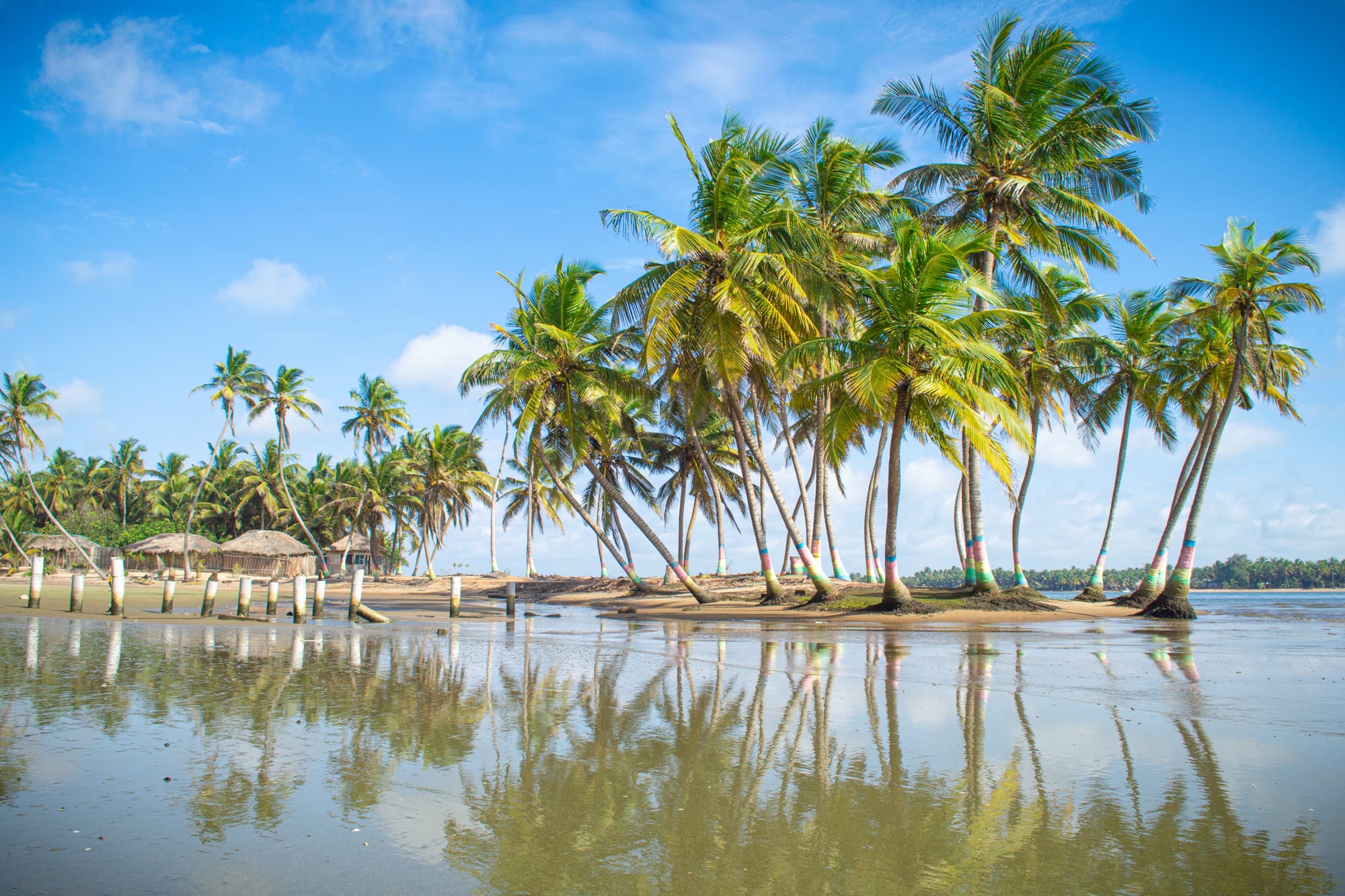
A cluster of tall leaning coconut palms on a sandbank, mirrored in shallow still water under a bright blue sky, with thatched huts along the shore behind

Ghana

Coconut palms reflected in the shallows at Ada Foah, on Ghana's southeast coast, where the Volta River meets the Atlantic Ocean. (Philip Nalangan / Wikimedia Commons · CC BY 4.0)

The first sub-Saharan African country to win independence — a stable West African democracy on the Gulf of Guinea, with gold, cocoa, a string of Atlantic slave-trade forts, and a lively music and diaspora culture.

Explore Ghana

History

The forest kingdom of Ashanti, centred on Kumasi and its Golden Stool, rose in the late seventeenth century into one of West Africa's most powerful states, built on gold and on supplying captives to the coast. The shoreline the Portuguese named the "Gold Coast" became the most fort-dense stretch in Africa, with dozens of European castles — Elmina, built by Portugal in 1482, is the oldest surviving European building south of the Sahara — through which enormous numbers of enslaved Africans were shipped across the Atlantic.

Britain gradually took over, fought a series of wars to subdue the Ashanti by 1901, and ran the Gold Coast as a colony producing cocoa, gold, and timber. In 1957, under Kwame Nkrumah, it became the first sub-Saharan African country to gain independence, renaming itself Ghana after a medieval empire and becoming a beacon for the wider independence movement.

Nkrumah's pan-Africanist government was overthrown in 1966, beginning two decades of coups and instability, the last bringing Jerry Rawlings to power in 1981. Rawlings oversaw a return to multiparty rule in 1992, and Ghana has since held regular elections with peaceful transfers of power between its two main parties — a rare record in the region — though debt, inflation, and a 2022 economic crisis have tested it.

Culture & Customs

Ghana's largest cultural bloc is the Akan (Ashanti, Fante, and related peoples), matrilineal societies with a rich tradition of chieftaincy, gold regalia, carved stools, adinkra symbols, and hand-woven kente cloth, whose colours and patterns carry meaning. The Ewe of the southeast, the Ga of Accra, and the Dagomba, Gonja, and others of the north each have their own languages, festivals, and forms of dress and music.

Religion is central and mostly Christian in the south — from established denominations to a booming Pentecostal and charismatic scene — with Islam strong in the north and among traders, and traditional practice woven through both. Funerals are major social events, often held weeks or months after a death, with printed invitations, matching cloth, brass bands or DJs, and large gatherings.

Music runs from highlife, the guitar-and-horn style Ghana gave the world, to hiplife and azonto, and the country's football team, the Black Stars, commands huge national feeling. Ties to the African diaspora are actively cultivated, notably through the 2019 "Year of Return" marking 400 years since the first enslaved Africans reached Virginia.

Daily Life

Greater Accra, on the coast, holds a large share of Ghana's roughly 34 million people and is the political and commercial centre; Kumasi, the Ashanti capital inland, is the second city and a huge market hub; Tamale is the main northern city. Cocoa farms, gold mines, and fishing villages define much of the rest.

The economy rests on gold (Ghana is Africa's largest producer), cocoa (among the top two or three worldwide), oil and gas since 2010, and a large services and informal sector. Growth has been strong over two decades, but a 2022 debt crisis, currency slide, and inflation have squeezed households hard.

Daily life runs on the tro-tro, the open-air market, the chop bar, church or mosque, and a strong culture of extended-family obligation. Power cuts ("dumsor"), road traffic, and the cost of living are the constant everyday complaints.

Food

Ghanaian food is built on starchy staples paired with rich, often fiery soups and stews. Fufu — pounded cassava and plantain — served in light soup or groundnut soup with goat, chicken, or fish, is the classic. Banku and kenkey (fermented maize dough) go with grilled tilapia and hot pepper shito, and waakye (rice and beans) with sides is the great street breakfast and lunch.

Jollof rice — cooked in a spiced tomato base — is a source of friendly national rivalry with Nigeria and Senegal, and red red (bean stew with fried plantain), kelewele (spiced fried plantain), and grilled meat and khebab skewers are everyday favourites. The north adds tuo zaafi and guinea-fowl dishes.

Sobolo (hibiscus), fresh coconut, and palm wine are common drinks; locally brewed pito (millet beer) is a northern staple, and Star and Club are the mass lagers.

  • Ghana: Food and the National Dish Pounded cassava and plantain eaten with a hot pepper soup, a jollof rice rivalry with Nigeria that never quite settles, and one of the world's great cocoa-growing nations

Attractions & Natural Wonders

The coast west of Accra holds the country's most significant history. Cape Coast Castle and, a short drive on, Elmina Castle — both UNESCO World Heritage Sites — preserve the dungeons, the "Door of No Return," and the machinery of the slave trade, and are visited by Ghanaians and members of the diaspora as places of pilgrimage. Nearby, Kakum National Park has a rainforest canopy walkway strung between giant trees.

Accra itself offers the Kwame Nkrumah Mausoleum and museum, the Independence Arch and Black Star Square, the Jamestown lighthouse and fishing harbour, the Makola market, and a growing arts and nightlife scene. Kumasi is the place for Ashanti culture: the Manhyia Palace, the Kejetia market, the kente-weaving village of Bonwire, and, if timing allows, an Akwasidae festival at the royal court.

The north opens up a different Ghana. Mole National Park, near Larabanga and its ancient mud-and-stick mosque, is the best place in the country to see elephants, antelope, and baboons, often on foot with an armed guide. Further options include the stilt village of Nzulezo on a lagoon in the west, the Wli waterfalls and hills of the Volta Region, and the crocodile pools and slave-history sites around Paga on the Burkina Faso border.

  • Ghana: Ten Attractions and Natural Wonders The slave-trade castles of the Gulf of Guinea, a rope walkway through the rainforest canopy, elephants in the northern savanna, and a village built on stilts over a lake

Planning basics

Budget

Ghana is moderately priced. Local food ("chop bars"), tro-tro minibuses, and simple guesthouses are cheap; Accra hotels, air-conditioned coaches, and hired cars with drivers are the main costs. Mobile money is used everywhere; ATMs are common in cities and larger towns.

Daily Budget Midrange
USD 70–150 (mid-range hotel, hired car with driver, tours, some flights)
Daily Budget Shoestring
USD 30–50 (guesthouse, chop-bar food, tro-tros and STC coaches)

Carry small cedi notes; agree fares before boarding shared taxis and tro-tros.

Visa Requirements

Most nationalities need a visa, usually arranged in advance at a Ghanaian mission; an e-visa and a visa on arrival (with prior approval) exist but can be slow and unreliable. A yellow fever vaccination certificate is mandatory for entry.

Typical Validity
30 to 90 days, single or multiple entry

Apply well ahead through an embassy; keep the yellow fever card with your passport.

Safety

Ghana is one of the more stable and safe countries in West Africa, and violent crime against visitors is relatively uncommon. Petty theft, pickpocketing in Accra markets and lorry parks, phone snatching, and scams (including romance and "gold deal" fraud) are the main risks. The far northeast near the Burkina Faso border has some spillover security concern.

Source
US Department of State and UK FCDO travel advisories — check for the latest wording.

Use registered or app-based taxis at night in Accra, keep valuables out of sight in crowds, be sceptical of unsolicited business propositions, and check current advice before travelling to the northern border areas.

Source: US Department of State and UK FCDO travel advisories — check for the latest wording.

Climate

Tropical. The south has two rainy seasons — a long one from about April to July and a shorter one in September and October — with heat and humidity year-round. The north has a single rainy season from May to September and a long, dry, dusty Harmattan season from about November to February.

North
one wet season; hazy and drier during the Harmattan
South
hot and humid, 26–33°C; heaviest rain May–June

Transportation

Kotoka International Airport in Accra is the gateway, with domestic flights to Kumasi, Tamale, and Takoradi. There is little useful passenger rail. Shared "tro-tro" minibuses and shared taxis cover everywhere cheaply; STC and VIP coaches run between the main cities in more comfort; a hired car with driver suits touring.

Accra traffic is heavy — allow far more time than distances suggest — and avoid intercity road travel at night.

Best Time to Visit

November to March, the main dry season, for the most comfortable travel, though the northern Harmattan brings dust haze. Wildlife viewing at Mole National Park is best late in the dry season, February to April. The rains of May and June make some roads difficult.

Events
Panafest and Emancipation Day commemorations (roughly July–August); the Ashanti Akwasidae festival cycle in Kumasi

Currency

The currency is the Ghanaian cedi (GHS), which has lost value steadily, so prices in cedi change quickly. Cash and mobile money dominate; carry small denominations.

Symbol
GH₵
Cash To Bring
US dollars or euros to change
Currency Code
GHS — Ghanaian cedi

Language

English is the official language, used in government, schooling, and the media. Around 80 languages are spoken; the most widely used are Akan (including Twi and Fante), Ewe, Ga, Dagbani, and Hausa as a northern trade language. English is widely spoken in the cities and the south.

Official Language
English
Main Local Languages
Akan (Twi/Fante), Ewe, Ga, Dagbani