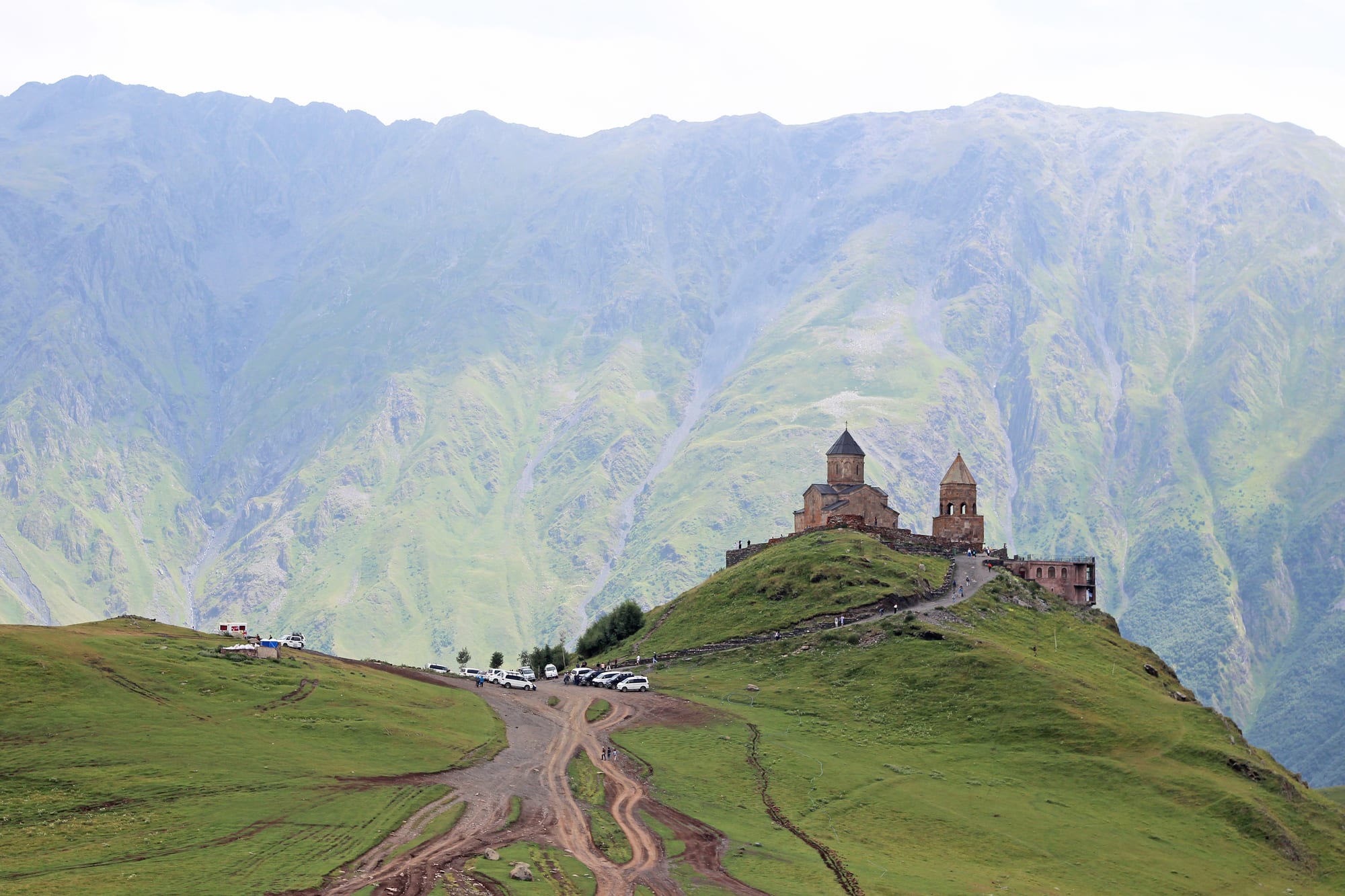
A lone stone church on a green ridge with a jagged snow-covered mountain towering behind it under scattered cloud

Georgia

Gergeti Trinity Church above the village of Stepantsminda, with Mount Kazbek (5,047 m) behind. (Stefan Wisselink / Wikimedia Commons · CC BY 2.0)

A small country in the South Caucasus where Europe and Asia meet — with its own ancient alphabet and church, a wine tradition thought to be the world's oldest, high mountains, and a fraught relationship with Russia.

Explore Georgia

History

Georgia's roots lie in the ancient kingdoms of Colchis (the land of the Golden Fleece) and Iberia, and it was one of the first states to adopt Christianity, in the early fourth century. A unified Georgian kingdom reached its "golden age" in the eleventh to thirteenth centuries under kings such as David the Builder and Queen Tamar, before Mongol invasions and, later, the pull between the Ottoman and Persian empires fragmented it.

Seeking protection, eastern Georgia accepted Russian suzerainty in 1783, and Russia annexed the kingdom outright in 1801, absorbing the other Georgian principalities over the following decades. A brief independent republic from 1918 was overrun by the Red Army in 1921, and Georgia became a Soviet republic — the birthplace of Joseph Stalin.

Independence returned in 1991, followed by civil conflict and the loss of control over the regions of Abkhazia and South Ossetia. The 2003 "Rose Revolution" brought reformers to power; a short war with Russia in 2008 ended with Russian recognition and military occupation of the two breakaway regions. Georgia has since pursued closer ties with the EU and NATO, becoming an EU candidate in 2023, amid recurring political turmoil over the pace and direction of that course.

  • Georgia: The Crossroads of the Caucasus An ancient Christian kingdom with its own alphabet — a medieval golden age, centuries caught between Persia and the Ottomans, two centuries under Russia, and a fierce modern argument about which way to face

Culture & Customs

Georgian identity is built on the language and alphabet, the Georgian Orthodox Church, and an intense culture of hospitality. The supra, a feast led by a tamada (toastmaster) who delivers a long, structured sequence of toasts to God, country, family, ancestors, and peace, is the central social ritual, fuelled by wine and polyphonic singing — a UNESCO-listed vocal tradition of interlocking male harmonies.

Wine is inseparable from this. Georgians make wine in qvevri, large clay vessels buried in the ground, a method dated by archaeologists to around 8,000 years ago — the oldest evidence of winemaking anywhere — and the practice is on UNESCO's list. Almost every rural family makes its own.

Georgians are proud, warm, and quick to insist that a guest is "a gift from God." Dance, from the athletic men's khevsuruli to the gliding women's parts, and a strong tradition in wrestling, rugby, and chess round out the cultural picture.

Daily Life

About a third of Georgia's 3.7 million people live in Greater Tbilisi, a city of sulphur baths, balconied old houses, Soviet blocks, and new glass landmarks strung along the Mtkvari River. Batumi, on the Black Sea, has boomed as a resort and casino city; Kutaisi is the old western capital; and much of the country is farming villages and mountain settlements, many losing population.

The economy runs on services — tourism has grown enormously — along with agriculture (wine, hazelnuts, fruit), transit and logistics between the Caspian and the Black Sea, and remittances. Wages are low, and the political argument over Europe versus a more cautious line toward Russia dominates national life.

Daily life keeps a Caucasian rhythm: strong coffee or tea, a large midday or evening meal, the marshrutka, church on Sunday for many, and — in autumn — the whole country turning to the grape harvest and the making of wine and chacha.

Food

Georgian food has a devoted following well beyond the country. Khachapuri, cheese-filled bread, comes in regional forms — the boat-shaped Adjaruli, topped with butter and a raw egg, is the most famous. Khinkali, large soup dumplings of spiced meat, are eaten by hand, holding the twisted top knot.

Walnuts, herbs, and spices define much of the cooking: pkhali (vegetable pâtés with walnut and garlic), badrijani (aubergine rolls with walnut paste), satsivi (chicken in cold walnut sauce), lobio (bean stew), and grilled meats (mtsvadi). Adjika, a fiery pepper paste, and tkemali, a sour-plum sauce, are on every table.

Wine is drunk with everything, often the family's own; chacha, a strong grape spirit, follows. Sparkling mineral water from Borjomi, and churchkhela — nuts threaded on string and dipped repeatedly in thickened grape juice — are the other national specialities.

  • Georgia: Food and the National Dish A boat-shaped cheese bread cracked open with a raw egg, dumplings eaten by hand and never with a fork, and a wine tradition that predates almost every other in the world

Attractions & Natural Wonders

Tbilisi rewards a couple of days: the old town's wooden balconies and churches, the sulphur bathhouses of Abanotubani, the Narikala fortress reached by cable car, and a lively café, wine-bar, and nightlife scene. Nearby, Mtskheta — the ancient royal and religious capital, a UNESCO site — has the Svetitskhoveli cathedral and the hilltop Jvari monastery.

The Georgian Military Highway climbs north to Stepantsminda (Kazbegi), where the lone Gergeti Trinity Church stands against the snows of Mount Kazbek — the country's postcard view — with the Gudauri ski resort on the way. To the west, the wine region of Kakheti around Sighnaghi and Telavi is the place to see qvevri winemaking and the supra at its fullest.

For mountains, Svaneti in the northwest is the star: the medieval defensive tower-houses of Mestia and Ushguli (among the highest permanently inhabited villages in Europe), glaciers, and multi-day treks. Tusheti, in the northeast, reached over a hair-raising summer-only pass, is even more remote. On the Black Sea, Batumi's boulevard and the botanical garden, and the rainforest and canyons around Kutaisi (Prometheus Cave, Martvili, Okatse), fill out the country.

Planning basics

Budget

Georgia is one of the cheaper countries in the region for visitors. Family guesthouses, marshrutka minibuses, and hearty restaurant meals cost little; Tbilisi's newer hotels and the ski resorts are pricier. Cards work in cities and towns; carry cash for villages, marshrutkas, and markets.

Daily Budget Midrange
USD 55–110 (hotel or good guesthouse, restaurants, a hired car or driver for the mountains)
Daily Budget Shoestring
USD 25–45 (guesthouse, local food, marshrutkas)

Visa Requirements

Georgia has one of the most open visa policies in the world: citizens of the EU, the UK, the US, Canada, Australia, and around 90 other countries can enter and stay for up to a full year without a visa.

Typical Stay
Up to 365 days, visa-free, for citizens of about 90 countries

Entry to the breakaway regions of Abkhazia and South Ossetia from the Russian side is illegal under Georgian law.

Safety

Georgia is a very safe country for visitors, with low levels of crime and a strong tradition of hospitality. The main caveats are political and territorial: the Russian-occupied regions of Abkhazia and South Ossetia and their boundary lines are dangerous and should not be approached, occasional large political protests occur in Tbilisi, and mountain roads and weather demand respect.

Source
US Department of State and UK FCDO travel advisories — check for the latest wording.

Stay well away from the administrative boundary lines of Abkhazia and South Ossetia, avoid demonstrations, and check conditions before driving mountain passes.

Source: US Department of State and UK FCDO travel advisories — check for the latest wording.

Climate

Varied for a small country. The Black Sea coast and western lowlands are humid subtropical, mild and very wet; eastern Georgia around Tbilisi is drier, with hot summers and cold winters; the high Caucasus is alpine, with deep snow and a long ski season.

Tbilisi
hot summers (30–35°C), cold winters near freezing
High Mountains
heavy winter snow; short cool summers
Black Sea Coast
mild and wet; warm humid summers

Transportation

Tbilisi and Kutaisi have the main airports (Kutaisi is a low-cost hub). Trains link Tbilisi with Batumi, Kutaisi, and Zugdidi; shared marshrutka minibuses go almost everywhere else, cheaply if not always comfortably. A hired car with driver, or a 4x4, is the practical choice for Svaneti, Tusheti, and Kazbegi.

The road to Kazbegi (the Georgian Military Highway) can close in winter storms; the Tusheti road is 4x4-only and open only in summer.

Best Time to Visit

May–June and September–October for warm, settled weather, wildflowers or the grape harvest (rtveli), and open mountain roads. July and August are hot in Tbilisi but the season for Svaneti and Kazbegi trekking. December to March is ski season at Gudauri and Bakuriani.

Currency

The currency is the Georgian lari (GEL). ATMs are widespread in cities and towns; exchange offices give good rates with little spread.

Cards
Widely accepted in cities; cash needed in the mountains and rural areas
Symbol
Currency Code
GEL — Georgian lari

Language

Georgian is the official language, written in its own distinctive alphabet and belonging to the small Kartvelian family, unrelated to any major language group. Russian is still understood by many, especially older people, though its use is politically sensitive; English is increasingly spoken by younger people and in Tbilisi and Batumi tourism.

English
Growing among the young and in tourism
Also Understood
Russian, especially among older people
Official Language
Georgian (own alphabet)