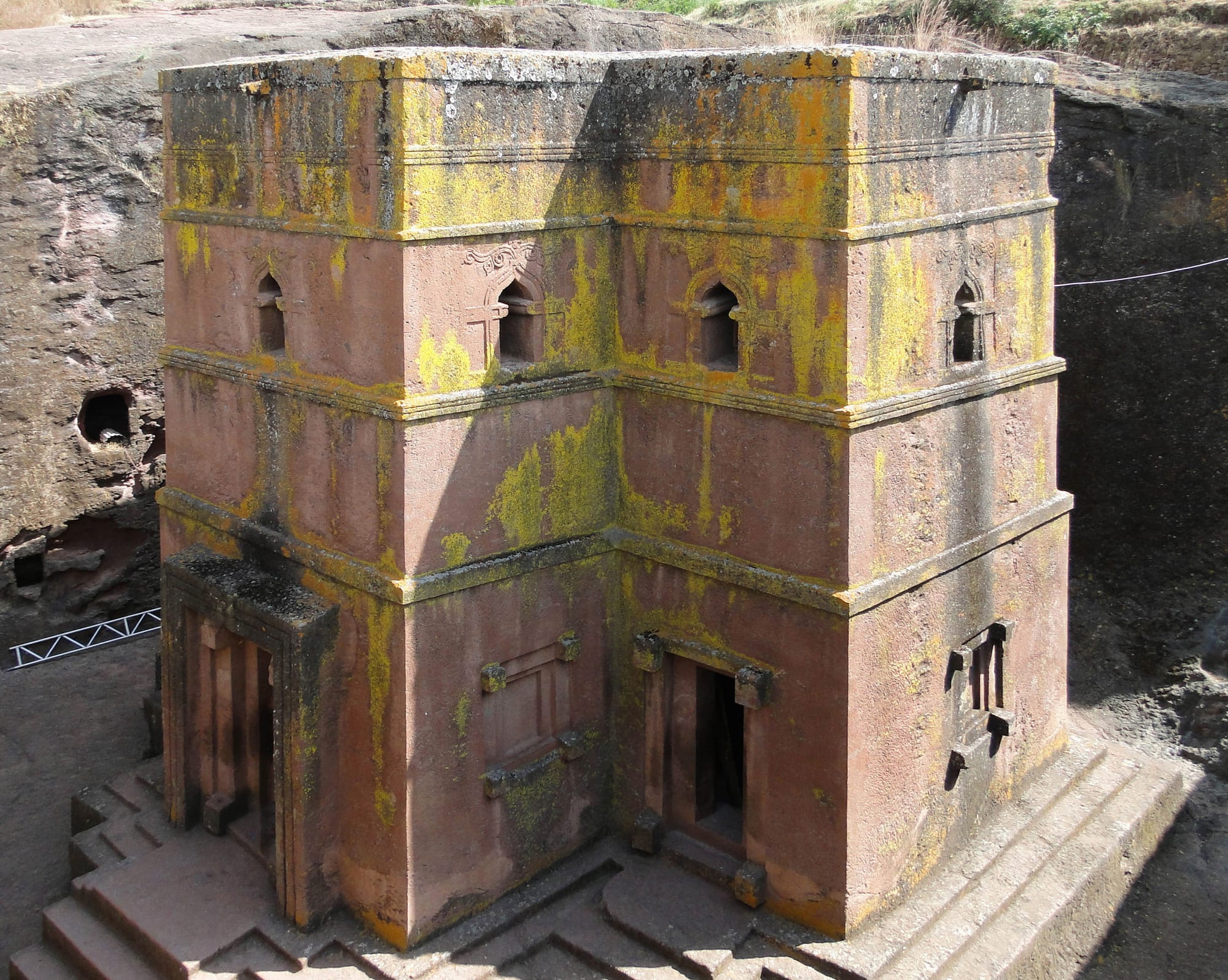
A cross-shaped church carved down into pink volcanic rock, cut off from the surrounding ground by a deep trench

Ethiopia

Bete Giyorgis, the cross-shaped Church of St George, one of eleven rock-hewn churches at Lalibela and a UNESCO World Heritage Site. (Bernard Gagnon / Wikimedia Commons · CC BY-SA 3.0)

An ancient highland empire that was never colonised, with its own alphabet, calendar, and church — the second-most-populous country in Africa, and one of its oldest continuously independent states.

Explore Ethiopia

History

Ethiopia's highlands hold some of the earliest evidence of humanity, including the 3.2-million-year-old skeleton "Lucy." Its recorded history begins with the kingdom of Aksum, a major trading power from the first centuries AD that minted its own coins and, in the fourth century, adopted Christianity — making the Ethiopian Orthodox Tewahedo Church one of the oldest in the world. A national epic, the Kebra Nagast, traces the royal line to Solomon and the Queen of Sheba.

Medieval Ethiopia was a Christian empire in the mountains, ringed and sometimes overrun by Muslim sultanates and Oromo migrations, its capital shifting and its rulers building the rock churches of Lalibela and, later, the castles of Gondar. In 1896 Emperor Menelik II's army destroyed an invading Italian force at Adwa, and Ethiopia remained the one African state, apart from Liberia, never colonised, though Italy occupied it from 1936 to 1941.

Emperor Haile Selassie, revered by the global Rastafari movement, was deposed in 1974 by the Derg, a Marxist military junta whose rule brought terror, war, and the 1984–85 famine. The Derg fell in 1991; Eritrea became independent in 1993; and Ethiopia adopted an ethnic-federal constitution. Reforms under Abiy Ahmed from 2018 won him a Nobel Peace Prize, but were followed by the devastating Tigray war of 2020–22 and continuing conflict in other regions.

Culture & Customs

Ethiopia is split roughly between Orthodox Christians, concentrated in the northern and central highlands, and Muslims, strong in the east, south, and lowlands, with Protestant Christians a large and growing group in the south and west. The Orthodox calendar — seven to eight years behind the Gregorian, with thirteen months — governs a dense cycle of fasts and feasts, and long fasting periods make vegan food a staple.

The coffee ceremony is the ritual of hospitality: green beans roasted over charcoal, ground, and brewed in a clay jebena, served in three rounds with incense and, often, popcorn. Injera, the sour, spongy flatbread, is shared from a common platter and eaten by hand. Ethiopia is proud that coffee itself originated in its forests, in the region of Kaffa.

The country's dozens of peoples keep distinct dress, music, dance (the shoulder-shaking eskista), and customs, from the highland Amhara and Tigrayan Christians to the pastoralists of the Somali region and the peoples of the Omo Valley in the south.

Daily Life

Ethiopia's population of well over 120 million is overwhelmingly rural, farming the highlands in one of the oldest continuously cultivated landscapes on Earth — teff, wheat, barley, maize, sorghum, and enset (the "false banana," a staple in the south) — and herding livestock. Addis Ababa, founded only in the 1880s and sitting above 2,300 metres, is the fast-growing capital and the seat of the African Union.

The economy grew rapidly for two decades on state-led investment, coffee, cut flowers, and manufacturing, before war, drought, debt, and inflation slowed it. Land is owned by the state and allocated to farmers, and food security is a constant concern in a country repeatedly hit by drought.

Daily life follows the Orthodox or Islamic calendar, the farming seasons and the rains, the market day, and the shared meal, with the coffee ceremony marking any significant visit.

Food

Ethiopian food is centred on injera, the wide sourdough pancake made mainly from teff, laid on a platter and topped with an array of stews (wat). Doro wat, chicken slow-cooked in spiced berbere and served with a boiled egg, is the festival dish; key wat (beef), tibs (sautéed meat), and kitfo (minced raw or lightly warmed beef with spiced butter) are everyday favourites.

On fasting days the food is entirely plant-based: shiro (chickpea purée), lentils (misir), split peas, greens (gomen), and beetroot and cabbage, combined as beyaynetu, a colourful vegetarian platter. Berbere and the herb butter niter kibbeh give the cuisine its character.

Tej, a honey wine served in a rounded flask, and tella, a homemade barley beer, are the traditional drinks, alongside the ceremonial coffee. In Muslim areas, spiced tea and fresh fruit juices take their place.

  • Ethiopia: Food and the National Dish A spiced chicken stew eaten from a shared plate of fermented flatbread, a raw beef delicacy for the adventurous, and the country credited with giving the world coffee itself

Attractions & Natural Wonders

The "historic route" through the northern highlands is the classic trip. Lalibela has eleven medieval churches carved down into the rock, still in daily use; Gondar keeps a walled compound of seventeenth-century castles; Aksum has its towering carved stelae and the church said to hold the Ark of the Covenant; and Bahir Dar sits by Lake Tana, dotted with island monasteries, near the Blue Nile Falls.

The Simien Mountains, a UNESCO World Heritage Site, offer high-altitude trekking among 1,000-metre escarpments, troops of gelada "bleeding-heart" baboons, and the rare walia ibex; the Bale Mountains in the south hold the Ethiopian wolf, Africa's most endangered carnivore. The Danakil Depression in the northeast is a volcanic lowland of sulphur springs, salt flats, and the lava lake of Erta Ale — visited only on organised, escorted trips.

The south is different again: the Rift Valley lakes, the walled Muslim city of Harar in the east with its "hyena men," and the Omo Valley, home to peoples such as the Mursi, Hamer, and Karo whose distinct cultures draw — and are strained by — a steady stream of photographers.

Planning basics

Budget

Ethiopia is inexpensive for local food, buses, and modest hotels, but the classic northern circuit adds up: internal flights, site entry fees, local guides, and — for the Danakil and some parks — mandatory escorts and 4x4s. Cash is essential outside top-end hotels, and the birr has been devalued sharply.

Danakil Tour
Organised multi-day Danakil trips run to several hundred USD, including escort and vehicles
Daily Budget Midrange
USD 70–150 (mid-range hotel, domestic flights, guides and drivers)
Daily Budget Shoestring
USD 25–45 (basic hotel, local eateries, buses)

Visa Requirements

Most nationalities need a visa. Ethiopia runs an e-visa system — apply online in advance and receive an approval to print — and a visa on arrival at Addis Ababa airport for many passports, typically 30 days and extendable. A yellow fever certificate is required if arriving from a risk country.

Typical Validity
30 days, e-visa or visa on arrival, extendable

Apply for the e-visa before travel; arriving without one can mean long queues or refusal.

Safety

Ethiopia's security picture is uneven and changeable. The core tourist circuit and Addis Ababa are generally manageable, but there has been armed conflict and instability in Tigray (a 2020–22 war), Amhara, and Oromia regions, and unrest elsewhere; several borders and regions are off-limits. Petty theft and aggressive begging affect visitors in towns.

Source
US Department of State and UK FCDO travel advisories — check for the latest wording.

Check current advisories closely and route around conflict-affected regions, travel the Danakil and remote parks only with a licensed operator and escort, and avoid political demonstrations.

Source: US Department of State and UK FCDO travel advisories — check for the latest wording.

Climate

Dominated by altitude. The highlands, where most people live and most sites are, are temperate year-round despite the tropical latitude. The main rains fall from about June to September; a shorter rainy spell comes in February–March. The lowlands — the Danakil, the Omo, the Somali region — are hot to extremely hot and dry.

Lowlands
hot; the Danakil is among the hottest places on Earth
Highlands
mild, 15–25°C by day, cool nights; wettest June–September

Transportation

Addis Ababa's Bole Airport is a major continental hub, and Ethiopian Airlines' domestic network — often cheaper if you fly the international leg with them — links the northern circuit towns and Gambela, Jimma, and the south. Long-distance buses and a Chinese-built railway to Djibouti serve overland travel; roads range from good to rough.

Flying the northern circuit (Bahir Dar, Gondar, Lalibela, Aksum) saves many long, hard days on mountain roads.

Best Time to Visit

October to March, after the main rains, for clear highland weather, green landscapes early on, and the big Orthodox festivals — Meskel in late September and Timkat (Epiphany) in January. Trekking in the Simien and Bale mountains is best October to April. Avoid the June–September rains for road travel.

Currency

The currency is the Ethiopian birr (ETB). A 2024 shift to a market exchange rate sharply devalued it, so prices in birr change fast. It cannot be obtained abroad; change money at banks or authorised hotels on arrival.

Symbol
Br
Cash To Bring
US dollars, in good condition
Currency Code
ETB — Ethiopian birr

Language

Ethiopia has no single national language. Amharic, written in the Ge'ez script, is the working language of the federal government and widely used as a lingua franca; Afaan Oromo has the most speakers; Tigrinya, Somali, Sidamo, and dozens of others are official in their regions. English is the language of secondary and higher education and of the tourism trade.

English
Common in tourism, education, and business
Most Spoken
Afaan Oromo
Federal Working Language
Amharic (Ge'ez script)