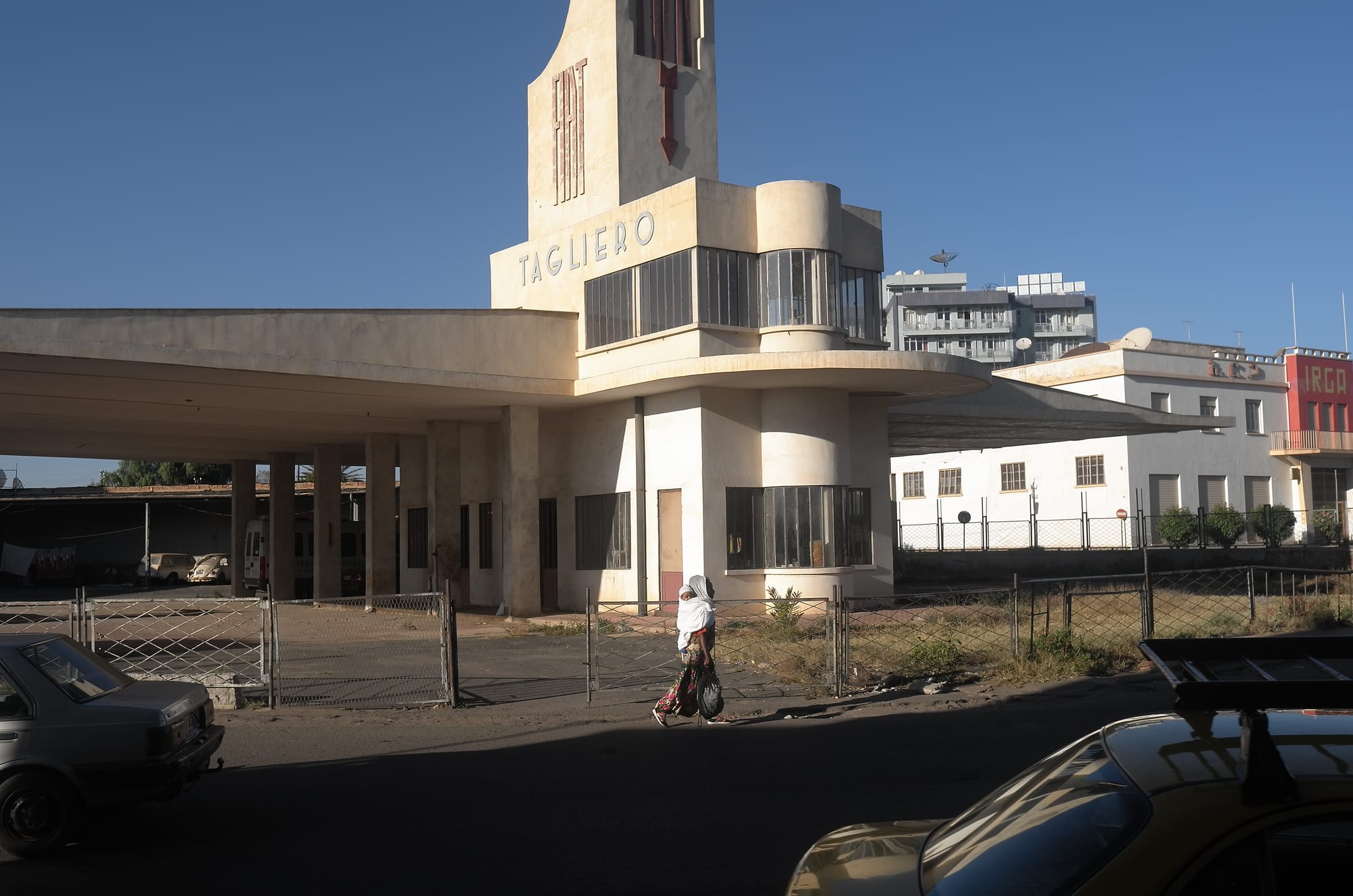
A streamlined 1930s petrol station shaped like an aeroplane, with long cantilevered concrete wings and a central tower

Eritrea

The Fiat Tagliero building in Asmara, a 1938 futurist petrol station and emblem of the capital's modernist architecture. (Martin Schibbye / Wikimedia Commons · CC BY-SA 4.0)

A Red Sea country that won independence from Ethiopia in 1993 after a 30-year war, and has since become one of the world's most closed states — with a modernist Italian-built capital and a long, empty coastline.

Explore Eritrea

History

The highlands were part of the ancient kingdom of Aksum and share deep history with Ethiopia, including early Christianity. The Red Sea coast, with its port of Massawa, was drawn into Ottoman, Egyptian, and Arab spheres over the centuries. Italy assembled these territories into the colony of Eritrea in 1890, using it as a base — and, in 1935–36, a springboard for the invasion of Ethiopia — and building Asmara, railways, and industry.

After Italy's defeat, Britain administered Eritrea until 1952, when the United Nations federated it with Ethiopia. Ethiopia annexed it outright a decade later, triggering a war of independence that lasted from 1961 to 1991. The Eritrean People's Liberation Front finally prevailed, and a 1993 referendum confirmed independence.

Hopes for the new state faded quickly. A devastating 1998–2000 border war with Ethiopia was followed by a "no war, no peace" standoff that the government used to justify indefinite military conscription and the suspension of the constitution and elections. Isaias Afwerki, the independence leader, has ruled without a vote ever since. A 2018 peace deal with Ethiopia briefly opened the border, and Eritrean forces later took part in the war in Ethiopia's Tigray region.

Culture & Customs

Eritrea has nine recognised ethnic groups, roughly split between Christians — mostly the ancient Eritrean Orthodox Tewahedo Church, plus Catholics and Protestants — concentrated in the highlands, and Muslims in the lowlands and along the coast. The largest group, the Tigrinya, are highland Orthodox Christian farmers; the Tigre, Saho, Afar, and others are largely Muslim pastoralists.

The coffee ceremony — roasting, grinding, and brewing beans over charcoal, served in three rounds with incense — is the central ritual of hospitality, shared with Ethiopia. So is injera, the sourdough flatbread that doubles as plate and utensil. Weddings, saints' days, and the two Eids are the main celebrations.

The long independence war shaped a national culture of stoicism, self-reliance, and discipline, and a large diaspora — the result of both the war and the ongoing exodus of young people avoiding conscription — sustains families through remittances and keeps Eritrean music and identity alive abroad.

Daily Life

Around 700,000 people live in Asmara, a highland city of wide streets, palm-lined boulevards, cinemas, and cafés built in the 1930s in Italian modernist and "rationalist" styles and remarkably intact — the whole city centre is a UNESCO World Heritage Site. Keren and the port of Massawa are the other main towns.

The economy is small, state-dominated, and constrained by sanctions (since partly lifted), the aftermath of war, and the diversion of labour into national service. Mining (gold, copper, potash), remittances, and subsistence farming and herding are the mainstays. Electricity, fuel, and imported goods are frequently in short supply.

Daily life is orderly and quiet, organised around the church or mosque, the extended family, the coffee ceremony, and — for a large part of the adult population — obligatory service in the military or the civil administration.

Food

Eritrean food is close to Ethiopian, centred on injera, the spongy sourdough made from taff, topped with an array of stews (tsebhi): fiery zigni (beef in berbere spice), alicha (milder vegetable and meat stews), lentils, chickpea purée (shiro), and greens. On fasting days, which are numerous in the Orthodox calendar, the food is entirely vegan.

The Italian legacy is unusually strong for East Africa: pasta ("pasta al sugo") is a genuine everyday dish, especially in Asmara, alongside good espresso, cappuccino, and pastries, and lasagne on menus.

Along the coast, grilled and fried Red Sea fish and shellfish, sometimes cooked in a clay oven, are the speciality. Suwa (barley beer) and mies (honey wine) are the traditional alcoholic drinks; strong spiced tea (shahi) is drunk in the lowlands.

Attractions & Natural Wonders

Asmara is the reason to come. Its 1930s core — the Fiat Tagliero petrol station shaped like a plane, the Cinema Impero, the Art Deco villas, the central market, and the Catholic and Orthodox cathedrals — is one of the most complete ensembles of early modernist architecture anywhere, best seen slowly on foot with a macchiato.

The old railway and the switchback road drop more than 2,000 metres from Asmara to Massawa, a coral-stone Ottoman and Egyptian port town heavily damaged in the independence war and only partly restored, with striking Turkish-influenced buildings around its two harbours.

Offshore lie the Dahlak Islands, a low, arid archipelago in the Red Sea with uncrowded reefs, clear water, and a few historic sites, reached by boat from Massawa. Inland, the town of Keren has a lively Monday camel market and a wartime history, and the highland monasteries and the Qohaito plateau's ruins reward those who secure the permits.

Planning basics

Budget

Eritrea is cheap by the numbers but hard to travel: hotels and food cost little, but there is no tourism industry to speak of, permits are needed for almost everywhere outside Asmara, and hard currency and fuel are scarce. It is a cash economy in nakfa, which cannot be taken out of the country.

Source
Very limited data — verify against current advice.
Daily Budget Midrange
USD 70–130 (better Asmara hotel, hired car with driver, guide)
Daily Budget Shoestring
USD 30–55 (basic hotel, local eateries, shared transport within permitted areas)

Change only what you need; exporting nakfa is prohibited and there is little to spend it on.

Source: Very limited data — verify against current advice.

Visa Requirements

A visa is required for all visitors and must be obtained in advance from an Eritrean embassy; approval can be slow and is not guaranteed. Separately, travel permits are required for essentially all destinations outside the capital and must be arranged in Asmara.

Typical Validity
30 days, single entry, plus internal travel permits

Arrange a local sponsor or agency; independent applications are frequently refused or ignored.

Safety

Everyday crime is very low and visitors are rarely troubled by it, but Eritrea is a militarised one-party state with indefinite national service, no independent media, and severe restrictions on movement, photography, and speech. Border regions with Ethiopia, Sudan, and Djibouti are sensitive or closed, and consular assistance is minimal.

Source
US Department of State and UK FCDO travel advisories — check for the latest wording.

Never photograph military sites, government buildings, bridges, ports, the airport, or people in uniform; carry your permits; and avoid any political conversation.

Source: US Department of State and UK FCDO travel advisories — check for the latest wording.

Climate

Three zones. The highland around Asmara, at over 2,000 metres, is mild and dry most of the year with a summer rainy season (June to September). The western lowlands are hot and have a similar summer rains pattern. The Red Sea coast and the Danakil in the southeast are among the hottest places on Earth, especially April to September.

Highlands
pleasant, 15–25°C, cool nights
Coast And Danakil
extreme heat, over 40°C for much of the year

Transportation

Asmara International Airport has a handful of regional connections. A narrow-gauge Italian-built railway between Asmara and the port of Massawa runs occasionally for tourists. Buses and shared taxis connect the main towns, and a hired car with driver is the practical option — but all intercity travel requires a permit.

The switchback road down from Asmara to Massawa is spectacular; you still need a permit to take it.

Best Time to Visit

October to March for comfortable highland weather and bearable temperatures on the coast and Dahlak islands. Avoid the coast and lowlands in the northern summer, when the heat is dangerous, and the highland rains of July and August.

Currency

The currency is the Eritrean nakfa (ERN), pegged to the US dollar at an official rate well above the informal one. It cannot be obtained or exchanged outside Eritrea, and taking notes out is illegal.

Symbol
Nfk
Cash To Bring
US dollars, to change on arrival at the official rate
Currency Code
ERN — Eritrean nakfa

Language

Eritrea has no single official language by law. Tigrinya is the most widely spoken and is used in government and the highlands; Arabic is also widely used and taught. English is the language of secondary and higher education. Tigre, Afar, Saho, Bilen, and others are spoken by their communities. Italian is understood by some older people.

Working Languages
Tigrinya, Arabic
Education Language
English