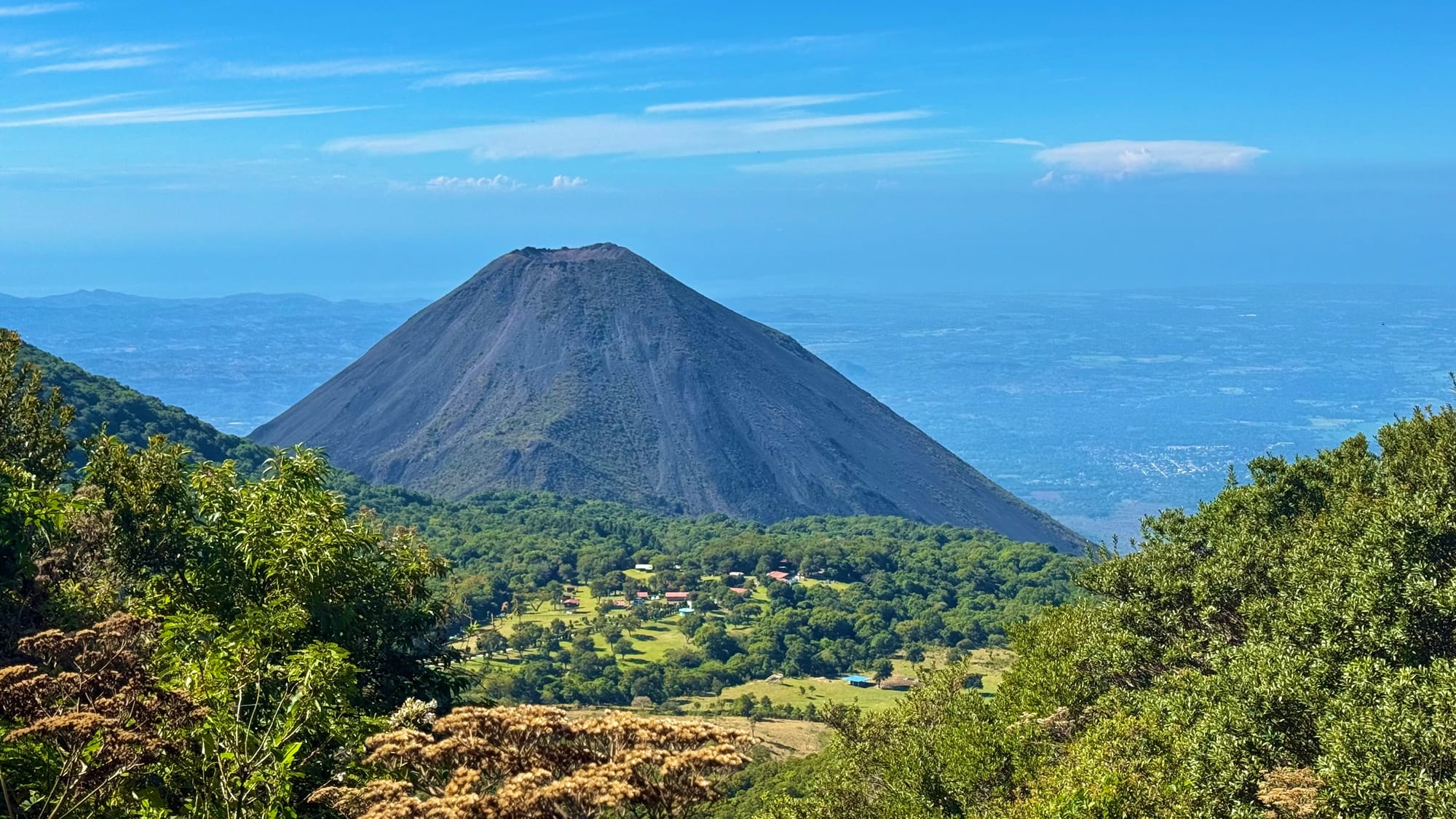
A steep, bare, dark-grey volcanic cone rising above green forest and a small farm clearing, with a hazy blue coastal plain stretching away behind it

El Salvador

The dark cone of Izalco volcano, seen from the slopes of Santa Ana volcano. (Dead.rabbit / Wikimedia Commons · CC BY-SA 4.0)

The smallest and most densely populated country in Central America — a volcanic Pacific strip that came through civil war and years of gang violence, and has drawn attention for a hard-line security crackdown and for adopting Bitcoin.

Explore El Salvador

History

The western highlands were the eastern frontier of Mesoamerica, home to the Pipil (Nahua) people and, earlier, to Maya communities; the ash-buried farming village of Joya de Cerén preserves a snapshot of daily life around 600 AD. Spanish forces under Pedro de Alvarado conquered the area in the 1520s after hard fighting.

El Salvador became independent from Spain in 1821 and, after the brief Central American federation collapsed, a separate republic in 1841. The nineteenth and early twentieth centuries were dominated by coffee, grown on land concentrated in the hands of a small elite, and by the military governments that protected it. A 1932 peasant uprising was crushed in a massacre, La Matanza, that killed tens of thousands, mostly Indigenous, and effectively ended open Pipil identity.

From 1979 to 1992 a civil war between the US-backed military government and the leftist FMLN guerrillas killed around 75,000 people, with death squads, massacres such as El Mozote, and the assassination of Archbishop Óscar Romero. A UN-brokered peace turned the FMLN into a political party, but the post-war years brought the gangs — partly deported from Los Angeles — and a new wave of violence, migration, and, since 2019 under President Nayib Bukele, a sweeping and controversial security crackdown.

  • El Salvador: The Little Country The smallest and most crowded nation in Central America — a coffee oligarchy, the 1932 massacre, a brutal civil war, gang violence, and a president who jailed a generation

Culture & Customs

Salvadoran culture is Central American and mestizo, shaped by coffee, Catholicism (with a strong evangelical presence), and, more than almost anywhere, by migration: perhaps a quarter of all Salvadorans live abroad, mostly in the United States, and remittances they send home are a huge share of the economy. Deportees and returnees, "hermanos lejanos" (distant brothers), are woven into national life.

Óscar Romero, the archbishop murdered in 1980 for speaking against repression and canonised in 2018, is a national and Catholic icon. The war and its memory, marked at El Mozote and in the FMLN's transformation into a party, remain present, as does a newer national conversation about security, rights, and Bukele's model.

Everyday culture centres on the pupusa, football, the church, and town patron-saint festivals with fireworks, processions, and food stalls. The surf towns of the Pacific have developed their own laid-back international scene.

Daily Life

Greater San Salvador, ringed by volcanoes, holds a large share of the country's roughly 6 million people; Santa Ana and San Miguel are the other main cities. The country is small enough to cross in a few hours, and densely populated throughout, with farmland, coffee slopes, and towns running into one another.

The economy depends on remittances, on manufacturing in free-trade zones (textiles above all), on agriculture — coffee, sugar, and staple grains — and, increasingly, on tourism promoted under the "Surf City" banner. Poverty and under-employment remain widespread, and the security crackdown has reshaped daily life, ending the gangs' extortion of buses and businesses while drawing criticism over due process.

Daily life runs on the comedor, the chicken bus, the evening in the town square, and, for many families, a phone call and a money transfer from a relative in Houston or Los Angeles.

Food

The pupusa is the national dish and a national identity: a thick handmade corn (or rice) tortilla stuffed with cheese, refried beans, chicharrón, or loroco flower buds, griddled and eaten with curtido (a tangy cabbage slaw) and a thin tomato salsa. Pupuserías are everywhere, and pupusas have their own national day.

Beyond them, everyday food is beans, rice, eggs, fried plantain, cream (crema) and queso fresco, and tortillas. Yuca frita with chicharrón, panes con pollo (a stuffed chicken sandwich), sopa de pata (cow's-foot soup), tamales, and seafood soups on the coast fill out the menu.

Horchata here is made with morro seeds and spices rather than rice; chan and tamarind drinks, coffee from the country's own highlands, and the sugarcane spirit chaparro are the traditional accompaniments.

  • El Salvador: Food and the National Dish A stuffed corn tortilla taken seriously enough to have its own official national day, a pickled cabbage slaw that never leaves its side, and a horchata that isn't made from rice

Attractions & Natural Wonders

El Salvador packs a lot into a small area. The Santa Ana volcano (Ilamatepec), the country's highest, is climbed on a popular guided morning hike to a rim above a steaming turquoise crater lake, in Los Volcanes National Park alongside the Izalco cone and Lake Coatepeque, a deep blue caldera lake.

The Ruta de las Flores, a highland road through Nahuizalco, Juayúa, Apaneca, Ataco, and Concepción de Ataco, links coffee towns known for murals, weekend food fairs, waterfalls, and cool mountain air. Suchitoto, a cobblestoned colonial town above a reservoir, is the other main highland base.

The Pacific coast is a string of world-class right-hand point-breaks — El Tunco, El Sunzal, Punta Roca at La Libertad, and the quieter east around El Cuco — plus turtle-nesting beaches and the mangroves of Bahía de Jiquilisco. For history and nature there are the Maya site of Tazumal, the ash-preserved village of Joya de Cerén (a UNESCO World Heritage Site), and the cloud forest of Montecristo, where El Salvador, Guatemala, and Honduras meet.

Planning basics

Budget

El Salvador is inexpensive, and the use of the US dollar removes exchange hassle. Comedor meals, pupusas, and "chicken buses" cost very little; surf-town guesthouses and private shuttles are the main costs. Cards work in San Salvador and tourist towns; carry cash elsewhere.

Daily Budget Midrange
USD 70–140 (hotel, rental car or shuttles, restaurants, tours)
Daily Budget Shoestring
USD 30–50 (guesthouse, comedor meals, chicken buses)

Visa Requirements

Citizens of the EU, the UK, the US, Canada, Australia, and most of Latin America enter visa-free for up to 90 days. El Salvador is part of the "CA-4" agreement with Guatemala, Honduras, and Nicaragua, so the 90 days are shared across all four countries.

Typical Stay
90 days across the CA-4 region, visa-free, for most Western passports

There may be a small tourist card fee on arrival by air.

Safety

El Salvador was for years one of the most violent countries in the world, dominated by the MS-13 and Barrio 18 gangs. Since a "state of exception" declared in 2022, which suspended some civil liberties and jailed tens of thousands, homicide rates have fallen dramatically, and tourist areas are much safer than a decade ago. Ordinary crime — theft, scams — and the state-of-exception legal environment are the current concerns.

Source
US Department of State and UK FCDO travel advisories — check for the latest wording.

Stick to established tourist areas and shuttles, use registered taxis or apps in San Salvador, don't photograph police or military, and check current advice before travelling.

Source: US Department of State and UK FCDO travel advisories — check for the latest wording.

Climate

Tropical, with a dry season ("verano") from about November to April and a wet season ("invierno") from May to October, when afternoon and evening downpours are the norm. The Pacific lowlands are hot; the highlands and volcano slopes are cooler.

Dry Season
Nov–Apr, hot and sunny, hazy from agricultural burning late in the season
Wet Season
May–Oct, green, with heavy afternoon rain and some storm risk

Transportation

San Salvador's international airport, on the coast southeast of the city, is the gateway. There is no passenger rail. Retired US school buses ("chicken buses") cover the country cheaply; tourist shuttles link the main destinations more comfortably; and a rental car works well on the compact, generally decent road network.

Driving
On the right; distances are short, but avoid driving between towns at night

Best Time to Visit

November to April for reliable dry weather, though late in the dry season the air can be smoky. The surf is good year-round on the Pacific point-breaks, with the biggest swells from March to October. The wet season is lush and quiet.

Currency

El Salvador uses the US dollar, adopted in 2001. It also made Bitcoin legal tender in 2021 (later softened after IMF pressure), but in practice the dollar is used for everything and Bitcoin acceptance is limited.

Cards
Accepted in cities and tourist areas; carry small bills for buses and comedores
Symbol
$
Currency Code
USD — US dollar

Language

Spanish is the official language, spoken with the Central American use of "vos." Nawat (Pipil), the Indigenous language, has only a handful of elderly native speakers and is the subject of revival efforts. English is spoken in tourism and by many in the large returnee and diaspora community.

English
In tourism and among people with US ties
Official Language
Spanish