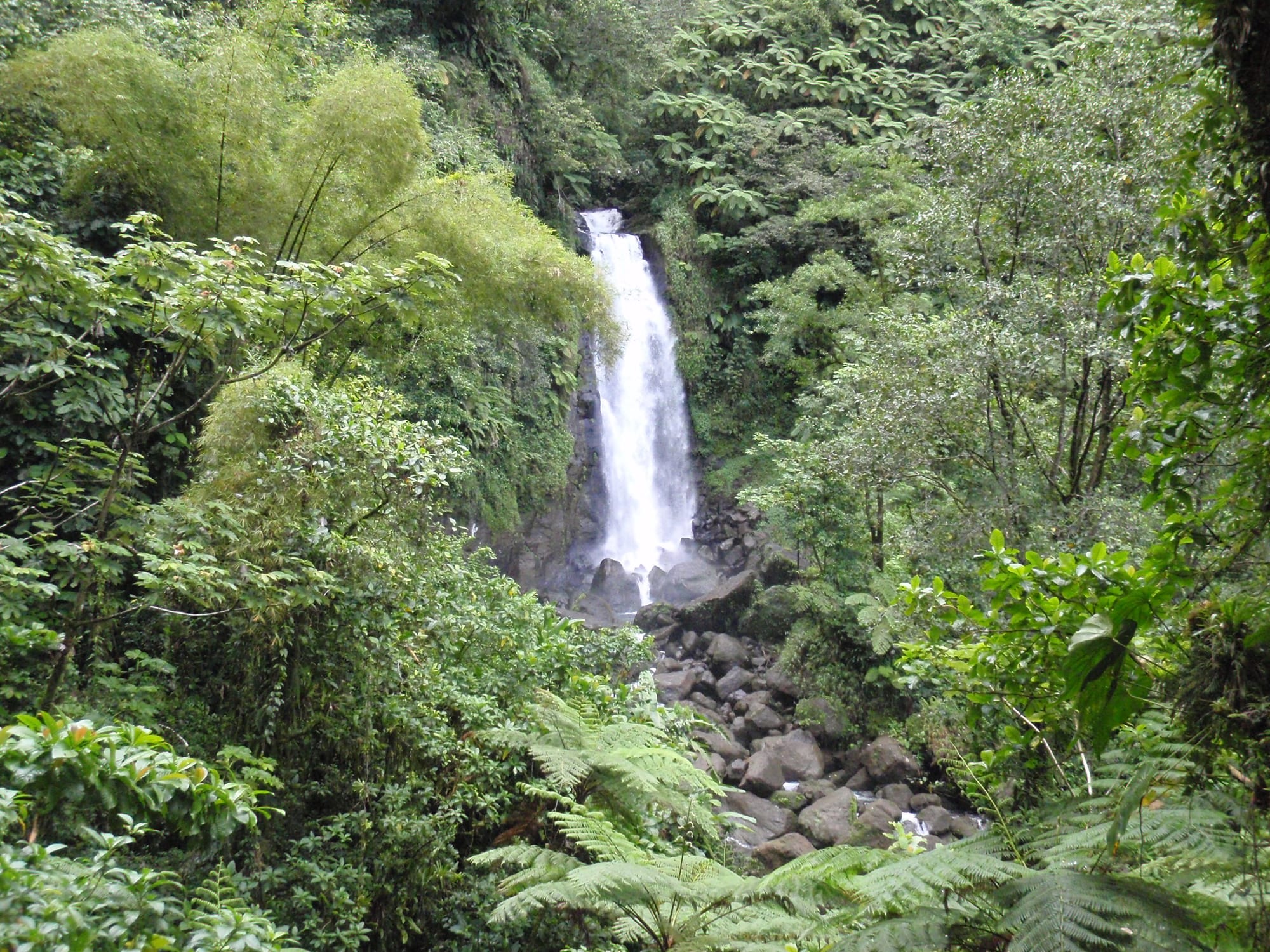
Two tall waterfalls plunging down forested cliffs into rocky pools in dense green rainforest

Dominica

The twin Trafalgar Falls in Morne Trois Pitons National Park, a UNESCO World Heritage Site. (XeresNelro / Wikimedia Commons · CC BY-SA 4.0)

A small, mountainous eastern Caribbean island — the "Nature Isle" — of rainforest, rivers, and volcanic peaks, with a boiling lake, the last surviving Indigenous Caribbean community, and few beaches to speak of.

Explore Dominica

History

Dominica was the last Caribbean island Europeans managed to hold onto, because its steep, forested terrain and its Kalinago (Island Carib) inhabitants made settlement so difficult. The Kalinago, who had displaced earlier peoples, fought off Spanish and then French and British attempts for well over a century, and a community of their descendants survives on the island's east coast — the only substantial Indigenous population left in the eastern Caribbean.

France and Britain both claimed and fought over the island in the eighteenth century, running coffee and sugar estates worked by enslaved Africans; Britain took final control in 1763. Enslaved people who escaped into the mountains formed "Maroon" communities that resisted for decades.

Dominica moved from a British colony to internal self-government and then to full independence in 1978, as a republic within the Commonwealth. Hurricane David in 1979 and, far worse, Hurricane Maria in 2017 — which struck as a Category 5 and stripped the island's forests bare — have repeatedly set back its development. The country now markets itself as the world's first "climate-resilient nation" and runs a citizenship-by-investment programme to fund reconstruction.

Culture & Customs

Dominica's culture is Afro-Caribbean and Creole, with a strong French-Catholic layer from the colonial back-and-forth and a distinct Kalinago thread. Kwéyòl, the French-based creole, is widely spoken, and there is a movement to keep it and the traditional bélé drumming and dance, the jing ping accordion-and-boom-boom music, and masquerade alive.

The Kalinago Territory, a stretch of the east coast held communally, is home to a few thousand people who maintain canoe-building, basketry woven from larouma reed, cassava bread, and their own council and chief. Bush medicine — the use of forest plants for healing — is still widely practised across the island.

Christianity, mostly Catholic, is central to community life, and the annual World Creole Music Festival, held around Independence in late October alongside "Creole in the Park" and Jounen Kwéyòl, is the cultural high point of the year.

Daily Life

Roughly a quarter of the island's roughly 70,000 people live in or near Roseau, the small capital on the southwest coast; Portsmouth in the north is the second town. The rest of the population is spread through farming villages along the coasts and in the valleys.

The economy rests on agriculture — bananas historically, now more diverse with root crops, citrus, coffee, cocoa, and bay oil — along with a growing eco- and adventure-tourism sector, geothermal energy development, and the passport programme. Emigration, especially to the other islands, the UK, and the US, is long-standing, and remittances matter.

Life is rural, church-centred, and closely tied to the land and the weather. Rebuilding stronger after Maria — hurricane-proof roofs, buried power lines — has been a national project.

Food

Dominican cooking is Creole and rooted in what the island grows. The national dish is "mountain chicken" — actually the legs of a large native frog, the crapaud — though hunting has been suspended for years to protect the species, so it is rarely served. In practice the everyday food is fish, chicken, and pork with "provisions": dasheen, yam, green banana, breadfruit, and plantain.

Callaloo soup (dasheen leaves), sancocho-style broths, saltfish with bakes, and bouyon, a hearty one-pot soup, are staples, along with the Kalinago cassava bread (kasav) and farine. Fresh river crayfish and coconut in many forms appear widely.

Local drinks include cocoa tea, bush teas, fresh juices, sea moss, and rum — Dominica's own distilleries produce it, and "bush rum" infused with herbs and roots is a village tradition. Kubuli is the local beer.

  • Dominica: Food and the National Dish A traditional national dish now protected almost out of existence, cassava bread still made by the Caribbean's last significant Indigenous community, and a food culture shaped by one of the most biodiverse islands in the region

Attractions & Natural Wonders

Dominica is a hiking and nature destination rather than a beach one. Morne Trois Pitons National Park, a UNESCO World Heritage Site, contains the Boiling Lake — a flooded fumarole, the second-largest of its kind in the world, reached by a strenuous guided day hike past the steaming Valley of Desolation — along with the Trafalgar Falls, the Emerald Pool, and Titou Gorge.

The 184-kilometre Waitukubuli National Trail runs the length of the island in fourteen segments through rainforest, ridges, and villages. Elsewhere, the Indian River near Portsmouth is a calm rowboat trip through swamp forest, and Cabrits National Park protects a restored Georgian garrison, Fort Shirley, on a headland.

Underwater, Dominica has some of the best diving in the region — dramatic drop-offs, pinnacles, and the champagne-bubble vents of Champagne Reef — and it is one of the few places where you can reliably swim near resident sperm whales. The Kalinago Territory on the wild windward coast offers a window into Indigenous Caribbean life.

Planning basics

Budget

Dominica is mid-range for the Caribbean and has little mass tourism. Guesthouses and locally run eco-lodges are the norm rather than big resorts; site passes for the national park and dive trips are the main add-on costs. Cards are accepted in Roseau and at dive shops; carry cash elsewhere.

Site Pass
A national parks pass covers Trafalgar Falls, the Boiling Lake trail, and other sites
Daily Budget Midrange
USD 150–300 (eco-lodge or small hotel, rental car, guided hikes and diving)
Daily Budget Shoestring
USD 70–110 (guesthouse, local food, buses)

Visa Requirements

Citizens of the US, Canada, the UK, the EU, and most Commonwealth countries do not need a visa and are typically admitted for up to six months. An onward or return ticket may be requested.

Typical Stay
Up to 6 months on entry, visa-free, for most Western passports

Safety

Dominica is generally safe, with low levels of violent crime, though petty theft and the occasional robbery occur. The real hazards are natural: flash floods and landslides on the trails and roads in heavy rain, strong currents on the exposed coasts, and hurricanes — Maria devastated the island in 2017.

Hike with a guide for the Boiling Lake and other long trails, check the forecast before heading into the interior, and never cross a flooded river.

Climate

Tropical and very wet — the mountainous interior is among the rainiest places in the Caribbean. The drier season runs roughly February to June; July to November is wetter and warmer and overlaps the Atlantic hurricane season.

Drier Season
Feb–Jun, still with frequent showers inland
Wetter Season
Jul–Nov, heavy rain, hurricane risk

Transportation

Douglas-Charles Airport in the northeast handles regional flights; there are no direct long-haul services, so most visitors connect through Antigua, Barbados, or the French islands, or arrive by ferry from Guadeloupe and Martinique. On the island, shared minibuses run fixed routes by day; a rental car (or 4x4) suits the winding mountain roads.

Driving
On the left; roads are steep, narrow, and slow, and landslips are common after heavy rain

Best Time to Visit

February to June for the driest weather and the best trail conditions, and the World Creole Music Festival falls in late October. Whale watching — Dominica has resident sperm whales — is good much of the year, best in the calmer months. Avoid the peak hurricane season if you can.

Currency

The currency is the East Caribbean dollar (XCD), shared across the eastern Caribbean and pegged to the US dollar at 2.70. US dollars are widely accepted, with change usually given in EC dollars.

Symbol
$ (EC$)
Currency Code
XCD — East Caribbean dollar (2.70 to 1 USD)

Language

English is the official language, used in government and schools. Most Dominicans also speak Kwéyòl (Antillean Creole), a French-based creole shared with the neighbouring French islands, and a distinct English-based dialect (Kokoy) is spoken in a few northern villages.

Everyday Language
Kwéyòl (Antillean Creole)
Official Language
English