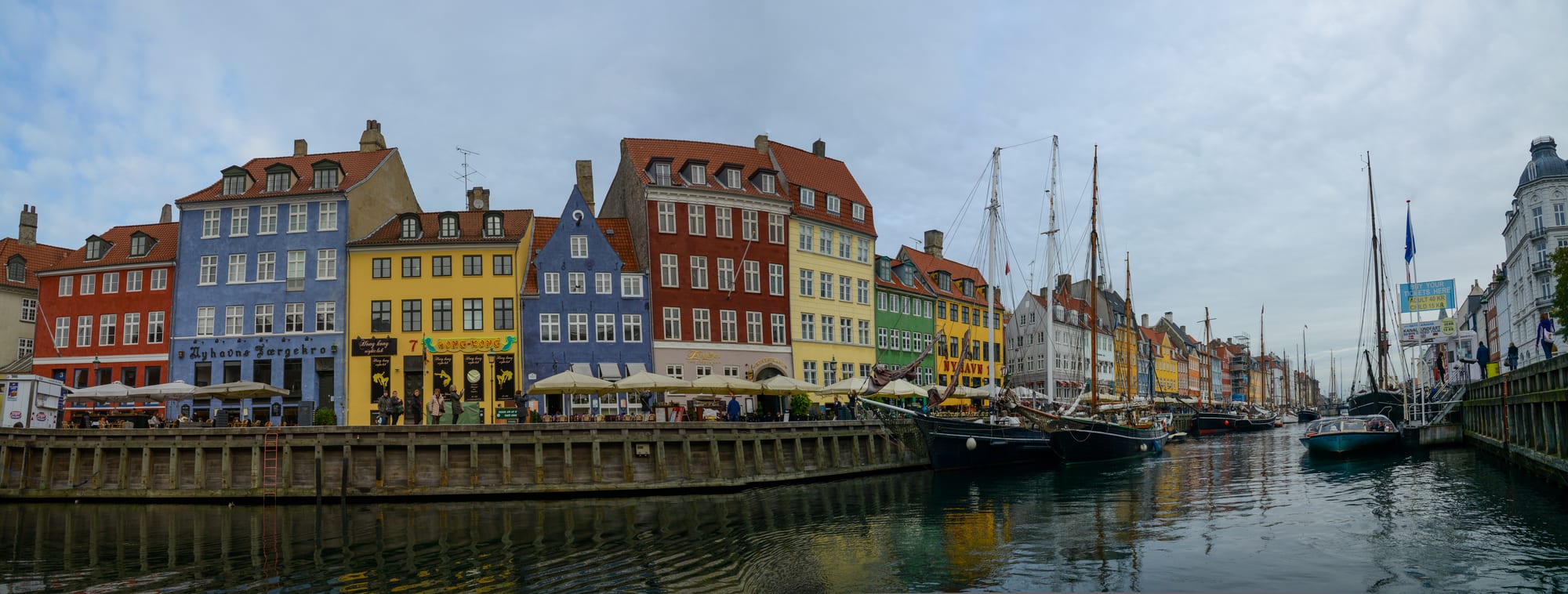
A row of narrow, brightly painted townhouses along a canal lined with wooden sailing boats

Denmark

Nyhavn in Copenhagen, a 17th-century canal district of painted merchant houses, now a waterfront of bars and cafés. (Jorge Láscar / Wikimedia Commons · CC BY 2.0)

The southernmost Nordic country — a low, tidy peninsula and hundreds of islands — with a long monarchy, a strong welfare state, a design and cycling culture, and a reputation for contentment.

Explore Denmark

History

Denmark's recorded history begins with the Vikings, who from the eighth to the eleventh centuries raided, traded, and settled across the North Atlantic and into England, where Danish kings ruled for a time. The monarchy that emerged is one of the oldest in the world, traced by tradition to Gorm the Old in the tenth century; his son Harald "Bluetooth" is credited on a runestone at Jelling with uniting Denmark and bringing it to Christianity.

In the late medieval period the Kalmar Union briefly joined Denmark, Norway, and Sweden under the Danish crown. Denmark then spent centuries as a regional power, losing Sweden, then Norway (in 1814, after backing Napoleon), and finally the duchies of Schleswig and Holstein to Prussia in 1864 — a defeat that shrank the country to roughly its present size and turned it inward.

Denmark stayed neutral in the First World War and was occupied by Nazi Germany in the Second, when a widely admired civil effort ferried most of the country's Jews to safety in Sweden. Post-war Denmark built one of the world's most comprehensive welfare states, joined NATO in 1949 and the European Community in 1973, while opting out of the euro and some other EU projects. Greenland and the Faroe Islands remain self-governing parts of the Danish realm.

Culture & Customs

Danish social life is informal and egalitarian, suspicious of showing off — an attitude often linked to the "Jante Law," a fictional set of rules mocking self-importance. Trust in institutions and in strangers is unusually high, and the welfare state, free education and healthcare, and a short working week are broadly popular across the spectrum.

Hygge — a hard-to-translate sense of cosy, unhurried togetherness, candles and coffee and good company — is a genuine cultural value, especially through the dark winter. Design is another: Danish furniture, lighting, and architecture, from Arne Jacobsen to Bjarke Ingels, and the toy company Lego, are sources of national pride.

Cycling is a daily habit rather than a hobby, church attendance is low even though most Danes belong nominally to the national Lutheran church, and Midsummer bonfires, Christmas traditions, and a strong bakery-and-coffee culture punctuate the year.

Daily Life

More than a third of Danes live in Greater Copenhagen, on the island of Zealand, with Aarhus, Odense, and Aalborg the other main cities on the Jutland peninsula and Funen. The country is flat, compact, and easy to cross, and no point is far from the sea.

The economy is high-income and open, strong in shipping (Maersk), pharmaceuticals (Novo Nordisk), wind energy (Denmark pioneered large-scale wind power), agriculture and food, and design. Taxes are among the highest in the world, and in return healthcare, education through university, and generous parental leave and unemployment support are provided.

Daily life is well-organised and outdoors-friendly: the school run and commute by bike, an early finish, sports clubs and evening classes, and summer weekends at a sommerhus on the coast.

Food

Traditional Danish food is centred on rye bread, pork, fish, and potatoes. The lunchtime classic is smørrebrød, an open sandwich on dense rye piled with herring, liver pâté, roast pork, shrimp, or egg and neatly garnished. Frikadeller (pan-fried meatballs), stegt flæsk (crisp pork belly with parsley sauce), and roast pork with crackling are the hearty staples.

Pastry is a national strength — the flaky wienerbrød known abroad as a "Danish" — along with rye-based rugbrød, liquorice, and the cinnamon kanelsnegl. At Christmas come roast duck, risalamande rice pudding, and gløgg.

Copenhagen has also become a world capital of fine dining, led by Noma and the "New Nordic" movement's focus on local, foraged, and seasonal ingredients — an influence now felt in restaurants across the region. Beer (Carlsberg, Tuborg, and a wave of craft brewers) and akvavit are the traditional drinks.

  • Denmark: Food and the National Dish A pork-and-parsley-sauce dish voted into the top spot by the public, an open sandwich treated almost as an art form, and a pastry the rest of the world names after the one country that doesn't

Attractions & Natural Wonders

Copenhagen is the main draw: the painted canal houses of Nyhavn, the Tivoli Gardens amusement park, the royal palaces of Amalienborg and Rosenborg with the crown jewels, the Little Mermaid statue, the "free town" of Christiania, and a run of excellent museums and modern architecture. Just north lies Kronborg Castle at Helsingør, the "Elsinore" of Hamlet, and the Louisiana Museum of Modern Art on the coast.

Elsewhere, Roskilde has a royal-burial cathedral and a Viking Ship Museum with reconstructed longships; Odense on Funen is the birthplace of Hans Christian Andersen; and Jutland has the original Legoland at Billund, the sculpted-away "buried church" and shifting dunes at Skagen where two seas meet, and the wide North Sea beaches of the west coast.

For history, the Jelling runestones and mounds and the reconstructed ring fortresses such as Trelleborg tell the Viking story, and the Wadden Sea tidal flats in the southwest — a UNESCO site shared with Germany and the Netherlands — draw vast flocks of migrating birds and the "black sun" starling murmurations.

Planning basics

Budget

Denmark is one of the most expensive countries in the world. Restaurants, alcohol, and hotels are the big costs; supermarkets, bakeries, tap water, and the excellent public transport soften the blow. The country is close to cashless — cards and phone payment work everywhere.

Daily Budget Midrange
DKK 1,500–2,800 (mid-range hotel, restaurants, museums, some train travel)
Daily Budget Shoestring
DKK 700–1,100 (hostel, self-catering and bakery food, bikes and transit)

Tap water is excellent and free; tipping is not expected as service is included.

Visa Requirements

Denmark is in the EU and the Schengen Area. Citizens of the EU, the UK, the US, Canada, Australia, and many others need no visa for stays of up to 90 days in any 180-day period. Greenland and the Faroe Islands are part of the Danish realm but outside the EU and Schengen, with their own entry rules.

Typical Stay
90 days in any 180-day period, visa-free, for most Western passports

Safety

Denmark is a very safe country with low levels of violent crime. Petty theft — pickpocketing around Copenhagen Central Station, Strøget, and Nyhavn — is the main issue for visitors. Cycling requires attention to the rules and to the flow of other cyclists.

Keep bags closed in tourist crowds, and learn the basic cycling signals and lane etiquette before riding.

Climate

Temperate maritime — mild, changeable, and often windy, with no great extremes. Summers are cool to warm; winters are cold and grey but rarely severe, with limited snow. Rain is possible year-round, and daylight swings from very long in June to short in December.

Summer
June–August, generally 17–24°C, long days
Winter
December–February, around 0–4°C, short dark days

Transportation

Copenhagen Airport is the main Nordic hub. Trains (DSB) link the cities quickly and reliably, crossing to Sweden over the Øresund Bridge; buses cover smaller places. Cycling is a genuine mode of transport, especially in Copenhagen, Odense, and Aarhus, with segregated lanes everywhere and bike-share and rental widely available.

Rent a bike in Copenhagen; it is often the fastest and most enjoyable way around the city.

Best Time to Visit

May to August for the long days, outdoor cafés, and festivals, with June and July the warmest and busiest. April and September are pleasant shoulders. December brings Christmas markets and Tivoli's lights to Copenhagen.

Events
Roskilde Festival (late June/July); Copenhagen Jazz Festival (July); Tivoli's Christmas season

Currency

The currency is the Danish krone (DKK), pegged closely to the euro. Denmark has opted out of the euro. Cards and mobile payment (MobilePay locally) are universal, and many places no longer accept cash at all.

Symbol
kr
Currency Code
DKK — Danish krone

Language

Danish is the official language, a North Germanic language related to Norwegian and Swedish but with a distinctive, softened pronunciation. English is spoken fluently by the large majority of Danes, and you can travel and live in Denmark using only English. German is also widely understood.

English
Near-universal and fluent
Official Language
Danish