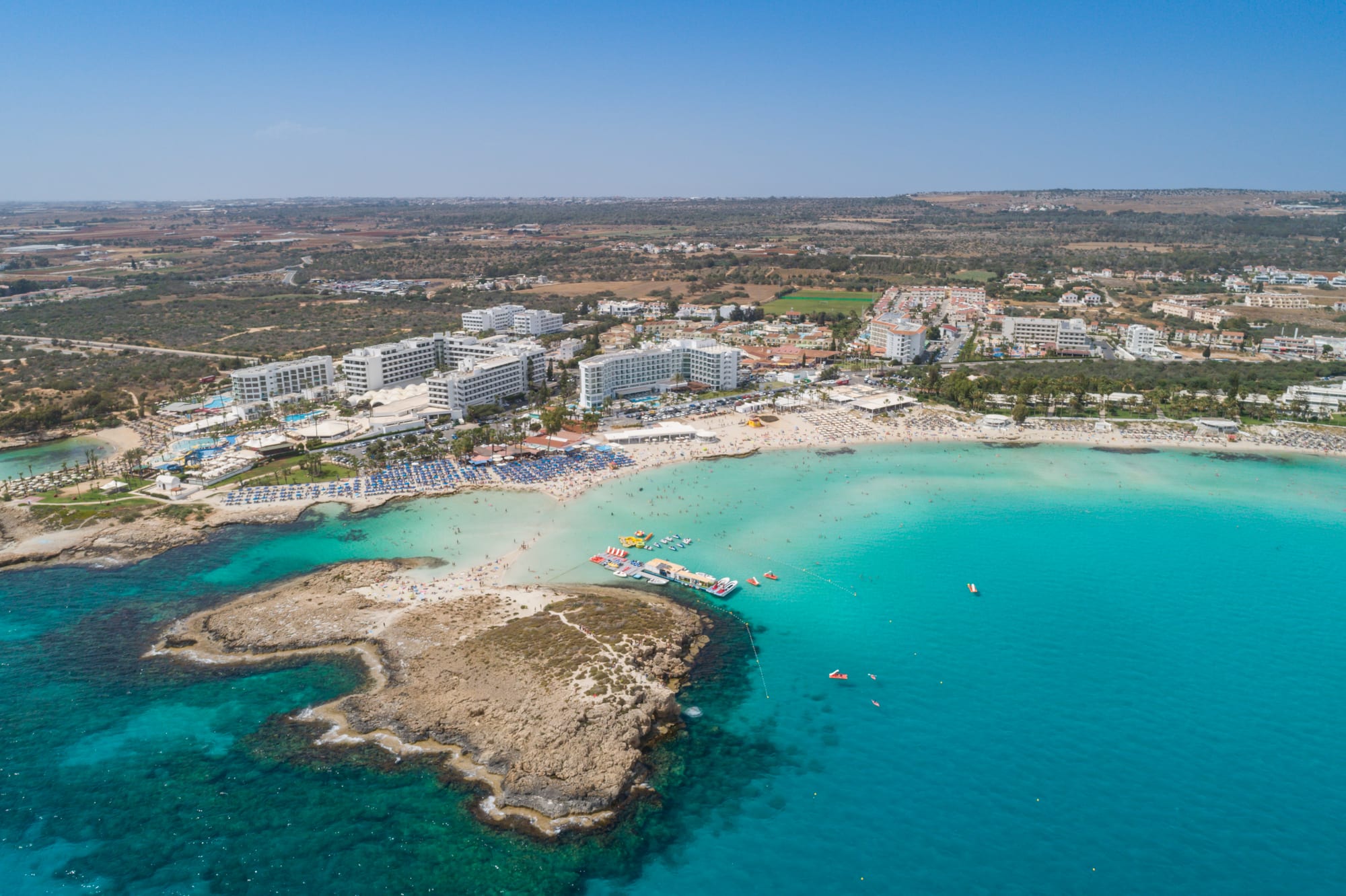
Aerial view of a curving white-sand beach and a rocky islet joined to it by a sandbar, surrounded by luminous turquoise shallows, with resort buildings and flat countryside behind

Cyprus

Nissi Beach at Agia Napa, seen from the air. (dronepicr / Wikimedia Commons · CC BY 2.0)

The third-largest island in the Mediterranean and an EU member — Greek-speaking in the south, divided since 1974 by a buffer zone from a Turkish-controlled north, with beaches, ancient ruins, and painted mountain churches.

Explore Cyprus

History

Cyprus has been inhabited for more than ten thousand years and, thanks to its copper — which gave the metal its name — was a prize for every Mediterranean power. Mycenaean Greeks settled it in the Bronze Age, fixing its language and culture; Phoenicians, Assyrians, Egyptians, Persians, and then Alexander's successors and Rome followed. It was an early centre of Christianity, visited by Paul and Barnabas.

Byzantine rule lasted centuries, interrupted by Arab raids, before the island passed to Crusader lords, the French Lusignan dynasty, and then Venice. The Ottomans conquered Cyprus in 1571, ruling for three centuries and settling a Turkish-speaking Muslim population alongside the Greek Orthodox majority. Britain took over administration in 1878 and annexed the island in 1914.

Cyprus became independent in 1960 under a power-sharing constitution that soon broke down into intercommunal violence. In 1974 a coup by supporters of union with Greece prompted a Turkish military invasion that seized the northern third of the island. The population was divided, with Greek Cypriots fleeing south and Turkish Cypriots north. The Republic of Cyprus joined the EU in 2004; the north, recognised only by Turkey, remains outside it, and reunification talks have repeatedly failed.

  • Cyprus: The Divided Island Ancient copper and Aphrodite, layer on layer of empire, a British colony, and an island split between Greeks and Turks since 1974

Culture & Customs

Greek Cypriot culture is Greek Orthodox and Hellenic, but with its own dialect, food, music, and a strong village-and-family orientation. The church is a major landowner and political actor as well as a religious one, and saints' days, weddings, and the Easter cycle structure the year. Turkish Cypriot culture in the north is Turkish and largely secular in outlook.

Hospitality is generous and food-centred, and both communities share many customs, foods, and a slow, sociable pace built around the coffee house (kafenio). Cypriots are proud of the island's antiquity and of Aphrodite, said to have risen from the sea off its southwest coast.

The division is an ever-present fact of life: the ghost suburb of Varosha, the buffer zone running through the middle of the divided capital Nicosia, and the missing persons of 1974 are all part of the political and emotional landscape.

Daily Life

Most of the roughly 900,000 people in the government-controlled area live in Nicosia, the divided capital, or the coastal cities of Limassol, Larnaca, and Paphos. Limassol has grown fast as a shipping, finance, and (controversially) "golden passport" hub, with a large Russian and other expatriate community.

The southern economy runs on services — tourism, financial and professional services, shipping — plus some agriculture and, prospectively, offshore natural gas. The north's smaller economy depends heavily on Turkey, tourism, and higher education.

Daily life on both sides is comfortable and Mediterranean: a long midday break in summer, dinner late and outdoors, weekends at the beach or in the mountain villages, and coffee that lingers. Many families move between a city flat and a village house.

Food

Cypriot cooking is Levantine-Mediterranean, best experienced as meze, a long succession of small dishes. Signatures include halloumi, the squeaky sheep-and-goat cheese invented here and often grilled; sheftalia (caul-wrapped minced-meat sausages); souvla, large chunks of pork or lamb grilled slowly over charcoal; and kleftiko, lamb baked for hours in a sealed oven.

Village food leans on pulses, greens, and grains: louvi (black-eyed peas with chard), koupepia (stuffed vine leaves), trahanas soup, and olives, bread, and tahini. Loukoumades (honey-soaked dough balls), daktyla, and the Turkish Cypriot muhallebi are the sweets.

Cyprus has an ancient wine tradition, including the sweet Commandaria, said to be the world's oldest named wine still in production; the fiery grape spirit zivania; and strong Cypriot coffee served with a glass of water.

  • Cyprus: Food and the National Dish A grilling cheese protected as uniquely Cypriot, meat cooked in secret long enough to give it a bandit's name, and one of the oldest wines still made anywhere in the world

Attractions & Natural Wonders

The southwest around Paphos holds the island's densest antiquities: the Roman mosaics of the House of Dionysus, the rock-cut Tombs of the Kings, and the dramatic sea stacks of Petra tou Romiou, all part of a UNESCO listing. Nearby Kourion has a cliff-top Greco-Roman theatre still used for performances.

The Troodos Mountains in the centre are cool and pine-forested, with hiking trails, the Kykkos monastery, and a cluster of small Byzantine churches whose painted interiors are collectively a World Heritage Site. In winter they carry enough snow for a modest ski area on Mount Olympus, the island's highest point.

The coast offers the sandy resorts and clear water of Ayia Napa and Protaras in the southeast, the sea-turtle beaches and wild Akamas Peninsula in the west, and, across the Green Line, the harbour town of Kyrenia beneath its castle, the ruined abbey of Bellapais, and the ancient city of Salamis near Famagusta. Nicosia's Venetian walls and its two-sided old town are worth walking on both sides of the divide.

Planning basics

Budget

The Republic of Cyprus is mid-range for the EU. The coastal resorts of Ayia Napa, Protaras, Limassol, and Paphos are the priciest in summer; the villages, the mountains, and the shoulder seasons are cheaper. Card payment is widespread. Prices in the Turkish-controlled north are generally lower.

Daily Budget Midrange
EUR 110–200 (mid-range hotel, rental car, restaurants, sites)
Daily Budget Shoestring
EUR 55–85 (guesthouse or budget hotel, taverna lunches, buses)

Visa Requirements

Cyprus is in the EU but not yet in the Schengen Area. Citizens of the EU, the UK, the US, Canada, Australia, and many others need no visa for stays of up to 90 days in any 180-day period. Entry must be through a legal port in the government-controlled south; entering only via the north is not recognised.

Typical Stay
90 days in any 180-day period, visa-free, for most Western passports

You can cross the Green Line between the two parts at designated checkpoints with your passport.

Safety

Cyprus is a very safe country with low levels of crime. Petty theft occurs in the summer resorts, and drink-driving and fast rural roads are the main practical hazards. The UN-patrolled buffer zone (the "Green Line") is militarised — do not photograph military positions or stray off marked crossing points.

Cross between north and south only at official checkpoints, and avoid the buffer zone and army areas.

Climate

Mediterranean, and one of the warmest and sunniest parts of Europe. Summers are long, hot, and dry; winters are mild on the coast and cold enough for snow and a short ski season in the Troodos Mountains. Spring and autumn are warm and pleasant.

Summer
hot and dry, 30–38°C on the coast, hotter inland
Winter
mild coast (10–17°C); snow on the Troodos peaks

Transportation

Larnaca and Paphos have the international airports in the south; Ercan in the north is used mainly via Turkey. There are no passenger trains. A rental car is by far the easiest way to get around; intercity and urban buses exist but are limited. Taxis and ride-hailing operate in the cities.

Driving
On the left, a British legacy; roads are good, with motorways linking the main southern cities

A hire car booked in the south can usually be taken north with extra insurance; check with the company.

Best Time to Visit

April to June and September to October for warm weather, a swimmable sea, wildflowers or the wine harvest, and comfortable sightseeing. July and August are very hot and busy at the resorts. Winter suits the mountains and the archaeological sites without the heat.

Currency

The Republic of Cyprus uses the euro. The Turkish-controlled north uses the Turkish lira, though euros are often accepted there; carry some lira or change money after crossing.

Symbol
€ / ₺
Currency Code
EUR — euro (south); Turkish lira in the north

Language

Greek is the official language in the government-controlled south, spoken in a distinct Cypriot dialect, and Turkish in the north. English is very widely spoken across the whole island, a legacy of British rule, and most signage in the south is bilingual Greek and English.

English
Very widely spoken island-wide
Official Languages
Greek (south), Turkish (north)