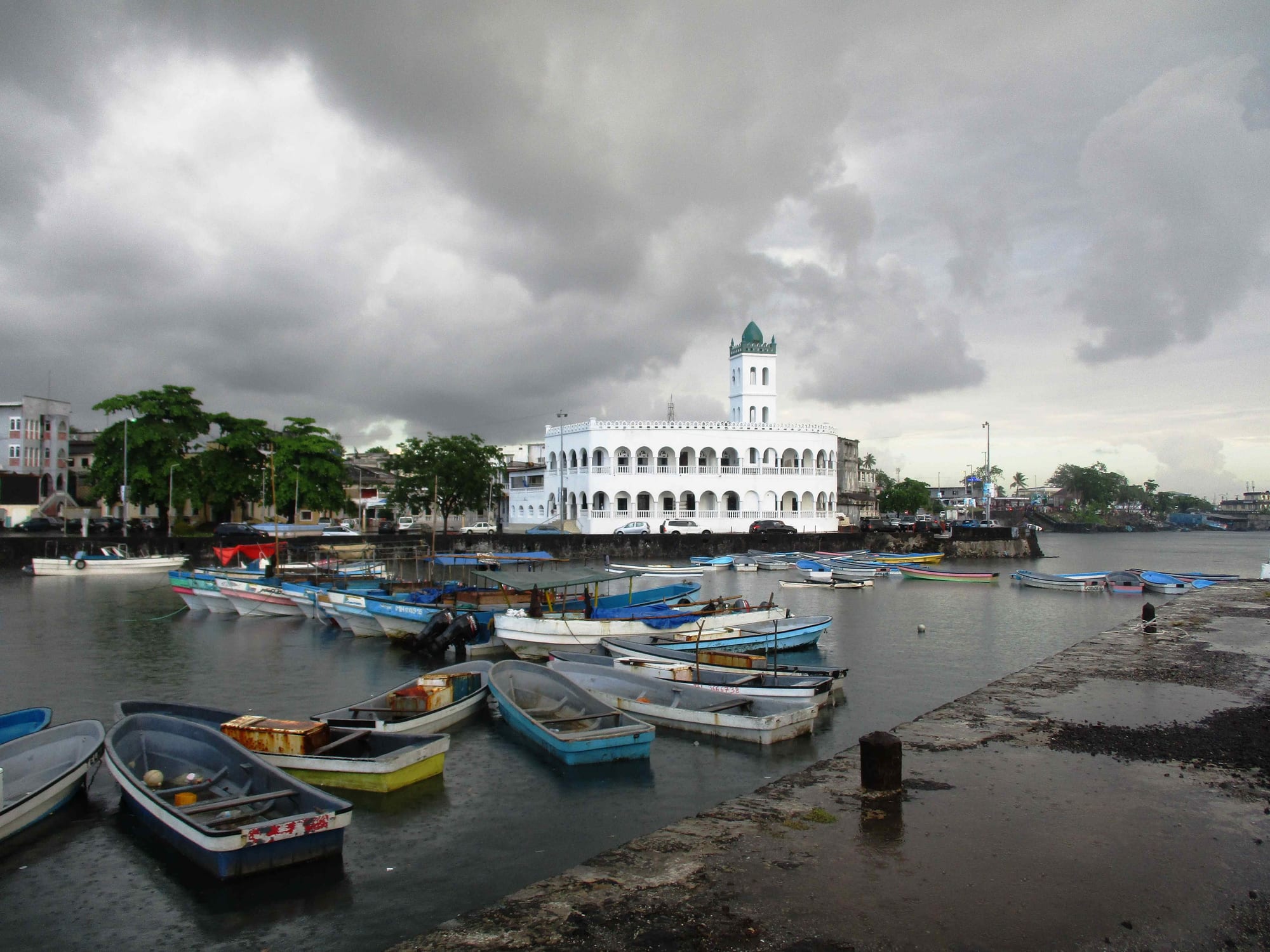
A white mosque with a slender minaret on a rocky volcanic shoreline, small fishing boats drawn up on the black rocks

Comoros

The old Friday Mosque on the waterfront of Moroni, the capital, on the island of Grande Comore. (Radosław Botev / Wikimedia Commons · CC BY 3.0)

A small three-island nation in the Indian Ocean between Mozambique and Madagascar — volcanic, Muslim, French- and Swahili-influenced, coup-prone, and barely touched by tourism.

Explore Comoros

History

The islands were settled by Bantu-speaking peoples from the East African coast and by Austronesian voyagers, and from around the tenth century were drawn into the Swahili trading world of the Indian Ocean, with Arab and Persian merchants and, later, Shirazi dynasties founding a patchwork of small sultanates. Islam took root early and has defined the islands ever since.

France established a protectorate in the nineteenth century and made the archipelago a colony administered from Madagascar. In a 1974 referendum, three of the four islands voted for independence, which they declared in 1975; the fourth, Mayotte, voted to remain French and still does, an arrangement the Comoros government continues to reject as an illegal occupation.

Independent Comoros became a byword for instability, with around twenty coups or attempted coups — several involving the French mercenary Bob Denard — and a period in which the islands of Anjouan and Mohéli declared their own secession. A 2001 constitution created a rotating union presidency. Azali Assoumani, who first took power in a 1999 coup, has dominated politics since, winning a disputed election in 2024 amid opposition protests.

  • Comoros: The Islands of the Moon Swahili sultanates at a crossroads of the Indian Ocean, a neglected French colony, a contested fourth island, and one of the most coup-prone nations on earth

Culture & Customs

Comorian society is Sunni Muslim and conservative, and Islam structures the day, the week, and the year; Friday prayers, Ramadan, and the two Eids are the fixed points, and Quranic schooling is near-universal. Dress is modest, and visitors, especially women, are expected to cover shoulders and knees away from beaches.

The islands keep a distinctive marriage custom, the grand mariage (anda), a lavish, expensive village wedding that a man is expected to hold once in his life to gain full social standing and the right to speak in community affairs; families save for years, and it drives much of the flow of remittances from abroad.

Culture blends African, Arab, Malagasy, and French elements — in the twarab music played at celebrations, the carved doors and coral-stone houses of the old towns, and the everyday use of French alongside Comorian. The perfume trade is woven into the landscape: Comoros is one of the world's main producers of ylang-ylang essence, and clove and vanilla are also grown.

Daily Life

Most of the roughly 850,000 people live on Grande Comore (Ngazidja), the largest island, and around the capital, Moroni. Anjouan (Ndzuani) is the most crowded and mountainous, and Mohéli (Mwali) the smallest and least developed.

Comoros is among the poorest countries in the world, with few resources, little industry, and farmland under pressure. The economy depends heavily on subsistence agriculture and fishing, on exports of ylang-ylang, cloves, and vanilla, and above all on money sent home by the large Comorian diaspora in France, especially around Marseille — remittances are the country's economic lifeline.

Daily life is rural and slow, organised around the mosque, the family compound, the market, and the farming and fishing calendar. Power and water supply are patchy, and inter-island travel is a real obstacle to ordinary life.

Food

Comorian cooking reflects the islands' Swahili and Indian Ocean setting: rice as the staple, coconut, plentiful spices, and fresh fish. Langouste à la vanille, lobster in a vanilla sauce, is the celebratory dish, and grilled or curried fish, octopus, and pweza wa nazi (octopus in coconut) are everyday fare on the coast.

Cassava, breadfruit, green banana, and mataba (pounded cassava leaves cooked with coconut) fill out meals, and mkatra breads and rice cakes accompany them. Cloves, nutmeg, cardamom, and vanilla — the islands' own crops — flavour both savoury dishes and sweets.

There is little alcohol, given the Muslim majority; fresh coconut water, fruit juices, and spiced tea and coffee are the usual drinks.

  • Comoros: Food and the National Dish Rice, coconut and seafood shaped by the Indian Ocean's old trade routes, and a nation known worldwide for the vanilla and cloves grown in its soil rather than for a single famous dish

Attractions & Natural Wonders

Comoros is a destination for people who want empty beaches and volcanoes without crowds. On Grande Comore, Mount Karthala is one of the world's largest active volcanoes, with a vast summit caldera reached by a long, guided two-day trek; Moroni's old medina, with its coral-stone alleys and waterfront Friday mosque, is the most atmospheric townscape in the country.

Mohéli, the smallest island, has the best-protected nature: the Mohéli Marine Park, where green turtles nest on the beaches at Itsamia, dolphins and — in season — humpback whales pass offshore, and a scatter of tiny uninhabited islets offer snorkelling and seabird colonies.

Anjouan is green and steep, with waterfalls, the old sultan's town of Mutsamudu beneath its citadel, ylang-ylang and clove plantations, and the crater lake of Dzialandzé. Diving and snorkelling on reefs around all three islands, and the chance of seeing the coelacanth's home waters, round out the appeal.

Planning basics

Budget

Comoros has almost no tourist economy, so there are few hotels and prices are higher than the low incomes suggest. A hired car with driver, boat transfers between islands, and the handful of decent guesthouses are the main costs. It is a cash economy in Comorian francs; euros are the easiest hard currency.

Daily Budget Midrange
USD 80–160 (better guesthouse or small hotel, hired car, inter-island flights or boats)
Daily Budget Shoestring
USD 35–60 (basic guesthouse, local food, shared taxis)

Bring enough euro cash for the whole trip; ATMs are few and unreliable, and cards are rarely accepted.

Visa Requirements

A visa is issued on arrival at Moroni airport to most nationalities for a modest fee, typically valid for up to 45 days. There is no e-visa; the on-arrival process is the norm.

Typical Validity
Up to 45 days, visa on arrival

Carry euros in cash for the visa fee; confirm current requirements before travel as procedures can change.

Safety

Comoros has low levels of violent crime, and casual visitors rarely have trouble, but the country is politically volatile — it has seen roughly twenty coups or attempts since independence, and elections and their aftermath can bring unrest and security clampdowns. Petty theft occurs in Moroni. Sea crossings on small, overloaded boats are genuinely risky.

Source
US Department of State and French diplomatic advisories — check for the latest wording.

Avoid political demonstrations, don't photograph government or military sites, and choose reputable operators for boat transfers and the Karthala climb.

Source: US Department of State and French diplomatic advisories — check for the latest wording.

Climate

Tropical maritime. A hot, humid, wet season runs from about November to April, coinciding with the cyclone season in the wider region; the cooler, drier season from May to October is more comfortable, with sea breezes.

Dry Season
May–Oct, 24–29°C, less rain, better for travel
Wet Season
Nov–Apr, hot and humid, heavy rain, cyclone risk

Transportation

Prince Said Ibrahim International Airport near Moroni has limited regional flights. A small domestic airline and passenger boats link the three islands, both unreliable and weather-dependent. On land, shared taxis and hired cars with drivers get you around; roads are rough in places.

Build spare days into any inter-island plan; flights and ferries are frequently delayed or cancelled.

Best Time to Visit

May to October, the drier and cooler season, is the best time for hiking Karthala, boat trips, and diving. Humpback whales pass between roughly July and October. Avoid the peak of the rains and the cyclone months.

Currency

The currency is the Comorian franc (KMF), pegged to the euro at a fixed rate. It cannot be obtained or exchanged outside the country.

Symbol
FC
Cash To Bring
Euros, to change on arrival
Currency Code
KMF — Comorian franc

Language

Three official languages: Comorian (Shikomori), a Swahili-related Bantu language with heavy Arabic influence and several island varieties; Arabic, the language of religion and Quranic schooling; and French, used in government, business, and education. English is rarely spoken.

English
Very limited
Everyday Language
Comorian
Official Languages
Comorian (Shikomori), Arabic, French