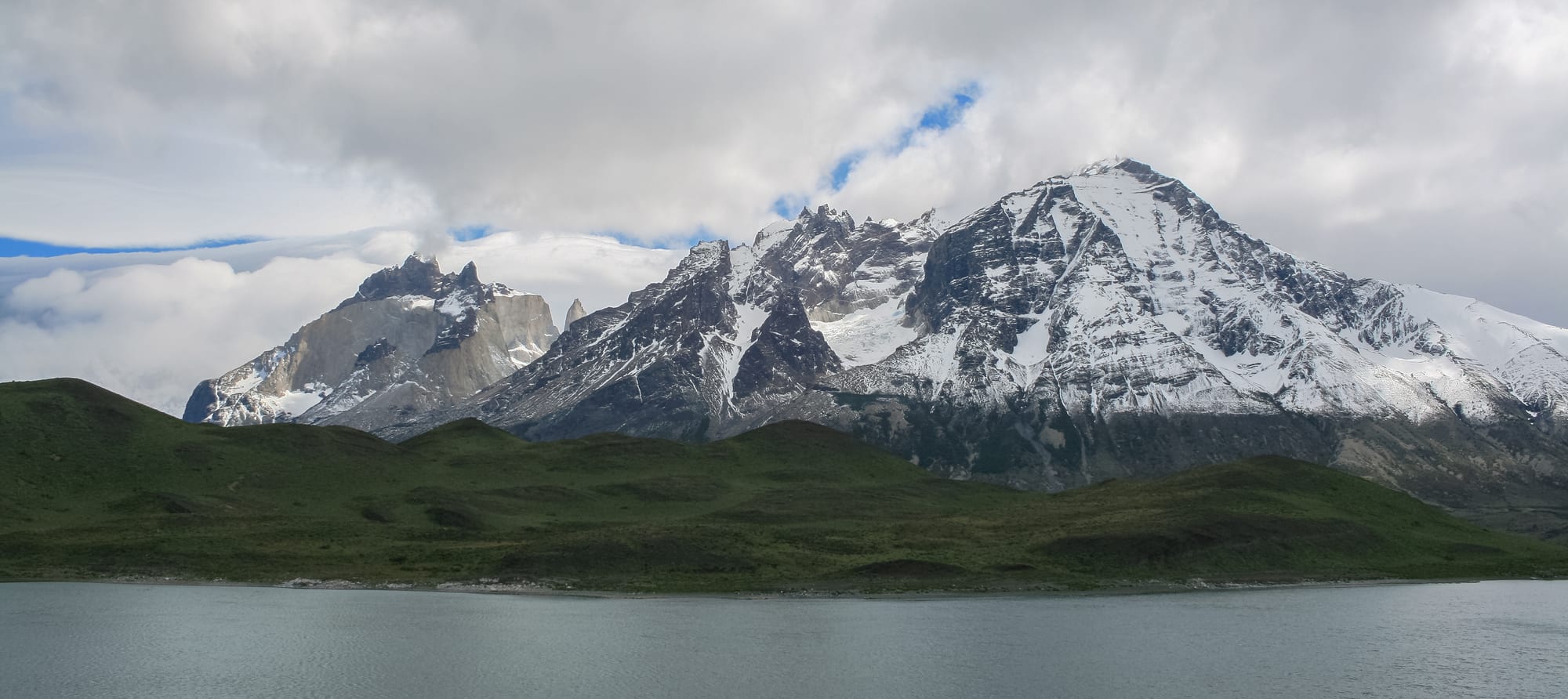
Sheer black-capped granite peaks rising above golden grassland and a turquoise lake in Patagonia

Chile

The Cuernos del Paine in Torres del Paine National Park, Chilean Patagonia. (Diego Delso / Wikimedia Commons · CC BY-SA 3.0)

A long, narrow ribbon of a country down the western edge of South America — from the driest desert on Earth to Patagonian ice — prosperous and stable by regional standards, and shadowed by the Pinochet years.

Explore Chile

History

Northern and central Chile were the southern edge of the Inca Empire when the Spanish arrived in the 1530s, but the Mapuche of the south fought Spanish and later Chilean forces to a standstill for more than 300 years, keeping their territory until the late nineteenth century. Chile declared independence in 1810 and secured it in 1818 under Bernardo O'Higgins and José de San Martín.

The young republic was unusually stable for the region. It won the War of the Pacific (1879–83) against Peru and Bolivia, gaining the nitrate- and copper-rich northern deserts and leaving Bolivia landlocked. Nitrate wealth, then copper, shaped the economy and its booms and busts.

In 1970 Salvador Allende was elected as the first Marxist president of a Latin American country by open vote. On 11 September 1973 the military under General Augusto Pinochet overthrew him in a coup; Allende died in the presidential palace. The 17-year dictatorship that followed killed or "disappeared" some 3,000 people and tortured tens of thousands, while imposing free-market reforms. Democracy returned in 1990. A mass wave of protests over inequality in 2019 led to two attempts to replace Pinochet's constitution, both rejected by voters.

  • Chile: The Long Thin Country Mapuche resistance and a Spanish frontier, the world's nitrate and copper mine, a democracy broken in 1973, and its slow rebuilding

Culture & Customs

Chile sees itself as sober, legalistic, and a little apart from the rest of South America — geographically walled off by desert, ocean, ice, and the Andes. Society is largely Catholic, though observance has fallen sharply, and family and a strong work ethic are common self-descriptions.

The country has an outsized literary reputation: two Nobel laureates in poetry, Gabriela Mistral and Pablo Neruda, and later Isabel Allende in fiction. The cueca, a courtship dance with handkerchiefs, is the national dance, performed above all around the 18 September independence holidays, the Fiestas Patrias, when the country fills with fondas, barbecues, and kite-flying.

Football is the main sport, wine and the asado the main social rituals, and the huaso — the Chilean cowboy of the central valley — the rural national figure. Rapa Nui (Easter Island) has its own Polynesian language and culture within the Chilean state.

Daily Life

Around 40 percent of Chileans live in Greater Santiago, a modern city in a valley ringed by the Andes, often trapped under winter smog. Valparaíso and Viña del Mar on the coast, Concepción in the south, and Antofagasta in the mining north are the other main centres. The far south and the desert north are thinly populated.

The economy rests heavily on copper — Chile is by far the world's largest producer — along with fruit, wine, salmon, and forestry exports, and a large services sector. Incomes are the highest in South America, but so is inequality, and pensions, healthcare, and the cost of living drove the 2019 unrest.

Daily life is comparatively orderly and middle-class in the cities, with a long lunch, once (an evening tea) rather than a late dinner in many households, and weekends at the coast, in the hills, or at a family parcela.

Food

Chilean cooking is hearty and less spicy than most of Latin America, built on seafood, maize, beans, and beef. Pastel de choclo, a baked pie of sweet ground corn over a meat, chicken, egg, and olive filling, is a summer classic, and cazuela, a clear stew with a piece of meat, a potato, and a chunk of pumpkin, is the everyday winter dish.

The 4,000-kilometre coastline delivers exceptional seafood: machas, locos (abalone), king crab from the far south, conger eel, and ceviche and paila marina stew. Empanadas de pino (baked beef turnovers), completos (loaded hot dogs), and sopaipillas (fried squash pastry) are the street staples.

Chile is a major wine country — Cabernet and Carmenère from the central valleys, crisp whites from Casablanca and the coast — and pisco, a grape brandy also claimed by Peru, is the base of the pisco sour and the piscola.

  • Chile: Food and the National Dish A baked pastry eaten by the millions every Independence Day, an earth-oven feast from a southern archipelago, and a grape once thought extinct that turned out to be growing all along

Attractions & Natural Wonders

Torres del Paine, in the far south, is the icon: granite towers and horns above turquoise lakes and glaciers, walked on the multi-day "W" and "O" circuits or seen on day trips from Puerto Natales. Further south still, Punta Arenas is the jumping-off point for Tierra del Fuego, penguin colonies, and Antarctic cruises.

At the other end of the country, the Atacama Desert around San Pedro offers salt flats and flamingo lagoons, the Valle de la Luna, the El Tatio geysers, and some of the clearest night skies on Earth, dotted with major observatories. Between the two extremes lie the Lake District and Chiloé, with their volcanoes, forests, German-influenced towns, and wooden churches.

Santiago and nearby Valparaíso — a UNESCO-listed port city of steep painted hills, funiculars, and street art — anchor a central-Chile visit, along with the Colchagua and Maipo wine valleys. Far out in the Pacific, Rapa Nui (Easter Island) holds the moai, the monumental stone figures of its Polynesian civilisation.

  • Chile: Ten Attractions and Natural Wonders Granite towers over a Patagonian lake, the driest desert on Earth, a row of stone giants facing inland on a remote island, and marble caves glowing blue from below

Planning basics

Budget

Chile is the most expensive country in South America for travellers, closer to southern European prices. Santiago, Patagonia, and Easter Island are the costliest; the north and centre are more moderate. Card payment is widespread and reliable.

Patagonia Premium
Torres del Paine, Easter Island, and the far south cost well above the rest of the country
Daily Budget Midrange
USD 110–220 (hotel, some domestic flights, restaurants, tours)
Daily Budget Shoestring
USD 50–80 (hostel, set-menu lunches, long-distance buses)

Visa Requirements

Citizens of the EU, the UK, the US, Canada, Australia, and most of Latin America enter visa-free for up to 90 days as tourists, extendable once. You receive a paper or electronic tourist card (PDI) on entry — keep it, as it is checked on departure and at hotels.

Typical Stay
90 days, visa-free, extendable once

Chile has strict agricultural controls; declare all food, and expect X-ray screening on domestic flights to Easter Island and the south.

Safety

Chile is one of the safer countries in South America, but petty and opportunistic crime has risen, especially in Santiago and Valparaíso — pickpocketing, bag-snatching, phone theft, and distraction scams in tourist areas, markets, and on transport. Violent crime against tourists is uncommon.

Natural Hazards
Chile is highly seismic — earthquakes and, on the coast, tsunami risk — and has active volcanoes; know the evacuation signs.

Keep valuables hidden, use app taxis at night, and watch your bag on the Valparaíso funiculars and Santiago metro.

Climate

Everything, because of the length. The far north is the Atacama, the driest desert on Earth. Central Chile around Santiago and Valparaíso is Mediterranean, with warm dry summers and mild wet winters. The south is cool and rainy, and Patagonia is cold, windy, and changeable. Seasons are southern-hemisphere.

Atacama
warm days, cold nights, almost no rain, intense sun
Santiago
hot dry summers (Dec–Feb), cool wet winters
Patagonia
cool and very windy even in summer; services shrink sharply in winter

Transportation

Santiago is the hub, and domestic flights (LATAM, JetSmart, Sky) are how most people cover the huge distances to the Atacama, Patagonia, and Easter Island. The long-distance bus network is excellent, comfortable, and cheap, with fully reclining seats on overnight routes. Passenger rail is limited to a few southern lines.

For Torres del Paine, fly to Punta Arenas or Puerto Natales; the drive from Santiago takes days.

Best Time to Visit

October to April for Patagonia and the Lake District, with December to February the warm, crowded, expensive peak. The Atacama and the central wine country are good year-round, the desert best in the cooler months. Ski season in the Andes near Santiago runs June to September.

Currency

The currency is the Chilean peso (CLP). Prices carry a lot of zeros; a basic lunch runs into the thousands of pesos. ATMs are widespread but charge fees and cap withdrawals.

Cards
Widely accepted; carry cash for small towns, markets, and remote areas
Symbol
$
Currency Code
CLP — Chilean peso

Language

Spanish is the official language, spoken with a fast, clipped Chilean accent and a lot of local slang that even other Spanish speakers find hard. Indigenous languages — Mapudungun in the south, Aymara and Quechua in the north, Rapa Nui on Easter Island — are spoken by minorities. English is limited outside tourism and business.

English
Common in tourism and in Santiago's business world; limited elsewhere
Official Language
Spanish (Chilean)