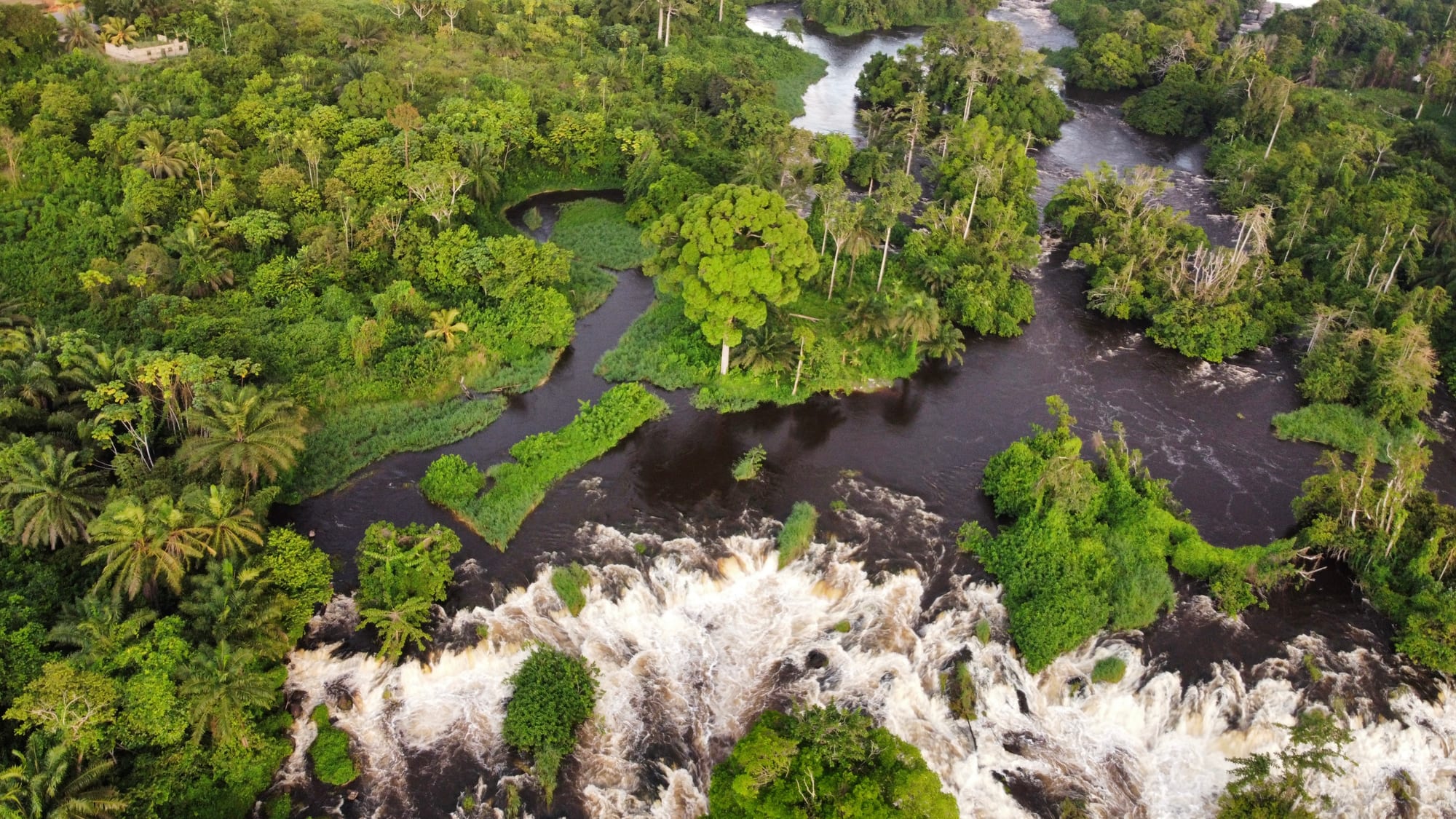
A wide, low waterfall spilling over dark rocks directly onto a sandy ocean beach, forest on the banks

Cameroon

The Lobé Falls near Kribi, where a river drops straight into the Atlantic — one of few waterfalls in the world to do so. (Blaizo 237 / Wikimedia Commons · CC BY-SA 4.0)

A hinge between West and Central Africa often called "Africa in miniature" for its range of landscapes and peoples — bilingual in French and English, football-mad, and troubled by conflict at its edges.

Explore Cameroon

History

The coast was named "Rio dos Camarões," river of prawns, by Portuguese sailors, and the name stuck. Powerful pre-colonial states included the Bamoun sultanate in the west, whose kings kept written records in their own script, and the Fulani emirates of the north. Germany claimed the territory as Kamerun in 1884.

After Germany's defeat in the First World War, the League of Nations split the territory between France, which took the larger eastern part, and Britain, which governed two strips alongside Nigeria. French Cameroun became independent in 1960 after suppressing a nationalist insurgency; in 1961 the southern British zone voted to join it, while the northern zone joined Nigeria.

The country was ruled as a one-party state under Ahmadou Ahidjo and then, from 1982, Paul Biya, who remains in office as one of the world's longest-serving leaders. Grievances among the English-speaking minority over marginalisation erupted in 2016 into a separatist conflict in the Northwest and Southwest regions that continues, alongside Boko Haram violence in the Far North.

  • Cameroon: Africa in Miniature A country stitched together from a German colony split between Britain and France — old kingdoms and sultanates, three colonial rulers, and an anglophone conflict that still burns

Culture & Customs

Cameroon's roughly 250 ethnic groups fall into broad regional cultures: forest peoples and the coastal Sawa in the south, the Bamileke and Bamoun of the western "Grassfields" highlands with their chiefdoms and secret societies, the Fulani, Kanuri, and others of the Muslim north, and the Baka and other forest hunter-gatherers of the southeast.

Religion tracks the geography — Christian in the south and west, Muslim in the north, with traditional practice throughout. The Grassfields are known for their carved royal thrones, beaded masks, elephant masquerades, and the ndop indigo cloth; the Bamoun palace and museum at Foumban hold one of the finest art collections in the region.

Football is close to a national religion. The Indomitable Lions' run to the 1990 World Cup quarter-finals, and stars from Roger Milla to Samuel Eto'o, are sources of enormous pride, and match days unite a country otherwise divided by language and region.

Daily Life

Douala, the steamy port on the coast, is the economic capital and largest city; Yaoundé, in the cooler hills inland, is the political capital. Together they draw migrants from across the country. Most Cameroonians, though, still farm — cocoa and coffee in the south and west, cotton and livestock in the north, plantains, cassava, and maize everywhere.

Cameroon is better off than many of its neighbours, with oil, timber, aluminium, and agriculture, and a relatively educated workforce, but growth is slow, jobs are scarce for the young, and the two regional conflicts drain resources and displace people.

Daily life features crowded shared taxis and motorcycle "bendskin," bustling markets, roadside grills in the evening, and the ever-present police and gendarmerie checkpoints on the roads between towns.

Food

Cameroonian cooking is rich and regional, often built around a starch "swallow" — pounded cassava (water fufu), plantain, cocoyam, or couscous of maize — dipped into a heavily seasoned sauce or soup. Ndolé, bitterleaf stewed with groundnuts, dried fish, and meat, is claimed as the national dish and is a speciality of the Douala area.

Other classics include eru (a forest-leaf and waterleaf stew from the southwest), grilled fish with fiery pepe sauce and fried plantain, poulet DG ("director-general's chicken," with plantain and vegetables), and koki, a steamed black-eyed-pea loaf. In the north, grilled meat, millet, and folere (hibiscus) feature.

Street food is everywhere: soya skewers dusted with spiced peanut, roast corn and safou (bush plum), beignets, and bili-bili millet beer in the north. Palm wine is the traditional drink of the forest zone.

  • Cameroon: Food and the National Dish A bitter-leaf and groundnut stew that unites a country of 250 ethnic groups, a chicken dish named for company directors that became everyone's celebration food, and cuisine split by a colonial language line

Attractions & Natural Wonders

Mount Cameroon, an active volcano rising straight from the coast to over 4,000 metres, is the highest peak in West and Central Africa and a two- or three-day climb from Buea — though its location in the troubled Southwest region currently makes access difficult. Nearby, at Kribi, the Lobé Falls tumble directly onto the beach and into the Atlantic.

The west's Grassfields offer cool highland scenery, the crater lakes of the Bamenda and Bamileke plateaus, the royal palaces of Bafut, Bandjoun, and Foumban, and the craft markets of the chiefdoms — again, partly affected by the anglophone conflict.

The north, when secure, holds the country's savanna wildlife: Waza National Park with elephant and giraffe, Bénoué and Bouba Njida further south, and the volcanic spires and terraced Kapsiki villages around Rhumsiki in the Mandara Mountains. In the southeast, Lobéké and Dja are dense rainforest reserves with forest elephants, gorillas, and Baka communities.

  • Cameroon: Nine Attractions and Natural Wonders A volcano that sometimes glows, a river that falls straight into the Atlantic, a sultan's palace of two thousand years' standing, and a lunar landscape of stone needles in the north

Planning basics

Budget

Cameroon is moderately priced. Local transport, markets, and street food are cheap; hotels in Douala and Yaoundé and any hired vehicle with driver are the main costs. Cash dominates outside the big cities. ATMs are common in Douala, Yaoundé, and larger towns.

Source
Traveller reports, 2022–2024 — verify against a current source.
Daily Budget Midrange
USD 80–160 (mid-range hotel, hired car with driver, guides)
Daily Budget Shoestring
USD 30–55 (basic hotel, local food, shared bush taxis and buses)

Carry CFA francs; euros are the easiest currency to exchange. Police checkpoints are frequent — keep your passport and vaccination card to hand.

Source: Traveller reports, 2022–2024 — verify against a current source.

Visa Requirements

A visa is required for most nationalities and is usually arranged in advance at a Cameroonian embassy; an e-visa system has been introduced and a visa on arrival is available at Douala and Yaoundé airports for some travellers. A yellow fever vaccination certificate is mandatory.

Typical Validity
30 days, single or multiple entry

Confirm the current e-visa and visa-on-arrival procedure with a Cameroonian mission before travelling.

Safety

Central and southern Cameroon — Yaoundé, Douala, Kribi, the western highlands' main towns — are generally calm, with urban petty crime the main concern. Two regions are dangerous and largely off-limits: the Far North, where Boko Haram operates around Lake Chad, and the anglophone Northwest and Southwest regions, where a separatist conflict since 2016 has killed thousands and displaced many more.

Source
US Department of State, UK FCDO, and French diplomatic advisories — check for the latest wording.

Most governments advise against all travel to the Far North and to the Northwest and Southwest regions, and against travel near the Central African Republic border. Avoid political demonstrations and any photography of officials or installations.

Source: US Department of State, UK FCDO, and French diplomatic advisories — check for the latest wording.

Climate

Highly varied. The south and coast are equatorial — hot, humid, and very wet, with Debundscha near Mount Cameroon among the rainiest places on Earth. The central plateau around Yaoundé is milder. The north is Sahelian, hot and dry, with a single summer rainy season and a dusty Harmattan in winter.

North
hot and dry; rains June to September, Harmattan December to February
South And Coast
hot and humid; long rains roughly March to November

Transportation

Douala and Yaoundé have the main airports. A railway links Douala, Yaoundé, and Ngaoundéré in the north, with an overnight sleeper on the northern section. Intercity coaches connect the main cities; bush taxis and motorcycle taxis cover shorter hops. Roads range from good highways to rough tracks.

The Yaoundé–Ngaoundéré train is the standard way north; road travel there is long and tiring.

Best Time to Visit

November to February is the driest, most comfortable window across most of the country, and the season for the north and for climbing Mount Cameroon. The long rains from about June to September make many roads difficult in the south and centre.

Events
The Ngondo water festival of the Sawa peoples in Douala, around late November or December

Currency

The currency is the Central African CFA franc (XAF), used by six countries and pegged to the euro at a fixed rate. It is a different currency from the West African CFA franc, though the value is the same.

Symbol
FCFA
Cash To Bring
Euros, to exchange in Douala or Yaoundé
Currency Code
XAF — Central African CFA franc

Language

French and English are both official, a legacy of the split colonial administration, though French speakers greatly outnumber English speakers and the imbalance is at the heart of the anglophone crisis. Around 250 Indigenous languages are spoken, with Pidgin English a common lingua franca in the west and Fulfulde in the north.

Lingua Franca
French; Cameroonian Pidgin English in the west; Fulfulde in the north
Official Languages
French, English