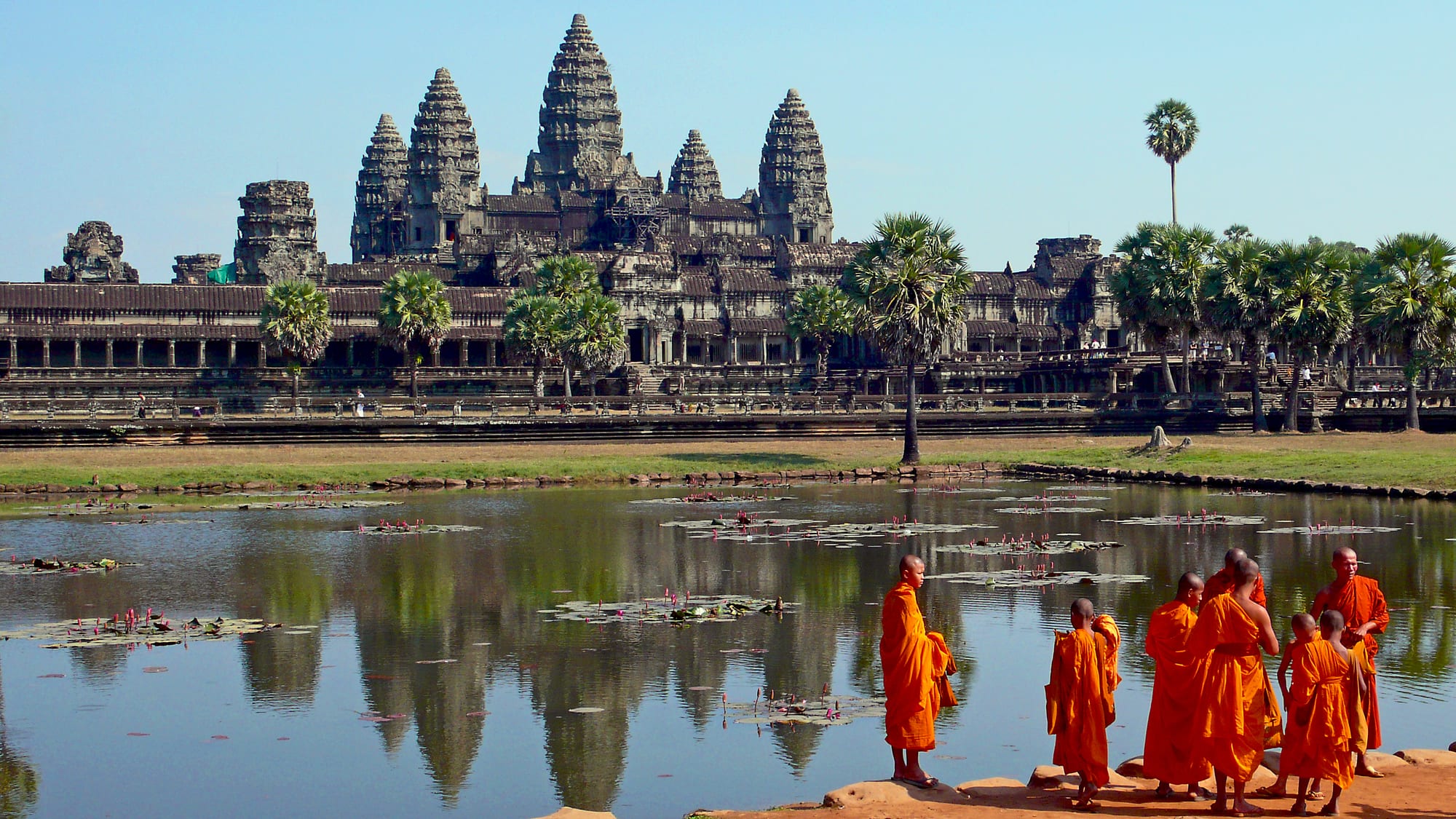
Saffron-robed Buddhist monks on a grassy bank looking across a pond to the five stone towers of Angkor Wat under a bright blue sky

Cambodia

Angkor Wat, the largest religious monument in the world, built in the 12th century, seen across its reflecting pool in full daylight. (sam garza / Wikimedia Commons · CC BY 2.0)

A Southeast Asian country defined by two things above all — the vast medieval temple city of Angkor, and the memory of the Khmer Rouge years that killed close to a quarter of its people.

Explore Cambodia

History

From the ninth to the fifteenth centuries the Khmer Empire dominated mainland Southeast Asia from its capital at Angkor, building hundreds of temples and a vast network of reservoirs and canals. Angkor Wat, raised in the twelfth century, is the largest religious monument in the world. The empire declined, the capital shifted south, and Cambodia became a smaller kingdom squeezed between Siam and Vietnam.

France made Cambodia a protectorate in 1863, which preserved the monarchy and arguably the state itself. Independence came in 1953 under King Norodom Sihanouk. The country was drawn into the Vietnam War, heavily bombed along its eastern border, and destabilised, and in 1975 the communist Khmer Rouge took Phnom Penh.

Under Pol Pot the Khmer Rouge emptied the cities, abolished money and religion, and worked, starved, and executed the population on collective farms. Between 1975 and 1979 an estimated 1.7 to 2 million people died — close to a quarter of the country. A Vietnamese invasion ended the regime in 1979, but civil war dragged on into the 1990s. Hun Sen governed from 1985 until 2023, when he handed the premiership to his son, Hun Manet.

  • Cambodia: Angkor and After The empire that built Angkor, five centuries of decline between Siam and Vietnam, a French protectorate, and the Khmer Rouge catastrophe

Culture & Customs

Cambodia is a Theravada Buddhist country, and the wat, the saffron-robed monks, and the merit-making rhythm of festivals shape daily life. Older animist beliefs persist alongside, in spirit houses outside homes and offerings to local guardians. Hinduism's older imprint survives in the Angkor temples and in the Ramayana, retold in Khmer as the Reamker.

Classical Khmer dance, with its slow, precise hand gestures and the apsara figures drawn straight from the temple walls, was nearly wiped out under the Khmer Rouge and painstakingly revived. Shadow puppetry, the pinpeat orchestra, and silk weaving are other traditions that survived by a thread.

Social life places weight on family, seniority, and saving face; greetings use the palms-together sampeah, with the height of the hands showing respect. The Khmer Rouge years are an ever-present undertone — almost every family lost members — and are marked at memorial sites and a day of remembrance.

Daily Life

Around two million people live in Phnom Penh, the riverside capital, which has grown fast and unevenly, with new towers beside markets and monasteries. Siem Reap, next to Angkor, lives almost entirely off tourism. Most Cambodians, though, are rural, farming rice in the plains around the Tonlé Sap and the Mekong.

The Tonlé Sap lake itself is central to life: it reverses its flow with the seasons, swelling enormously in the wet season and feeding one of the world's most productive inland fisheries, with whole villages built on stilts or floating on the water.

The economy runs on garment manufacturing, tourism, construction, and agriculture, with heavy Chinese investment in recent years — nowhere more visibly than in Sihanoukville, transformed and then partly hollowed out by a casino boom and bust. Wages are low, and many young people work abroad in Thailand.

Food

Khmer cooking is subtler and less fiery than its neighbours', built on rice, freshwater fish, and fresh herbs, with a base note of prahok, a pungent fermented fish paste. The national dish is fish amok, a mild coconut-and-lemongrass curry steamed in a banana leaf until it sets to a mousse.

Everyday meals include samlor korko (a thick vegetable and fish soup), lok lak (stir-fried marinated beef with a lime-and-pepper dip), grilled fish with green mango, and nom banh chok, rice noodles under a green fish gravy eaten for breakfast. Kampot pepper, from the southern coast, is prized worldwide.

Street food and markets serve num pang sandwiches (a French-colonial legacy), grilled skewers, fresh spring rolls, tropical fruit, and, for the adventurous, fried insects and balut. Sugar-palm juice and iced coffee with condensed milk are the standard drinks.

  • Cambodia: Food and the National Dish A fish curry steamed into a soft custard inside a banana leaf, a fermented fish paste that underlies almost everything, and a pepper prized enough to be exported to French kitchens

Attractions & Natural Wonders

The Angkor Archaeological Park, outside Siem Reap, is the reason most people come: Angkor Wat itself, the giant carved faces of the Bayon at Angkor Thom, the tree-swallowed ruins of Ta Prohm, and dozens of other temples spread across a forested area the size of a city, best explored over two or three days.

Phnom Penh holds the Royal Palace and Silver Pagoda, the National Museum of Khmer sculpture, and the two essential sites for understanding the recent past: the Tuol Sleng (S-21) prison museum and the Choeung Ek "killing fields" memorial.

Beyond the temples, the Tonlé Sap's floating and stilted villages, the colonial riverside town of Kampot and the pepper farms and old hill station of Bokor nearby, the beaches and islands off Sihanoukville and Koh Rong, and the remote forests and waterfalls of Mondulkiri and Ratanakiri in the northeast round out the country.

  • Cambodia: Ten Attractions and Natural Wonders The largest religious monument ever built, stone faces staring out of the jungle, a temple being pulled apart by tree roots, and villages that float on a lake that changes size

Planning basics

Budget

Cambodia is inexpensive. Local food, guesthouses, and transport cost little; the main fixed cost is the Angkor Archaeological Park pass. The US dollar is used for almost everything, with the riel serving as small change. Cards are accepted in tourist hubs; carry cash elsewhere.

Angkor Pass
USD 37 for one day, USD 62 for three days, USD 72 for a week
Daily Budget Midrange
USD 60–120 (hotel, restaurants, a private driver, guided temple days)
Daily Budget Shoestring
USD 25–40 (guesthouse, local food, buses, shared tuk-tuks)

Visa Requirements

Most nationalities need a visa, available as an e-visa online or on arrival at the airports and main land borders, valid for 30 days and extendable. Bring a passport photo and US dollars in cash for the visa-on-arrival fee.

Typical Validity
30-day tourist visa (e-visa or on arrival), extendable once

Use the official e-visa site to avoid look-alike sites that charge extra.

Safety

Cambodia is generally safe for visitors, with violent crime against tourists uncommon. The everyday risks are bag-snatching by passing motorbike in Phnom Penh, road accidents, and petty scams. Rural areas near the Thai border and some remote tracks still hold unexploded ordnance and landmines from the war years.

Landmines
Stick to marked paths and cleared areas in the northwest and along old front lines.

Wear bags across the body and away from the traffic side, and be cautious with drinks and gambling scams in nightlife areas.

Climate

Tropical monsoon. The dry season runs roughly November to April, cooler and more comfortable early on, then very hot in March and April. The wet season, May to October, brings heavy afternoon rain, a green landscape, and, late in the season, flooding around the Tonlé Sap and Mekong.

Wet
May–October, humid, heavy but usually short downpours
Hot Dry
March–April, often 35–40°C
Cool Dry
November–February, 24–32°C, low humidity

Transportation

Siem Reap, Phnom Penh, and Sihanoukville have airports. A slow train links Phnom Penh with the coast and the Thai border. Most travel is by comfortable intercity bus or minivan, or by private car with driver. In towns, tuk-tuks and ride-hailing apps (PassApp, Grab) are the way around.

Angkor is best covered with a hired tuk-tuk or car and driver for the day; distances between temples are large.

Best Time to Visit

November to February for the most comfortable weather and clear skies at Angkor, which is also the busiest and priciest time. The wet season is green, quieter, and cheaper, with the Tonlé Sap at its fullest, at the cost of daily rain.

Events
Khmer New Year in mid-April; the Water Festival (Bon Om Touk) in Phnom Penh around November

Currency

Cambodia runs on the US dollar in practice; prices are quoted in dollars and ATMs dispense them. The Cambodian riel (KHR) is used for amounts under a dollar, at roughly 4,000 to the dollar. Bring clean, untorn dollar notes — damaged ones are refused.

Cards
Accepted in Phnom Penh and Siem Reap; cash elsewhere
Symbol
$ / ៛
Currency Code
USD in daily use; KHR — Cambodian riel for small change

Language

Khmer is the official language, written in its own script and unrelated to Thai or Vietnamese despite the geography. English is widely spoken in Siem Reap, Phnom Penh, and the tourist trade; French lingers among some older people; and Chinese is increasingly heard in business.

English
Common in tourist areas; limited in the countryside
Official Language
Khmer