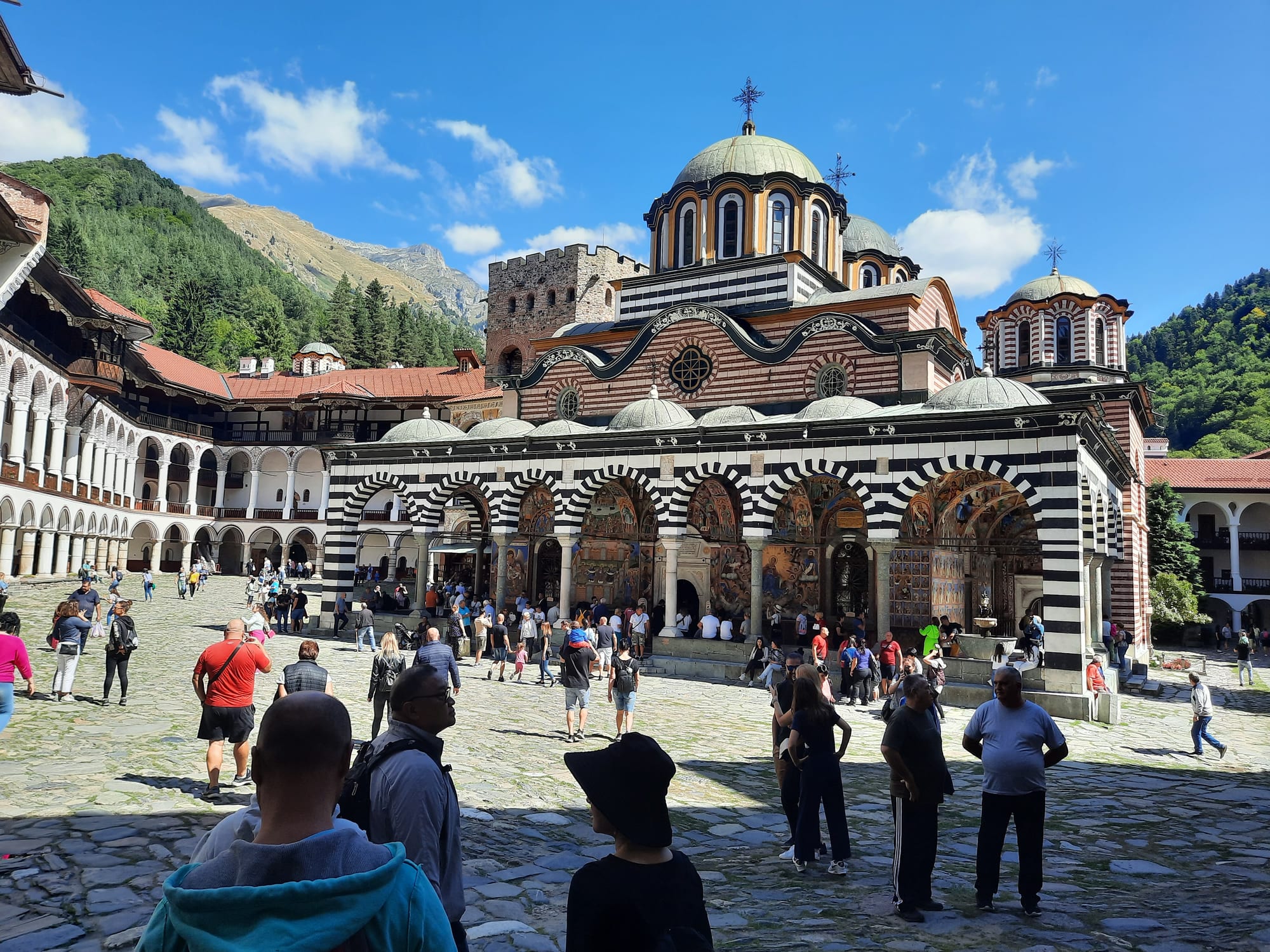
A monastery courtyard ringed by arcades painted in bold black-and-white stripes and red arches, a domed church at the centre

Bulgaria

The colonnaded courtyard of Rila Monastery, founded in the 10th century and rebuilt in the 19th, a UNESCO World Heritage Site. (King of Rona / Wikimedia Commons · CC BY-SA 4.0)

A Balkan country on the Black Sea with a long Orthodox and Ottoman history, mountain monasteries, Thracian gold, and a coastline of resorts — the European Union's least expensive member.

Explore Bulgaria

History

The Thracians, famed for their goldwork and horsemanship, lived here in antiquity, followed by Roman and then Byzantine rule. The first Bulgarian empire was founded in 681, when Bulgar and Slavic groups united north of the Balkan range; it was here, in the ninth and tenth centuries, that the Cyrillic alphabet was created and spread through the Orthodox Slavic world.

A second Bulgarian empire rose in the twelfth century before the Ottomans conquered the region in the late fourteenth. Nearly five centuries of Ottoman rule followed. A national revival in the nineteenth century, and a brutal suppression of the 1876 uprising that shocked Europe, led to the Russo-Turkish war of 1877–78 and an autonomous, then independent, Bulgarian state.

Bulgaria was on the losing side in both world wars. A communist People's Republic, closely tied to the Soviet Union, ran the country from 1946 until 1989. The transition that followed was rocky, with hyperinflation and organised crime, but Bulgaria joined NATO in 2004 and the European Union in 2007, and is now moving toward adopting the euro.

Culture & Customs

Bulgaria is an Orthodox Christian country, and the church — with its painted monasteries and its role in preserving national identity under Ottoman rule — remains a cultural anchor. There is also a significant Muslim minority, both ethnic Turks and Bulgarian-speaking Pomaks, mostly in the south and northeast.

Folk tradition is strong and distinctive: the close-harmony, dissonant singing of women's choirs that became known abroad as "the mystery of Bulgarian voices," the horo line dance, and, on New Year and at Lent, the kukeri, villagers in shaggy costumes and huge bells who drive off evil spirits. On 1 March people exchange red-and-white martenitsa tokens for health and spring.

A well-known quirk: Bulgarians often shake the head for "yes" and nod for "no," which can cause genuine confusion. The country is proud of its rose oil — it supplies much of the world's supply for perfume — and of yoghurt, whose bacterial culture bears the country's name.

Daily Life

About a sixth of the population lives in Sofia, the capital, in the west beneath Vitosha mountain. Plovdiv, Varna, and Burgas are the other main cities, the last two on the Black Sea. Much of the country is small towns and villages, many of them ageing and shrinking as young people move to the cities or abroad — depopulation is Bulgaria's defining social problem.

The economy combines IT and outsourcing in Sofia, heavy industry and energy, farming, and summer tourism on the coast. Wages have risen but remain the lowest in the EU, and corruption and the state of the courts are persistent public grievances.

Life keeps a Balkan rhythm: long coffee breaks, a big midday or early-evening meal, and weekends spent at a village house, in the mountains, or on the beach. The Orthodox calendar, name days as much as birthdays, and the summer exodus to the sea structure the year.

Food

Bulgarian cooking is Balkan and Mediterranean, built on vegetables, dairy, bread, and grilled meat. The national salad is shopska — diced tomato, cucumber, and pepper under a heap of grated white sirene cheese — eaten as a starter with a glass of rakia, the fruit brandy.

Grilled minced meat (kebapche and kyufte), stuffed peppers, banitsa (a coiled filo pastry with cheese and egg), tarator (a cold cucumber-and-yoghurt soup), and slow-baked bean and vegetable stews (gyuvech) are everyday dishes. Yoghurt appears at almost every meal, plain or as a drink (ayran).

Bulgaria has a long wine tradition — reds from the Thracian valley, whites from the coast — and every household seems to distil its own rakia in autumn. Honey, walnuts, and rose or fruit preserves round out the table.

  • Bulgaria: Food and the National Dish A tomato-and-cheese salad said to echo the colours of the flag, a filo pie with fortunes baked inside for New Year, and the country that gave yogurt its name

Attractions & Natural Wonders

Rila Monastery, in a forested valley south of Sofia, is the country's spiritual and artistic high point: a fortress-like complex with a courtyard of black-and-white striped arcades and a church covered in frescoes, and a UNESCO World Heritage Site. Bachkovo Monastery in the Rhodope Mountains is a quieter second.

Plovdiv, one of the oldest continuously inhabited cities in Europe, has a Roman theatre still used for performances and a hillside old town of painted nineteenth-century merchant houses. Veliko Tarnovo, the medieval capital, stacks its houses above a river gorge below the Tsarevets fortress.

The mountains — Rila, Pirin, and the Rhodopes — offer hiking to glacial lakes, the Seven Rila Lakes among them, and skiing in winter. The Black Sea coast runs from big resorts to the old wooden town of Nesebar, another World Heritage Site, and quieter beaches in the south. Near Kazanlak, the Valley of the Thracian Kings holds painted burial mounds and the museums of the rose-growing country.

Planning basics

Budget

Bulgaria is the cheapest country in the European Union for visitors. Meals, transport, museums, and guesthouses all cost noticeably less than in Western Europe, and the Black Sea resorts, while busier and pricier in summer, are still good value. Cards are widely accepted; carry cash for village shops and small restaurants.

Coffee
EUR 1.50–2.50
Daily Budget Midrange
EUR 70–130 (mid-range hotel, restaurants, a rental car, day trips)
Daily Budget Shoestring
EUR 35–55 (hostel or guesthouse, local food, buses and trains)

Visa Requirements

Bulgaria is in the EU and the Schengen Area. Citizens of the EU, the UK, the US, Canada, Australia, and many other countries need no visa for stays of up to 90 days in any 180-day period.

Typical Stay
90 days in any 180-day period, visa-free, for most Western passports

Safety

Bulgaria is a safe country for visitors, with low levels of violent crime. The usual precautions apply against pickpocketing in central Sofia and on the coast, and against taxi overcharging — use marked, metered cabs or an app, and agree fares at airports.

Driving
Roads vary from good motorways to rough rural routes; winter conditions can be severe in the mountains.

Be firm with unofficial taxis at Sofia airport and the main stations.

Climate

Temperate continental, with a milder, near-Mediterranean influence in the south and along the coast. Summers are hot and mostly dry; winters are cold with snow, especially in the mountains, where the ski season runs from December to April.

Summer
hot, often 28–35°C inland, warm on the coast
Winter
cold, around -2 to 4°C in the lowlands, heavy mountain snow

Transportation

Sofia is the main airport, with others at Plovdiv, Burgas, and Varna for the coast. Trains are cheap and scenic but slow; intercity buses are faster and cover more towns. A rental car is the easiest way to reach the monasteries and mountain villages. Sofia has a metro, trams, and buses.

For the Rila and Bachkovo monasteries and the Rhodope villages, a car saves a lot of connections.

Best Time to Visit

May–June and September–October for warm, settled weather, wildflowers or the wine harvest, and thinner crowds. July and August are hot and busiest on the Black Sea coast. December to March is the ski season at Bansko, Borovets, and Pamporovo.

Events
The rose harvest and festival around Kazanlak in late May and early June

Currency

The currency is the Bulgarian lev (BGN), long pegged to the euro at a fixed rate. Bulgaria is on track to adopt the euro, so check whether that has happened before you travel.

Cards
Widely accepted; keep cash for rural areas and markets
Symbol
лв
Currency Code
BGN — Bulgarian lev

Language

Bulgarian is the official language, a South Slavic language written in Cyrillic — the script was developed here in the ninth and tenth centuries. English is widely spoken by younger people and in tourism; Russian is understood by many older people. Some ability to read Cyrillic is useful.

English
Common among the young and in tourist areas
Official Language
Bulgarian (Cyrillic script)