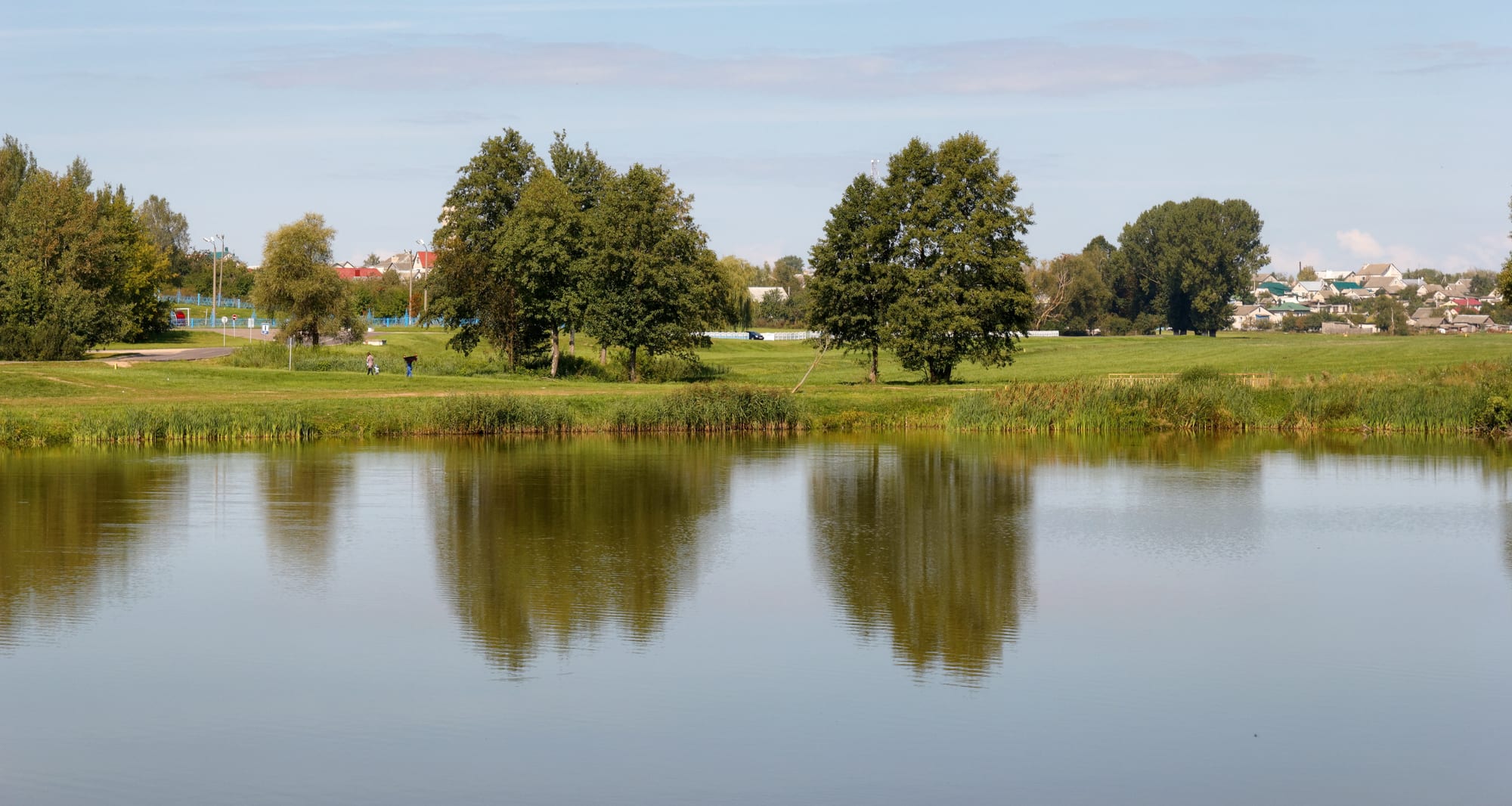
The white towers and red roofs of Nesvizh Castle reflected in a still pond, trees framing the view

Belarus

Nesvizh Castle, the Radziwiłł family seat and a UNESCO World Heritage Site, reflected in one of its ponds. (Alexxx1979 / Wikimedia Commons · CC BY-SA 4.0)

A landlocked country of forest, farmland, and marsh in Eastern Europe — rebuilt from near-total wartime destruction, ruled by one man since 1994, and closely bound to Russia.

Explore Belarus

History

This is the land of the medieval principality of Polotsk and then a core territory of the Grand Duchy of Lithuania, whose administrative language was an early form of Belarusian. From 1569 it was part of the Polish–Lithuanian Commonwealth, and the partitions of the late eighteenth century transferred it to the Russian Empire. It was also a centre of Jewish life in the Pale of Settlement, with many towns that were majority Jewish — a world annihilated in the Holocaust.

Belarus was fought over ferociously in both world wars. As Soviet "Belorussia" it lost between a quarter and a third of its entire population in 1941–44, with hundreds of villages burned and Minsk left in ruins, which is why the capital today is a city of sweeping Stalinist avenues. In 1986 the Chernobyl disaster, just over the border in Ukraine, deposited most of its fallout on southern Belarus.

A brief national revival around independence in 1991 was rolled back after Alexander Lukashenko took power in 1994 and restored Soviet-style symbols and Russian's dominance. The disputed 2020 election triggered the largest protests in the country's history, met with mass arrests; the opposition leadership is now in exile. Belarus is tightly aligned with Russia and served as a staging ground for Russia's 2022 invasion of Ukraine, drawing heavy Western sanctions.

  • Belarus: The Borderland A land between — the Grand Duchy of Lithuania, the Russian Empire, the bloodiest ground of the Second World War, and a Soviet republic that never quite left

Culture & Customs

Belarus is an East Slavic country, Orthodox-majority with a notable Catholic minority in the west around Hrodna. National identity has had a suppressed history, and the Belarusian language is a real marker of it — its everyday use is now itself a quietly political act, associated with the opposition.

Folk culture is strong: Kupalle, the midsummer festival with fire-jumping and wreath-floating; straw-weaving and the vytsinanka paper-cut craft; and village rites still practised in places. Literature is central to the national canon, from the founding poets Yanka Kupala and Yakub Kolas to the Nobel laureate Svetlana Alexievich, whose oral histories of the Soviet and post-Soviet experience are read worldwide — and who, like many cultural figures, has left the country.

Hospitality is warm and food-heavy. Belarus has a strong sporting record in ice hockey — Lukashenko's game — athletics, and tennis, with Victoria Azarenka and Aryna Sabalenka among its best-known figures.

Daily Life

About a fifth of the population lives in Minsk, a spacious, orderly capital of monumental boulevards, a reconstructed old quarter, cheap public transport, and a visible state presence. The rest of the country is mid-sized regional cities — Brest, Hrodna, Vitebsk, Homel, Mahilyow — and farming villages among the forests and drained marshes.

The economy retains a large state sector and heavy industry from Soviet days — tractors, trucks, potash, refined oil — cushioned for years by cheap Russian energy and now squeezed by sanctions. Media and political life are tightly controlled, and the security service still operates under its old name, the KGB.

Everyday life is calm and inexpensive, with well-kept parks, reliable services, and little of the petty crime common in busier countries. Foraging for mushrooms and berries in the forests is a national habit, and the dacha — a country plot for growing vegetables — is central to many families' year.

Food

Belarusian cooking is hearty and northern, and built above all on the potato; Belarusians half-jokingly call themselves bulbashy, "potato people." The emblem is draniki, crisp potato pancakes served with sour cream or with machanka, a rich pork gravy. Kolduny (stuffed potato dumplings) and baked grated-potato puddings are variations on the theme.

Beyond potatoes there are beet and cabbage soups, including kholodnik, a cold, shocking-pink beet-and-kefir summer soup; salo (cured pork fat); homemade sausages; rye bread; and pickled mushrooms and forest berries. Meals are substantial and plainly seasoned.

To drink: kvass in summer, herbal balzam liqueurs, krambambulya (a spiced honey-and-vodka drink), and Belarusian vodkas. Tea and cake follow almost any visit.

  • Belarus: Food and the National Dish A nation built so thoroughly around the potato that its people are nicknamed after it, served alongside sour cream, forest mushrooms and a vodka flavoured with bison grass

Attractions & Natural Wonders

Two UNESCO castles in the Minsk region anchor most trips. Mir Castle is a picturesque sixteenth-century fortified residence blending Gothic, Renaissance, and Baroque; Nesvizh is grander — the palace complex, park, and mausoleum of the powerful Radziwiłł family. They are an easy day trip from the capital and often visited together.

Minsk itself has the monumental Independence Avenue and its Stalinist ensemble, Victory Square, the reconstructed Upper Town and Trinity Suburb, and the sobering Great Patriotic War museum. Brest, on the Polish border, holds the vast Soviet memorial at the Brest Fortress, honouring the defenders of 1941.

For nature, Belovezhskaya Pushcha National Park — the primeval forest straddling the Polish border, also a UNESCO site — is home to Europe's largest herd of wild bison. Polotsk, the oldest town, has the St. Sophia Cathedral and the Euphrosyne monastery, and the northern lake district around Braslaw is a quiet lake-and-forest landscape. Khatyn, north of Minsk, memorialises the wartime villages destroyed with their inhabitants.

Planning basics

Budget

Belarus is inexpensive for visitors. Minsk restaurants, museums, and public transport cost little, and the regions less still. The complication is banking: Western sanctions mean many foreign-issued cards do not work, so bring backup cash in euros or US dollars to exchange.

Metro Ride
under USD 0.30
Daily Budget Midrange
USD 55–110 (mid-range hotel, restaurants, a hired car for the castles)
Daily Budget Shoestring
USD 25–45 (hostel or budget hotel, canteen food, trains and the metro)

Confirm before travelling whether your bank's cards function in Belarus, and carry enough cash for the whole trip if unsure.

Visa Requirements

Belarus has a visa-free scheme for citizens of many countries — including EU states, the UK, and the US — arriving and departing through Minsk National Airport, for a limited number of days, with insurance and sufficient funds. It does not apply if you arrive from or leave to Russia, because that border is not an international crossing for third-country nationals.

Typical Stay
A capped number of visa-free days via Minsk airport; the limit has changed repeatedly

Rules shift often — confirm the current terms and the list of eligible countries with a Belarusian mission before you go.

Safety

Setting aside politics, Belarus has low street crime and is an orderly place to travel. The serious risks are political and legal: the authorities detain people, including foreigners and dual nationals, on vague charges; there is no tolerance of protest, political comment, or photography of security and government sites; and consular help is very limited. Several Western governments advise against all or all-but-essential travel.

Source
US Department of State and UK FCDO travel advisories — check for the latest wording.

Follow your government's current advisory closely, keep a low profile, avoid anything touching on politics, and note the military activity near the southern border with Ukraine.

Source: US Department of State and UK FCDO travel advisories — check for the latest wording.

Climate

Humid continental, milder toward the west. Cold, snowy winters with snow cover for one to three months; mild to warm summers that are the wettest part of the year, with afternoon thunderstorms; and short, changeable spring and autumn.

Summer
July around 18–25°C, occasionally hotter
Winter
January around -4 to -8°C, colder in the east
Daylight
Long summer evenings; short, grey winter days

Transportation

Minsk National Airport is the hub, but the national carrier has been shut out of EU airspace since 2021, so most flights now go east and south. Inside the country the railway is cheap, punctual, and links all the main towns; buses and marshrutkas fill the gaps. Minsk has a clean, cheap metro and extensive trams and trolleybuses.

Overland
Trains and buses from Poland, Lithuania, and Latvia, though EU border queues can be very long

Roads are good and uncrowded; car hire is available in Minsk for reaching Mir and Nesvizh.

Best Time to Visit

May to September for warmth, greenery, and festivals — late spring and early autumn are especially pleasant, with September bringing colour and the mushroom season. Winter is properly cold but atmospheric for Minsk and the snowbound castles.

Events
Kupalle (midsummer) with fire-jumping and wreath-floating; Victory Day (9 May), a major state occasion

Currency

The currency is the Belarusian rubl (BYN), redenominated in 2016. Cards, including contactless, are widely accepted in Minsk and other cities where they work at all; carry cash in rural areas and small towns.

Cards
Accepted in cities, but foreign cards are often blocked by sanctions
Symbol
Br
Currency Code
BYN — Belarusian rubl

Language

Belarusian and Russian are both official, but Russian dominates public life, media, and daily speech, especially in the cities. Belarusian is more heard in rural areas and among the culturally self-conscious, and appears on signage and in the metro. English is limited outside Minsk; some ability to read Cyrillic is very useful.

English
Spoken by younger people in Minsk and the tourist trade; limited elsewhere
Dominant Language
Russian
Official Languages
Belarusian, Russian