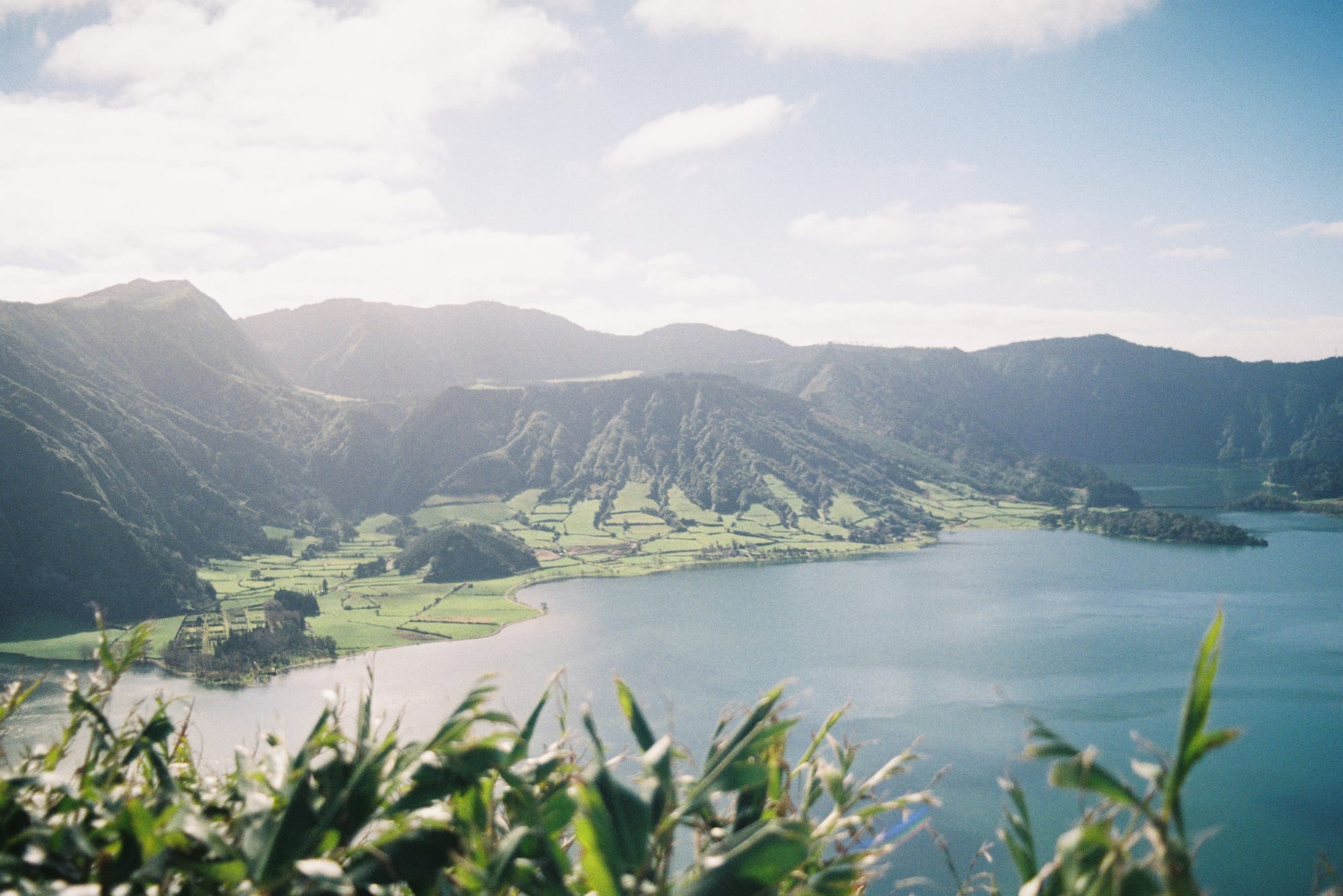
Two joined crater lakes, one blue and one green, filling a broad caldera ringed by steep forested slopes

The Azores

The twin lakes of Sete Cidades, filling a volcanic caldera at the western end of São Miguel, the largest Azorean island. (Gonçalo Torres / Wikimedia Commons · CC BY-SA 4.0)

Nine volcanic islands in the mid-Atlantic, an autonomous region of Portugal, roughly 1,400 km west of Lisbon — green, wet, and thinly populated, with crater lakes, hot springs, whale-watching, and a long history as a mid-ocean stopover and a source of emigrants.

Explore The Azores

History

The Azores were uninhabited when Portuguese navigators reached them in the 1420s and 1430s, and settlement began soon after, with colonists from mainland Portugal and a group of Flemish settlers on the central islands. Their mid-Atlantic position made them strategically valuable: the Spanish treasure fleets sheltered and reprovisioned here on the way back from the Americas, and Angra do Heroísmo on Terceira became a fortified imperial port, now a UNESCO World Heritage Site.

For centuries the islands lived from oranges (a major export to Britain until disease struck), wheat, wine, and whaling — open-boat hunting of sperm whales from lookout stations, continued until the 1980s. Poverty, land pressure, and volcanic disasters, such as the 1957–58 Capelinhos eruption on Faial that buried farmland and a lighthouse, drove waves of emigration, chiefly to Massachusetts, Rhode Island, California, and Ontario; today far more people of Azorean descent live in North America than in the archipelago.

After the 1974 revolution in Portugal, the Azores became an autonomous region with their own parliament and government, keeping Portuguese sovereignty, the euro, and EU membership. Air-service liberalisation in 2015 brought low-cost flights and a tourism boom built on the islands' green landscapes, whales, and geothermal spas, alongside the mainstay dairy and beef farming that supplies much of Portugal's milk.

Culture & Customs

Azorean culture is rural, Catholic, and devout, and its most visible expression is the Holy Ghost (Espírito Santo) festival — a cycle of processions, communal soup meals, and the crowning of a symbolic "emperor", centred on small painted chapels (impérios) found in villages across the islands, and carried by emigrants to North America. The Senhor Santo Cristo procession in Ponta Delgada draws enormous crowds.

Emigration and return shape the islands: money, ideas, and North American English flow back with visiting relatives, and many families straddle two continents. Community life is strong, with folk music (including the Azorean viola da terra, a heart-shaped guitar), bullfights on a rope in Terceira's streets (touradas à corda), and a slow, weather-conscious rhythm.

Hospitality is warm and food-centred, the pace is unhurried, and there is a quiet pride in the archipelago's distinctness from the mainland.

Daily Life

About 240,000 people live in the Azores, roughly half on São Miguel; the smallest island, Corvo, has only a few hundred. The population has been broadly stable, with tourism and returning emigrants offsetting the long outflow of young people.

The economy rests on farming — the islands are a dairy powerhouse for Portugal — along with fishing, tourism, and the public sector, supported by EU funds and mainland transfers. São Miguel also grows pineapples in greenhouses and has Europe's only commercial tea plantations, at Gorreana and Porto Formoso.

Everyday life is centred on the village, the parish, the farm or the sea, and the constant negotiation with a climate that can deliver sun, rain, wind, and fog in a single afternoon.

Food

Azorean cooking is simple, hearty, and shaped by volcanic ground and the sea. The signature dish is cozido das Furnas on São Miguel — beef, pork, sausage, chicken, cabbage, and potatoes packed into a pot and lowered into a steaming hole in the ground beside the Furnas hot springs, then cooked for hours by geothermal heat. Terceira's version, alcatra, is a beef pot roast cooked slowly in a clay dish with wine and spices.

From the sea come lapas (limpets grilled with garlic butter), cracas (goose barnacles), fresh tuna and bluefish, and caldeirada fish stew. Queijo São Jorge, a sharp cow's-milk cheese, and bolo lêvedo, a soft griddled sweet muffin, are eaten across the islands, and Azorean beef, grazed on lush pasture, is prized on the mainland.

Pico and Biscoitos produce distinctive volcanic-vineyard wines, the verdelho whites in particular; passion-fruit and pineapple liqueurs are local specialities; and the regional sodas Kima and Gazosa and the Melo Abreu and Especial beers are the everyday drinks.

  • Azores: Food and the National Dish A stew cooked underground using the heat of a volcano, cheese and pineapple grown nowhere else quite like it, and a Portuguese table set on nine green Atlantic islands

Attractions & Natural Wonders

São Miguel, the largest island, holds the headline sights: the blue-and-green twin lakes of Sete Cidades in a caldera; the deep bowl of Lagoa do Fogo; and the Furnas valley, with its bubbling caldeiras, the botanical Terra Nostra thermal pool, and the buried cozido lunch. Ponta Delgada is the main town, and the Gorreana tea estate and pineapple greenhouses are nearby.

Pico, in the central group, is dominated by its 2,351-metre volcano — the highest mountain in Portugal, climbed overnight for a sunrise summit — with a UNESCO-listed landscape of black-lava vineyard walls at its foot and superb whale-watching offshore. Faial has the yacht harbour at Horta, its quay painted by transatlantic sailors, Peter Café Sport, and the ash desert and drowned lighthouse of Capelinhos. São Jorge is a long ridge dropping to flat coastal fajãs.

Terceira has the Renaissance streets of Angra do Heroísmo and the vast Algar do Carvão lava cave. Far to the west, Flores is the greenest island, hung with waterfalls, and tiny Corvo is a single crater with one village — the edge of Europe.

Planning basics

Budget

The Azores are moderately priced — cheaper than most of Western Europe, with good-value guesthouses, rural tourism farms, and small hotels. Inter-island flights and boat tours (whale-watching, islet trips) are the main extras, and a hire car is close to essential on each island.

Daily Budget Midrange
EUR 100–200 (hotel or rural-tourism house, restaurants, car hire, a whale-watching trip)
Daily Budget Shoestring
EUR 45–80 (guesthouse or hostel, bakery and tasca meals, shared or small hire car)

Base on one or two islands rather than island-hopping constantly, hire a car on each, and book whale-watching and Corvo day trips ahead in summer.

Visa Requirements

The Azores are part of Portugal, the European Union, and the Schengen Area, so the same rules apply as for mainland Portugal. EU and EEA citizens have free movement; UK, US, Canadian, Australian, and many other visitors enter visa-free for 90 days in any 180, with the EU's ETIAS pre-authorisation expected to apply once launched.

Typical Stay
90 days in any 180 (Schengen) for most Western passports

The Schengen 90-day allowance is shared with the rest of the area; arrivals from mainland Portugal are domestic flights with no separate check.

Safety

The Azores are very safe, with little crime. The real hazards are the landscape and weather: fog and cloud on mountain roads and trails, big Atlantic swell and strong currents, slippery levada-style paths, and the islands' volcanic and seismic nature — there are frequent small earthquakes and occasional swarms.

Health
Tap water is safe; the main risks are exposure, falls on wet trails, and rough seas; medical care is good on the larger islands and by air transfer from the smaller ones

Check the forecast and trail conditions before hikes, keep well back from unfenced cliffs and blowholes, and take a guide for Pico mountain.

Climate

Mild, humid oceanic, and famously changeable — several kinds of weather in a day are normal, and low cloud often sits on the higher ground. Summers (June–September) are the warmest and driest, around 22–26°C; winters are mild but wet and windy. The islands are green year-round.

Summer
Warmest and driest, June–September
Winter
Mild, wet, windy

Transportation

São Miguel (Ponta Delgada), Terceira, and Faial have the main airports, with flights from Lisbon, Porto, mainland Europe, and North America; SATA Azores Airlines links the islands, and ferries connect the central group (and, in summer, more widely). A hire car is needed on each island.

Fly between island groups and take the ferry within the central 'triangle' of Faial, Pico, and São Jorge; hire a car wherever you land.

Best Time to Visit

June to September has the best chance of settled weather, the warmest sea, and the peak of the resident-and-migrating whale season, though it is also busiest. May and October are quieter and often still good. Blue and fin whales pass mainly in spring; sperm whales are around all year.

Events
Holy Ghost (Espírito Santo) festivals across the islands from spring into summer; the Senhor Santo Cristo dos Milagres procession in Ponta Delgada (fifth Sunday after Easter); Semana do Mar in Horta (August); Sanjoaninas in Angra (June)

Currency

The currency is the euro. Cards are accepted almost everywhere; carry a little cash for rural bakeries, small tascas, and honesty-box farm stalls.

Symbol
Currency Code
EUR — euro

Language

Portuguese is the language, spoken with a distinctive Azorean accent. English is widely understood in tourism, hotels, and among the many islanders with family in North America; French is known by some older returnees.

English
Widely understood in tourism
Language
Portuguese