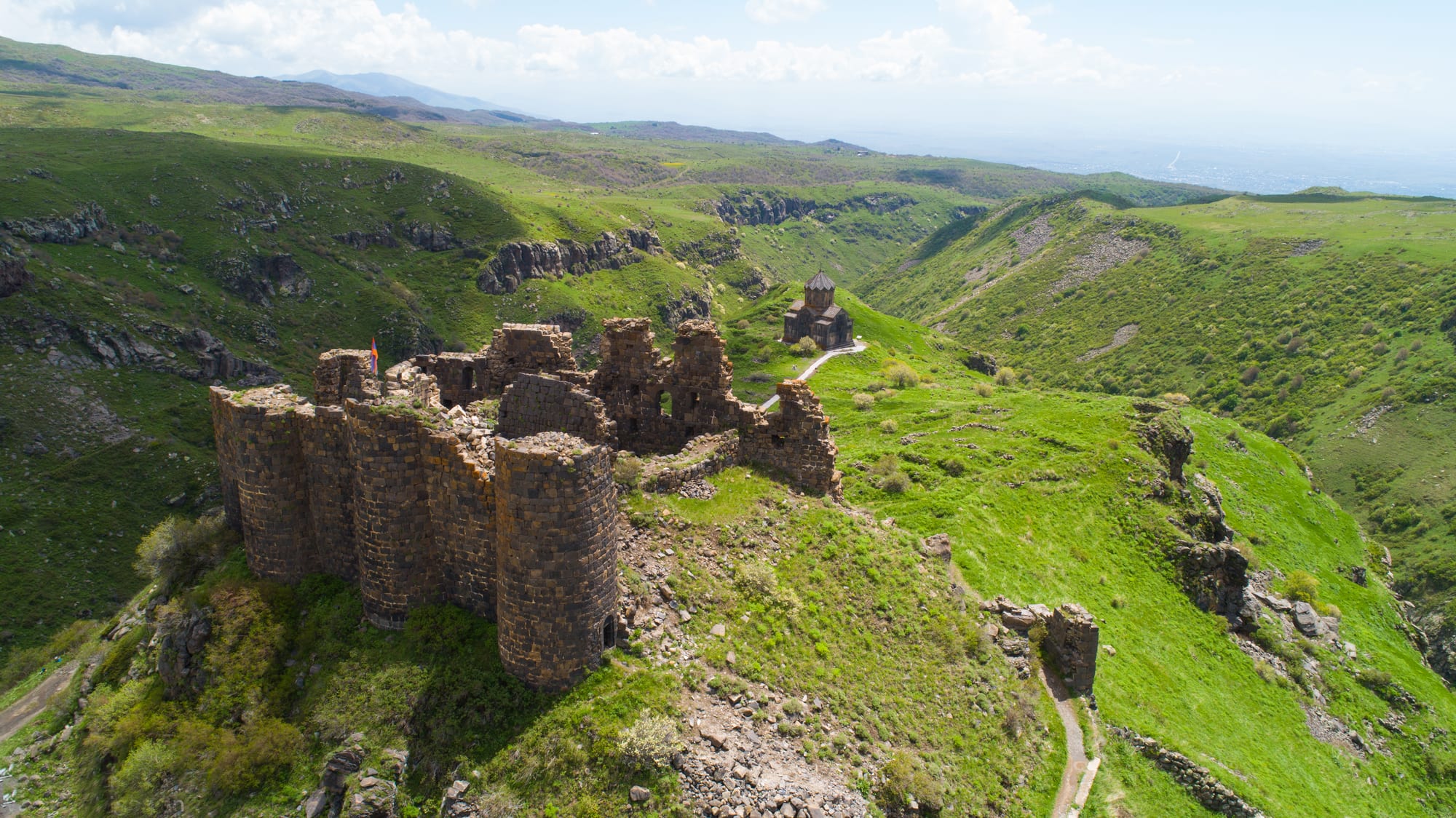
Aerial view of the ruined round-towered Amberd fortress on a green ridge between two gorges, with a small domed stone church on the slope behind it

Armenia

The ruined fortress of Amberd and its small stone church on a green ridge in Aragatsotn Province, seen from the air in spring. (Vahagn Grigoryan / Wikimedia Commons · CC BY-SA 4.0)

A small, mountainous republic in the South Caucasus — the first country to adopt Christianity as a state religion, with a diaspora far larger than its own population.

Explore Armenia

History

Armenians are one of the oldest peoples of the region, with a kingdom that appears in Persian and Roman records and that reached its greatest extent under Tigranes the Great in the first century BC. In 301 AD, tradition holds, King Trdat III made Christianity the state religion — the first ruler anywhere to do so — and around a century later the monk Mesrop Mashtots created the Armenian alphabet, largely to translate scripture.

For most of the next 1,500 years Armenia had no state of its own. It sat on the fault line between empires — Rome and Persia, Byzantium and the Arabs, the Ottomans and the Safavids — and was repeatedly partitioned. Eastern Armenia passed to the Russian Empire in 1828. During the First World War the Ottoman government deported and killed up to 1.5 million Armenians in what is now widely recognised as the first genocide of the twentieth century; Turkey still rejects the term.

A short-lived independent republic in 1918 was absorbed into the Soviet Union in 1920. Armenia became independent again in 1991 and has been at war, on and off, with neighbouring Azerbaijan over Nagorno-Karabakh — a mostly Armenian enclave inside Azerbaijan — ever since. After Azerbaijani offensives in 2020 and September 2023, the enclave's entire Armenian population, around 100,000 people, fled to Armenia and the self-declared republic there dissolved.

  • Armenia: The First Christian Nation Three thousand years between empires on the Armenian Highland — from Urartu and the first state church to genocide, Soviet rule, and independence

Culture & Customs

Christianity is woven through Armenian identity. The Armenian Apostolic Church, one of the oldest in the world, shapes the calendar, the architecture, and the sense of nationhood, and its monasteries — often set on remote crags or in gorges — are the country's defining monuments. Carved stone crosses called khachkars, no two alike, stand in churchyards and beside roads.

The genocide and the centuries of statelessness produced a diaspora that now outnumbers the population of Armenia several times over, concentrated in Russia, the United States, France, and the Middle East. Diaspora money, visits, and politics are a constant presence, and "repatriation" is an emotive idea.

Everyday culture prizes hospitality, long meals, and elaborate toasting led by a designated tamada. The duduk, a double-reed pipe of apricot wood with a mournful tone, is the national instrument and appears at weddings and funerals alike. Chess is taught in schools and Armenia has produced a run of world-class grandmasters.

Daily Life

More than a third of Armenians live in Yerevan, a pink-tufa city rebuilt on a Soviet plan around Republic Square and the Cascade stairway, with Mount Ararat — unreachable across the closed Turkish border — dominating the skyline on clear days. The rest of the country is small towns and farming villages in the mountains and along the river valleys.

Emigration for work, mainly to Russia, is a fact of life for many families, and remittances matter to the rural economy. Farming means orchards, vineyards, and vegetable plots on the plains, and livestock on the high pastures; brandy, canned fruit, and mineral water are traditional exports alongside a fast-growing technology sector in the capital.

The rhythm of the year turns on the church feasts, the autumn harvest and its preserving, and family gatherings that fill tables with more food than anyone can eat. Winters are cold and, in remote areas, still shaped by wood stoves and occasional power cuts.

Food

Armenian cooking is built on bread, herbs, grilled meat, and fruit. Lavash, a thin flatbread baked against the wall of a clay tonir oven, is served with almost everything and is itself on UNESCO's heritage list. Khorovats, the Armenian barbecue of pork, lamb, or vegetables over vine cuttings, is the centrepiece of any celebration and a weekend ritual.

Around it are dolma (vine or cabbage leaves stuffed with rice and meat), ghapama (a pumpkin baked with rice and dried fruit), harissa (a slow porridge of wheat and chicken), and, in winter, khash — cow's feet simmered overnight and eaten early in the morning with garlic and lavash. String cheese, fresh herbs, and pickles fill the rest of the table.

Fruit is a point of pride. The apricot is so identified with the country that its botanical name is Prunus armeniaca, and pomegranates appear in the cooking, the crafts, and the symbolism. Armenian brandy, aged in oak and often called cognac locally, is the national drink and a common gift.

  • Armenia: Food and the National Dish Skewered meat grilled over an open fire, stuffed grape leaves, paper-thin bread baked in a clay pit, and one of the oldest wine traditions on earth

Attractions & Natural Wonders

The signature view is Khor Virap, a monastery on the Ararat plain where, the story goes, Gregory the Illuminator was imprisoned in a pit for thirteen years before converting the king; behind it rises Mount Ararat, the national symbol, now just across the sealed border in Turkey. Geghard, partly hewn into the rock of a gorge, and the Hellenistic Garni temple nearby make an easy pairing east of Yerevan.

Lake Sevan, one of the largest high-altitude lakes in the world, fills a basin in the centre of the country, with the Sevanavank monastery on a promontory above it. Noravank sits at the head of a red-walled canyon; Haghpat and Sanahin in the north, and the great domed cathedral at Etchmiadzin — among the oldest in the world — are UNESCO World Heritage Sites.

In the far south, Tatev monastery clings to the edge of the Vorotan gorge and is reached by the "Wings of Tatev," billed as the longest reversible cable car in the world. For landscapes rather than churches, the forests around Dilijan and the alpine meadows of the Aragats massif are the usual choices.

Planning basics

Budget

Armenia is inexpensive by European standards. Cards work in Yerevan restaurants, shops, and hotels, but cash is needed for marshrutka minibuses, village guesthouses, and markets. ATMs are common in towns.

Coffee
USD 0.80–1.50
Source
Traveller reports and price observation, 2023–2024 — verify against a current source.
Daily Budget Midrange
USD 60–110 (small hotel, restaurants, a hired car with driver for day trips)
Daily Budget Shoestring
USD 30–45 (guesthouse or hostel, local food, shared minibuses)

A hired car and driver for a day of monasteries is affordable split between two or three people.

Source: Traveller reports and price observation, 2023–2024 — verify against a current source.

Visa Requirements

Citizens of the EU, the United States, the United Kingdom, Canada, Australia, and many other countries enter visa-free, most for up to 180 days in a year. Some other nationalities can obtain an e-visa or a visa on arrival.

Typical Stay
Up to 180 days per year, visa-free, for most Western passports

Check Armenia's Ministry of Foreign Affairs list for your nationality.

Safety

Armenia is a safe country for visitors, with low levels of crime against tourists. The one real caution is the militarised border with Azerbaijan, especially in the southern Syunik region and along the former Nagorno-Karabakh line, where tensions can flare with little warning.

Source
US Department of State and UK FCDO travel advisories — check for the latest wording.

Avoid unmarked roads and hiking near the eastern and southern borders, and check the current situation before travelling to Syunik.

Source: US Department of State and UK FCDO travel advisories — check for the latest wording.

Climate

A highland continental climate. Nearly everything sits above 1,000 metres, so summers are warm to hot and dry, and winters are cold with snow. Yerevan bakes in July and August; the mountains and Lake Sevan stay cool.

Mountains
snow-bound in winter; pleasant in summer
Yerevan Summer
hot and dry, often 33–40°C
Yerevan Winter
cold, around -5 to 3°C, with snow

Transportation

There is no useful domestic passenger rail beyond a slow overnight train to Georgia. Travel is by marshrutka minibus, intercity bus, or — most practical for sightseeing — a hired car with driver. The land borders with Turkey and Azerbaijan are closed, so overland entry is only from Georgia or Iran.

Borders
Turkey and Azerbaijan borders closed; enter overland via Georgia or Iran
Main Airport
Zvartnots International Airport, Yerevan

Marshrutkas to popular sites are infrequent and fill up early; a driver saves a lot of waiting.

Best Time to Visit

May–June and September–October have the most comfortable weather and, in autumn, the grape and pomegranate harvest. July–August are good for the high country and Lake Sevan but very hot in the capital and the Ararat plain.

Winter
December–March for skiing at Tsaghkadzor, and snowbound monasteries

Currency

The currency is the Armenian dram (AMD). It is not easily obtained outside the country, so change money on arrival; exchange offices in Yerevan give good rates with no commission.

Cards
Widely accepted in Yerevan, much less so elsewhere
Symbol
֏
Currency Code
AMD — Armenian dram

Language

Armenian forms its own branch of the Indo-European family and is written in a distinctive 36-letter alphabet created around 405 AD. Russian is widely spoken as a second language, and English is increasingly common among younger people in Yerevan.

English
Common among the young and in Yerevan tourism
Second Language
Russian, very widely understood
Official Language
Armenian