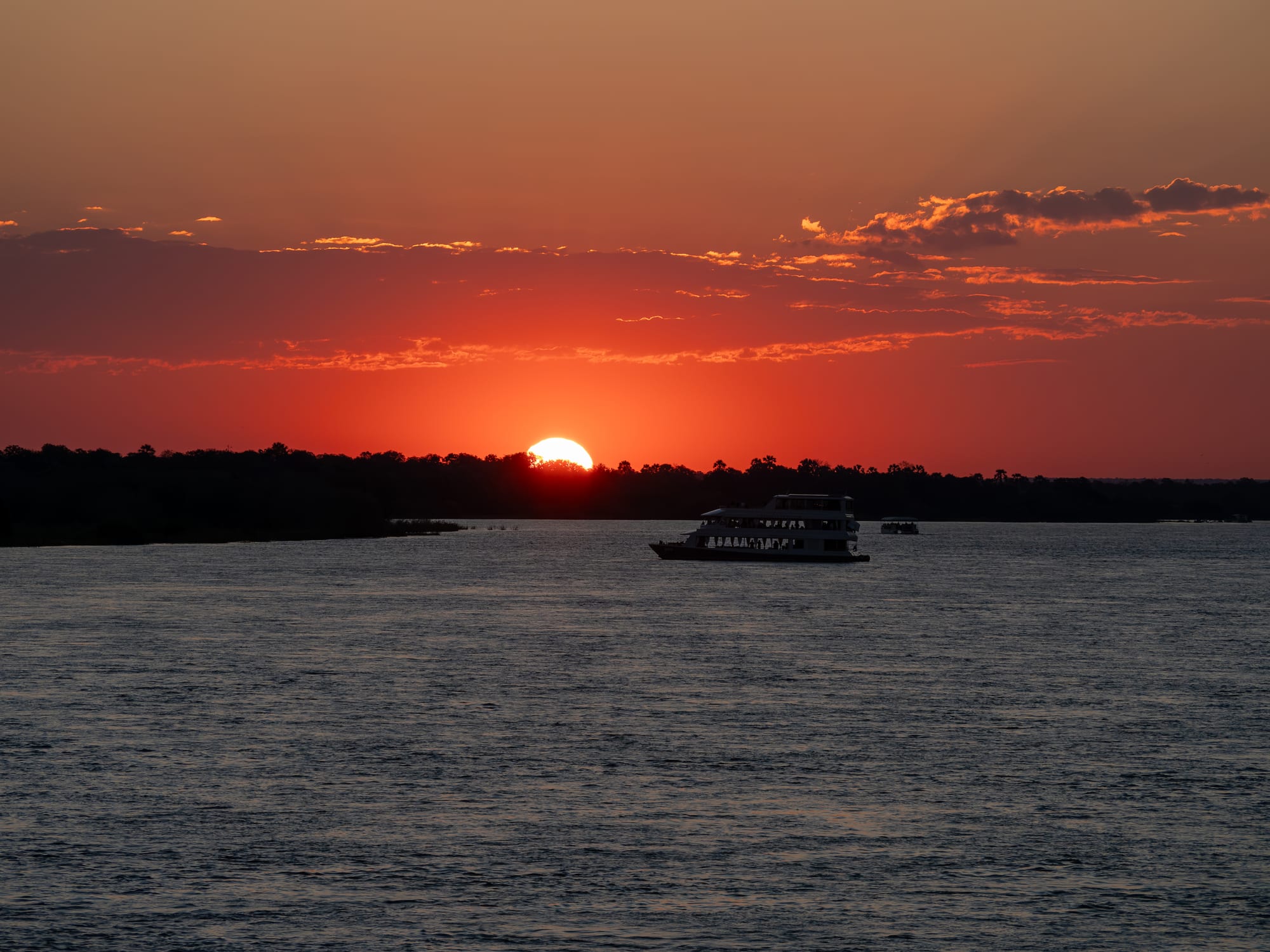
A huge sun sinking behind a dark tree line under a blazing red and orange sky, with a double-deck river boat in silhouette on a wide, calm river

Zimbabwe

Sunset over the Zambezi above Victoria Falls, where evening cruise boats drift along the river between Zimbabwe and Zambia. (Matti Blume / Wikimedia Commons · CC BY-SA 4.0)

A landlocked southern African country on the high plateau between the Zambezi and the Limpopo — named after the medieval stone city of Great Zimbabwe, shaped by white-minority rule and a long liberation war, and marked since 2000 by land upheaval and economic crisis.

Explore Zimbabwe

History

Between about the 11th and 15th centuries, the ancestors of the Shona built Great Zimbabwe, a city of mortarless granite walls that was the capital of a gold-trading state linked to the Indian Ocean coast — the largest stone structure in sub-Saharan Africa, and the origin of the country's name. Later Shona states such as Mutapa and the Rozvi succeeded it, and in the 1830s the Ndebele, moving north under Mzilikazi during the upheavals in southern Africa, founded a kingdom in the southwest.

Cecil Rhodes's British South Africa Company conquered the region in the 1890s, crushing Ndebele and Shona risings (the First Chimurenga), and it became the self-governing colony of Southern Rhodesia, run by and for a white minority. In 1965 Ian Smith's government issued a Unilateral Declaration of Independence to avoid Black majority rule, bringing international sanctions and a guerrilla war (the Second Chimurenga) waged by Robert Mugabe's ZANU and Joshua Nkomo's ZAPU.

Independence came in 1980 as Zimbabwe, with Mugabe as leader for the next 37 years. Early gains in education and health were overshadowed by the Gukurahundi massacres of the mid-1980s, in which a North Korean-trained army brigade killed an estimated 20,000 people in Ndebele-majority Matabeleland. From 2000 a violent "fast-track" seizure of white-owned commercial farms collapsed agriculture and the economy, culminating in hyperinflation so extreme that the Zimbabwe dollar was abandoned in 2009. A 2017 military intervention forced Mugabe out (he died in 2019), and his former deputy Emmerson Mnangagwa has governed since, through disputed elections in 2018 and 2023 and continuing economic crisis, including several more failed currency relaunches.

  • Zimbabwe: The Stone Houses and the Lost Promise The land of Great Zimbabwe, a medieval African city of dry-stone walls — seized by Cecil Rhodes's company, ruled by a white minority that rebelled against Britain rather than share power, freed after a long war in 1980, and then wrecked by the man who led it

Culture & Customs

Zimbabwe is majority Shona, with a large Ndebele minority in the southwest and smaller groups elsewhere, and this Shona–Ndebele divide has a political dimension rooted in the liberation war and the Gukurahundi. The country is strongly Christian, often blended with traditional belief in ancestral spirits (vadzimu) and consultation of a n'anga (traditional healer or diviner).

Respect for elders, greetings before any exchange, and the extended family and clan are central social values, and lobola (bridewealth) negotiations remain an important family process. Zimbabwe has an outsized cultural footprint for its size: internationally collected Shona stone sculpture, the mbira thumb piano and its trance music, sungura and gospel, and a strong literary tradition.

Sport matters — cricket and football, and a national pride in Olympic swimmer Kirsty Coventry, now the country's most prominent figure in international sport. Education is highly valued, and Zimbabwe long had one of Africa's highest literacy rates despite the economic decline.

Daily Life

About 16 million people live in Zimbabwe, with Harare the capital and largest city and Bulawayo the historic second city and Ndebele heartland. Millions of Zimbabweans have emigrated, chiefly to South Africa and the UK, and the remittances they send are a lifeline for families at home.

Daily life is shaped by economic hardship: a currency few trust, widespread use of the US dollar, frequent power cuts (the country depends heavily on the Kariba dam and ageing coal plants), fuel queues, and a large informal sector that absorbs those without formal jobs. Farming — maize, tobacco (a leading export again), cotton, and cattle — mining (gold, platinum, lithium, diamonds), and tourism are the mainstays.

For most people, life centres on the musha (rural home) and the extended family, the church, the market or tuckshop, and the constant work of managing scarcity, alongside a widely noted resilience and humour.

Food

The staple is sadza, a thick maize-meal porridge eaten by hand with relish (muriwo) — leafy greens such as covo and pumpkin leaves cooked with tomato and onion and sometimes peanut butter, plus beans, matemba (small dried fish), or, for a treat, stewed or grilled meat. "Road runner" (free-range village chicken) is prized above commercial broilers.

Nyama — beef or goat, often braaied — is central to gatherings, and madora (mopane worms), dried and fried, are a protein-rich delicacy. Cornmeal also becomes breakfast porridge, sweetened and sometimes with peanut butter, and maputi (puffed maize) is a common snack.

Chibuku, an opaque, mildly alcoholic sorghum-and-maize beer sold in cartons and known as "Shake Shake", and maheu, a non-alcoholic fermented maize drink, are the traditional beverages, alongside Zambezi and Castle lagers and the enduringly popular Mazoe orange cordial.

Attractions & Natural Wonders

Victoria Falls, on the Zambezi at the Zambian border, is the country's most famous sight — the Zimbabwe side has the longest stretch of the falls in view, with a rainforest walk facing the full curtain, plus rafting, bungee jumping from the bridge, gorge swings, and sunset cruises, based in the town of Victoria Falls.

Hwange, Zimbabwe's largest national park, holds one of Africa's biggest elephant populations along with lion, wild dog, and buffalo, and is an easy add-on to the Falls. Mana Pools, a UNESCO World Heritage Site on the Zambezi, is celebrated for walking and canoe safaris and for elephants that stand on their hind legs to reach acacia pods. Matusadona on Lake Kariba and the vast Gonarezhou in the southeast round out the wildlife circuit.

Great Zimbabwe, near Masvingo, is the cultural centrepiece — the Hill Complex, the Great Enclosure, and its conical tower — and the Matobo Hills near Bulawayo, also UNESCO-listed, combine balancing granite kopjes, some of the richest San rock art in the region, Cecil Rhodes's grave at "World's View", and a reserve with black and white rhino. The cool, green Eastern Highlands — Nyanga, the Vumba, and Chimanimani — offer hiking, waterfalls, and tea estates along the Mozambican border.

  • Zimbabwe: Seven Attractions and Natural Wonders The stone ruins of a medieval African empire that gave the country its name, one of the greatest concentrations of elephants left on earth, and a landscape of ancient balancing granite boulders sacred for millennia

Planning basics

Budget

Zimbabwe is a mixed picture: local transport, markets, and township guesthouses are cheap, but the wildlife circuit — Hwange, Mana Pools, and the Victoria Falls activities — is priced in US dollars and can be as expensive as anywhere in the region, with several remote fly-in camps.

Daily Budget Safari
USD 250–650+ per day for a guided Hwange or Mana Pools safari, all in
Daily Budget Shoestring
USD 40–75 off-safari (guesthouses, sadza and relish, local buses and shared taxis)

Carry clean, newer US dollar notes in a range of denominations; combine Victoria Falls with Hwange, which is only a few hours away, to cut transfers.

Visa Requirements

Most visitors, including UK, US, EU, Canadian, and Australian citizens, get a visa on arrival or can use the e-visa, typically for 30 days (single or double entry), extendable in Harare. The KAZA UniVisa, covering Zimbabwe and Zambia plus day trips to Botswana, is convenient for a Victoria Falls trip.

Typical Stay
30 days on arrival or e-visa, extendable; KAZA UniVisa for cross-border Falls trips

Carry US dollars cash for the visa fee, and get the KAZA UniVisa if you plan to cross to the Zambian side of the Falls.

Safety

Zimbabwe is generally calm and welcoming to visitors, with petty theft, opportunistic crime in Harare and Bulawayo after dark, and road hazards (potholes, animals, unlit vehicles, and numerous police roadblocks) the main concerns. Political demonstrations, particularly around elections, can turn violent and are best avoided. Economic stress means frequent power and fuel shortages.

Health
Malaria is a risk in the Zambezi valley, Hwange, the lowveld, and Victoria Falls — take prophylaxis; bilharzia is in lakes and rivers; cholera outbreaks occur; drink bottled or treated water

Take malaria precautions in the low-lying areas, avoid political gatherings, don't drive at night, keep documents and small change ready for roadblocks, and don't swim in still fresh water outside managed sites.

Climate

Subtropical, tempered by altitude on the central plateau. The cool dry season runs May to August (cold nights on the highveld), the hot dry season September to October, and the warm wet season November to April, when afternoon storms green the bush. The Zambezi valley and the lowveld are hotter year-round.

Dry Season
May–October (cool then hot)
Wet Season
November–April

Transportation

Harare and Victoria Falls are the main airports, with Bulawayo also served and light aircraft flying into the parks. Intercity coaches link the main towns on a reasonable paved network, and the old overnight train between Bulawayo and Victoria Falls still runs. Fuel shortages can disrupt road travel; self-driving is feasible for the experienced but plan for scarce fuel and police checkpoints.

Fly or take a lodge transfer into the parks; carry extra fuel and small US dollar notes for checkpoints and tips if self-driving.

Best Time to Visit

July to October is the classic safari window — sparse bush and wildlife packed around water, spectacular at Hwange and Mana Pools, though October is very hot. Victoria Falls is at its most powerful after the rains (March–May) and lowest and clearest (with better rainbow and gorge views) from about September.

Events
Independence Day (18 April); the Harare International Festival of the Arts (HIFA, when running); the Victoria Falls Carnival at New Year; Heroes' Day (August)

Currency

After years of failed currencies and hyperinflation, Zimbabwe introduced the gold-backed ZiG in 2024, but the US dollar is legal tender and is what most tourism, fuel, and larger transactions use in practice. Bring US dollars in cash — clean, recent notes, and plenty of small bills, as change is a constant problem.

Symbol
$
Currency Code
ZWG — Zimbabwe Gold (ZiG); US dollars widely used

Language

Zimbabwe recognises 16 official languages. English is used in government, business, and education; Shona is the first language of roughly three quarters of the population, and Ndebele of most of the southwest around Bulawayo. Tonga, Kalanga, Venda, and others are spoken regionally.

Most Spoken
Shona; Ndebele in the southwest
Official Languages
English, Shona, Ndebele and 13 others