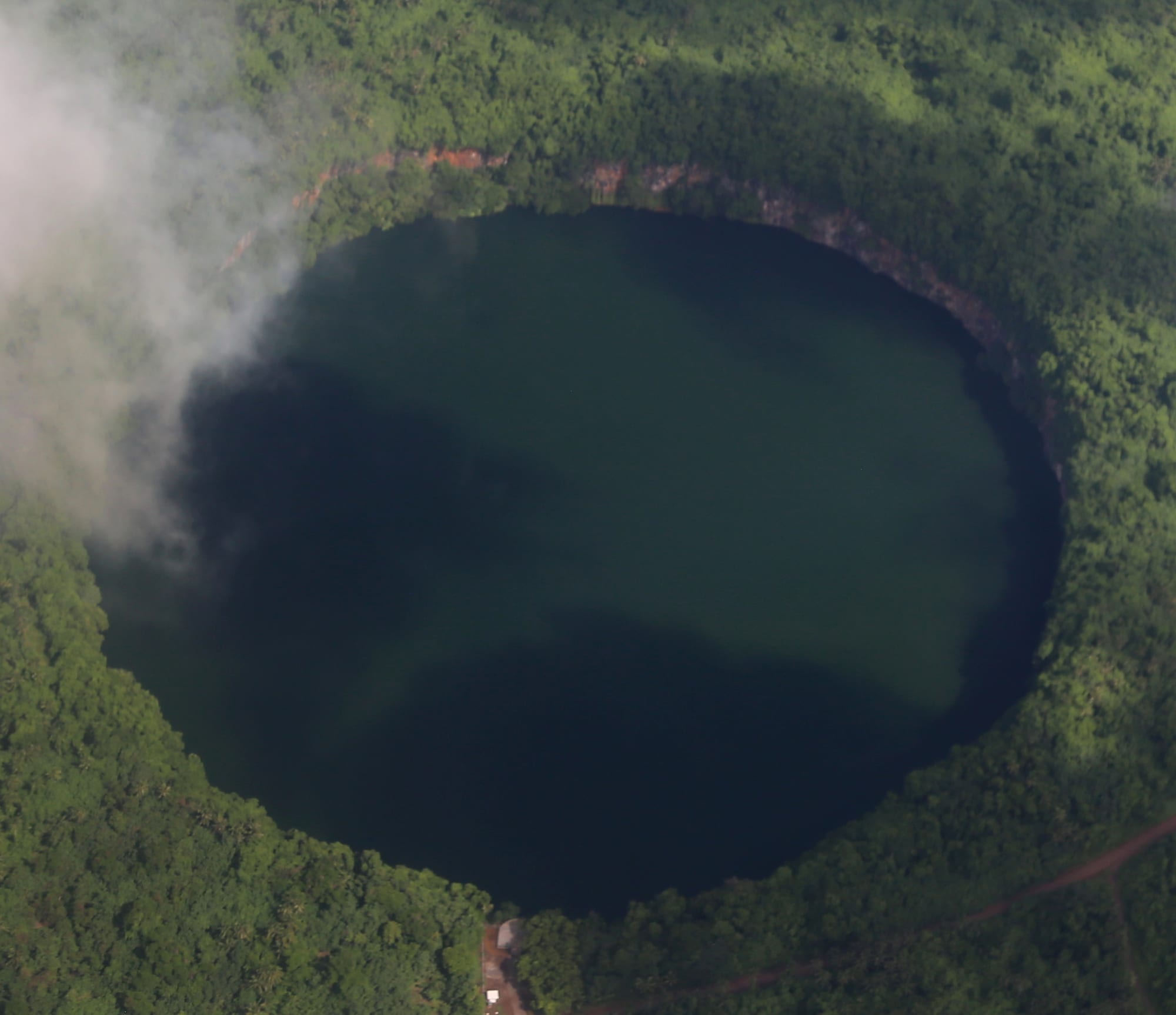
A near-perfect circular lake of deep blue-green water ringed by sheer wooded cliffs, dense forest all around

Wallis and Futuna

Lake Lalolalo on Wallis, a near-circular crater lake with vertical walls, one of the island's sacred sites. (Vogensto / Wikimedia Commons · CC BY-SA 4.0)

A small French overseas collectivity in the western Pacific, between Fiji and Samoa — three Polynesian kingdoms under a French administrator, deeply Catholic and custom-bound, and losing people steadily to New Caledonia and mainland France.

Explore Wallis and Futuna

History

Polynesians settled these islands long ago — Wallis, known as ʻUvea, with strong Tongan influence and connections, and Futuna with ties toward Samoa — and each kept its own chiefly kingdom. French Marist missionaries arrived in 1837 and converted the islands within a few years; the missionary Pierre Chanel was killed on Futuna in 1841 and later canonised as the "protomartyr of Oceania". The kingdoms signed protectorate treaties with France in 1887, and the islands were administered as a dependency of New Caledonia.

In a 1959 referendum the islanders voted to become a French overseas territory, effective 1961, under an arrangement that formally recognised the three traditional kingdoms — ʻUvea on Wallis, and Sigave and Alo on Futuna — alongside the French state. The Lavelua, the king of Wallis, and the two Futunan kings retain real authority over custom, land, and daily life. The territory became an "overseas collectivity" in 2003. Its population has fallen sharply through emigration, and there are now far more Wallisians and Futunans in New Caledonia and mainland France than on the islands themselves.

  • Wallis and Futuna: The Kingdoms Under France Three small Polynesian kingdoms in the western Pacific — converted wholesale by a French missionary in the 1840s, made a protectorate, and the only French territory where traditional monarchs still hold official power alongside the Republic

Culture & Customs

Wallis and Futuna is among the most traditional and most Catholic societies in the Pacific. The kava ceremony, the chiefly hierarchy, and the katoaga — large customary feasts and gift exchanges — are central, as are fine mat and tapa making and Sunday Mass. Custom (coutume) and the Church often carry more weight in daily life than the French administration, and the kings, chiefs, and the bishop are the figures who matter.

Dance, including the soamako and eke, and choral singing are strong. Land is held under custom and cannot be bought or sold. Visitors are expected to observe protocol — asking permission, dressing modestly, and keeping Sunday quiet.

Daily Life

Around 11,000 people live on Wallis and Futuna combined, down from about 15,000 two decades ago, most of them on Wallis. The economy is almost entirely the French public sector, subsistence agriculture (taro, yam, breadfruit, pigs), fishing, and remittances from relatives in New Caledonia and France. There is no industry and little private-sector work, which is why so many young people leave. French social benefits and a hospital on each island are part of the framework, and the rhythm of life is slow, set by the church and by custom.

Food

Feast food comes from the earth oven (umu): pork, taro, yam, breadfruit, and fish in coconut cream. Everyday meals are root crops, reef fish and tuna, tinned meat and rice, and French bread. The pig, pua'a, is the prestige feast food and is central to gift exchange. Kava is drunk ceremonially, and French wine and beer are imported.

Attractions & Natural Wonders

Very few visitors come, and there is minimal tourism infrastructure. On Wallis, the crater lake of Lalolalo — a near-perfect circular caldera with sheer walls — is the standout, along with the Talietumu (Tonga Toto) archaeological site of a fortified Tongan settlement, the many roadside chapels and the cathedral at Mata-Utu, and the reef and motu of the lagoon.

On Futuna, the imposing Sic'ele church at Poi — the Pierre Chanel basilica, a pilgrimage site built where the missionary was killed — sits below a rugged interior and coast, with the uninhabited island of Alofi just offshore. Diving and snorkelling on the reefs, and, for those invited, the customary feasts, are the real experiences here.

  • Wallis and Futuna: Five Attractions and Natural Wonders A French territory that still crowns its own traditional king, a volcanic crater lake filling an extinct cone with startlingly still water, and two islands so remote that even other French Pacific territories consider them isolated

Planning basics

Budget

Expensive and awkward to reach. Wallis has a few small hotels and guesthouses, Futuna fewer, and imported goods carry French-territory prices. The flights from Nouméa are the main cost, and there is very little organised tourism to spend money on.

Daily Budget Note
High for a Pacific island, driven by the airfares and imported prices; little tourist infrastructure

Arrange accommodation before arriving, as options are few, and treat the inter-island flight to Futuna as unreliable — build in slack.

Visa Requirements

Part of France, outside the Schengen Area. EU citizens enter freely, and citizens of the UK, US, Canada, Australia, New Zealand, and many others are visa-free for up to 90 days. Others need a specific French overseas visa, not a Schengen one.

Typical Stay
Up to 90 days visa-free for most Western passports

You will also need confirmed accommodation and onward travel, given how limited the options are.

Safety

Very safe, with almost no crime. Visitors should be careful with custom — ask before entering villages, land, or ceremonies, dress modestly, and treat Sunday as a day of rest. The hazards are the sea, cyclones in the wet season, and the isolation: medical facilities are basic and serious cases are flown to Nouméa.

Health
No malaria; dengue and other mosquito-borne illnesses occur; hospitals on each island handle only routine care

Follow local guidance on where you may go and swim, respect chiefly and church protocol, and carry insurance that covers evacuation to New Caledonia.

Climate

Tropical, hot and humid year-round at around 26–32°C. A wetter, cyclone-prone season runs November to April, and a slightly drier one from May to October.

Dry Season
May–October
Wet Season
November–April (cyclone risk)

Transportation

Hihifo airport on Wallis has flights from Nouméa in New Caledonia a few times a week on Aircalin, with a connection to Nadi in Fiji. A small inter-island plane links Wallis and Futuna, and its schedule and reliability are a perennial local complaint. On each island a hire car or a lift is the way around; roads are limited, and driving is on the right.

Fly in via Nouméa, and do not plan a tight itinerary around the Wallis–Futuna hop.

Best Time to Visit

May to October for drier, less humid weather and a lower cyclone risk. The feast of Saint Pierre Chanel on 28 April, on Futuna, and the wider Catholic calendar are the main events of the year.

Events
Feast of Saint Pierre Chanel (28 April, Futuna); Territory Day (29 July); the many parish and kingdom feast days (katoaga)

Currency

The CFP franc, pegged to the euro at a fixed rate of about 119.33 to €1 — the same currency as New Caledonia and French Polynesia. Cash is essential; card acceptance is very limited.

Symbol
Currency Code
XPF — CFP franc

Language

French is the official language, used in administration and schooling. Wallisian (Faka'uvea) is spoken on Wallis and Futunan (Fakafutuna) on Futuna; both are Polynesian languages, and most people use their island's language at home.

Indigenous
Wallisian and Futunan
Official Language
French