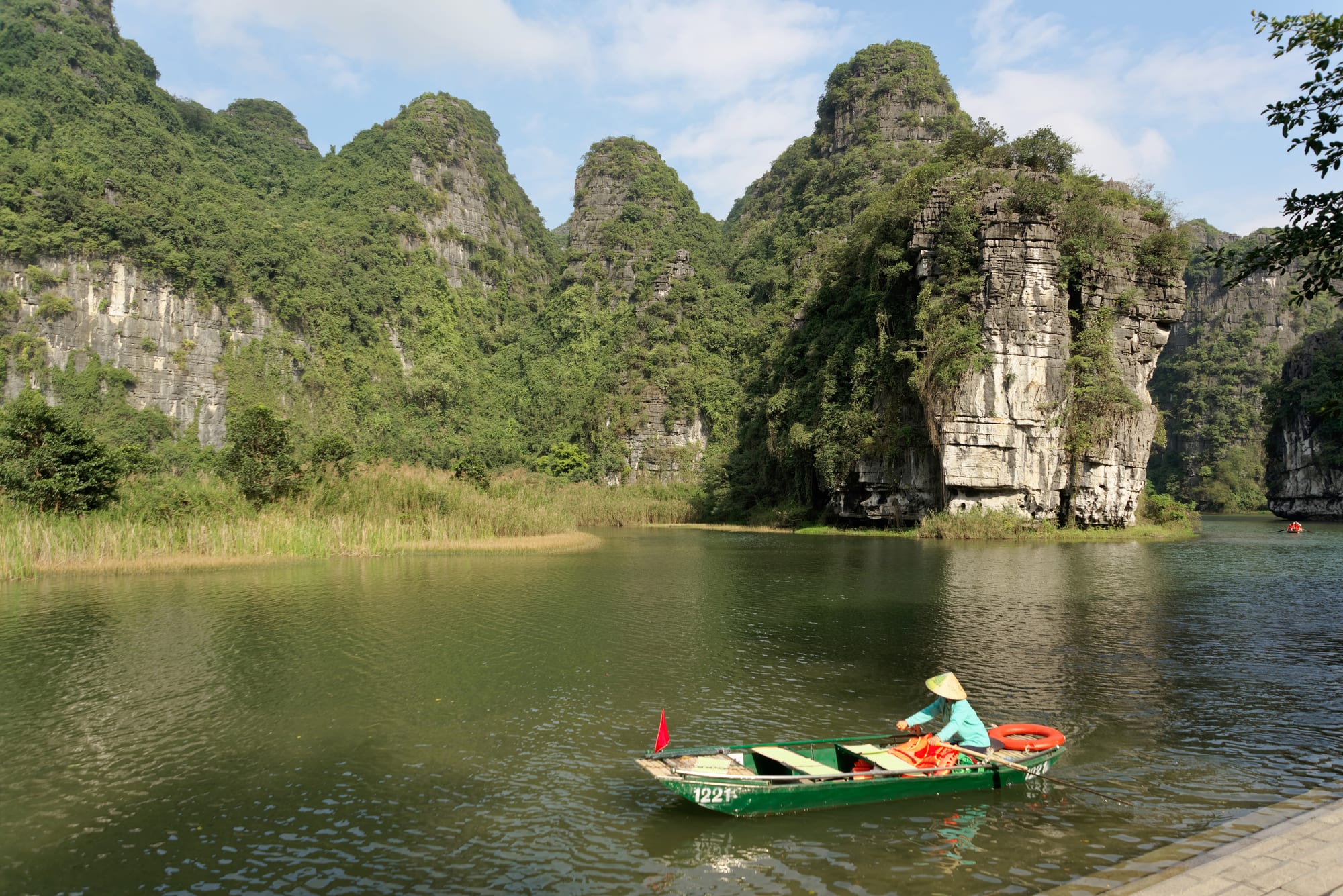
Sharp forested limestone towers rising from bright green rice fields and a winding river, small rowing boats on the water under a clear sky

Vietnam

The Tràng An landscape in Ninh Bình province, a UNESCO-listed maze of limestone peaks, rivers, and caves sometimes called the "inland Hạ Long Bay". (Jakub Hałun / Wikimedia Commons · CC BY 4.0)

A long, narrow country down the eastern edge of mainland Southeast Asia — a thousand years under Chinese rule, then dynastic, then French, then split and fought over in a war that ended in 1975 — now a fast-growing, one-party socialist state and a major manufacturing hub.

Explore Vietnam

History

Vietnamese history begins in the Red River delta, where an independent kingdom was conquered by Han China around 111 BC and ruled for roughly a thousand years, leaving a deep imprint of Confucian administration, Mahayana Buddhism, and written Chinese. Independence was won in 938, and a succession of dynasties — Lý, Trần, Lê, and finally Nguyễn — expanded the country steadily southward, absorbing the Hindu kingdom of Champa and the Mekong delta from the Khmer.

France colonised Vietnam between 1858 and 1887, joining it with Cambodia and Laos as French Indochina and running plantations, mines, and a divided administration. The Việt Minh under Hồ Chí Minh declared independence in 1945; the First Indochina War ended with France's defeat at Điện Biên Phủ in 1954 and the division of the country at the 17th parallel into a communist North and a US-backed South.

The war that followed — the "American War" in Vietnam — drew in a huge US military commitment, killed an estimated two to three million Vietnamese and tens of thousands of Americans, and left the land scarred by bombing, defoliants, and mines. It ended with the fall of Saigon in 1975 and reunification in 1976, followed by a harsh post-war decade, the exodus of the "boat people", and a brief 1979 border war with China. The Đổi Mới reforms of 1986 opened the economy to markets while keeping one-party rule, and Vietnam has since become one of the world's fastest-growing economies and a major manufacturing exporter, with relations with the United States normalised in 1995 and now close.

  • Vietnam: A Thousand Years of Resistance A long, narrow country that spent a millennium under Chinese rule, expanded south over the Cham and Khmer, was colonised by France, and then fought the French, the Americans and China in turn to unify itself under a single Communist state

Culture & Customs

Vietnamese culture blends a Confucian social framework — respect for age, education, and hierarchy, and strong obligations to family and ancestors — with Mahayana Buddhism, Daoism, and a pervasive folk religion of ancestor and spirit worship, marked by household altars and the burning of paper offerings. There is a significant Catholic minority and the home-grown Cao Đài and Hòa Hảo faiths in the south.

Family is the core institution, with several generations often under one roof and death anniversaries and Tết bringing relatives together. Saving face, indirectness in disagreement, and modesty are social norms, and the two-handed passing of objects and business cards is polite.

Daily life is lived on the street and the pavement — coffee, food, haircuts, repairs, and commerce all spill outdoors — and the motorbike is central to it. The 54 recognised ethnic groups, particularly in the northern and central highlands, maintain distinct dress, languages, festivals, and textile traditions.

Daily Life

About 100 million people live in Vietnam, concentrated in the Red River delta around Hanoi and the Mekong delta and Ho Chi Minh City in the south; the central coast and the mountainous interior are less dense. It is a young country that is ageing fast, and rapid urbanisation has pulled millions from the countryside into the two big metropolitan areas.

The economy has been transformed by manufacturing — electronics, textiles, footwear, and furniture for global brands — alongside agriculture (Vietnam is a top exporter of rice, coffee, cashews, and seafood), tourism, and a fast-growing tech and services sector. Incomes have risen sharply, a large consumer middle class has emerged, and extreme poverty has fallen dramatically, though corruption, pollution, and the impacts of climate change on the low-lying deltas are serious concerns.

Everyday life runs on the scooter, the morning bowl of phở or bún, the pavement café, family obligations, and long working hours, with Tết the one time the whole country stops.

Food

Vietnamese cooking is fresh, light, and herb-heavy, balancing sweet, sour, salty, and hot, with fish sauce (nước mắm) as its backbone. Phở, a beef or chicken noodle soup eaten mostly at breakfast, is the national dish; bún chả (grilled pork with noodles and herbs) is Hanoi's, and bún bò Huế the fiery central version.

The bánh mì — a crisp baguette, a French legacy, filled with pâté, cold cuts, pickled vegetables, coriander, and chilli — is the world-famous sandwich. Gỏi cuốn (fresh rice-paper rolls), chả giò (fried spring rolls), cơm tấm (broken rice with grilled pork, a Saigon staple), and the Hội An specialities cao lầu and "white rose" dumplings show the regional range.

Coffee is central: Vietnam is the world's second-largest producer, and it is served strong and dark with condensed milk over ice (cà phê sữa đá), or as Hanoi's egg coffee, whipped with yolk and sugar. Bia hơi, cheap fresh draught beer poured on street corners in the north, is an institution.

Attractions & Natural Wonders

The north centres on Hanoi — the Old Quarter's 36 trade streets, Hoàn Kiếm Lake, the Temple of Literature, and the French Quarter — with day and overnight trips to Hạ Long Bay and the quieter Lan Hạ Bay for karst cruising and kayaking, to Ninh Bình's inland version at Tam Cốc and Tràng An, and to the terraced rice country and ethnic-minority markets around Sapa and Hà Giang.

The centre holds the imperial citadel and royal tombs of Huế, the lantern-lit UNESCO town of Hội An with its tailors and beaches, the fast-growing city of Da Nang, the Chăm ruins of Mỹ Sơn, and — inland at Phong Nha-Kẻ Bàng — some of the largest caves on Earth, including Sơn Đoòng.

The south is Ho Chi Minh City, still widely called Saigon, with the War Remnants Museum, the Reunification Palace, and the Củ Chi tunnels nearby, plus the waterways, floating markets, and orchards of the Mekong Delta, the cool hill town of Đà Lạt, and beach escapes at Mũi Né, Nha Trang, and the island of Phú Quốc.

  • Vietnam: Ten Attractions and Natural Wonders Thousands of limestone islands rising from an emerald bay, a lantern-lit riverside town so well preserved it feels suspended in time, and a hand-dug tunnel network that once stretched over a hundred kilometres beneath the jungle

Planning basics

Budget

Vietnam is one of the best-value countries in the world for travellers. Street food, local guesthouses, and long-distance sleeper buses and trains cost very little; the extras are domestic flights, a Hạ Long Bay cruise, the caves at Phong Nha, and mid-range beach resorts.

Daily Budget Midrange
USD 60–130 (comfortable hotel, restaurants, domestic flights, a cruise and guided tours)
Daily Budget Shoestring
USD 25–40 (guesthouse or hostel, street food, buses and trains)

Eat where you see small plastic stools and a crowd, take the sleeper train on the north–south line, and negotiate or use apps for taxis.

Visa Requirements

Most nationalities need either the government e-visa, issued online for stays of up to 90 days (single or multiple entry), or a visa exemption. Citizens of the UK, France, Germany, Italy, Spain, and several other countries get 45 days visa-free; some Southeast Asian and Nordic passports get shorter exemptions.

Typical Stay
45 days visa-free for some; 90-day e-visa for most others

Apply through the official government e-visa portal (evisa.gov.vn), not a lookalike agency, and print the approval.

Safety

Vietnam is generally safe, with low violent crime against tourists. The real risks are road traffic — motorbike accidents are the leading cause of injury to visitors — along with bag-snatching from moving scooters in Ho Chi Minh City, overcharging and taxi scams, and the sea's rip currents. Unexploded ordnance remains a hazard if you leave marked paths in some central provinces.

Health
Dengue is common; tap water is not for drinking; food hygiene at busy stalls is generally fine; traffic is the biggest danger

Only ride a motorbike if experienced and licensed, and always with a helmet; hold bags away from the road; drink bottled or filtered water; and check surf conditions before swimming.

Climate

The country is long enough to have three climates at once. The north has a cool, damp winter (December–February) and a hot, wet summer; the centre has a distinct rainy season and typhoon risk from about September to December; the south is tropical year-round with a wet season roughly May to November.

North
Cool winter, hot wet summer
Centre And South
Central rains and typhoons Sep–Dec; southern wet season May–Nov

Transportation

Hanoi (Nội Bài), Ho Chi Minh City (Tân Sơn Nhất), and Da Nang are the main airports, and cheap domestic flights link the length of the country. The Reunification Express railway runs Hanoi–Ho Chi Minh City with sleeper carriages; open-tour and sleeper buses are the budget option. In cities, ride-hailing (Grab, Be) for cars and motorbikes is cheap and easy.

Fly for the big north–south jumps, take the train for the scenic Hải Vân Pass stretch, and use Grab rather than hailing taxis on the street.

Best Time to Visit

There is no single best time because of the regional differences. Broadly, February to April and August to October give reasonable weather across much of the country. The north is best March–May and September–November; the south is driest December–April; avoid the central coast during the autumn typhoon season.

Events
Tết (Lunar New Year, Jan/Feb) — the biggest holiday, when much closes; the Huế Festival (biennial); Hội An's monthly full-moon lantern nights; Reunification Day (30 April) and National Day (2 September)

Currency

The currency is the đồng, quoted in large numbers (tens of thousands to the US dollar). Cash is used for most day-to-day spending; cards work in hotels, malls, and mid-range restaurants in the cities. ATMs are everywhere but cap withdrawals low and charge per transaction.

Symbol
Currency Code
VND — Vietnamese đồng

Language

Vietnamese, a tonal language written in a Latin-based alphabet since the colonial era, is the national language. English is the main foreign language taught and is widely used in tourism and among younger urban people; some older people speak French, and Chinese and the languages of 53 recognised ethnic minorities are spoken in their regions.

Tourism Language
English (French among some older people)
National Language
Vietnamese