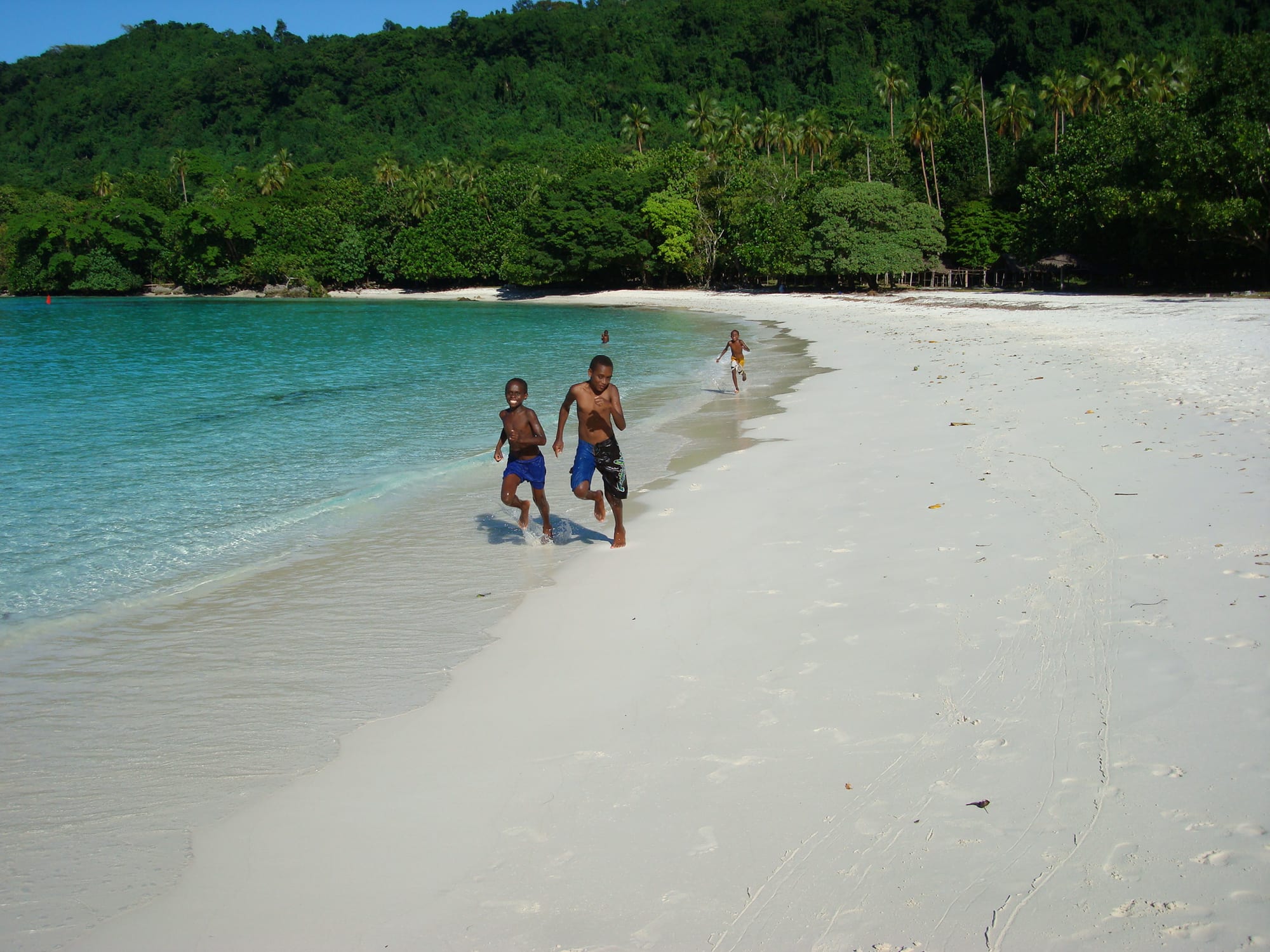
A curve of bright white sand meeting clear pale-turquoise water, backed by dense green forest under a blue sky

Vanuatu

Champagne Beach on Espiritu Santo, a sheltered white-sand bay named for the bubbles that rise from the seabed at low tide. (Bkj1000 / Wikimedia Commons · CC BY-SA 3.0)

A Y-shaped chain of some 80 volcanic islands in the southwest Pacific — jointly ruled by Britain and France until 1980, extraordinarily diverse in language and custom, and one of the most disaster-exposed countries on Earth.

Explore Vanuatu

History

The islands were settled around three thousand years ago by the Lapita people, ancestors of Melanesians and Polynesians, and developed into hundreds of small communities with their own languages, chiefly systems, and customs — a diversity that survives to a remarkable degree. Europeans arrived with the Spanish explorer Queirós in 1606 and Captain Cook, who named the group the New Hebrides, in 1774.

In the nineteenth century "blackbirding" ships carried tens of thousands of islanders, often by force, to work plantations in Queensland and Fiji, and sandalwood traders and missionaries followed. Britain and France, unable to agree on who should control the islands, settled in 1906 on a joint administration — the Condominium — under which the New Hebrides had two of almost everything: two police forces, two currencies, two legal systems, and no nationality for its own people. Islanders and outsiders alike called it the "Pandemonium".

Independence came in 1980 as the Republic of Vanuatu, briefly disrupted by an attempted secession on Espiritu Santo (the "Coconut War"). Since then it has been a parliamentary democracy, stable in broad terms but with frequent changes of government through votes of no confidence. Cyclone Pam in 2015, Cyclone Harold in 2020, and a major earthquake at Port Vila in December 2024 have each caused severe damage, and Vanuatu has become a leading advocate for global action on climate change, successfully pushing for a 2025 International Court of Justice opinion on states' climate obligations.

  • Vanuatu: The Condominium That Became a Nation An 80-island Melanesian archipelago with more than a hundred languages — depopulated by labour traders, then jointly and chaotically ruled by Britain and France for 74 years, and independent since 1980 with its custom traditions unusually intact

Culture & Customs

Kastom — the body of indigenous custom, law, ritual, land tenure, and knowledge — is central and is explicitly protected in the constitution alongside Christianity, which most ni-Vanuatu also practise. Chiefs retain real authority, and a person's standing is often tied to rank, earned through ceremony and the exchange of pigs, mats, and kava, with the curved tusks of a specially raised pig a mark of status.

Land is held by clans under customary tenure, not the state, and permission is needed to enter or use it. Each island and district has distinct dances, music (including the water-drumming of the women of Gaua), sand drawing (a UNESCO-listed art), grade-taking ceremonies, and magic traditions. On Tanna, the John Frum movement and the Prince Philip Movement — which venerated the Duke of Edinburgh as a divine figure — are well-known "cargo cults".

Kava, made from the pounded root of a pepper plant and drunk from a shell in the nakamal at dusk, is the social and ceremonial drink, stronger here than elsewhere in the Pacific and treated with quiet respect.

Daily Life

About 330,000 people live in Vanuatu, roughly a fifth of them in Port Vila on Efate and another cluster in Luganville on Espiritu Santo; the rest are spread thinly across dozens of islands in villages that live largely by subsistence. Gardening (yam, taro, manioc, banana), fishing, pig-raising, and small cash crops of copra, kava, cocoa, and coffee sustain most households.

The cash economy depends on tourism (cruise ships call at Port Vila and Mystery Island), agriculture, an offshore financial centre, and — controversially — the sale of citizenship, which has brought in significant revenue but damaged Vanuatu's passport's standing. Seasonal work schemes in Australia and New Zealand are an increasingly important source of income and remittances.

Life on the outer islands is slow, communal, and church- and kastom-centred, with limited electricity, roads, and communications, and a constant awareness of the next cyclone or earthquake.

Food

The national dish is laplap: grated root vegetable or green banana pounded into a dough, spread with coconut cream and often meat, fish, or island cabbage, wrapped in leaves, and baked in an earth oven for hours. Tuluk, a leaf parcel of grated cassava around a pork filling, is a festive relative.

Everyday food is root crops — taro, yam, sweet potato, manioc — with reef fish, coconut in every form, island cabbage, and pork or chicken for occasions. The coconut crab, a large land crab, is a delicacy. Port Vila's market and its ring of food trucks serve cheap plates of these dishes alongside rice and imported foods.

Kava is the drink of the evening, not alcohol; Tanna also grows a well-regarded coffee, and fresh coconut water and tropical fruit are everywhere.

Attractions & Natural Wonders

Tanna Island's Mount Yasur is the star: a small, safely climbable volcano that has erupted mildly and almost without pause for centuries, with visits at dusk to watch glowing rock hurled from the crater. Tanna also has kastom villages, hot springs, giant banyans, and the John Frum community at Sulphur Bay.

Espiritu Santo, the largest island, is the adventure base: the postcard-perfect Champagne Beach, a string of freshwater "blue holes" in the jungle, the Millennium Cave, and — offshore — the wreck of the SS President Coolidge, a converted liner that sank in 1942 and is one of the world's most accessible large wreck dives, along with "Million Dollar Point", where US forces dumped their equipment at the end of the war.

Efate, the main island, has Port Vila's harbour and market, the Mele Cascades, blue lagoons, and offshore islets. Pentecost Island hosts the Naghol land diving between April and June, in which men leap from wooden towers with only vines tied to their ankles — the ritual that inspired the bungee jump. Ambrym is a moody island of twin lava-lake volcanoes and a strong magic tradition, and Gaua and Vanua Lava in the north have waterfalls and rarely-visited volcanoes.

  • Vanuatu: Five Attractions and Natural Wonders An accessible active volcano that lets visitors peer directly into its glowing crater, and a centuries-old ritual of diving from towering wooden platforms with only vines to break the fall — the likely origin of modern bungee jumping

Planning basics

Budget

Vanuatu is moderately expensive for the Pacific. Port Vila on Efate has a range of hotels, resorts, and guesthouses; the outer islands have simple bungalows and homestays. The main costs are inter-island flights and the few organised tours — the Yasur volcano visit, dive trips, and 4x4 transfers.

Daily Budget Midrange
USD 150–320 (resort or hotel, restaurants, domestic flights, the Yasur tour and dives)
Daily Budget Shoestring
USD 55–95 (guesthouse or island bungalow, market food, shared transport)

Eat at Port Vila's market and food trucks, and book domestic flights (Air Vanuatu's successor carriers) as early as possible, as capacity is limited.

Visa Requirements

Citizens of most countries, including the UK, US, Canada, Australia, New Zealand, and (currently) the EU, receive a visitor visa free on arrival for 30 days, extendable. Vanuatu's citizenship-by-investment "passport" programme has led some countries and the EU to review or suspend visa-free access for Vanuatu passport holders — check your own passport's status.

Typical Stay
30 days on arrival, extendable

Carry an onward ticket and proof of accommodation; confirm the current arrival-visa list before travel.

Safety

Vanuatu is generally safe and welcoming, with petty theft the main everyday crime, more common in Port Vila. The serious risks are natural: cyclones (Cyclone Pam in 2015 was devastating), earthquakes and tsunamis (a strong earthquake struck Port Vila in December 2024, causing deaths and major damage), volcanic activity, and strong ocean currents. Medical facilities are limited.

Health
Malaria is present on most islands except the far south — take prophylaxis; dengue occurs; serious cases are evacuated to Australia or New Zealand

Take malaria precautions, follow cyclone and tsunami warnings, respect volcano-alert levels at Yasur and Ambrym, and carry evacuation insurance.

Climate

Tropical, hot and humid, cooled by trade winds. The wetter, hotter season runs November to April and carries the cyclone risk; May to October is drier, less humid, and the main travel season. The southern islands are a little cooler than the north.

Dry Season
May–October
Wet Season
November–April (cyclone risk)

Transportation

Bauerfield International Airport at Port Vila has flights from Brisbane, Sydney, Auckland, Nadi, and Nouméa. Domestic flights on small aircraft link the main islands, supplemented by cargo boats and, on Efate, a ring road served by minibuses and shared taxis. Roads on most other islands are rough tracks needing a 4x4.

Allow generous buffers around domestic flights, which are frequently rescheduled, and arrange island transfers through your accommodation.

Best Time to Visit

May to October, the dry season, gives the best weather, sea conditions, and diving visibility, and the lowest cyclone risk. The Pentecost land-diving ceremonies take place only between about April and June. Avoid the January–March cyclone peak.

Events
Independence Day (30 July); the Naghol land diving on Pentecost (April–June); the Toka festival and other kastom ceremonies on Tanna; John Frum Day on Tanna (15 February)

Currency

The currency is the vatu. Port Vila and Luganville have ATMs and card acceptance in hotels and larger shops; elsewhere it is strictly cash, so carry enough vatu for the whole of any island trip.

Symbol
VT
Currency Code
VUV — vatu

Language

Vanuatu has three official languages — Bislama, English, and French — a legacy of joint colonial rule, and more than 100 indigenous languages, the highest density of languages per head of population of any country. Bislama, an English-based creole, is the national lingua franca.

Indigenous
Over 100 local languages
Official Languages
Bislama, English, French