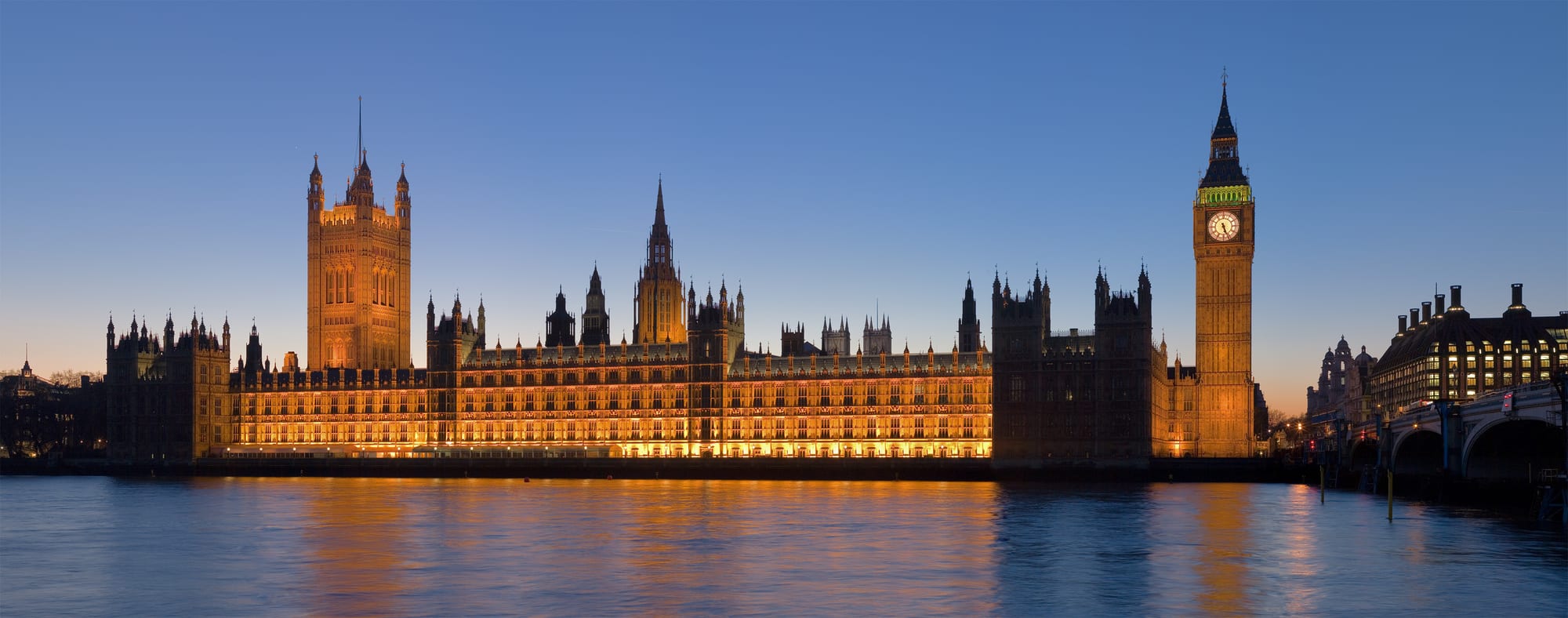
A long Gothic-revival riverside palace with a tall clock tower, seen across a calm river under soft light

United Kingdom

The Palace of Westminster and the clock tower housing Big Ben, on the Thames in London — the seat of the UK Parliament. (Diliff / Wikimedia Commons · CC BY-SA 2.5)

A union of four nations — England, Scotland, Wales, and Northern Ireland — on the islands off northwest Europe; a constitutional monarchy and parliamentary democracy, the first industrial nation and once the largest empire in history, and since 2020 outside the European Union.

Explore United Kingdom

History

Roman Britain lasted nearly four centuries, followed by Anglo-Saxon kingdoms, Viking incursions, and the Norman Conquest of 1066, which reshaped England's language, law, and aristocracy. Magna Carta in 1215 began the long limitation of royal power. The English and Scottish crowns were united under James I in 1603, and the parliaments joined in the 1707 Act of Union to create Great Britain; a further union with Ireland followed in 1801.

Britain was the birthplace of the Industrial Revolution and, through trade, naval power, and colonisation, built the largest empire in history, covering roughly a quarter of the world's land and people at its height. It profited from and then, in 1807, abolished the transatlantic slave trade, and led the coalition that defeated Napoleon. The twentieth century brought victory at enormous cost in two world wars, the loss of most of the empire, mass immigration from the Commonwealth, and the creation of the National Health Service and the welfare state in 1945–48.

Most of Ireland left the union in 1922; Northern Ireland remained, and endured three decades of sectarian conflict, "the Troubles", ended by the 1998 Good Friday Agreement. Devolved parliaments and assemblies for Scotland, Wales, and Northern Ireland were established in 1999. Scotland voted to stay in the UK in 2014, and in 2016 the UK voted narrowly to leave the European Union, which it did in 2020. After fourteen years of Conservative-led government marked by austerity, Brexit, and a run of prime ministers, the Labour Party won a large majority in July 2024 under Keir Starmer.

  • United Kingdom: Four Nations, One State An island kingdom assembled by conquest and union — the first industrial nation, the largest empire in history, a survivor of two world wars, and a state now redefined by devolution, the loss of empire, and departure from the European Union

Culture & Customs

The UK is four nations with distinct identities, histories, and, in Scotland, Wales, and Northern Ireland, their own legal or education systems and devolved politics — and "British" and "English", "Scottish", "Welsh", or "Northern Irish" can mean quite different things depending on who is speaking.

Everyday culture is often described in terms of understatement, queuing, irony, class-consciousness, and a fondness for talking about the weather; the pub remains a central social institution. The monarchy, Parliament, the BBC, the NHS, and the Premier League are national reference points. The country is markedly multicultural, especially in the cities, with large communities of South Asian, Black British, and other heritage, and religious life has shifted from a Christian majority toward a large non-religious population alongside significant Muslim, Hindu, Sikh, and Jewish minorities.

Britain's cultural exports are outsized — from Shakespeare and the Romantic poets to the Beatles, Bond, Harry Potter, and a globally followed football league — and its museums, theatre, and music scenes are among the world's strongest.

Daily Life

About 68 million people live in the UK, more than 80 per cent of them in England, which is one of Europe's most densely populated countries; London alone holds around 9 million. The population is ageing, and immigration is both an economic mainstay and a persistent political flashpoint.

Life is shaped by a services-dominated economy centred on finance, tech, the creative industries, education, and tourism, with manufacturing much reduced. Living standards have stagnated since the 2008 crisis, and recent years have brought a sharp cost-of-living squeeze, strain on the NHS and public services, and housing costs that put ownership out of reach for many younger people, particularly in the southeast.

Weekends and holidays revolve around the pub, sport, the countryside and coast, garden and DIY culture, and short breaks; the weather ensures that a fine day is never taken for granted.

Food

British cooking has a poor old reputation and a much better modern reality. The traditional repertoire includes the Sunday roast (beef, lamb, chicken, or pork with roast potatoes, vegetables, and gravy; Yorkshire pudding with beef), fish and chips, the full cooked breakfast, pies, sausages and mash, and puddings like crumble and sticky toffee. Regional dishes include haggis, neeps and tatties in Scotland, Welsh cakes and cawl, the Ulster fry, the Cornish pasty, and Bakewell tart.

Immigration transformed the everyday diet: the "Indian" curry house is a national fixture, chicken tikka masala is half-jokingly called a national dish, and Chinese, Turkish, Caribbean, Italian, and countless other cuisines are woven into ordinary eating. Afternoon tea — scones with clotted cream and jam, sandwiches, cakes — survives as a treat.

Real ale and cask cider, gin, Scotch whisky, and, increasingly, English sparkling wine are the drinks with the strongest identity, and the pub is where much of the country's social life still happens.

Attractions & Natural Wonders

London holds the Tower of London, Westminster Abbey and the Houses of Parliament, Buckingham Palace, St Paul's, and a cluster of free world-class museums — the British Museum, the National Gallery, the Tates, the V&A, and the Natural History Museum. Beyond the capital, England offers Stonehenge and Georgian Bath, the walled city and Minster of York, university Oxford and Cambridge, the Lake District, the Peak District, the Cotswolds, the Cornish coast, Hadrian's Wall, and the white cliffs of Dover.

Scotland's Edinburgh has its castle, the Royal Mile, and the world's largest arts festival each August; beyond it lie the Highlands and islands — Glencoe, Loch Ness, the Isle of Skye, and the road network of the North Coast 500 — and Glasgow's art and music scene. Wales pairs the mountains of Eryri (Snowdonia) and the Pembrokeshire coast with a ring of medieval castles at Caernarfon, Conwy, and Harlech, and the small capital, Cardiff.

Northern Ireland has the basalt columns of the Giant's Causeway, the Antrim coast road, the Mourne Mountains, and Belfast with its Titanic museum and murals. Across the UK, National Trust houses and gardens, national parks, and long coastal paths make the countryside as much of a draw as the cities.

  • United Kingdom: Ten Attractions and Natural Wonders A prehistoric stone circle older than the pyramids, a coastline of tens of thousands of naturally hexagonal basalt columns, and a castle perched on a volcanic rock that has guarded a capital for over a thousand years

Planning basics

Budget

The UK is expensive, and London especially so for accommodation, eating out, and transport. Costs fall sharply outside the capital and the honeypot towns. Free national museums, well-priced rail if booked ahead, supermarket meal deals, pubs, and hostels and B&Bs keep a trip manageable.

Daily Budget Midrange
GBP 150–280 / USD 190–360 (mid-range hotel, restaurant meals, trains, paid attractions)
Daily Budget Shoestring
GBP 55–90 / USD 70–115 (hostel or budget B&B, self-catering and pub meals, advance rail and buses)

Book train tickets weeks ahead for the cheapest fares, use the free national museums, and base outside central London to cut lodging costs.

Visa Requirements

Citizens of the EU, US, Canada, Australia, and many other countries visit visa-free for up to six months, but now need an Electronic Travel Authorisation (ETA) obtained online before travel. Ireland's citizens need neither, under the Common Travel Area.

Typical Stay
Up to 6 months visa-free for most Western passports, with an ETA

Apply for the ETA online before you travel; it is linked to your passport and valid for multiple trips over two years.

Safety

The UK is generally safe, with the main risks being pickpocketing and phone theft in crowded parts of London and other cities, occasional late-night antisocial behaviour, and drink-related trouble around nightlife. Terrorism is rated a substantial background threat but incidents are rare. Coastal and hill walking carries real weather and tide hazards.

Health
Tap water is safe everywhere; emergency care is provided by the NHS, but visitors should have travel insurance for non-emergency treatment and repatriation

Keep your phone secure in busy areas and on public transport, check tide times and mountain forecasts before coastal or hill walks, and carry travel insurance.

Climate

Temperate maritime — mild, changeable, and often wet, with no extremes. Summers (June–August) are mild to warm, roughly 18–25°C, with occasional heatwaves; winters are cool and damp, around 2–8°C, with rain more common than snow except in the hills and the north. The west and the Scottish Highlands are wettest.

Summer
Mild to warm, June–August
Winter
Cool and damp, December–February

Transportation

London has six airports; Manchester, Edinburgh, Birmingham, and others serve the regions. The rail network reaches most towns and is fast on the main lines, though privatised and pricey without advance booking; National Express and Megabus coaches are the cheap alternative. Cities have good buses and, in London, the Underground; a car is worth it for the Highlands, Wales, the Lake District, and rural Ireland.

Drive on the left; book rail 'Advance' tickets online for big savings; and use contactless to tap on and off in London rather than buying paper tickets.

Best Time to Visit

May to September has the longest days and the best chance of decent weather, with July and August the busiest. Spring (April–May) and early autumn are pleasant and quieter. Winter suits cities, Christmas markets, and Scottish Hogmanay, but days are short and many rural attractions close.

Events
Edinburgh Festival Fringe (August); Notting Hill Carnival (August); Wimbledon (late June–July); Glastonbury and the summer festival season; Bonfire Night (5 November); Hogmanay (New Year)

Currency

The currency is the pound sterling. Card and contactless payment are near-universal, including on buses and the London Underground; cash is increasingly optional. Scottish and Northern Irish banknotes are legal currency but occasionally refused in England — spend or swap them there.

Symbol
£
Currency Code
GBP — pound sterling

Language

English is the main language throughout. Welsh is an official language in Wales, compulsory in schools there and widely seen on signage, with around a fifth of the population speaking it. Scottish Gaelic, Irish, Scots, and Cornish have smaller numbers of speakers and varying official recognition.

Also Official
Welsh (in Wales); Gaelic and Irish have recognised status
Main Language
English