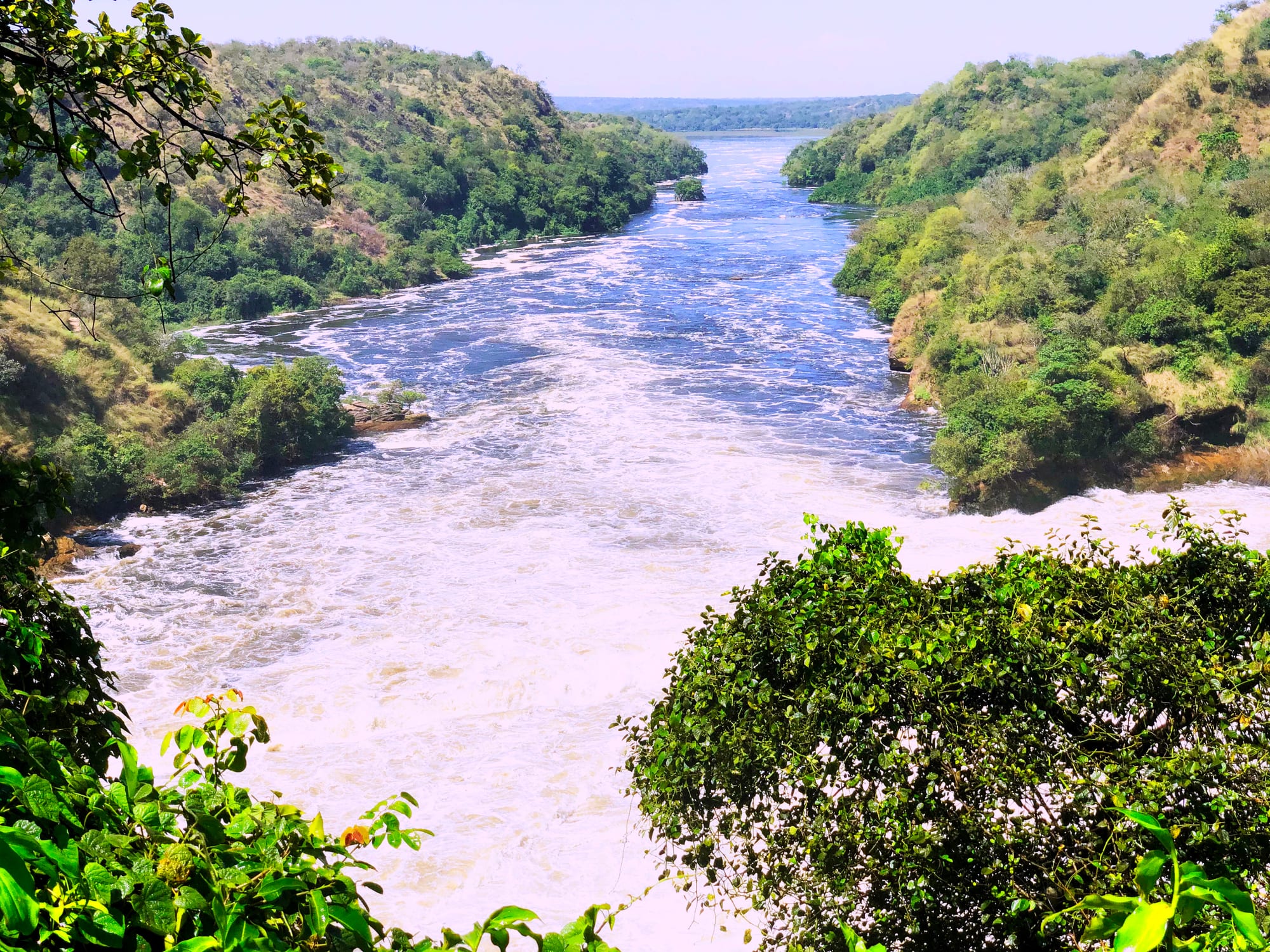
A powerful white torrent of river forcing through a narrow rock cleft into a churning gorge, spray rising above green banks

Uganda

Murchison Falls, where the White Nile squeezes through a seven-metre gap and drops into the gorge below, in Uganda's largest national park. (Jingo Faizal / Wikimedia Commons · CC BY-SA 4.0)

A green, landlocked East African country on the equator — the "Pearl of Africa" of Churchill's phrase — holding the source of the Nile, half the world's mountain gorillas, and a long history of turbulent politics under a president in power since 1986.

Explore Uganda

History

The lands around Lakes Victoria, Albert, and Kyoga were home to organised kingdoms for centuries — Buganda, Bunyoro, Toro, Ankole, and Busoga — with Buganda the most powerful by the nineteenth century. Arab and then European traders and missionaries arrived from the 1840s, and in 1894 Britain declared a protectorate, ruling in part through the Buganda monarchy and drawing labour and administrators unevenly from different regions, a pattern that fed later divisions.

Uganda became independent in 1962 under Milton Obote, who soon clashed with the Buganda king and abolished the kingdoms. In 1971 the army commander Idi Amin seized power and ran an eight-year reign of terror: an estimated 300,000 people killed, the expulsion of the country's Asian community in 1972, economic collapse, and a disastrous 1978 invasion of Tanzania that led to his overthrow. Obote returned, and a new guerrilla war in the "Luweero Triangle" killed many thousands more.

Yoweri Museveni's National Resistance Army took Kampala in 1986, and he has been president ever since, one of Africa's longest-serving leaders, having removed presidential term and age limits from the constitution. His government brought stability and growth and won early praise for an aggressive HIV/AIDS campaign, but has grown increasingly repressive, jailing and harassing opposition figures such as the musician-politician Bobi Wine. A long insurgency by the Lord's Resistance Army devastated the north until the late 2000s. Uganda hosts one of the world's largest refugee populations, mainly from South Sudan and the DR Congo, and oil discoveries near Lake Albert, with a planned export pipeline through Tanzania, are contentious.

  • Uganda: The Pearl and Its Troubles A fertile land of ancient kingdoms on the Nile's headwaters — a British protectorate built around Buganda, a chaotic first decade of independence, the terror of Idi Amin, a bush-war government that has held power since 1986, and a long recovery

Culture & Customs

Uganda is highly diverse — around forty languages, and Bantu-speaking peoples in the south and centre, Nilotic and other groups in the north and east. The kingdoms, abolished in 1966 and restored in a cultural (non-political) form in 1993, remain important markers of identity, Buganda most visibly, with the Kabaka (king) and the royal tombs at Kasubi.

The country is strongly religious, roughly split between Catholics and Anglicans with a significant Muslim minority and fast-growing Pentecostal churches. The Uganda Martyrs, 19th-century converts executed at Namugongo, draw one of Africa's largest pilgrimages each June. Traditional beliefs and healers persist alongside the churches.

Hospitality, greetings before business, respect for elders, and the extended family are central social values. The 2023 Anti-Homosexuality Act, among the harshest in the world, reflects a socially conservative mainstream and has drawn international condemnation and some aid cuts. Music, especially Kampala's Afrobeat and dancehall scene, and football and athletics are national passions.

Daily Life

Around 48 million people live in Uganda, with one of the youngest populations in the world — a median age of about 16 — and rapid growth. Most people farm: matoke (cooking bananas), cassava, maize, beans, sweet potato, millet, and cash crops of coffee (Uganda is a leading African exporter), tea, and sugar. Kampala, built over many hills around the old Buganda capital, is a fast-growing, crowded, boda-boda-choked city.

The economy has grown steadily for years but remains poor, with limited formal employment, patchy electricity, and heavy reliance on subsistence agriculture and the informal sector. Corruption, the cost of hosting large refugee populations, climate shocks to farming, and the politics of the coming oil are recurring national issues.

Everyday life runs on the shamba (garden plot), the market, the church or mosque, the extended family, and the constant weave of boda-bodas and matatus.

Food

The staple across much of Uganda is matoke — green cooking bananas steamed and mashed, often wrapped in banana leaves — served with a sauce of groundnut (binyebwa), beans, greens, or meat. Luwombo, a stew of chicken, beef, or mushrooms steamed in banana leaf, is the celebratory dish. In the north and east, posho (maize meal) and millet bread take the staple role, and cassava and sweet potato are eaten everywhere.

The great Ugandan street food is the rolex — a chapati rolled around a fried egg omelette with tomato and onion, cheap, filling, and sold from roadside stalls nationwide. Grilled meat (muchomo), fried tilapia and Nile perch from the lakes, samosas, and roasted maize and gonja (plantain) round out the casual eating.

Ugandan Arabica and Robusta coffee is prized abroad but tea is the common hot drink, often boiled with milk and ginger (African tea). Local drinks include malwa (millet beer drunk communally through long straws), banana beer, and waragi, a distilled spirit, alongside bottled lagers like Nile Special.

Attractions & Natural Wonders

Uganda's headline wildlife experience is trekking mountain gorillas in Bwindi Impenetrable National Park (and, for a few, in Mgahinga), home to roughly half the world's remaining population — an hour in the company of a habituated family in dense forest. Kibale National Park offers the best chimpanzee tracking in East Africa.

Murchison Falls, in the country's largest park, is the scenic centrepiece: the Nile compressed through a rock gap and thrown into a gorge, with boat trips to its base past hippos, crocodiles, and elephants. Queen Elizabeth National Park has the tree-climbing lions of Ishasha and a boat cruise on the Kazinga Channel, and remote Kidepo Valley in the far northeast is one of Africa's great wilderness parks.

Jinja, on Lake Victoria, marks the source of the White Nile and is East Africa's adventure hub for white-water rafting, kayaking, and bungee jumping. The Rwenzori Mountains — Ptolemy's "Mountains of the Moon" — rise to snow and glaciers on the DR Congo border for serious multi-day climbs, and the terraced islands of Lake Bunyonyi in the southwest offer a calm, malaria-light spot to rest between treks.

  • Uganda: Six Attractions and Natural Wonders A rainforest tracking route to some of the last mountain gorillas on earth, the exact spot Victorian explorers identified as the source of the Nile, and a waterfall that forces the entire river through a gap barely six metres wide

Planning basics

Budget

Independent travel in Uganda is inexpensive — guesthouses, matoke-and-stew meals, and shared transport cost little. The budget-breaker is wildlife: gorilla trekking permits alone run to several hundred US dollars a person, plus a vehicle, guide, and lodge, and the far-flung parks add long transfer costs.

Daily Budget Wildlife
USD 250–600+ per day on a gorilla-and-savanna itinerary, permits included
Daily Budget Shoestring
USD 35–65 off-safari (guesthouses, local food, matatus and buses)

Book gorilla and chimpanzee permits months ahead through the Uganda Wildlife Authority or an operator; combine parks that are near each other to cut transfer days.

Visa Requirements

Most visitors need a visa, obtained through the official online e-visa system before arrival (visa on arrival has been phased out for most). The East Africa Tourist Visa, covering Uganda, Kenya, and Rwanda, is useful for a regional trip. Yellow-fever vaccination is required for entry.

Typical Validity
90 days, single entry; East Africa Tourist Visa for multi-country trips

Apply for the e-visa in advance on the official government portal, and carry your yellow-fever certificate.

Safety

Uganda is generally safe for tourists on the main routes, with petty theft, road accidents, and boda-boda crashes the everyday risks. Governments advise against travel to parts of the far northeast (Karamoja) and caution near the Democratic Republic of the Congo border, where the ADF militant group has carried out attacks, including on a school near Queen Elizabeth National Park in 2023. Political demonstrations in Kampala can turn violent. Same-sex activity is criminalised, with severe penalties under a 2023 law.

Health
Malaria is a serious year-round risk — take prophylaxis; yellow-fever vaccination is required; bilharzia is present in Lake Victoria; tap water is not for drinking

Take malaria precautions everywhere, avoid the DR Congo border area and Karamoja, don't swim in still fresh water, use bottled water, and steer clear of protests. LGBTQ travellers should be aware of the legal situation and exercise discretion.

Climate

Tropical but tempered by altitude — most of the country sits above 1,000 metres, so it is rarely very hot. There are two rainy seasons, roughly March–May and September–November, and two drier spells in between; the north is drier with a single wet season. Mountain areas are cool and wet.

Drier
June–August and December–February
Rains
March–May and September–November

Transportation

Entebbe International Airport, on Lake Victoria near Kampala, is the gateway. There is no useful passenger rail. Travel is by private vehicle with a driver-guide for safaris, by long-distance "coaster" buses between towns, and by shared minibus (matatu) and boda-boda motorbike taxi locally. Roads to the main parks are mostly paved; the last stretches are rough.

Use a reputable operator's 4x4 with a driver-guide for wildlife areas; boda-bodas are quick but a major accident risk — insist on a helmet or avoid them.

Best Time to Visit

The drier months, June to September and December to February, are best for gorilla and chimpanzee trekking (forest trails are less muddy), for savanna wildlife, and for road travel. Trekking runs year-round, but the wet seasons make the forest tougher going.

Events
Independence Day (9 October); Martyrs' Day pilgrimage to Namugongo (3 June); the Nyege Nyege music festival near Jinja; Kampala city festival

Currency

The currency is the Ugandan shilling. US dollars are used for park fees, gorilla permits, and upmarket lodges (notes must be recent and clean). ATMs are common in Kampala and larger towns; carry cash for rural areas and markets.

Symbol
USh
Currency Code
UGX — Ugandan shilling

Language

English is an official language, used in government, business, and education. Swahili is also an official language and an army and regional lingua franca, though less rooted in daily life than in Kenya or Tanzania. Luganda is the most widely spoken language, dominant in and around Kampala, and dozens of other languages are used across the country.

Most Spoken
Luganda (central Uganda); many regional languages
Official Languages
English and Swahili