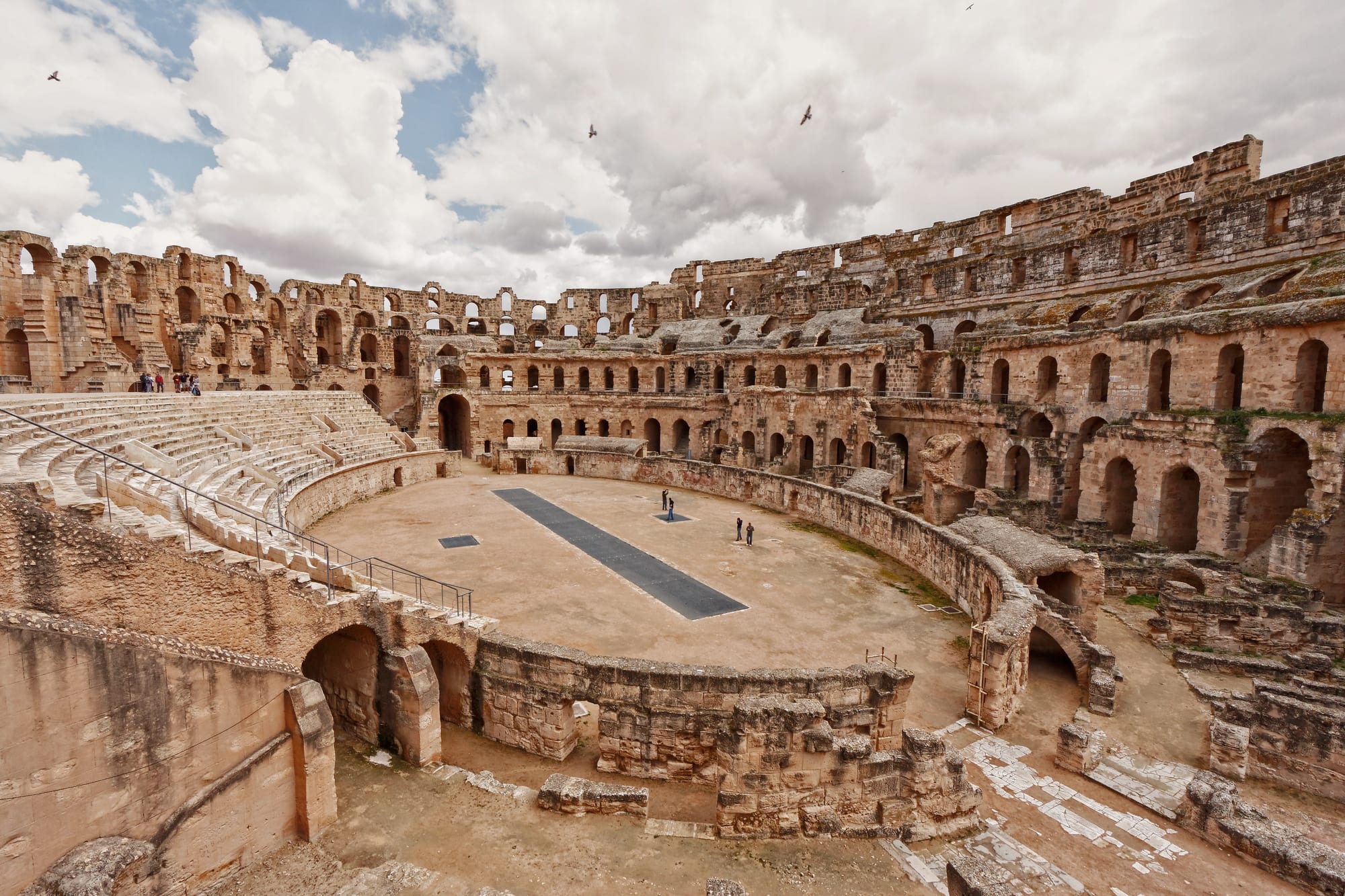
A huge, well-preserved Roman amphitheatre of golden stone standing amid a low modern town under a clear sky

Tunisia

The amphitheatre of El Djem, built in the third century AD to hold tens of thousands, one of the largest in the Roman world. (Agnieszka Wolska / Wikimedia Commons · CC BY-SA 3.0)

The northernmost country in Africa and the smallest of the Maghreb — the land of ancient Carthage, a French protectorate until 1956, socially liberal by regional standards, and the birthplace of the 2011 Arab Spring, now troubled by a slide back toward one-man rule.

Explore Tunisia

History

Phoenician settlers founded Carthage near modern Tunis around 814 BC, and it grew into a maritime empire that fought Rome in the three Punic Wars; Rome destroyed it in 146 BC and later rebuilt it as the capital of the wealthy province of Africa, a granary of the empire studded with cities whose ruins — El Djem, Dougga, Bulla Regia — are among the finest anywhere. Vandals, Byzantines, and then the Arab conquest of the seventh century followed, and Kairouan became one of the first great centres of Islam in North Africa.

A series of dynasties ruled from Tunis, and from 1574 the region was an Ottoman province, increasingly autonomous under its beys and notorious in the Mediterranean for corsair raiding. France imposed a protectorate in 1881, retaining the bey as a figurehead. The nationalist movement, led by Habib Bourguiba's Neo Destour party, won independence in 1956.

Bourguiba abolished the monarchy and ruled for three decades as a modernising autocrat, pushing through a Personal Status Code in 1956 that banned polygamy and gave women rights unmatched in the Arab world. In 1987 his prime minister, Zine El Abidine Ben Ali, deposed him and ran a repressive police state until December 2010, when the self-immolation of a street vendor, Mohamed Bouazizi, sparked protests that drove Ben Ali out in January 2011 — the first uprising of the Arab Spring. Tunisia then built the region's only functioning democracy, producing a widely praised 2014 constitution and a Nobel Peace Prize for its "National Dialogue Quartet". But amid economic stagnation and political gridlock, President Kais Saied suspended parliament in 2021, assumed sweeping powers, and pushed through a new constitution in 2022, jailing opponents and rolling back much of the democratic transition.

  • Tunisia: Carthage to the Arab Spring The small, fertile hinge of North Africa — home of Carthage, a Roman breadbasket, an Ottoman then French possession, the most liberal of the post-independence Arab states, and the country where the Arab Spring began and, for a decade, its only democracy survived

Culture & Customs

Tunisia is almost entirely Sunni Muslim and Arabic-speaking, with a small Amazigh minority in the south and a historic Jewish community now concentrated on Djerba, where the Ghriba synagogue draws an annual pilgrimage. Society is more secular and liberal in daily life than much of the region — a legacy of Bourguiba's reforms — though this varies between the cosmopolitan coast and the more conservative interior and south.

Café culture is central: strong coffee, mint tea with pine nuts, sheesha, and long conversation. Hospitality is generous, and guests are pressed with food and drink. Family ties are strong, weddings are elaborate multi-day affairs, and Ramadan reshapes the daily rhythm.

Craft traditions — Kairouan carpets, Nabeul pottery, Berber silver, chechia felt caps — remain alive, and the country has a lively film and music scene, with the Carthage festivals among the oldest in Africa and the Arab world.

Daily Life

About 12 million people live in Tunisia, concentrated on the northern and eastern coasts around Tunis, Sfax, and Sousse; the centre and south are more sparsely populated. It is a middle-income, largely urban and literate society with a strong education system and a large graduate population.

The economy — tourism, textiles and clothing, phosphates, olive oil (Tunisia is a leading producer), agriculture, and offshore services — has struggled since 2011 with slow growth, high youth unemployment, inflation, and heavy public debt, prompting difficult negotiations with the IMF. Many young Tunisians emigrate, legally to France and Italy or by boat across the central Mediterranean, and the country has also become a transit and flashpoint for sub-Saharan migrants.

Everyday life centres on the extended family, the neighbourhood café and mosque, the souk, and, in summer, the beach.

Food

Tunisian cuisine is the spiciest in the Maghreb, defined by harissa, the fiery chilli-and-garlic paste served with almost everything. Couscous is the national dish, steamed and served with lamb, fish, or vegetables and a rich stew. Brik — a thin pastry parcel of egg, tuna, capers, and parsley, deep-fried and eaten without letting the yolk escape — is the signature starter.

Other staples include lablabi (a garlicky chickpea soup with bread, a cheap breakfast), ojja (eggs poached in a spiced tomato-and-pepper sauce, often with merguez sausage or shrimp), grilled fish on the coast, mechouia salad of charred peppers and tomatoes, and tajine (here a baked egg-and-filling dish, unlike the Moroccan stew). Sfax is known for its seafood and Kairouan for makroudh, a date-filled semolina sweet.

Mint tea, often with pine nuts or almonds, and strong coffee are the social drinks. Tunisia makes wine, boukha (a fig spirit), and the aniseed thibarine liqueur, and dates from the southern oases, especially the deglet nour, are a famous export.

Attractions & Natural Wonders

The ruins of Carthage spread across a seaside Tunis suburb — Punic ports, Roman baths, villas, and cisterns — and nearby Sidi Bou Said is a cliff-top village of blue-and-white houses above the Gulf of Tunis. The medina of Tunis, a UNESCO World Heritage Site, is a dense warren of souks, mosques, and madrasas, and the Bardo Museum holds one of the world's greatest collections of Roman mosaics.

Roman Tunisia is exceptional: the towering amphitheatre of El Djem, the hillside city of Dougga, the underground villas of Bulla Regia, and the temples of Sbeitla. Kairouan, the fourth-holiest city of Islam, has the vast Great Mosque, and the seaside ribat fortresses of Sousse and Monastir guard the Sahel coast.

The south is desert country: the oasis towns of Tozeur and Nefta with their palmeries, the mountain oases of Chebika and Tamerza, the salt flats of Chott el Jerid, the troglodyte houses of Matmata and the fortified granaries (ksour) of the Dahar — several used as Star Wars locations — and camel treks into the Grand Erg Oriental from Douz. Offshore, the flat, palm-fringed island of Djerba mixes beaches, a whitewashed medina, and one of the oldest synagogues in Africa.

  • Tunisia: Six Attractions and Natural Wonders A Roman amphitheatre rivalling the Colosseum for scale, a blue-and-white clifftop village that inspired painters for a century, and the ruins of a once-great empire that fought Rome to a standstill

Planning basics

Budget

Tunisia is inexpensive, and the coastal resort strip runs on low-cost package tourism. Independent travel is cheap too: pensions and small hotels, shared louage vans, and street food keep costs down, with desert excursions and camel trips the main splurge.

Daily Budget Midrange
USD 60–130 (mid-range or resort hotel, restaurants, a hired car, a desert tour)
Daily Budget Shoestring
USD 25–45 (pension or small hotel, street food and cafés, louages and trains)

Use louages (shared long-distance vans) to get around cheaply, and book desert trips from Douz or Tozeur.

Visa Requirements

Citizens of the UK, EU, US, Canada, and many other countries enter visa-free for up to 90 days. Arrivals on a package holiday to the resort areas may be processed on a tourist card. A passport valid for the length of stay is required.

Typical Stay
Up to 90 days visa-free for most Western passports

Keep the entry stamp or card; you may be asked for it on departure.

Safety

Tunisia is generally calm, with petty theft and pushy hustlers around medinas and sites the everyday nuisance. There have been deadly terrorist attacks in the past, notably at the Bardo Museum and a Sousse beach in 2015, and security remains heavy at tourist sites. Governments advise against travel to the mountainous Chaambi area on the Algerian border and to the far south near Libya. Protests and strikes occur.

Health
Tap water is chlorinated but bottled water is advised; the summer heat and desert sun are severe; medical care is reasonable in cities

Avoid the Algerian and Libyan border zones, keep to marked areas, be firm with touts, drink bottled water, and carry sun protection for the desert.

Climate

Mediterranean on the coast and in the north — mild wet winters, hot dry summers — grading to semi-arid in the centre and full desert in the south, where summer days are extreme and winter nights cold. The north can be green and rainy in winter; the Sahara is best in the cooler months.

South
Desert — very hot summers, cool winter nights
Coast And North
Mild wet winters, hot dry summers

Transportation

Tunis–Carthage is the main airport, with Enfidha and Djerba serving the resorts. Trains run along the coast and to the interior from Tunis; the TGM light rail links Tunis to the northern suburbs. Between towns, shared louage vans are fast, cheap, and frequent, and buses (SNTRI) cover longer routes. A car is useful for the Roman sites and the south.

Use louages for intercity travel; hire a car to link the scattered Roman sites and to explore the south around Tozeur and Matmata.

Best Time to Visit

Spring (March–May) and autumn (September–November) are ideal for combining the coast, the Roman sites, and the desert. Summer is beach season but too hot for the interior and the Sahara; winter suits the south and the oases but is cool and wet in the north.

Events
El Djem International Symphonic Music Festival (July, in the amphitheatre); the Sahara Festival in Douz (December); Carthage Film and Music festivals; Eid al-Fitr and Eid al-Adha

Currency

The currency is the Tunisian dinar, which is a "closed" currency — it cannot legally be taken out or obtained abroad, so change money on arrival and reconvert any excess before leaving. Cards work in cities and hotels; carry cash for the interior and the south.

Symbol
DT / د.ت
Currency Code
TND — Tunisian dinar

Language

Arabic is the official language, spoken locally as Tunisian Arabic (Derja). French is very widely used in business, media, and education and understood by most Tunisians. Amazigh (Berber) survives in a few southern villages, and English is growing among the young and in tourism.

Widely Used
French
Official Language
Arabic (Tunisian Derja in speech)